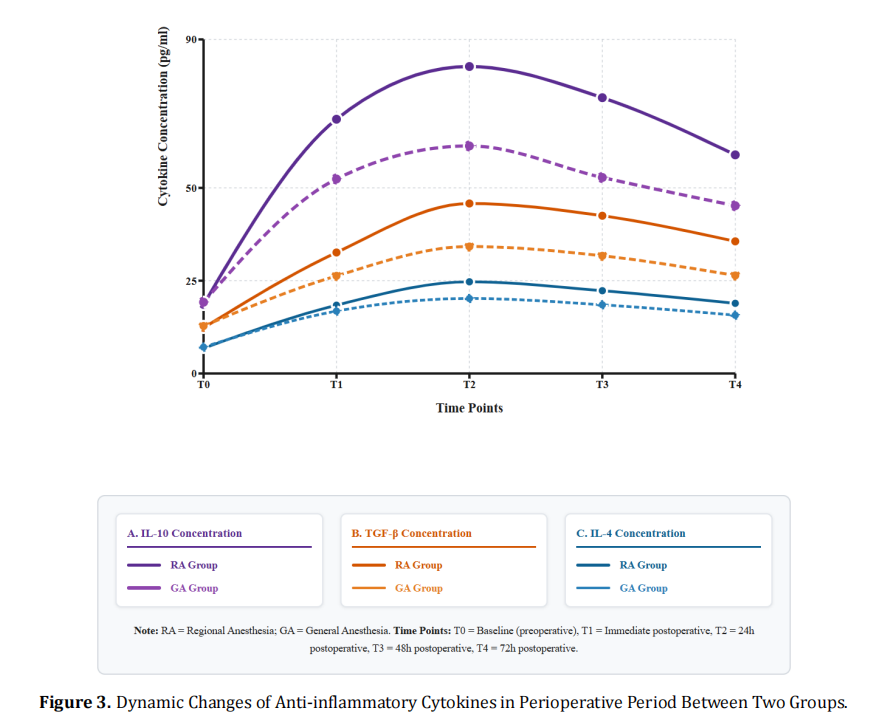
This study enrolled 120 patients undergoing elective abdominal or orthopedic surgery (aged 18–75 years, ASA classification I-III) and employed a prospective randomized controlled design to evaluate the effects of regional anesthesia (RA group, n = 60) versus general anesthesia (GA group, n = 60) on perioperative neuro-immune regulation. Through systematic assessment of perioperative cytokine profiles, immune cell subsets, autonomic nervous function, and clinical outcome indicators, we investigated the mechanisms underlying the role of regional anesthesia in inflammation control. The results demonstrated that at 24 h postoperatively, serum IL-6 levels in the RA group were significantly lower than those in the GA group (156.8 ± 35.7 vs 215.3 ± 41.2 pg/ml, p < 0.001), with the IL-6/IL-10 ratio reduced by 46.2% (1.89 ± 0.35 vs 3.51 ± 0.62, p < 0.001), indicating optimized pro-inflammatory/anti-inflammatory balance. Regarding immune cell function, the RA group showed a 56.9% decrease in M1/M2 ratio (0.59 ± 0.15 vs 1.37 ± 0.28, p < 0.001), maintained higher NK cell cytotoxic activity (58.3 ± 9.5% vs 38.7 ± 7.8%, p < 0.001), and exhibited a 213% increase in Treg/Th17 ratio (1.44 ± 0.28 vs 0.46 ± 0.12, p < 0.001). Autonomic nervous function assessment revealed that the RA group had 103.8% higher HRV-HF power (785.3 ± 142.6 vs 385.4 ± 98.7 ms², p < 0.001), 55.1% lower LF/HF ratio (1.28 ± 0.35 vs 2.85 ± 0.62, p < 0.001), and 77.3% elevated plasma acetylcholine levels (32.8 ± 7.5 vs 18.5 ± 5.2 pmol/ml, p < 0.001). Correlation analysis indicated that HRV-HF was positively correlated with IL-10 (r = 0.625, p < 0.001), and the LF/HF ratio was positively correlated with IL-6 (r = 0.512, p < 0.01), suggesting an association between autonomic nervous function and immune status. In terms of clinical outcomes, the RA group demonstrated lower postoperative pain scores, reduced incidence of cognitive dysfunction, and shortened hospital stay. This study suggests that regional anesthesia may improve perioperative inflammatory response by optimizing autonomic nervous balance, regulating cytokine networks, and modulating immune cell function; however, the precise mechanistic pathways require further investigation and validation.