
Article
Multimodal Deep Learning Framework for Decoding Treatment Response in NSCLC: Biomarker Discovery for Immune Checkpoint Inhibitors
 Download

This work is licensed under a Creative Commons Attribution 4.0 International License.
Copyright
The authors shall retain the copyright of their work but allow the Publisher to publish, copy, distribute, and convey the work.
License
Trends in Immunotherapy (TI) publishes accepted manuscripts under Creative Commons Attribution 4.0 International (CC BY 4.0). Authors who submit their papers for publication by TI agree to have the CC BY 4.0 license applied to their work, and that anyone is allowed to reuse the article or part of it free of charge for any purpose, including commercial use. As long as the author and original source are properly cited, anyone may copy, redistribute, reuse, and transform the content.
Authors
-
Shilpa Karegoudra
 Department of Computer Science and Engineering, NMAM Institute of Technology (NMAMIT), Karkala, Karnataka 574110, India
-
Viswanathan Ramasamy
Department of Computer Science and Engineering, Koneru Lakshmaiah Education Foundation, Vaddeswaram, Andhra Pradesh 522502, India
-
S Rajiv
Department of Information Technology, Vel Tech Rangarajan Dr. Sagunthala R&D Institute of Science and Technology, Tamil Nadu 600062, India
-
S. Radhakrishnan
Department of CSE‑AI, KKR & KSR Institute of Technology and Sciences, Vinjanampadu, Guntur 522017, India
-
Hemlata Makarand Jadhav
Department of E&TC, Marathwada Mitra Mandal’s College of Engineering, Pune 411052, India
-
Tirukoti Sudha Rani
Department of Computer Science & Engineering, Aditya University, Surampalem 533437, India
Received: 14 July 2025; Revised: 21 July 2025; Accepted: 6 August 2025; Published: 11 December 2025
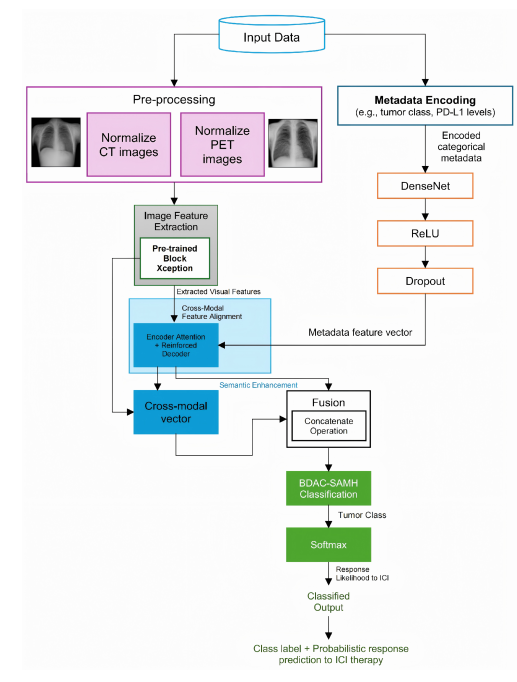
Non-small cell lung cancer (NSCLC) remains one of the leading causes of cancer-related mortality worldwide, with therapeutic progress often limited by late-stage diagnosis and the variable effectiveness of existing treatments. Immune checkpoint inhibitors (ICIs) have emerged as a promising therapeutic approach, but their clinical success depends critically on accurate biomarker-based patient stratification. Current strategies for integrating biomarkers, however, remain fragmented and lack the robustness needed for reliable prediction of treatment outcomes. To address this gap, we propose a novel multimodal deep learning framework that integrates CT images, PET/CT scans, and curated biomarker profiles to improve prediction of ICI treatment response in NSCLC patients. Our model employs a pre-trained Xception encoder for advanced image feature extraction, an Encoder Attention Network for semantic representation learning, and a DenseNet-inspired metadata processor for structured biomarker data. Multimodal features are fused through a Block Dense Attention Convolutional Module with Self-Attention Multi-Head (BDAC-SAMH) mechanism, enabling richer interactions across modalities. Experimental evaluation demonstrates that our framework achieves 94.3% accuracy, 92.1% sensitivity, and 93.5% specificity, significantly outperforming conventional CNN-based unimodal methods. Importantly, the proposed system improves prediction of key ICI biomarkers, including PD-L1, TMB, and MSI, by 15.6% compared to unimodal baselines while revealing novel biomarker interactions. This highlights its potential to guide personalized immunotherapy strategies in NSCLC.
Keywords:
Multimodal Deep Learning; NSCLC; Immune Checkpoint Inhibitors; Biomarker Discovery; Lung Cancer DiagnosisReferences
- Sharma, R. Mapping of Global, Regional and National Incidence, Mortality and Mortality-to-Incidence Ratio of Lung Cancer in 2020 and 2050. Int. J. Clin. Oncol. 2022, 27, 665–675.
- Leiter, A.; Veluswamy, R.R.; Wisnivesky, J.P. The Global Burden of Lung Cancer: Current Status and Future Trends. Nat. Rev. Clin. Oncol. 2023, 20, 624–639.
- Hendriks, L.E.; Remon, J.; Faivre-Finn, C.; et al. Non-Small-Cell Lung Cancer. Nat. Rev. Dis. Primers 2024, 10, 71.
- Dasgupta, S. Next-Generation Cancer Phenomics: A Transformative Approach to Unraveling Lung Cancer Complexity and Advancing Precision Medicine. OMICS 2024, 28, 585–595.
- Najjar, R. Redefining Radiology: A Review of Artificial Intelligence Integration in Medical Imaging. Diagnostics 2023, 13, 2760.
- Roscoe, D.M. In Vitro Diagnostics in Oncology in Precision Medicine. In The New Era of Precision Medicine; Bydon, M., Ed.; Academic Press: London, UK, 2024; pp. 49–82.
- Hammad, M.; ElAffendi, M.; Asim, M.; et al. Automated Lung Cancer Detection Using Novel Genetic TPOT Feature Optimization With Deep Learning Techniques. Results Eng. 2024, 24, 103448.
- Aboussaleh, I.; Riffi, J.; El Fazazy, K.; et al. 3DUV-NetR+: A 3D Hybrid Semantic Architecture Using Transformers for Brain Tumor Segmentation With Multimodal MR Images. Results Eng. 2024, 21, 101892.
- Rajasekar, V.; Vaishnnave, M.P.; Premkumar, S.; et al. Lung Cancer Disease Prediction With CT Scan and Histopathological Images Feature Analysis Using Deep Learning Techniques. Results Eng. 2023, 18, 101111.
- Arvind, S.; Tembhurne, J.V.; Diwan, T.; et al. Improvised Lightweight Deep CNN-Based U-Net for the Semantic Segmentation of Lungs From Chest X-Rays. Results Eng. 2023, 17, 100929.
- Sangeetha, S.K.B.; Mathivanan, S.K.; Karthikeyan, P.; et al. An Enhanced Multimodal Fusion Deep Learning Neural Network for Lung Cancer Classification. Syst. Soft Comput. 2024, 6, 200068.
- Kumar, S.; Ivanova, O.; Melyokhin, A.; et al. Deep-Learning-Enabled Multimodal Data Fusion for Lung Disease Classification. Inform. Med. Unlocked 2023, 42, 101367.
- Uddin, A.H.; Chen, Y.L.; Akter, M.R.; et al. Colon and Lung Cancer Classification From Multi-Modal Images Using Resilient and Efficient Neural Network Architectures. Heliyon 2024, 10, e30625.
- Kim, G.; Moon, S.; Choi, J.H. Deep Learning With Multimodal Integration for Predicting Recurrence in Patients With Non-Small Cell Lung Cancer. Sensors 2022, 22, 6594.
- William, F.; Serener, A.; Serte, S. Effect of Multimodal Imaging on COVID-19 and Lung Cancer Classification via Deep Learning. In Proceedings of the 2021 5th International Symposium on Multidisciplinary Studies and Innovative Technologies (ISMSIT), Ankara, Turkey, 21–23 October 2021.
- Janßen, C.; Boskamp, T.; Le’Clerc Arrastia, J.; et al. Multimodal Lung Cancer Subtyping Using Deep Learning Neural Networks on Whole Slide Tissue Images and MALDI MSI. Cancers 2022, 14, 6181.
- Shim, S.O.; Alkinani, M.H.; Hussain, L.; et al. Feature Ranking Importance From Multimodal Radiomic Texture Features Using Machine Learning Paradigm: A Biomarker to Predict the Lung Cancer. Big Data Res. 2022, 29, 100331.
- Barrett, J.; Viana, T. EMM-LC Fusion: Enhanced Multimodal Fusion for Lung Cancer Classification. AI 2022, 3, 659–682.
- Amin, M.M.; Ismail, A.S.; Shaheen, M.E. Multimodal Non-Small Cell Lung Cancer Classification Using Convolutional Neural Networks. IEEE Access 2024, 12, 134770–134778.
- Kuang, Q.; Feng, B.; Xu, K.; et al. Multimodal Deep Learning Radiomics Model for Predicting Postoperative Progression in Solid Stage I Non-Small Cell Lung Cancer. Cancer Imaging 2024, 24, 140.
- Aksu, F.; Gelardi, F.; Chiti, A.; Soda, P. Toward a Multimodal Deep Learning Approach for Histological Subtype Classification in NSCLC. In Proceedings of the 2024 IEEE International Conference on Bioinformatics and Biomedicine (BIBM), Lisbon, Portugal, 3–6 December 2024.
- Sharma, A.; Singh, S.K.; Kumar, S.; Preet, M.; Gupta, B.B.; Arya, V.; Chui, K.T. Revolutionizing Healthcare Systems: Synergistic Multimodal Ensemble Learning and Knowledge Transfer for Lung Cancer Delineation and Taxonomy. In Proceedings of the 2024 IEEE International Conference on Consumer Electronics (ICCE), Las Vegas, NV, USA, 6–8 January 2024.
- Karthikeyan, B.; Seethalakshmi, N.; Nandhini, V.; et al. Multimodal Feature Fusion Using Optimal Transfer Learning Approach for Lung Cancer Detection and Classification on CT Images. J. Intell. Syst. Internet Things 2024, 12, 84–96.
- Park, J.; Kim, S.; Lim, J.H.; et al. Development of a Multi-Modal Learning-Based Lymph Node Metastasis Prediction Model for Lung Cancer. Clin. Imaging 2024, 114, 110254.
- Kaggle. Available online: https://www.kaggle.com/datasets/adityamahimkar/iqothnccd-lung-cancer-dataset (accessed on 7 July 2025).
- Lung Cancer Biomarker Database. Available online: http://lcbd.biomarkerdb.com/home (accessed on 7 July 2025).
- IEEEDataPort. Available online: https://ieee-dataport.org/documents/example-multimodal-lung-tumor-dataset (accessed on 7 July 2025).