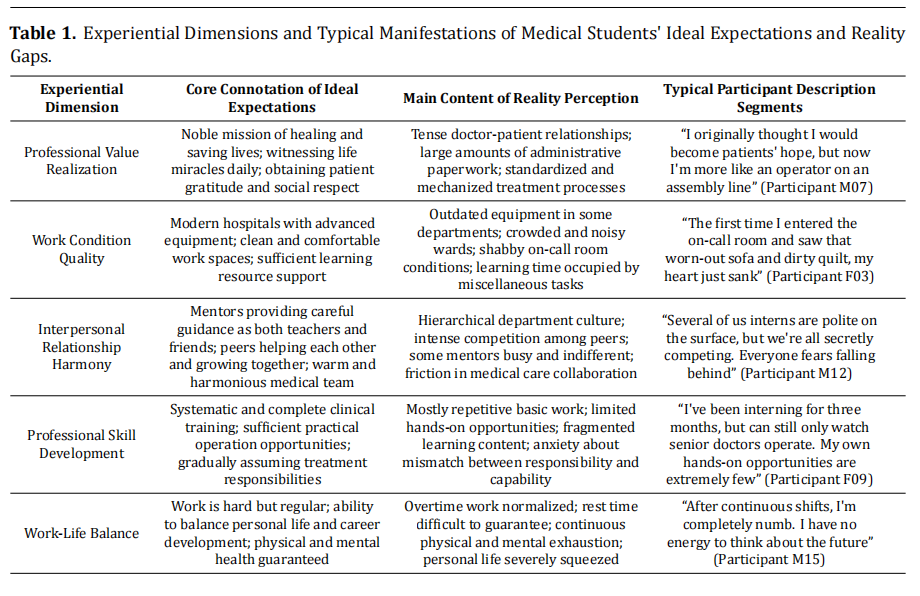
Career path selection among medical students represents a critical challenge in contemporary medical education, yet mechanisms linking environmental perceptions to career decisions remain theoretically underspecified. This study addresses the research question: How do value conflicts embedded in medical students' work environment quality perceptions influence their career development path selection through meaning construction processes? Adopting integrated phenomenological and symbolic interactionist theoretical frameworks, we conducted in-depth semi-structured interviews with 15 Chinese medical students (junior to second-year graduate levels, from three teaching hospitals across urban and rural regions) and 120-hour participant observation in clinical settings. Data were analyzed using phenomenological three-layer explication (noematic-noetic-temporal analysis) combined with thematic coding and constant comparative method, achieving theoretical saturation. Findings reveal: (1) Medical students' environmental perceptions constitute active meaning-making in their lifeworld, characterized by ideal-reality gaps, multidimensional intentional attribution, and temporal-contextual constitution; (2) Value conflicts emerge as social processes through symbolic interactions with mentors, patients, peers, and families, generating five coping strategies—compromise, persistence, integration, postponement, escape; (3) Career selection unfolds through five spiral-recursive stages—initial perception, reflective questioning, meaning negotiation, value integration, decision-action—with critical turning points catalyzing transitions; (4) Five career trajectories crystallize: clinical persistence, non-clinical shift, compromised adjustment, delayed decision, innovative integration, each following distinct meaning construction logic. This research contributes a mid-range theory explaining career choice as situated meaning synthesis, provides a methodological template for phenomenological-interactionist integration, and offers evidence-based recommendations for medical education reform prioritizing students' lifeworld experiences and symbolic interaction optimization.

 586 (Views)
  391 (Downloads)