
Article
Perceived Achievements and Challenges with Using the Blended Writing Feedback System Based on CEFR in China
 Download

This work is licensed under a Creative Commons Attribution 4.0 International License.
Copyright
The authors shall retain the copyright of their work but allow the Publisher to publish, copy, distribute, and convey the work.
License
Journal of Qualitative Research in Education (ENAD) publishes accepted manuscripts under Creative Commons Attribution 4.0 International (CC BY 4.0). Authors who submit their papers for publication by ENAD agree to have the CC BY 4.0 license applied to their work, and that anyone is allowed to reuse the article or part of it free of charge for any purpose, including commercial use. As long as the author and original source are properly cited, anyone may copy, redistribute, reuse, and transform the content.
Authors
-
Ting Li
 Faculty of Education, National University of Malaysia (UKM), Bangi 43600, Malaysia
-
Azlina Binti Abdul Aziz
Faculty of Education, National University of Malaysia (UKM), Bangi 43600, Malaysia
-
Nur Ainil Binti Sulaiman
Faculty of Education, National University of Malaysia (UKM), Bangi 43600, Malaysia
Received: 13 July 2025; Revised: 31 October 2025; Accepted: 24 November 2025; Published: 1 December 2025
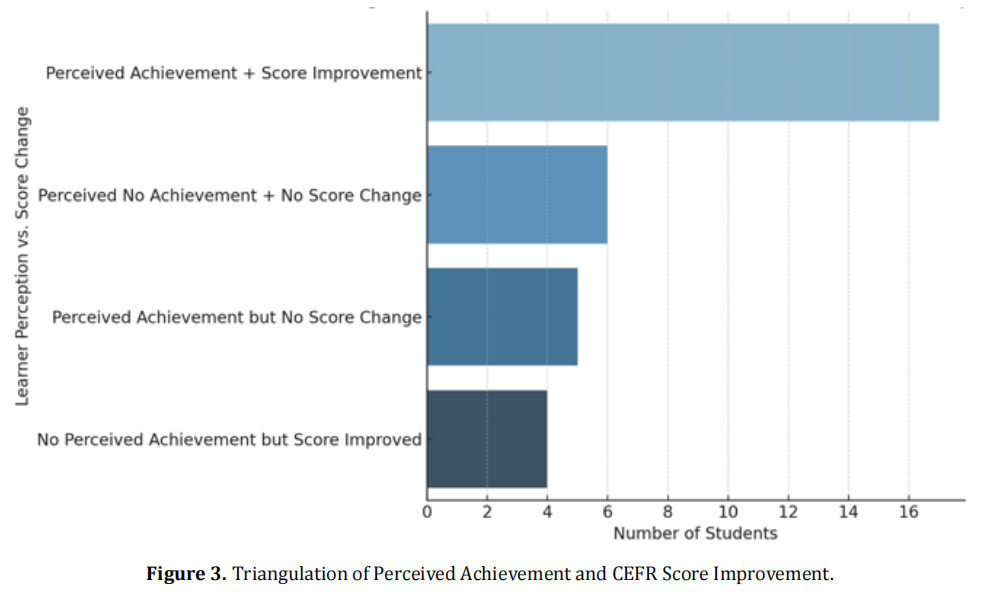
This study examines Chinese undergraduate EFL learners’ perceptions of a Blended Writing Feedback (BWF) system aligned with the Common European Framework of Reference for Languages (CEFR), integrating automated feedback from Cambridge Write & Improve and detailed teacher comments. Thirty-seven third-year English majors participated in a 12-week writing module, with 32 submitting comprehensive reflection logs describing their experiences. An explanatory mixed-methods design triangulated in-depth thematic analysis with systematic CEFR score tracking. Findings indicated perceived gains in grammar accuracy, rhetorical organization, CEFR awareness, and writing confidence, supported by feedback literacy and self-regulated learning frameworks. Reported challenges included difficulty interpreting vague or conflicting feedback, emotional frustration from stagnant CEFR levels, and a growing over-dependence on teacher input for revisions. Quantitative results showed overall CEFR level improvement across tasks, though notable discrepancies emerged between perceived and actual progress. The study highlights both the pedagogical benefits and the emotional-cognitive complexities of CEFR-based blended feedback in EFL writing. Recommendations include targeted feedback literacy training, more coordinated feedback delivery, and localized CEFR adaptation to enhance student engagement and motivation. The findings contribute to a deeper understanding of how automated and teacher-mediated feedback can be successfully integrated in higher education writing instruction.
Keywords:
Automatic Feedback Blended Feedback CEFR EFL Writing Feedback LiteracyReferences
- Vinther, J. CEFR-in a Critical Light. In Proceedings Language Testing in Europe: Time for a New Framework?; Colpaert, J., Simons, M., Aerts, A., et al., Eds.; University of Antwerp: Antwerp, Belgium, 2013; pp. 242–247.
- Ranalli, J.; Link, S.; Chukharev-Hudilainen, E. Automated Writing Evaluation for Formative Assessment of Second Language Writing: Investigating the Accuracy and Usefulness of Feedback as Part of Argument-Based Validation. Educ. Psychol. 2017, 37, 8–25. DOI: https://doi.org/10.1080/01443410.2015.1136407
- Zhang, Z.V.; Hyland, K. Student Engagement with Teacher and Automated Feedback on L2 Writing. Assess. Writ. 2018, 36, 90–102. DOI: https://doi.org/10.1016/j.asw.2018.02.004
- Yu, S.; Zhou, N.; Zheng, Y.; et al. Evaluating Student Motivation and Engagement in the Chinese EFL Writing Context. Stud. Educ. Eval. 2019, 62, 129–141. DOI: https://doi.org/10.1016/j.stueduc.2019.06.002
- Salavatizadeh, M.; Tahriri, A. The Effect of Blended Online Automated Feedback and Teacher Feedback on EFL Learners’ Essay Writing Ability and Perception. Teach. Engl. Second Lang. Q. 2020, 39, 181–225. DOI: https://doi.org/10.22099/jtls.2021.38753.2899
- Li, C. A Positive Psychology Perspective on Chinese EFL Students’ Trait Emotional Intelligence, Foreign Language Enjoyment and EFL Learning Achievement. J. Multiling. Multicult. Dev. 2020, 41, 246–263. DOI: https://doi.org/10.1080/01434632.2019.1614187
- Cavalcanti, A.P.; Barbosa, A.; Carvalho, R.; et al. Automatic Feedback in Online Learning Environments: A Systematic Literature Review. Comput. Educ. Artif. Intell. 2021, 2, 100027. DOI: https://doi.org/10.1016/j.caeai.2021.100027
- Winstone, N.; Carless, D. Designing Effective Feedback Processes in Higher Education: A Learning-Focused Approach; Routledge: London, UK, 2019.
- Council of Europe. Common European Framework of Reference for Languages: Learning, Teaching, Assessment; Council of Europe Publishing: Strasbourg, France, 2020.
- North, B. The CEFR in Practice; Cambridge University Press: Cambridge, UK, 2014.
- Alderson, J.C. The CEFR and the Need for More Research. Mod. Lang. J. 2007, 91, 659–663. DOI: https://doi.org/10.1111/j.1540-4781.2007.00627_4.x
- Lei, Y. The Implementation of China Standards of English (CSE) Framework and CEFR-Based English Test Performance of University Students in China. Engl. Lang. Teach. Linguist. Stud. 2024, 6, 174. DOI: https://doi.org/10.22158/eltls.v6n5p174
- Dunlea, J.; Spiby, R.; Wu, S.; et al. China's Standards of English Language Ability: Linking UK Exams to the CSE; British Council: London, UK, 2019. DOI: https://doi.org/10.57884/E102-K344
- Kaowiwattanakul, S. CEFR-Based Learning Approach: Using Literature to Enhance EFL Students’ Reading Skills and Critical Thinking Skills. Engl. Lang. Teach. 2021, 14, 66–79. DOI: https://doi.org/10.5539/elt.v14n11p66
- Byrnes-Cloet, H.; Hill, S. Writing Play-Books with Linguistically Diverse Young Learners. Read. Teach. 2022, 75, 413–427. DOI: https://doi.org/10.1002/trtr.2056
- Jin, Y.; Wu, Z.; Alderson, C.; et al. Developing the China Standards of English: Challenges at Macropolitical and Micropolitical Levels. Lang. Test. Asia 2017, 7, 1–19. DOI: https://doi.org/10.1186/s40468-017-0032-5
- Zhang, Z.; Hyland, K. The Role of Digital Literacy in Student Engagement with Automated Writing Evaluation (AWE) Feedback on Second Language Writing. Comput. Assist. Lang. Learn. 2023, 36, 1–26. DOI: https://doi.org/10.1080/09588221.2023.2256815
- Liu, H.-J. Understanding EFL Undergraduate Anxiety in Relation to Motivation, Autonomy, and Language Proficiency. Electron. J. Foreign Lang. Teach. 2012, 9, 1–15.
- Leacock, C.; Chodorow, M.; Gamon, M.; et al. Automated Grammatical Error Detection for Language Learners; Morgan & Claypool Publishers: San Rafael, CA, USA, 2014.
- Wilson, J.; Roscoe, R.D. Automated Writing Evaluation and Feedback: Multiple Metrics of Efficacy. J. Educ. Comput. Res. 2020, 58, 87–125. DOI: https://doi.org/10.1177/0735633119830764
- Bitchener, J.; Ferris, D.R. Written Corrective Feedback in Second Language Acquisition and Writing; Routledge: New York, NY, USA, 2012.
- Flemisch, F.; Heesen, M.; Hesse, T.; et al. Towards a Dynamic Balance between Humans and Automation: Authority, Ability, Responsibility and Control in Shared and Cooperative Control Situations. Cognit. Technol. Work 2012, 14, 3–18. DOI: https://doi.org/10.1007/s10111-011-0191-6
- Juan, Q. Blended Learning Attitudes, Engagement, and Effectiveness among Chinese EFL College Students. Educ. 2023, 6, 138–145.
- Wang, Y.-J.; Shang, H.-F.; Briody, P. Exploring the Impact of Using Automated Writing Evaluation in English as a Foreign Language University Students' Writing. Comput. Assist. Lang. Learn. 2013, 26, 234–257. DOI: https://doi.org/10.1080/09588221.2012.655300
- Liu, M.; Li, Y.; Xu, W. Automated Essay Feedback Generation and Its Impact on Revision. IEEE Trans. Learn. Technol. 2016, 10, 502–513. DOI: https://doi.org/10.1109/TLT.2016.2612659
- Rad, H.S.; Alipour, R.; Jafarpour, A. Using Artificial Intelligence to Foster Students’ Writing Feedback Literacy, Engagement, and Outcome: A Case of Wordtune Application. Interact. Learn. Environ. 2024, 32, 5020–5040. DOI: https://doi.org/10.1080/10494820.2023.2208170
- Saint, J.; Fan, Y.; Gašević, D. Temporally-Focused Analytics of Self-Regulated Learning: A Systematic Review of Literature. Comput. Educ. Artif. Intell. 2022, 3, 100060. DOI: https://doi.org/10.1016/j.caeai.2022.100060
- Yu, R.; Yang, L. ESL/EFL Learners' Responses to Teacher Written Feedback: Reviewing a Recent Decade of Empirical Studies. Front. Psychol. 2021, 12, 735101. DOI: https://doi.org/10.3389/fpsyg.2021.735101
- Wu, X.M.; Dixon, H.R.; Zhang, L.J. Sustainable Development of Students’ Learning Capabilities: The Case of University Students’ Attitudes towards Teachers, Peers, and Themselves as Oral Feedback Sources in Learning English. Sustain. 2021, 13, 5211. DOI: https://doi.org/10.3390/su13095211
- Ren, B.B.; Zhu, W. A Chinese EFL Student’s Strategies in Graduation Thesis Writing: An Activity Theory Perspective. J. Engl. Acad. Purp. 2023, 61, 101–110. DOI: https://doi.org/10.1016/j.jeap.2022.101202
- Wette, R. Source Text Use by Undergraduate Post-Novice L2 Writers in Disciplinary Assignments: Progress and Ongoing Challenges. J. Second Lang. Writ. 2017, 37, 46–58. DOI: https://doi.org/10.1016/j.jslw.2017.05.015
- Dewaele, J.-M.; MacIntyre, P.D. The Two Faces of Janus? Anxiety and Enjoyment in the Foreign Language Classroom. Stud. Second Lang. Learn. Teach. 2014, 4, 237–274. DOI: https://doi.org/10.14746/ssllt.2014.4.2.5
- Yung, K.W.H.; Fong, N. Learning EAP at University: Perceptions of High-Achieving First-Year ESL Undergraduates. Engl. Lang. Teach. J. 2019, 73, 306–315.
- Creswell, J.W. Educational Research: Planning, Conducting, and Evaluating Quantitative and Qualitative Research; Pearson Higher Ed: London, UK, 2020.
- Hussein, A. The Use of Triangulation in Social Sciences Research: Can Qualitative and Quantitative Methods Be Combined? J. Comp. Soc. Work 2009, 4, 106–117.
- Richey, R.C.; Klein, J.D. Design and Development Research. In Handbook of Research on Educational Communications and Technology, 4th ed.; Reiser, R.A., Dempsey, J.V., Eds.; Springer: New York, NY, USA, 2014; pp. 141–150.
- McKenney, S.; Reeves, T.C. Conducting Educational Design Research; Routledge: London, UK, 2018.
- Rojas, J.S.T. The Effect of Blended Learning on Language Proficiency of an EFL Class: An Empirical Study; PhD Thesis, West Virginia University, Morgantown, WV, USA, 2020.
- Hyland, K.; Hyland, F. Feedback in Second Language Writing: Contexts and Issues; Cambridge University Press: Cambridge, UK, 2019.
- Strauss, A.; Corbin, J. Basics of Qualitative Research Techniques; Sage Publications: Thousand Oaks, CA, USA, 1998.
- Nicol, D.J.; Macfarlane-Dick, D. Formative Assessment and Self-Regulated Learning: A Model and Seven Principles of Good Feedback Practice. Stud. High. Educ. 2006, 31, 199–218.
- Hyland, K.; Hyland, F. Feedback on Second Language Students’ Writing. Lang. Teach. 2006, 39, 83–101. DOI: https://doi.org/10.1017/S0261444806003399
- Wu, L. A Survey of Blended Learning for EGP Writing Supported by MOOCs and Juku. In Proceedings of the 2018 2nd International Conference on Education and E-Learning, Bali, Indonesia, 5–7 November 2018. pp. 98–103. DOI: https://doi.org/10.1145/3291078.3291087