
Article
Creating and Evaluating Instructional Materials to Foster Purposeful Communication in Filipino Language Learning
 Download

This work is licensed under a Creative Commons Attribution 4.0 International License.
Copyright
The authors shall retain the copyright of their work but allow the Publisher to publish, copy, distribute, and convey the work.
License
Journal of Qualitative Research in Education (ENAD) publishes accepted manuscripts under Creative Commons Attribution 4.0 International (CC BY 4.0). Authors who submit their papers for publication by ENAD agree to have the CC BY 4.0 license applied to their work, and that anyone is allowed to reuse the article or part of it free of charge for any purpose, including commercial use. As long as the author and original source are properly cited, anyone may copy, redistribute, reuse, and transform the content.
Authors

Received: 24 May 2025; Revised: 16 July 2025; Accepted: 28 November 2025; Published: 3 December 2025
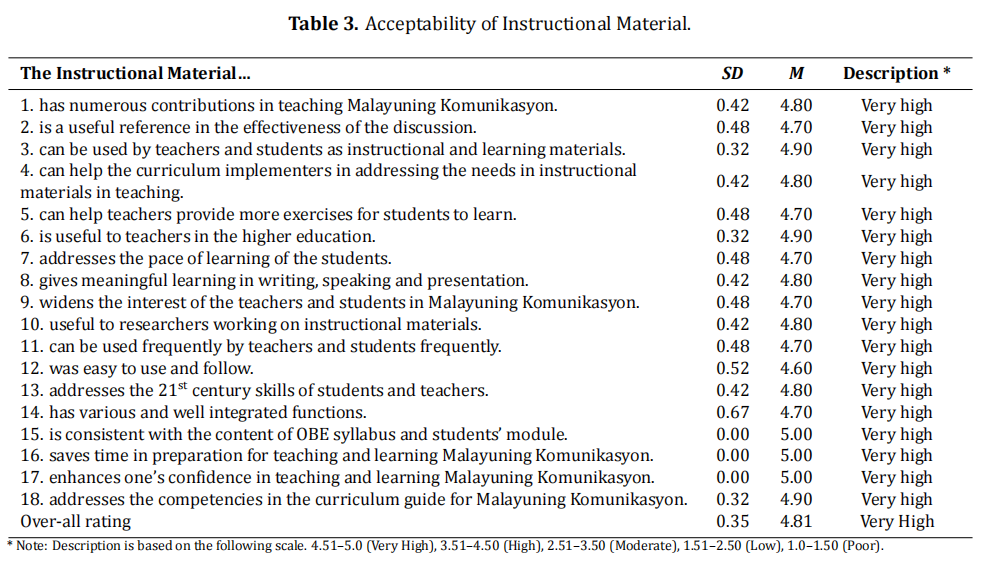
This study developed and evaluated outcomes-based instructional materials to enhance purposeful communication in the Filipino language course, Malayuning Komunikasyon. Using a Type 1 developmental research design anchored on the ADDIE model, the researcher created an OBE-aligned syllabus and a student module responsive to the needs of both teachers and learners. A mixed-methods approach was employed to determine the materials' appropriateness and acceptability: questionnaires were used to gather quantitative data, while in-depth interviews with teachers and students provided qualitative insights. Quantitative data were analyzed using means and standard deviations, and qualitative responses were examined through thematic analysis using NVivo 12. Findings from the qualitative phase revealed challenges in teaching and learning the course, such as a lack of instructional materials, difficulty achieving competencies, inconsistent delivery, and the need for clear, structured, and culturally relevant resources. The developed instructional materials addressed these gaps, as shown by the quantitative results, which rated the OBE syllabus (M = 4.70) and student module (M = 4.62) as very highly appropriate, and the overall instructional materials as very highly acceptable (M = 4.81). The study concludes that the developed materials effectively align with outcomes-based education principles and significantly support the teaching and learning of Malayuning Komunikasyon. Their adoption is recommended to improve competency attainment and foster more purposeful and meaningful communication in Filipino.
Keywords:
Language Oriented Purposeful Communication Instructional Materials Outcomes–Based Syllabus Developmental ResearchReferences
- Magno, J.M.; Indal, R.S.; Chavez, J.V.; et al. Alternative Teaching Strategies in Learning Filipino Language among Dominant English Speakers. Forum Linguist. Stud. 2024, 6, 404–419. DOI: https://doi.org/10.30564/fls.v6i4.6742
- Cabiles, N.V.; Samilo, E.; Magallanes, J.S.; et al. Qualitative Exploration on the Prevalence of Swear Words in MLBB among Filipino Online Players. Environ. Soc. Psychol. 2025, 10. DOI: https://doi.org/10.59429/esp.v10i2.3113
- Richards, J.C.; Rodgers, T.S. Approaches and Methods in Language Teaching, 3rd ed.; Cambridge University Press: Cambridge, UK, 2014.
- CHED Memorandum (CMO) No. 20, Series 2013. Available online: https://www.scribd.com/document/621770446/CHED-MEMO-NO-20-SERIES-OF-2013 (accessed on 29 April 2025).
- Barrot, J.; Sipacio, P.J. Purposive Communication in 21st Century, 1st ed.; C & E Publishing, Inc.: Mandaluyong City, Philippines, 2018.
- Garcia, C.S.; Lastam, J.M.P.; Chavez, J.V.; et al. Discourse Analysis on Learners Halting Their Education Due to Early Marriage. Environ. Soc. Psychol. 2025, 10. DOI: https://doi.org/10.59429/esp.v10i1.2558
- Pagcaliwagan, S. Assessment of Instructional Materials in Speech and Oral Communication: Basis for Curriculum Enhancement. IARJSET 2015, 2, 7–13. DOI: https://doi.org/10.17148/IARJSET.2015.21102
- Lamorinas, D.D.; Luna, L.A.; Lai, M.N.D.; et al. A General Perspective on the Factors Influencing the Low Preferences of Gen Z College Students towards the Filipino Language. Forum Linguist. Stud. 2025, 7, 451–466. DOI: https://doi.org/10.30564/fls.v7i3.8482
- Koparan, T.; Yılmaz, G.K. Using Dynamic Geometry Software for the Intersection Surfaces. J. Educ. Train. Stud. 2015, 3, 195–205. DOI: https://doi.org/10.11114/jets.v3i5.939
- Navejas, A. Integration of Pedagogical Content Knowledge (PCK) in the Learning Module on Mathematics in the Modern World. PhD Thesis, West Visayas State University, Iloilo, Philippines, 2017.
- Reigeluth, C.M. Instructional-Design Theories and Models: A New Research Journal in Science, Engineering and Technology, 1st ed.; Routledge: Oxfordshire, UK, 1999; Volume II.
- Branch, R.M. Instructional Design: The ADDIE Approach, 1st ed.; Springer: New York, NY, USA, 2009.
- Cabiles, N.V. Exploring the Development Process and Appropriateness of a Competency-Based Instructional Materials Package in Pagbasa at Pagsusuri ng Iba’t Ibang Teksto Tungo sa Pananaliksik. Asia Pac. J. Educ. Perspect. 2022, 9, 8–17.
- Adalia, H.G.; Chavez, J.V.; Hayudini, M.A.A.; et al. Relevance of Grammar among Gen Z College Students Using Social Learning Perspectives. Forum Linguist. Stud. 2025, 7, 432–450. DOI: https://doi.org/10.30564/fls.v7i3.8401
- Ornstein, A.C.; Hunkins, F.P. Curriculum: Foundations, Principles and Issues, 5th ed.; Pearson Education: Toronto, ON, Canada, 2004.
- McKenney, S. Computer-Based Support for Science Education Materials Developers in Africa: Exploring Potentials. PhD Thesis, University of Twente, Enschede, Netherlands, 2002.
- Garil, B.A. Socio-Cultural Factors Affecting Reading Comprehension Levels and Demographic-Based Grammatical Competence of Higher Education Students. Forum Linguist. Stud. 2024, 6, 184–197. DOI: https://doi.org/10.30564/fls.v6i3.6564
- Mendoza, D.V. Analysis of the Filipino Brand of Customer Service in the Accommodation Sector. J. Namib. Stud. 2023, 33, 4685–4704. DOI: https://doi.org/10.59670/jns.v33i.2830
- Divinagracia, L.T. Macro and Micromanagement Practices of Reading Comprehension Programs in Selected Grade Schools in the Post-Pandemic. Forum Linguist. Stud. 2024, 5. DOI: https://doi.org/10.59400/fls.v5i2.1664
- Braun, V.; Clarke, V. Using Thematic Analysis in Psychology. Qual. Res. Psychol. 2006, 3, 77–101. DOI: https://doi.org/10.1191/1478088706qp063oa
- Edwin Jason Duenas. A Learning Module in English for Academic and Professional Purposes for Students of Shielded Metal Arc Welding (SMAW). DEPED, CAPIZ DIVISION: Capiz, Philippines, 2018. Available online: https://lrmds.deped.gov.ph/detail/14683 (accessed on 29 April 2025)
- Embajador, P.J.N. Glossary of Selected Hiligaynon Words: Development and Evaluation. In Proceedings of the 1st UPY International Conference on Applied Science and Education, Yogyakarta, Indonesia, 24–26 October 2018. DOI: https://doi.org/10.1088/1742-6596/1254/1/012037
- Saylo, M. Developing “Genesis” Instructional Material in Learning the Different Theories on the Origin of Life. J. Innov. Technol. Converg. 2019, 1. 11–18. DOI: https://doi.org/10.69478/JITC2019v1n1a02