
Article
Social Studies Educators' Evaluations About Children' s Delinquency and Preventive Measures
 Download

This work is licensed under a Creative Commons Attribution 4.0 International License.
Copyright
The authors shall retain the copyright of their work but allow the Publisher to publish, copy, distribute, and convey the work.
License
Journal of Qualitative Research in Education (ENAD) publishes accepted manuscripts under Creative Commons Attribution 4.0 International (CC BY 4.0). Authors who submit their papers for publication by ENAD agree to have the CC BY 4.0 license applied to their work, and that anyone is allowed to reuse the article or part of it free of charge for any purpose, including commercial use. As long as the author and original source are properly cited, anyone may copy, redistribute, reuse, and transform the content.
Authors

Received: 3 August 2025; Revised: 4 October 2025; Accepted: 1 November 2025; Published: 4 January 2026
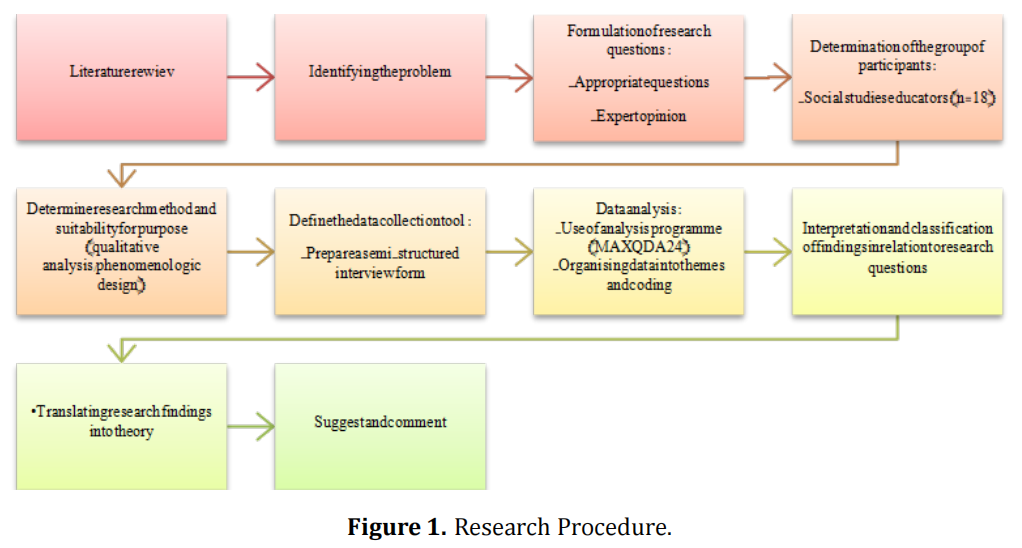
Juvenile delinquency is now a major social problem and has become not only a national but also a global issue. In fact, children are at risk of becoming involved in crime due to various factors (economic, family and social). The most important task at the point of taking protective measures by identifying the situation of children before they are drawn into crime falls to educators. The group of participants in the study conducted for this purpose consisted of 18 social studies educators working in the Ministry of National Education and Higher Education Institutions. The data obtained through a semi-structured interview form was designed as a case study from qualitative research approaches, as it aimed to understand the reasons that lead to juvenile delinquency and the measures that should be taken based on the opinions of social studies educators. The data were interpreted by dividing them into codes, categories and themes according to the content analysis technique and MAXQDA 24 was used in this process. According to the results of the research, the participants stated that role models and parental attitudes among the family factors and peer bullying among the social environment factors have an important effect among the reasons that push juvenile delinquency; the family should show interest in order to prevent the child from being involved in crime; the current protective measures for juvenile delinquency are insufficient. The Ministry of the Interior should prioritize at-risk groups and organize seminars on crime prevention.
Keywords:
Juvenile Delinquency Social Studies Education Preventive Measures Family and Peer Influence Qualitative Case StudyReferences
- Coşar, Y. Juvenile delinquency in urbanising Turkey. TBB Dergisi 2005, 56, 281–327. Available online: http://portal.ubap.org.tr/App_Themes/Dergi/2005-56-112.pdf (accessed on 19 May 2024). (in Turkish)
- Burt, C. The Young Delinquent; D. Appleton: New York, NY, USA, 1925.
- Barker, G.H. Family factors in the ecology of juvenile delinquency. Am. Inst. Crim. L. & Criminology 1939, 30, 681. Available online: https://scholarlycommons.law.northwestern.edu/cgi/viewcontent.cgi?params=/context/jclc/article/2906/&path_info=71_30AmInstCrimL_Criminology681_1939_1940_.pdf (accessed on 24 April 2024).
- Aktu, Y.; İlhan, T. Individuals’ life structures in the early adulthood period based on Levinson’s theory. Educ. Sci. Theory Pract. 2017, 17, 1383–1403.
- Yağbasan, Y. Social Causes and Criminal Responsibility of Juvenile Delinquency; Yüksek Lisans Tezi, Kırıkkale Üniversitesi: Kırıkkale, Turkey, 2010. (in Turkish)
- Kaime, T. ‘Vernacularising’ the convention on the rights of the child: Rights and culture as analytic tools. Int. J. Child. Rights 2010, 18, 637–653.
- Schepers, D. Causes of the causes of juvenile delinquency: Social disadvantages in the context of Situational Action Theory. Eur. J. Criminol. 2017, 14, 143–159.
- Agnew, R.; Brezina, T. Juvenile Delinquency: Causes and Control; Oxford University Press: New York, NY, USA, 2012; p. 624.
- Çelik, E.; Efe, A. The importance of the family and the religion preventing of children involved in crime. Sül. Dem. Üni. İkt. ve İd. Bil. Fak. Der. 2018, 23, 1425–1432.
- Öngören, H.; Katılmış, A. Reasons that push children to crime and precautions to be taken: Opinions and evaluations of Istanbul police directorate children’s branch directorate officers. Child. Civiliz. 2021, 6, 83–108. DOI: https://doi.org/10.47646/CMD.2021.235 (in Turkish)
- Laan, A.M.; Blom, M.; Kleemans, E.R. Exploring long-term and short-term risk factors for serious delinquency. Eur. J. Criminol. 2009, 6, 419–438. DOI: https://doi.org/10.1177/1477370809337882
- Bridges, B.K.M. Factors contributing to juvenile delinquency. J. Crim. Law Criminol. 1927. Available online: https://scholarlycommons.law.northwestern.edu/cgi/viewcontent.cgi?article=2038&context=jclc (accessed on 12 March 2024).
- Rondelli, I.; Ivaldi, M.V.; Franchi, F. Juvenile delinquency; environment and character. Minerva Med. 1951, 42, Varia 360–Varia 361.
- Gibbens, T.C. Trends in Juvenile Delinquency. World Health Organization: Geneva, Switzerland, 1961. Available online: https://iris.who.int/bitstream/handle/10665/37818/WHO_PHP_5.pdf (accessed on 9 March 2024).
- Wilkins, L.T. Juvenile delinquency: A critical review of research and theory. Educ. Res. 1963, 5, 104–119. DOI: https://doi.org/10.1080/0013188630050208
- Kraus, J. Causes of delinquency as perceived by juveniles. Int. J. Offender Ther. Comp. Criminol. 1977, 21, 79–86.
- Moore, D.R.; Arthur, J.L. Juvenile delinquency. In Handbook of Child Psychopathology; Ollendick, T.H., Hersen, M., Eds.; Springer: Boston, MA, USA, 1983. DOI: https://doi.org/10.1007/978-1-4757-1162-2_9
- Saran, N. Juvenile delinquency and broken families. Fam. Writ. III Indiv. Pers. Soc. Sci. Ser. 1990, 131–134.
- Calabrese, R.; Adams, J. Alienation: A cause of juvenile delinquency. Adolescence 1990, 25, 435–440.
- Farrıngton, D. Early developmental prevention of juvenile delinquency. RSA J. 1994, 142, 22–34. Available online: http://www.jstor.org/stable/41376602 (accessed on 12 March 2024).
- Yavuzer, H. Children and Crime; Remzi Kitabevi: İstanbul, Turkey, 1994.
- Chung, H.; Elias, M. Patterns of adolescent involvement in problem behaviors: Relationship to self-efficacy, social competence, and life events. Am. J. Community Psychol. 1996, 24, 771–784. DOI: https://doi.org/10.1007/BF02511034
- Esen, D. The Relationship between Adolescents' Perceived Level of Parental Psychological Abuse and Anger Expression Styles; Yüksek Lisans Tezi, İstanbul Sabahattin Zaim Üniversitesi: İstanbul, Turkey, 2020.
- Kumpfer, K.L.; Alvarado, R. Family-strengthening approaches for the prevention of youth problem behaviors. Am. Psychol. 2003, 58, 457–465. DOI: https://doi.org/10.1037/0003-066X.58.6-7.457
- Monahan, J.; Steadman, H.J.; Silver, E.; et al. Rethinking Risk Assessment: The MacArthur Study of Mental Disorder and Violence; Oxford University Press: Oxford, UK, 2001.
- De Araujo, A.F.; Shikida, C.D.; Nogueira, R.P.; et al. Socio-economic determinants of juvenile crime among street children and teenagers in a Brazilian state. Econ. Bull. 2012, 32, 2076–2084.
- Solmaz, H. Examining the Relationship Between Interpersonal Dependency Levels and Childhood Traumas among University Students; Yüksek Lisans Tezi, Necmettin Erbakan Üniversitesi: Konya, Turkey, 2019.
- İbiloğlu, A.O. Domestic Violence. Cur. Appr. in Psychiatry 2012, 4, 204–222.
- U.S. Department of Health and Human Services. Available online: https://ojjdp.ojp.gov/sites/g/files/xyckuh176/files/pubs/statement/ddshhs.htm (accessed on 22 June 2024).
- Erdoğan, T.; Tuncer, B. Positive and negative aspects of institutional care for the child. IBAD 2018, 3, 474–484. DOI: http://dx.doi.org/10.21733/ibad.414956 (in Turkish)
- Wedig, M.; Nock, M.K. Parental expressed emotion and adolescent self-injury. J. Am. Acad. Child Adolesc. Psychiatry 2007, 46, 1171–1178. DOI: https://doi.org/10.1097/chi.0b013e3180ca9aaf
- Bulgurcuoğlu, S.E.; Çamur Duyan, G. Convicted children: The case of Istanbul and Ankara children’s education centres. Hac. Üni. Türki. Araş. 2019, 30, 167–190. DOI: https://doi.org/10.20427/turkiyat.468673 (in Turkish)
- Hoffmann, J.P.; Erickson, L.D.; Spence, K.R. Modeling the association between academic achievement and delinquency: An application of interactional theory. Criminology 2013, 51, 629–660. DOI: https://doi.org/10.1111/1745-9125.12014
- Şentuna, T. Evaluation of the transformation of juvenile delinquency into a social problem. Int. J. Soc. Sci. 2023, 7, 68–90. DOI: http://dx.doi.org/10.30830/tobider.sayi.16.5
- Vazsonyi, A.T.; Pickering, L.E. The importance of family and school domains in adolescent deviance: African American and Caucasian youth. J. Youth Adolesc. 2003, 32, 115–128.
- Gönültaş, B.M.; Hilal, A. Role of the immigration on juvenile delinquency: Adana Example. Turk. J. Forensic Med. 2012, 26, 156–164.
- Cuervo, K.; Villanueva, L.; González, F.; et al. Characteristics of young offenders depending on the type of crime. Psicosoc. Interv. 2015, 24, 9–15. DOI: https://doi.org/10.1016/j.psi.2014.11.003
- Karataş, S. An evaluation for children dragged into crime and children’s victims of crime. Curr. Approaches Psychiatry 2020, 12, 575–586. DOI: https://doi.org/10.18863/pgy.711319
- Gümüştaş, F.; Yulaf, Y.; Gökçe, S.; et al. A one-year retrospective study of forensic cases referred to child and adolescent psychiatry outpatient clinic in Adıyaman province. Cukurova Med. J. 2014, 39, 280–289. DOI: https://doi.org/10.17826/cutf.36075
- Ayaz, M.; Ayaz, A.B.; Soylu, N. Psychological assessment in child and adolescent forensic cases. Klin. Psikiyatri Dergisi 2012, 15, 33–40.
- Akduman, G.; Akduman, B.; Cantürk, G. Investigation of some personal and familial characteristics in adolescent delinquency original research. TPAJ 2007, 42, 156–161.
- TSI (Turkish Statistical Institute). Statistics of Children Coming to or Being Brought to the Security Unit, 2022. Available online: https://data.tuik.gov.tr/Bulten/Index?p=Guvenlik-Birimine-Gelen-veya-Getirilen-Cocuk-Istatistikleri-2022-49662 (accessed on 3 January 2024). (in Turkish)
- Boğa, M. Socio-Economic Causes of Juvenile Delinquency and Measures to be Taken to Prevent It; Yüksek Lisans Tezi, Dumlupınar Üniversitesi: Kütahya, Turkey, 2011. Available online: https://tez.yok.gov.tr/UlusalTezMerkezi/tezDetay.jsp?id=w76xmMWPUfKShRDTkwgODQ&no=lsExSMGdfQwHwWL2ccUxVQ (accessed on 19 March 2024). (in Turkish)
- Howell, J.C. Preventing and Reducing Juvenile Delinquency: A Comprehensive Framework; Sage: Thousand Oaks, CA, USA, 2003.
- Çalışkan, H.; Yıldırım, Y.; Kılınç, G. Examination of the Responsibility and Tolerance of Students Raised in Families with Different Cultural Structures. Educ. and Scien. 2019, 44, 353–372. DOI: https://doi.org/10.15390/EB.2019.7986
- Merey, Z.; Karatekin, K.; Kuş, Z. Citizenship education in primary education: A comparative study. Gazi Üni. Gazi Eğit. Fak. Dergisi 2012, 32, 795–821.
- Yıldırım, Y.; Çalışkan, A. Comparative analysis of the 2024 social studies curriculum with the 2005, 2015 and 2018 programs. Int. J. West. Black Sea Soc. Humanit. Sci. 2024, 8, 108–142. DOI: https://doi.org/10.46452/baksoder.1485390 (in Turkish)
- Sağdıç, M.; İlhan, G.O. Metaphoric perceptions of social studies teacher candidates on the homeland concept. Int. J. Geogr. Geogr. Educ. 2018, 38, 104–118. DOI: https://doi.org/10.32003/iggei.430827 (in Turkish)
- Ministry of National Education. Social Studies Curriculum (Starting from the 2023–2024 Academic Year). Available online: https://mufredat.meb.gov.tr/ProgramDetay.aspx?PID=1264 (accessed on 30 May 2024). (in Turkish)
- Avcı, E.K.; Faiz, M.; Turan, S. Values education in effective citizenship education: Social studies teachers’ opinions. DED 2020, 18, 263–296. DOİ: https://doi.org/10.34234/ded.655916 (in Turkish)
- Creswell, J.W.; Miller, D.L. Determining validity in qualitative inquiry. TIP 2000, 39, 124–130. DOI: https://doi.org/10.1207/s15430421tip3903_2
- Reiners, G.M. Understanding the differences between Husserl’s (descriptive) and Heidegger’s (interpretive) phenomenological research. J. Nurs. Care 2012, 1, 119. DOI: https://doi.org/10.4172/2167-1168.1000119
- Yıldırım, A.; Şimşek, H. Qualitative Research Methods in Social Sciences, 9th ed.; Seçkin Yayınları: Ankara, Turkey, 2013.
- Çabuk, G. The reasons pushing a child to crime in the context of child delinquency. J. Soc. Policy Soc. Work Stud. 2022, 3, 129–142.
- Bogdan, R.; Biklen, S.K. Qualitative Research for Education, 2nd ed.; Allyn & Bacon: Boston, MA, USA, 1997.
- Patton, M.Q. How to Use Qualitative Methods in Evaluation; Sage: Thousand Oaks, CA, USA, 1987.
- James, N.; Busher, H. Ethical issues in online educational research: Protecting privacy, establishing authenticity in e-mail interviewing. Int. J. Res. Method Educ. 2007, 30, 101–113. DOI: https://doi.org/10.1080/17437270701207868
- Gibson, L. Type me your answer: Generating interview data via email. In Collecting Qualitative Data: A Practical Guide to Textual, Media and Virtual Techniques; Braun, V., Clarke, V., Gray, D., Eds.; Cambridge University Press: Cambridge, UK, 2017; pp. 211–212. DOI: https://doi.org/10.1017/9781107295094.011
- Nicholas, D.B.; Lach, L.; King, G.; et al. Contrasting internet and face-to-face focus groups for children with chronic health conditions: Outcomes and participant experiences. Int. J. Qual. Methods 2010, 9, 105–121. DOI: https://doi.org/10.1177/160940691000900102
- Johnson, B.; Christensen, L. Educational Research: Quantitative, Qualitative, and Mixed Approaches, 2nd ed.; Allyn & Bacon: Needham Heights, MA, USA, 2024.
- Mayring, P. Qualitative content analysis: Theoretical background and procedures. In Approaches to Qualitative Research in Mathematics Education: Examples of Methodology and Methods; Springer: Dordrecht, Netherlands, 2015; pp. 365–380. DOI: https://doi.org/10.1007/978-94-017-9181-6_13
- Çakır, M. Bureaucracy and crime. Kar. Meh. Üni Sos. ve Eko. Araş. Derg. 2014, 18–24.
- Öngören, H.; Uzun, A.; Katılmış, A. Teachers’ views on in-class factors affecting prosocial and antisocial behaviors of secondary school students. Erzincan Üni. Eğit. Fak. Dergisi 2024, 26, 47–61. DOI: https://doi.org/10.17556/erziefd.1252103 (in Turkish)
- Okatan, Ö.; Tagay, Ö. Pre-school teachers’ views on play as a method of recognition and assessment of children. İnönü Üni. Eğit. Fak. Dergisi 2021, 22, 2140–2164. DOI: https://doi.org/10.17679/inuefd.892681 (in Turkish)
- Kitapçıoğlu Yüksel, T. Evaluation of juvenile delinquency. Kirklareli Univ. J. Law Fac. 2024, 2, 69–110. DOI: https://doi.org/10.62124/kluhfd.1360506 (in Turkish)
- Sternberg, R.J. Why schools should teach for wisdom: The balance theory of wisdom in educational settings. Educ. Psychol. 2001, 36, 227–245. DOI: https://doi.org/10.1207/S15326985EP3604_2
- Harrikari, T. Securitizing childhood–Childhood and youth in Finnish crime prevention programmes. Youth Justice 2013, 13, 57–72. DOI: https://doi.org/10.1177/1365480212474734
- Aslan, Y. Examining publications about children being dragged into crime. Anatol. J. Health Res. 2021, 2, 79–86. DOI: https://doi.org/10.29228/anatoljhr.53877 (in Turkish)
- Türkiye Cumhuriyeti Strateji ve Bütçe Başkanlığı. Twelfth Development Plan (2024–2028). Available online: https://www.sbb.gov.tr/wp-content/uploads/2023/12/On-Ikinci-Kalkinma-Plani_2024-2028_11122023.pdf (accessed on 6 January 2024). (in Turkish)