
Article
Exploring How Mentor Incentive Mechanisms in the Context of Resource Allocation Promote Sustainable Quality Enhancement in Residency Training: An Educational Phenomenology Study
 Download

This work is licensed under a Creative Commons Attribution 4.0 International License.
Copyright
The authors shall retain the copyright of their work but allow the Publisher to publish, copy, distribute, and convey the work.
License
Journal of Qualitative Research in Education (ENAD) publishes accepted manuscripts under Creative Commons Attribution 4.0 International (CC BY 4.0). Authors who submit their papers for publication by ENAD agree to have the CC BY 4.0 license applied to their work, and that anyone is allowed to reuse the article or part of it free of charge for any purpose, including commercial use. As long as the author and original source are properly cited, anyone may copy, redistribute, reuse, and transform the content.
Authors

Received: 1 December 2025; Revised: 6 January 2026; Accepted: 12 January 2026; Published: 22 January 2026
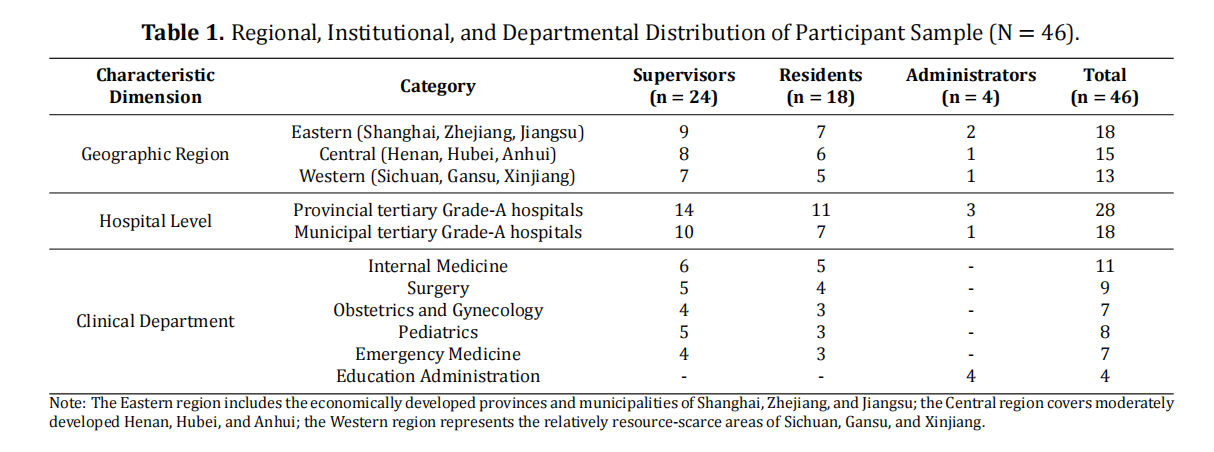
This qualitative study explores how mentor incentive mechanisms shape educational experiences and learning outcomes within residency training programs, adopting an interpretive paradigm to understand participants' lived experiences. Through in-depth interviews with 42 participants—24 clinical mentors and 18 residents—across provincial and municipal tertiary hospitals in nine provinces spanning eastern, central, and western China, we employed thematic analysis to uncover rich narratives about teaching practices and educational resource dynamics from dual perspectives.Five key themes emerged. First, incentive structures were dominated by material rewards, while recognition of teaching excellence and pedagogical development opportunities remained undervalued, with notable disparities favoring eastern regions. Second, educational resource accessibility emerged as a crucial bridge connecting incentive experiences to teaching effectiveness, suggesting mentors' motivation translates into quality instruction primarily through enhanced resource utilization rather than direct pathways. Third, different incentive forms fostered distinct educational processes: compensation stability enabled sustained mentor-learner relationships, professional development opportunities enriched teaching methodologies, while collegial recognition cultivated collaborative learning environments. Fourth, training outcomes revealed multidimensional learning trajectories, with technical competencies developing strongly while higher-order clinical reasoning and professional identity formation required deeper mentorship attention. Fifth, enhancing residency education demands constructing layered recognition systems responsive to diverse mentor needs, strengthening pedagogical resource infrastructure, and establishing continuous dialogue mechanisms between educators and learners. These findings illuminate how institutional recognition practices shape teaching commitment and learner development in professional education settings.
Keywords:
Residency Training Mentor Incentive Mechanisms Resource Allocation Efficiency Training Quality Medical EducationReferences
- Knowles, M.S. Andragogy in Action: Applying Modern Principles of Adult Learning; Jossey-Bass Publishers: San Francisco, CA, USA, 1984.
- Lave, J.; Wenger, E. Situated Learning: Legitimate Peripheral Participation; Cambridge University Press: Cambridge, UK, 1991. https://doi.org/10.1017/CBO9780511815355
- Deci, E.L.; Ryan, R.M. The "what" and "why" of goal pursuits: Human needs and the self-determination of behavior. Psychol. Inq. 2000, 11, 227–268. https://doi.org/10.1207/S15327965PLI1104_01
- Chen, P.; Ding, X.; Chen, M.; et al. The impact of resource spatial mismatch on the configuration analysis of agricultural green total factor productivity. Agriculture 2024, 15, 23. DOI: https://doi.org/10.3390/agriculture15010023
- Duan, L.; Yu, X.; Ni, J. Reconstruction of cultural resource allocation theory and governance framework from the perspective of new quality productive forces. J. Zhejiang Gongshang Univ. 2025, 3, 116–124. DOI: https://doi.org/10.14134/j.cnki.cn33-1337/c.2025.03.011 (in Chinese)
- Eiadeh, A.R.M.; Abdallah, M. PR-DRA: PageRank-based defense resource allocation methods for securing interdependent systems modeled by attack graphs. Int. J. Inf. Secur. 2024, 24, 50. DOI: https://doi.org/10.1007/s10207-024-00964-3
- Fan, W.; Li, J. Joint device assignment and resource allocation for hierarchical semi-asynchronous federated learning over wireless networks. Cluster Comput. 2025, 28, 522. DOI: https://doi.org/10.1007/s10586-025-05164-9
- Hendrie, D.; Miller, R.T. Economic evaluation of evidence-based strategies to reduce unhealthy alcohol use: A resource allocation guide. Front. Public Health 2025, 13, 1466552. DOI: https://doi.org/10.3389/fpubh.2025.1466552
- Hou, W.; Zheng, X.; Liang, T.; et al. Improving ecosystem services production efficiency by optimizing resource allocation in 130 cities of the Yangtze River Economic Belt, China. Sustainability 2025, 17, 7189. DOI: https://doi.org/10.3390/su17167189
- Hu, X.; Zhao, H.; He, D.; et al. Secure communication and resource allocation in double-RIS cooperative-aided UAV-MEC networks. Drones 2025, 9, 587. DOI: https://doi.org/10.3390/drones9080587
- Hurtado, C.A.; Prado, M.D.R.; Campos, L.M. Challenging the "resource allocation" paradigm: A meta-analysis on how nitrogen fertilization balances plant growth and defense against insects. Theor. Exp. Plant Physiol. 2025, 37, 35.
- Kurni, M.; Krishnamaneni, R.; Murthy, A. Osprey–Lyrebird optimization‐based resource allocation with optimal edge‐server placement and offloading in mobile‐edge server computing. Int. J. Commun. Syst. 2025, 38, e70214. DOI: https://doi.org/10.1002/dac.70214
- Li, B.; Zhu, L.; Tan, L. Optimizing task offloading and resource allocation in latency-constrained vehicular edge computing. Cluster Comput. 2025, 28, 525.
- Liu, Y.; Mai, L.; Huang, F.; et al. Regional healthcare resource allocation and decision-making: Evaluating the effectiveness of the three-stage super-efficiency DEA model. Heliyon 2024, 10, e40312. DOI: https://doi.org/10.1016/j.heliyon.2024.e40312
- Liu, Y.; Wang, L.; Chen, B.; et al. Study on the sustainability of innovation resource allocation: Measurement, spatial differentiation, and dynamic evolution in China. Discov. Sustain. 2025, 6, 814.
- Luo, S.; Chen, Z. Mode-aware radio resource allocation algorithm in hybrid users based cognitive radio networks. Sensors 2025, 25, 5086. DOI: https://doi.org/10.3390/s25165086
- Meng, Z. Research on university budget performance management system from a resource allocation perspective. China Townsh. Enterp. Account. 2025, 14, 140–142. (in Chinese)
- Moulard, J.; Lang, M.; Andreff, W. The influence of public subsidies on strategic decision-making and resource allocation: The case of France's new football stadiums. Soc. Soc. 2025, 26, 978–1001.
- Ni, J. Enterprise resource allocation optimization strategies from an economic management perspective. Bus. 2.0 2025, 19, 64–66. (in Chinese)
- Parsa, M.; Ramsey, D.; Barnes, B. Optimal allocation of resources between control and surveillance for complex eradication scenarios. Methods Ecol. Evol. 2024, 16, 388–399.
- Piuaru, A.B.; Tescașiu, B.; Epuran, G.; et al. Information asymmetry in the European funds market: Impact on resource allocation and sustainable development. Sustainability 2024, 16, 11101. DOI: https://doi.org/10.3390/su162411101
- Princy, N.S.S.; Kumar, R.P. Hybrid quantum-enhanced reinforcement learning for energy-efficient resource allocation in fog-edge computing. J. Comb. Optim. 2025, 50, 1–36.
- Sabeeh, S.; Wesołowski, K. On adaptation of resources in New Radio Vehicle-to-Everything Mode 1 dynamic resource allocation. Electronics 2024, 14, 77. DOI: https://doi.org/10.3390/electronics14010077
- Shi, G.; Li, H. Government-led resource allocation and firm productivity: Evidence from a quasi-natural experiment. Pac.-Basin Finance J. 2025, 90, 102638.
- Soares, J.; Batker, D.; Sun, H.Y.; et al. Incorporating natural capital damage from major wildfire events in headwaters management and resource allocation. Water 2025, 17, 2368. DOI: https://doi.org/10.3390/w17162368
- Sun, S. Analysis of influencing factors of institutional elderly care resource allocation from a supply perspective. Mark. Outlook 2025, 7, 208–210. (in Chinese)
- Wang, H. Research on human resource allocation optimization from a public policy perspective. Mark. Outlook 2025, 7, 202–204. (in Chinese)
- Wu, G.; Chen, G. Task offloading and resource allocation in cellular heterogeneous networks for NOMA-based mobile edge computing. Ad Hoc Netw. 2025, 169, 103742.
- Yao, L.; Zhuang, X. Research on the impact of digital economy development on carbon emissions and its potential mechanisms from a resource allocation perspective. J. Zhengzhou Univ. Light Ind. (Soc. Sci. Ed.) 2024, 5, 56–64. (in Chinese)
- Yao, X.; Yuste, P.A. A ML-based resource allocation scheme for energy optimization in 5G NR. Sensors 2025, 25, 4978. DOI: https://doi.org/10.3390/s25164978
- Zhang, C.; Liu, S.; Yang, H.; et al. Joint task offloading and resource allocation in mobile edge computing-enabled medical vehicular networks. Mathematics 2024, 13, 52. DOI: https://doi.org/10.3390/math13010052
- Zhang, C.; Lv, W.; Liu, G.; et al. Multidimensional spatiotemporal autocorrelation analysis theory based on multi-observation spatiotemporal Moran's I and its application in resource allocation. Earth Sci. Inform. 2024, 18, 36.
- Zhang, C.; Wan, X.; Li, W.; et al. A survey on communication and computing resources allocation and management for cohesive clustered satellites systems. Sci. China Inf. Sci. 2025, 68, 190302.
- Zheng, Y.; Chen, N.; Yin, Y.; et al. Sac-lstm: Optimal resource allocation based on user intent in computility networks. J. Supercomput. 2025, 81, 1240.
- Zhou, J.; Li, F. Research on pathways for improving rural medical resource allocation efficiency in China from a configurational perspective. Chin. Rural Health Serv. Adm. 2025, 7, 491–496. (in Chinese)