
Climate and Sustainable Agriculture Research

Volume 2 Issue 1 (2026)

Articles Article ID: 2407

Climate Variability and Its Impact on Rice Yield and Disease Dynamics in Pakistan's Basmati Belt

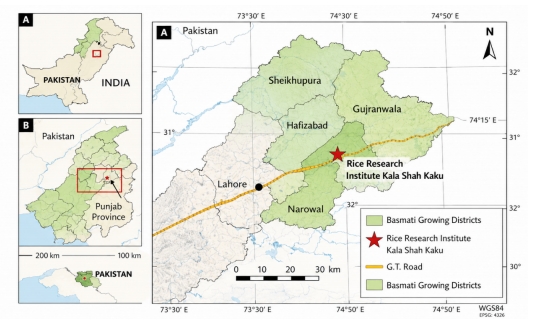
Global agricultural output is seriously threatened by climate change, particularly rice, a commodity essential to both food security and economic stability. This study evaluates the effects of three main climatic factors—temperature, rainfall, and humidity—on rice productivity and disease dynamics in Pakistan with an emphasis on the basmati-growing area of Kala Shah Kaku, Punjab. A mixed-methods approach was used to incorporate a thorough literature study (PRISMA framework) with long-term climate and crop data analysis (1981–2018). Trends were examined using the Mann-Kendall test and Sen's slope estimator. The findings revealed a significant rise in temperature (+0.03 ℃/year) and humidity (+0.12%/year), along with a slight drop in rainfall (−2.10 mm/year). Additionally, the yield of Super Basmati rice exhibited a declining trend (−0.02 t/ha/year). The results demonstrate that while rising temperatures over optimal thresholds (20–36 ℃) negatively affect rice growth and reproductive activities, variable rainfall patterns, both surplus and shortage, reduce yield stability. It has been discovered that important rice diseases, namely bacterial leaf blight and sheath blight, are more common when humidity and temperature rise. Rice blast, on the other hand, had a trend that was either lower or declining because its strict environmental needs (16–30 ℃ and >90% humidity) didn't match the milder conditions that were present. Overall, the study shows that in Pakistan's rice systems, climate variability is changing both yield patterns and disease spectra. The results highlight the critical need for improved disease management, climate-resilient techniques, and flexible agronomic practices to sustain rice productivity amid changing climatic conditions.