
Articles
Climate Variability and Its Impact on Rice Yield and Disease Dynamics in Pakistan's Basmati Belt
 Download

This work is licensed under a Creative Commons Attribution 4.0 International License.
Authors
-
Sana E. Mustafa
 Rice Research Institute, Kala Shah Kaku 39020, Pakistan
- Ruqeyah Abdul Majeed Programme Management Unit, Agriculture Department, Lahore 42000, Pakistan
-
Syed Ali Zafar
Rice Research Institute, Kala Shah Kaku 39020, Pakistan
-
Misbah Riaz
Rice Research Institute, Kala Shah Kaku 39020, Pakistan
- Faisal Rasool Programme Management Unit, Agriculture Department, Lahore 42000, Pakistan
-
Rana Ahsan Raza Khan
Rice Research Institute, Kala Shah Kaku 39020, Pakistan
-
Hafiz Mutther Javed
Rice Research Institute, Kala Shah Kaku 39020, Pakistan
-
Amara Nasiba
Rice Research Institute, Kala Shah Kaku 39020, Pakistan
-
Muhammad Usman Saleem
Rice Research Institute, Kala Shah Kaku 39020, Pakistan
-
Tahir Hussain Awan
Rice Research Institute, Kala Shah Kaku 39020, Pakistan
-
Summra Siddique
Department of Plant Breeding and Genetics, University of Agriculture, Faisalabad 38070, Pakistan
-
Bilal Atta
Rice Research Institute, Kala Shah Kaku 39020, Pakistan
Received: 21 August 2025; Revised: 4 October 2025; Accepted: 8 October 2025; Published: 5 January 2026
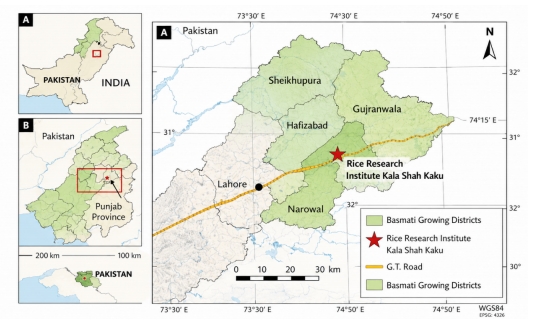
Global agricultural output is seriously threatened by climate change, particularly rice, a commodity essential to both food security and economic stability. This study evaluates the effects of three main climatic factors—temperature, rainfall, and humidity—on rice productivity and disease dynamics in Pakistan with an emphasis on the basmati-growing area of Kala Shah Kaku, Punjab. A mixed-methods approach was used to incorporate a thorough literature study (PRISMA framework) with long-term climate and crop data analysis (1981–2018). Trends were examined using the Mann-Kendall test and Sen's slope estimator. The findings revealed a significant rise in temperature (+0.03 ℃/year) and humidity (+0.12%/year), along with a slight drop in rainfall (−2.10 mm/year). Additionally, the yield of Super Basmati rice exhibited a declining trend (−0.02 t/ha/year). The results demonstrate that while rising temperatures over optimal thresholds (20–36 ℃) negatively affect rice growth and reproductive activities, variable rainfall patterns, both surplus and shortage, reduce yield stability. It has been discovered that important rice diseases, namely bacterial leaf blight and sheath blight, are more common when humidity and temperature rise. Rice blast, on the other hand, had a trend that was either lower or declining because its strict environmental needs (16–30 ℃ and >90% humidity) didn't match the milder conditions that were present. Overall, the study shows that in Pakistan's rice systems, climate variability is changing both yield patterns and disease spectra. The results highlight the critical need for improved disease management, climate-resilient techniques, and flexible agronomic practices to sustain rice productivity amid changing climatic conditions.
Keywords:
Blast Bacterial Leaf Blight Sheath Blight Rice ClimateReferences
- Zhao, W.; Chou, J.; Li, J.; et al. Impacts of extreme climate events on future rice yields in global major rice-producing regions. Int. J. Environ. Res. Public Health 2022, 19, 4437.
- Sarker, M.S. Regional spatial and temporal variability of rainfall, temperature over Bangladesh and Northern Bay of Bengal. Environ. Chall. 2021, 5, 100309.
- Senapati, M.; Tiwari, A.; Sharma, N.; et al. Rhizoctonia solani Kühn pathophysiology: status and prospects of sheath blight disease management in rice. Front. Plant Sci. 2022, 13, 881116.
- Shahrier, R.; Hasan, M.N.; Ankita, S.Y.; et al. Impact of climate change on Boro rice production in Bangladesh: Evidence from time series modeling. PLoS One 2025, 20, e0328699.
- Samal, P.; Babu, S.C.; Mondal, B.; et al. The global rice agriculture towards 2050: An inter-continental perspective. Outlook Agric. 2022, 51, 164–172.
- Saravanakumar, V. Impact of Climate Change on Yield of Major Food Crops in Tamil Nadu, India; South Asian Network for Development and Environmental Economics: Kathmandu, Nepal, 2015.
- Sarkar, M.A.; Rahman, M.C.; Rahaman, M.S.; et al. Adoption determinants of exotic rice cultivars in Bangladesh. Front. Sustain. Food Syst. 2022, 6, 813933.
- Simkhada, K.; Thapa, R. Rice blast, a major threat to the rice production and its various management techniques. Turk. J. Agric.-Food Sci. Technol. 2022, 10, 147–157.
- Singh, P.; Mazumdar, P.; Harikrishna, J.A.; et al. Sheath blight of rice: A review and identification of priorities for future research. Planta 2019, 250, 1387–1407.
- Tang, L.; Wu, A.; Li, S.; et al. Impacts of climate change on rice grain: A literature review on what is happening, and how should we proceed? Foods 2023, 12, 536.
- Wang, H.; Hijmans, R.J. Climate change and geographic shifts in rice production in China. Environ. Res. Commun. 2019, 1, 011008.
- Zannat, F.; Islam, A.T.; Rahman, M.A. Spatiotemporal variability of rainfall linked to ground water level under changing climate in northwestern region, Bangladesh. Eur. J. Geosci. 2019, 12, 35–56.
- Wu, F.; Wang, Y.; Liu, Y.; et al. Simulated responses of global rice trade to variations in yield under climate change: Evidence from main rice-producing countries. J. Clean. Prod. 2021, 281, 124690.
- Shew, A.M.; Durand-Morat, A.; Nalley, L.L.; et al. Warming increases Bacterial Panicle Blight (Burkholderia glumae) occurrences and impacts on USA rice production. PLoS One 2019, 14, e0219199.
- Abbas, S.; Mayo, Z.A. Impact of temperature and rainfall on rice production in Punjab, Pakistan. Environ. Dev. Sustain. 2021, 23, 1706–1728.
- Adenle, A.A.; Wedig, K.; Azadi, H. Sustainable agriculture and food security in Africa: The role of innovative technologies and international organizations. Technol. Soc. 2019, 58, 101143.
- Baig, I.A.; Chandio, A.A.; Ozturk, I.; et al. Assessing the long-and short-run asymmetrical effects of climate change on rice production: Empirical evidence from India. Environ. Sci. Pollut. Res. 2022, 29, 34209–34230.
- Bhardwaj, M.; Kumar, P.; Kumar, S.; et al. A district-level analysis for measuring the effects of climate change on production of agricultural crops, i.e., wheat and paddy: evidence from India. Environ. Sci. Pollut. Res. 2022, 29, 31861–31885.
- Fargnoli, M.; Lombardi, M. Safety vision of agricultural tractors: An engineering perspective based on recent studies (2009–2019). Safety 2019, 6, 1.
- Garrett, K.A.; Bebber, D.P.; Etherton, B.A.; et al. Climate change effects on pathogen emergence: Artificial intelligence to translate big data for mitigation. Annu. Rev. Phytopathol. 2022, 60, 357–378.
- Halbeisen, G.; Braks, K.; Huber, T.J.; et al. Exploring gender differences in early weight change and variability in adolescents with anorexia nervosa during inpatient treatment. J. Clin. Med. 2024, 13, 3255.
- Haque, M.M.; Mita, M.M.; Bashar, S.; et al. Weather parameters largely regulate the outbreak of the rice bacterial blight: An endemic disease poses a threat to food security in Bangladesh. Asian-Australas. J. Food Saf. Secur. 2022, 6, 35–47.
- He, W.; Liu, Y.; Sun, H.; et al. How does climate change affect rice yield in China? Agriculture 2020, 10, 441.
- Ali, N.I.; Aiyub, K.; Lam, K.C.; et al. A bibliometric review on the inter-connection between climate change and rice farming. Environ. Sci. Pollut. Res. 2022, 29, 30892–30907.
- Jamal, M.R.; Kristiansen, P.; Kabir, M.J.; et al. Challenges and adaptations for resilient rice production under changing environments in Bangladesh. Land 2023, 12, 1217.
- Juroszek, P.; Bartsch, L.; Fontaine, J.F.; et al. Summary of the worldwide available crop disease risk simulation studies that were driven by climate change scenarios and published during the past 20 years. Plant Pathol. 2022, 71, 1815–1838.
- Kashyap, D.; Agarwal, T. Temporal trends of climatic variables and water footprint of rice and wheat production in Punjab, India from 1986 to 2017. J. Water Clim. Change 2021, 12, 1203–1219.
- Lee, K.T.; Jeon, H.W.; Park, S.Y.; et al. Comparison of projected rice blast epidemics in the Korean Peninsula between the CMIP5 and CMIP6 scenarios. Clim. Change 2022, 173, 12.
- Mousumi, M.A.; Paparrizos, S.; Ahmed, M.Z.; et al. Common sources and needs of weather information for rice disease forecasting and management in coastal Bangladesh. NJAS Impact Agric. Life Sci. 2023, 95, 2191794.
- Nor Diana, M.I.; Zulkepli, N.A.; Siwar, C.; et al. Farmers’ adaptation strategies to climate change in Southeast Asia: A systematic literature review. Sustainability 2022, 14, 3639.
- Ossifo, M.E.; Duarte, M.L.; Carneiro, A.P.; et al. Selection of covariates in a logistic regression model for the prediction of resistance to rice blast. Braz. J. Biom. 2022, 40.
- Pophiwa, P.; Mwape, A.; Hassen, A.; et al. Insights on agricultural greenhouse gas research and collaboration in Southern Africa. Reg. Environ. Change 2025, 25, 104.
- Richard, B.; Qi, A.; Fitt, B.D. Control of crop diseases through Integrated Crop Management to deliver climate-smart farming systems for low-and high-input crop production. Plant Pathol. 2022, 71, 187–206.
- Cassman, K.G.; Pingali, P.L. Intensification of irrigated rice systems: learning from the past to meet future challenges. GeoJournal 1995, 35, 299–305.
- Dingkuhn, M.; Laza, M.R.; Kumar, U.; et al. Improving yield potential of tropical rice: achieved levels and perspectives through improved ideotypes. Field Crops Res. 2015, 182, 43–59.
- Mausch, K.; Almekinders, C.J.; Hambloch, C.; et al. Putting diverse farming households’ preferences and needs at the centre of seed system development. Outlook Agric. 2021, 50, 356–365.
- Pingali, P.L. Green revolution: impacts, limits, and the path ahead. Proc. Natl. Acad. Sci. U.S.A. 2012, 109, 12302–12308.
- Bhatt, D.; Sonkar, G.; Mall, R.K. Impact of climate variability on the rice yield in Uttar Pradesh: An agro-climatic zone based study. Environ. Process. 2019, 6, 135–153.
- Chandio, A.A.; Gokmenoglu, K.K.; Ahmad, M.; et al. Towards sustainable rice production in Asia: the role of climatic factors. Earth Syst. Environ. 2022, 6, 1–14.
- Debnath, S.; Mishra, A.; Mailapalli, D.R.; et al. Assessment of rice yield gap under a changing climate in India. J. Water Clim. Change 2021, 12, 1245–1267.
- Hasan, M.K.; Kumar, L. Yield trends and variabilities explained by climatic change in coastal and non-coastal areas of Bangladesh. Sci. Total Environ. 2021, 795, 148814.
- Rodenburg, J. Inland valleys: Africa's future food baskets. In Realizing Africa's Rice Promise; CABI: Wallingford, UK, 2013; pp. 276–293.
- Tolba, R.A.; El-Shirbeny, M.A.; Abou-Shleel, S.M.; et al. Rice Acreage Delineation in the Nile Delta Based on Thermal Signature. Earth Syst. Environ. 2020, 4, 287–296.
- Wang, B.X.; Hof, A.R.; Ma, C.S. Impacts of climate change on crop production, pests and pathogens of wheat and rice. Front. Agric. Sci. Eng. 2022, 9, 4–18.
- Wassmann, R.; Nelson, G.C.; Peng, S.B.; et al. Rice and global climate change. In Rice in the Global Economy: Strategic Research and Policy Issues for Food Security; International Rice Research Institute (IRRI): Los Banos, Philippines, 2010; pp. 411–432.
- Mackill, D.J.; Singh, U.S.; Thomson, M.J.; et al. Technological opportunities for developing and deploying improved germplasm for key target traits. In Rice in the Global Economy; International Rice Research Institute (IRRI): Makati City, Philippines, 2010.
- Kumar, U.; Werners, S.; Paparrizos, S.; et al. Hydroclimatic information needs of smallholder farmers in the lower Bengal delta, Bangladesh. Atmosphere 2020, 11, 1009.
- Velásquez, A.C.; Castroverde, C.D.; He, S.Y. Plant–pathogen warfare under changing climate conditions. Curr. Biol. 2018, 28, R619–R634.
- Yoshida, S.; Satake, T.; Mackill, D.S. High-Temperature Stress in Rice; International Rice Research Institute: Los Baños, Philippines, 1981.
- Al Mamun, M.A.; Sarkar, M.A.; Sarker, M.R.; et al. Temperature variability and its effect on seasonal yield of rice in Bangladesh: A long-term trend assessment. Cogent Food Agric. 2025, 11, 2447903.
- Aziz, M.A.; Shohan, H.U.; Rahman, N.M.; et al. Projection of future precipitation in Bangladesh at Kharif-II season using geospatial techniques. Earth Syst. Environ. 2023, 7, 255–266.
- Bagchi, M.; Rahman, S.; Shunbo, Y. Growth in agricultural productivity and its components in Bangladeshi regions (1987–2009): An application of bootstrapped data envelopment analysis (DEA). Economies 2019, 7, 37.
- Pakistan Bureau of Statistics. Pakistan Statistical Yearbook 2020; Pakistan Bureau of Statistics: Islamabad, Pakistan, 2020.
- Bhuiyan, M.S.; Rahman, A.; Kim, G.W.; et al. Eco-friendly yield-scaled global warming potential assists to determine the right rate of nitrogen in rice system: A systematic literature review. Environ. Pollut. 2021, 271, 116386.
- Boonwichai, S.; Shrestha, S.; Babel, M.S.; et al. Climate change impacts on irrigation water requirement, crop water productivity and rice yield in the Songkhram River Basin, Thailand. J. Clean. Prod. 2018, 198, 1157–1164.
- Das, S.K. Rice cultivation under changing climate with mitigation practices: A mini review. Univ. J. Agric. Res. 2017, 5, 333–337.
- Ferdous, Z.; Datta, A.; Anwar, M. Plastic mulch and indigenous microorganism effects on yield and yield components of cauliflower and tomato in inland and coastal regions of Bangladesh. J. Crop Improv. 2017, 31, 261–279.
- Gupta, R.; Mishra, A. Climate change induced impact and uncertainty of rice yield of agro-ecological zones of India. Agric. Syst. 2019, 173, 1–11.
- Hasan, M.M.; Rahman, M.M. Simulating climate change impacts on T. aman (BR‐22) rice yield: A predictive approach using DSSAT model. Water Environ. J. 2020, 34, 250–262.
- Khairulbahri, M. Understanding the impacts of climate change on rice production: A qualitative perspective. Sci. Technol. Asia 2022, 169–179.
- Hossain, N.; Saifullah, A.S.; Bhuiyan, S.H.; et al. Effects of climate change on rice production at Khulna district, Bangladesh. Environ. Earth Ecol. 2019, 3.
- Kodaty, S.C.; Halavath, B. A new approach for paddy leaf blast disease prediction using logistic regression. In Proceedings of the Advances in Information Communication Technology and Computing (AICTC 2019), New Delhi, India, 2019; pp. 533–542.
- Maniruzzaman, M.; Muttaleb, M.A.; Choudhury, A.K.; et al. Characterization of Inter-seasonal Climatic Variability through Dry-season Rice Productivity in the North-west Region of Bangladesh. Ital. J. Agrometeorol. 2017, 2017, 5–18.
- Mondol, M.A.; Zhu, X.; Dunkerley, D.; et al. Observed meteorological drought trends in Bangladesh identified with the Effective Drought Index (EDI). Agric. Water Manag. 2021, 255, 107001.
- R Core Team. R: A Language and Environment for Statistical Computing; R Foundation for Statistical Computing: Vienna, Austria, 2020.
- Ratsiatosika, O.; Blanchart, E.; Razafimbelo, T.; et al. Does rice breeding affect the ability of plants to interact with earthworms in nutrient-depleted Ferralsols? Appl. Soil Ecol. 2021, 163, 103958.
- Mann, H.B. Nonparametric tests against trend. Econometrica 1945, 13, 245–259.
- Moher, D.; Liberati, A.; Tetzlaff, J.; et al. Preferred reporting items for systematic reviews and meta-analyses: The PRISMA statement. Rev. Esp. Nutr. Hum. Diet. 2014, 18, 172–181.
- Britwum, K.; Demont, M. Tailoring rice varieties to consumer preferences induced by cultural and colonial heritage: Lessons from New Rice for Africa (NERICA) in The Gambia. Outlook Agric. 2021, 50, 305–314.
- Singh, P.K.; Singh, K.K.; Bhan, S.C.; et al. Impact of projected climate change on rice (Oryza sativa L.) yield using CERES-rice model in different agroclimatic zones of India. Curr. Sci. 2017, 112, 108–115.
- Abeysingha, N.S.; Singh, M.; Islam, A.; et al. Climate change impacts on irrigated rice and wheat production in Gomti River basin of India: A case study. SpringerPlus 2016, 5, 1250.
- Cohen, J. Statistical Power Analysis for the Behavioral Sciences; Routledge: New York, NY, USA, 2013.
- Ansari, T.H.; Ahmed, M.; Ara, A.; et al. Yield loss assessment of rice due to bacterial blight at different resistance levels. Bangladesh J. Plant Pathol. 2018, 34, 71–76.