
Article
Predicted Immunomodulatory and Anti-Inflammatory Potential of Ficus carica Phytochemicals Targeting NF-kB and TNF-α Signaling Pathways: An In-Silico Investigation
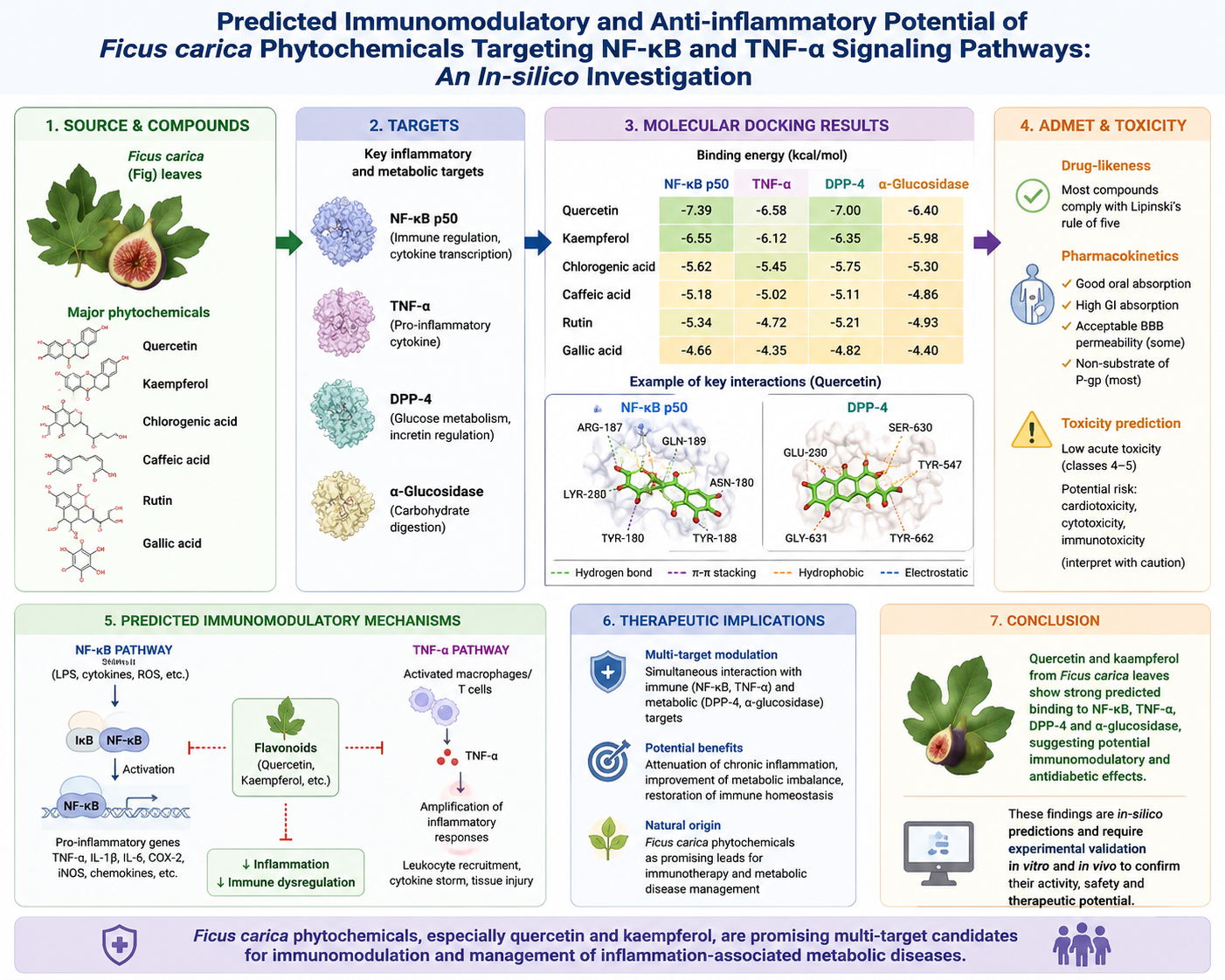
 Download

This work is licensed under a Creative Commons Attribution 4.0 International License.
Copyright
The authors shall retain the copyright of their work but allow the Publisher to publish, copy, distribute, and convey the work.
License
Trends in Immunotherapy (TI) publishes accepted manuscripts under Creative Commons Attribution 4.0 International (CC BY 4.0). Authors who submit their papers for publication by TI agree to have the CC BY 4.0 license applied to their work, and that anyone is allowed to reuse the article or part of it free of charge for any purpose, including commercial use. As long as the author and original source are properly cited, anyone may copy, redistribute, reuse, and transform the content.
Authors
-
Mounia Mezouara
 Laboratory of Natural Resources and Sustainable Development, Department of Biology, Faculty of Sciences, Ibn Tofail University, Kenitra 14000, Morocco
-
Marouane Aouji
Laboratory of Natural Resources and Sustainable Development, Department of Biology, Faculty of Sciences, Ibn Tofail University, Kenitra 14000, Morocco
-
Yassine Mouniane
Scientific Research and Innovation Laboratory (SRILab), Higher School of Technology, Ibn Tofail University, Kenitra 14000, Morocco
-
Nada Belmejdoub
Laboratory of Natural Resources and Sustainable Development, Department of Biology, Faculty of Sciences, Ibn Tofail University, Kenitra 14000, Morocco
-
Mohamed El Bakkali
Laboratory of Natural Resources and Sustainable Development, Department of Biology, Faculty of Sciences, Ibn Tofail University, Kenitra 14000, Morocco
Higher Institute of Nursing and Health Techniques (ISPITS-Kenitra), Kenitra 14000, Morocco -
Youssef Aboussaleh
Laboratory of Natural Resources and Sustainable Development, Department of Biology, Faculty of Sciences, Ibn Tofail University, Kenitra 14000, Morocco
-
Driss Hmouni
Laboratory of Natural Resources and Sustainable Development, Department of Biology, Faculty of Sciences, Ibn Tofail University, Kenitra 14000, Morocco
Received: 10 May 2026; Revised: 29 May 2026; Accepted: 25 June 2026; Published: 29 June 2026
Chronic inflammation and immune dysregulation are key contributors to the development and progression of metabolic diseases, including type 2 diabetes mellitus (T2DM). Natural phytochemicals capable of modulating inflammatory signaling pathways have attracted increasing interest as potential multi-target therapeutic agents. This study investigated the predicted immunomodulatory and antidiabetic potential of major Ficus carica leaf phytochemicals using an integrated in silico approach combining molecular docking, physicochemical characterization, pharmacokinetic analysis, and toxicity prediction. Six bioactive compounds (quercetin, kaempferol, chlorogenic acid, caffeic acid, rutin, and gallic acid) were evaluated against four key inflammatory and metabolic targets: NF-κB p50, TNF-α, DPP-4, and α-glucosidase. Molecular docking demonstrated that quercetin and kaempferol exhibited the strongest binding affinities toward both inflammatory and metabolic targets. Quercetin showed the highest affinity for NF-κB p50 (−7.39 kcal/mol) and DPP-4 (−7.00 kcal/mol), forming stable complexes through hydrogen bonds, hydrophobic interactions, π–π stacking, and electrostatic contacts. Physicochemical and pharmacokinetic analyses indicated favorable drug-likeness and acceptable aqueous solubility for most compounds. Toxicity prediction suggested low acute toxicity (classes 4–5) but indicated potential cardiotoxicity, cytotoxicity, and immunotoxicity, emphasizing the need for cautious interpretation. Overall, the predicted interactions with NF-κB and TNF-α support the potential immunomodulatory properties of Ficus carica phytochemicals, particularly quercetin and kaempferol, as promising multi-target candidates for inflammation-associated metabolic disorders. However, these computational findings remain hypothesis-generating and require validation through in vitro and in vivo studies to confirm their biological activity, safety, and therapeutic potential.
Keywords:
Ficus carica Immunomodulation Chronic Inflammation NF-kB TNF-α Flavonoids Molecular Docking Inflammatory Signaling PathwaysReferences
- Garn, H.; Bahn, S.; Baune, B.T.; et al. Current concepts in chronic inflammatory diseases: Interactions between microbes, cellular metabolism, and inflammation. J. Allergy Clin. Immunol. 2016, 138, 47–56. DOI: https://doi.org/10.1016/j.jaci.2016.02.046
- Gusev, E.; Zhuravleva, Y. Inflammation: A new look at an old problem. Int. J. Mol. Sci. 2022, 23, 4596. DOI: https://doi.org/10.3390/ijms23094596
- Leyane, T.S.; Jere, S.W.; Houreld, N.N. Oxidative stress in ageing and chronic degenerative pathologies: Molecular mechanisms involved in counteracting oxidative stress and chronic inflammation. Int. J. Mol. Sci. 2022, 23, 7273. DOI: https://doi.org/10.3390/ijms23137273
- Ren, N.; Wang, W.F.; Zou, L.; et al. The nuclear factor kappa B signaling pathway is a master regulator of renal fibrosis. Front. Pharmacol. 2024, 14, 1335094. DOI: https://doi.org/10.3389/fphar.2023.1335094
- Yu, W.; Li, C.; Zhang, D.; et al. Advances in T cells based on inflammation in metabolic diseases. Cells 2022, 11, 3554. DOI: https://doi.org/10.3390/cells11223554
- Mallick, R.; Basak, S.; Chowdhury, P.; et al. Targeting cytokine-mediated inflammation in brain disorders: Developing new treatment strategies. Pharmaceuticals 2025, 18, 104. DOI: https://doi.org/10.3390/ph18010104
- Accili, D.; Deng, Z.; Liu, Q. Insulin resistance in type 2 diabetes mellitus. Nat. Rev. Endocrinol. 2025, 21, 413–426. DOI: https://doi.org/10.1038/s41574-025-01114-y
- Młynarska, E.; Czarnik, W.; Dzieża, N.; et al. Type 2 diabetes mellitus: New pathogenetic mechanisms, treatment and the most important complications. Int. J. Mol. Sci. 2025, 26, 1094. DOI: https://doi.org/10.3390/ijms26031094
- International Diabetes Federation. IDF Diabetes Atlas, 11th ed.; International Diabetes Federation: Brussels, Belgium, 2025. Available online: https://diabetesatlas.org/resources/idf-diabetes-atlas-2025/
- Datta, D.; Kundu, R.; Basu, R.; et al. Pathophysiological hallmarks in type 2 diabetes heterogeneity. Diabetol. Int. 2025, 16, 201–222. DOI: https://doi.org/10.1007/s13340-024-00783-w
- Tian, X.; Wang, L.; Zhong, L.; et al. The research progress and future directions in the pathophysiological mechanisms of type 2 diabetes mellitus from the perspective of precision medicine. Front. Med. 2025, 12, 1555077. DOI: https://doi.org/10.3389/fmed.2025.1555077
- Tsushima, Y.; Galloway, N. Glycemic targets and prevention of complications. J. Clin. Endocrinol. Metab. 2025, 110, S100–S111. DOI: https://doi.org/10.1210/clinem/dgae776
- Okdahl, T.; Wegeberg, A.; Pociot, F.; et al. Low-grade inflammation in type 2 diabetes: A cross-sectional study from a Danish diabetes outpatient clinic. BMJ Open 2022, 12, e062188. DOI: https://doi.org/10.1136/bmjopen-2022-062188
- Ruze, R.; Liu, T.; Zou, X.; et al. Obesity and type 2 diabetes mellitus: Connections in epidemiology, pathogenesis, and treatments. Front. Endocrinol. 2023, 14, 1161521. DOI: https://doi.org/10.3389/fendo.2023.1161521
- Nashtahosseini, Z.; Eslami, M.; Paraandavaji, E.; et al. Cytokine signaling in diabetic neuropathy: A key player in peripheral nerve damage. Biomedicines 2025, 13, 589. DOI: https://doi.org/10.3390/biomedicines13030589
- Zamanian, M.Y.; Alsaab, H.O.; Golmohammadi, M.; et al. NF-κB pathway as a molecular target for curcumin in diabetes mellitus treatment: Focusing on oxidative stress and inflammation. Cell Biochem. Funct. 2024, 42, e4030. DOI: https://doi.org/10.1002/cbf.4030
- Caturano, A.; D’Angelo, M.; Mormone, A.; et al. Oxidative stress in type 2 diabetes: Impacts from pathogenesis to lifestyle modifications. Curr. Issues Mol. Biol. 2023, 45, 6651–6666. DOI: https://doi.org/10.3390/cimb45080420
- Majety, P.; Lozada Orquera, F.A.; Edem, D.; et al. Pharmacological approaches to the prevention of type 2 diabetes mellitus. Front. Endocrinol. 2023, 14, 1118848. DOI: https://doi.org/10.3389/fendo.2023.1118848
- Ojo, O.A.; Ibrahim, H.S.; Rotimi, D.E.; et al. Diabetes mellitus: From molecular mechanism to pathophysiology and pharmacology. Med. Nov. Technol. Devices 2023, 19, 100247. DOI: https://doi.org/10.1016/j.medntd.2023.100247
- Kanwal, A.; Kanwar, N.; Bharati, S.; et al. Exploring new drug targets for type 2 diabetes: Success, challenges and opportunities. Biomedicines 2022, 10, 331. DOI: https://doi.org/10.3390/biomedicines10020331
- Su, J.; Luo, Y.; Hu, S.; et al. Advances in research on type 2 diabetes mellitus targets and therapeutic agents. Int. J. Mol. Sci. 2023, 24, 13381. DOI: https://doi.org/10.3390/ijms241713381
- Najmi, A.; Javed, S.A.; Al Bratty, M.; et al. Modern approaches in the discovery and development of plant-based natural products and their analogues as potential therapeutic agents. Molecules 2022, 27, 349. DOI: https://doi.org/10.3390/molecules27020349
- Shamsudin, N.F.; Ahmed, Q.U.; Mahmood, S.; et al. Flavonoids as antidiabetic and anti-inflammatory agents: A review on structural activity relationship-based studies and meta-analysis. Int. J. Mol. Sci. 2022, 23, 12605. DOI: https://doi.org/10.3390/ijms232012605
- Mazzeo, A.; Magarelli, A.; Ferrara, G. The fig (Ficus carica L.): Varietal evolution from Asia to Puglia region, southeastern Italy. CABI Agric. Biosci. 2024, 5, 57. DOI: https://doi.org/10.1186/s43170-024-00262-x
- Walia, A.; Kumar, N.; Singh, R.; et al. Bioactive compounds in Ficus fruits, their bioactivities, and associated health benefits: A review. J. Food Qual. 2022, 2022, 6597092. DOI: https://doi.org/10.1155/2022/6597092
- Bao, Y.; He, M.; Zhang, C.; et al. Advancing understanding of Ficus carica: A comprehensive genomic analysis reveals evolutionary patterns and metabolic pathway insights. Front. Plant Sci. 2023, 14, 1298417. DOI: https://doi.org/10.3389/fpls.2023.1298417
- Noor, F.; Rehman, A.; Ashfaq, U.A.; et al. Integrating network pharmacology and molecular docking approaches to decipher the multi-target pharmacological mechanism of Abrus precatorius L. acting on diabetes. Pharmaceuticals 2022, 15, 414. DOI: https://doi.org/10.3390/ph15040414
- Rigby, S.P. Uses of molecular docking simulations in elucidating synergistic, additive, and/or multi-target (SAM) effects of herbal medicines. Molecules 2024, 29, 5406. DOI: https://doi.org/10.3390/molecules29225406
- Othman, B.; Beigh, S.; Albanghali, M.A.; et al. Comprehensive pharmacokinetic profiling and molecular docking analysis of natural bioactive compounds targeting oncogenic biomarkers in breast cancer. Sci. Rep. 2025, 15, 5426. DOI: https://doi.org/10.1038/s41598-024-84401-4
- Zhang, Q.; Yue, P.; Fan, L.; et al. An updated review of composition, health benefits, and applications of phenolic compounds in Ficus carica L. EFood 2024, 5, e154.
- Daina, A.; Michielin, O.; Zoete, V. SwissADME: A free web tool to evaluate pharmacokinetics, drug-likeness and medicinal chemistry friendliness of small molecules. Sci. Rep. 2017, 7, 42717. DOI: https://doi.org/10.1038/srep42717
- Aouji, M.; Zirari, M.; Rkhaila, A.; et al. An in-silico analysis of the targeting of cyclooxygenase-2, lipoxygenases, and glutathione S-transferase, major components of the flesh of the snail Helix aspersa Müller, using molecular docking: Research focused on colorectal cancer. Biointerface Res. Appl. Chem. 2025, 15, 31. DOI: https://doi.org/10.33263/BRIAC153.031
- Desai, M.; Singh, S.D.; Nagamani, S.; et al. Decoding the relationship between oxidative stress and antiseizure medications using network pharmacology and molecular docking. Sci. Rep. 2025, 15, 33294. DOI: https://doi.org/10.1038/s41598-025-02884-1
- Oliveira, A.P.; Valentão, P.; Pereira, J.A.; et al. Ficus carica L.: Metabolic and biological screening. Food Chem. Toxicol. 2009, 47, 2841–2846.
- Deepa, P.; Sowndhararajan, K.; Kim, S.; et al. A role of Ficus species in the management of diabetes mellitus: A review. J. Ethnopharmacol. 2018, 215, 210–232.
- Galati, G.; O'Brien, P.J. Potential toxicity of flavonoids and other dietary phenolics: Significance for their chemopreventive and anticancer properties. Free Radic. Biol. Med. 2004, 37, 287–303.
- Middleton Jr., E.; Kandaswami, C.; Theoharides, T.C. The effects of plant flavonoids on mammalian cells: Implications for inflammation, heart disease, and cancer. Pharmacol. Rev. 2000, 52, 673–751.
- Lipinski, C.A. Lead- and drug-like compounds: The rule-of-five revolution. Drug Discov. Today Technol. 2004, 1, 337–341.
- Veber, D.F.; Johnson, S.R.; Cheng, H.Y.; et al. Molecular properties that influence the oral bioavailability of drug candidates. J. Med. Chem. 2002, 45, 2615–2623.
- Aertgeerts, K.; Ye, S.; Tennant, M.G.; et al. Crystal structure of human dipeptidyl peptidase IV in complex with a decapeptide reveals details on substrate specificity and tetrahedral intermediate formation. Protein Sci. 2004, 13, 412–421.
- Lin, S.R.; Chang, C.H.; Tsai, M.J.; et al. The perceptions of natural compounds against dipeptidyl peptidase 4 in diabetes: From in silico to in vivo. Ther. Adv. Chronic Dis. 2019, 10, 2040622319875305.
- Pan, J.; Zhang, Q.; Zhang, C.; et al. Inhibition of dipeptidyl peptidase-4 by flavonoids: Structure–activity relationship, kinetics and interaction mechanism. Front. Nutr. 2022, 9, 892426. DOI: https://doi.org/10.3389/fnut.2022.892426
- Meng, S.; Cao, J.; Feng, Q.; et al. Roles of chlorogenic acid on regulating glucose and lipids metabolism: A review. Evid.-Based Complement. Altern. Med. 2013, 2013, 801457.
- Zhai, X.; Wu, K.; Ji, R.; et al. Structure and function insight of the α-glucosidase QsGH13 from Qipengyuania seohaensis sp. SW-135. Front. Microbiol. 2022, 13, 849585. DOI: https://doi.org/10.3389/fmicb.2022.849585
- Proença, C.; Freitas, M.; Ribeiro, D.; et al. α-Glucosidase inhibition by flavonoids: An in vitro and in silico structure–activity relationship study. J. Enzyme Inhib. Med. Chem. 2017, 32, 1216–1228. DOI: https://doi.org/10.1080/14756366.2017.1368503
- Ganeshpurkar, A.; Saluja, A.K. The pharmacological potential of rutin. Saudi Pharm. J. 2017, 25, 149–164. DOI: https://doi.org/10.1016/j.jsps.2016.04.025
- Jaddah, M.M.; Khalaf, S.N.; Ahmed, M.M.; et al. Computational analysis of SPI1 missense mutations and ADMET-guided molecular docking of cinnamic acid targeting the PU.1 ETS domain: Implications for hematopoietic dysregulation and leukemogenesis. Int. J. Mol. Sci. 2026, 27, 4278. DOI: https://doi.org/10.3390/ijms27104278
- Comalada, M.; Ballester, I.; Bailón, E.; et al. Inhibition of pro-inflammatory markers in primary bone marrow-derived mouse macrophages by naturally occurring flavonoids: Analysis of the structure–activity relationship. Biochem. Pharmacol. 2006, 72, 1010–1021. DOI: https://doi.org/10.1016/j.bcp.2006.07.016
- Yahfoufi, N.; Alsadi, N.; Jambi, M.; et al. The immunomodulatory and anti-inflammatory role of polyphenols. Nutrients 2018, 10, 1618. DOI: https://doi.org/10.3390/nu10111618
- Boots, A.W.; Haenen, G.R.; Bast, A. Health effects of quercetin: From antioxidant to nutraceutical. Eur. J. Pharmacol. 2008, 585, 325–337. DOI: https://doi.org/10.1016/j.ejphar.2008.03.008
- Sato, S.; Mukai, Y. Modulation of chronic inflammation by quercetin: The beneficial effects on obesity. J. Inflamm. Res. 2020, 13, 421–431. DOI: https://doi.org/10.2147/JIR.S228361
- Calderon-Montano, J.; Burgos-Moron, E.; Perez-Guerrero, C.; et al. A review on the dietary flavonoid kaempferol. Mini Rev. Med. Chem. 2011, 11, 298–344.
- Safe, S.; Jayaraman, A.; Chapkin, R.S.; et al. Flavonoids: Structure–function and mechanisms of action and opportunities for drug development. Toxicol. Res. 2021, 37, 147–162. DOI: https://doi.org/10.1007/s43188-020-00080-z
- Furman, D.; Campisi, J.; Verdin, E.; et al. Chronic inflammation in the etiology of disease across the life span. Nature Medicine 2019, 25, 1822–1832. DOI: https://doi.org/10.1038/s41591-019-0675-0
- Zotova, N.; Zhuravleva, Y.; Chereshnev, V.; et al. Acute and Chronic Systemic Inflammation: Features and Differences in the Pathogenesis, and Integral Criteria for Verification and Differentiation. Int. J. Mol. Sci. 2023, 24, 1144. DOI: https://doi.org/10.3390/ijms24021144
- Kannan, G.; Paul, B.M.; Thangaraj, P. Stimulation, regulation, and inflammaging interventions of natural compounds on nuclear factor kappa B (NF-kB) pathway: a comprehensive review. Inflammopharmacology 2025, 33, 145–162. DOI: https://doi.org/10.1007/s10787-024-01635-4