
Review Article
When the Living Drug Strikes Back: Cytokine Release Syndrome and Neurotoxicity from CAR T-Cell and Bispecific Therapies
 Download

This work is licensed under a Creative Commons Attribution 4.0 International License.
Copyright
The authors shall retain the copyright of their work but allow the Publisher to publish, copy, distribute, and convey the work.
License
Trends in Immunotherapy (TI) publishes accepted manuscripts under Creative Commons Attribution 4.0 International (CC BY 4.0). Authors who submit their papers for publication by TI agree to have the CC BY 4.0 license applied to their work, and that anyone is allowed to reuse the article or part of it free of charge for any purpose, including commercial use. As long as the author and original source are properly cited, anyone may copy, redistribute, reuse, and transform the content.
Authors
-
Alexandre Bueno Merlini
 Hospital do Coração (HCor), São Paulo 04004-030, Brazil
-
Polliane Arruda
Hospital do Coração (HCor), São Paulo 04004-030, Brazil
-
Natalia Silva Fernandes
Hospital do Coração (HCor), São Paulo 04004-030, Brazil
-
Daniela Regina de Carvalho Rocha
Hospital do Coração (HCor), São Paulo 04004-030, Brazil
-
Renan Henrique Aparecido Camilo Merlini
Department of Medicine, Faculdade de Ciências Médicas da Santa Casa de São Paulo, São Paulo 01225-010, Brazil
Received: 29 May 2026; Revised: 15 June 2026; Accepted: 23 June 2026; Published: 30 June 2026
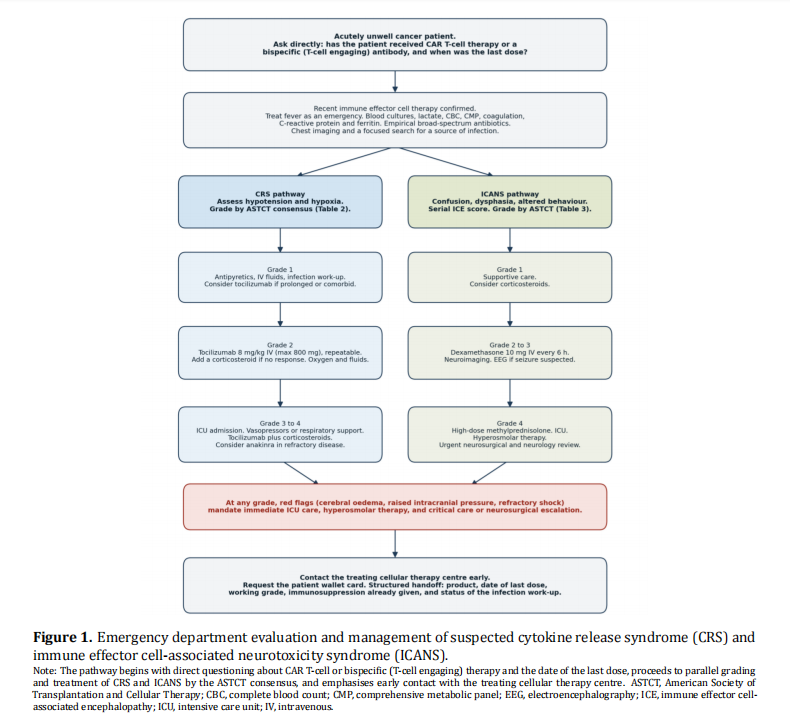
Chimeric antigen receptor (CAR) T-cell therapies and bispecific T-cell engagers have produced durable remissions in haematological malignancies that were previously considered refractory, and the bispecific class has now extended this approach to a solid tumour, extensive-stage small-cell lung cancer, through the delta-like ligand 3 engager tarlatamab. The shared mechanism of intense, sustained T-cell activation generates two characteristic and potentially fatal toxicities: cytokine release syndrome (CRS) and immune effector cell-associated neurotoxicity syndrome (ICANS). As bispecific agents shift toward subcutaneous and outpatient administration, an increasing proportion of treated patients present to emergency departments without immediate access to the treating cellular therapy centre, where the syndrome may not be recognised. This narrative review translates the consensus produced by haematology and cellular therapy societies into an operational framework for acute care. It synthesises the mechanism, epidemiology, grading, and initial management of CRS, ICANS, and related immune effector cell toxicities, drawing on the American Society of Transplantation and Cellular Therapy consensus, the American Society of Clinical Oncology guideline, the joint European recommendations, and pivotal and updated product trials. Recognition rests on a few disciplined habits: naming the therapy, treating fever in a recently treated patient as an emergency, grading CRS and ICANS while methodically excluding infection, and contacting the treating centre early. Management centres on tocilizumab for CRS, corticosteroids for ICANS, anakinra in refractory disease, and aggressive supportive care. Competence with these syndromes is becoming a general expectation of acute care rather than the exclusive concern of cellular therapy units.
Keywords:
CAR T-Cell Therapy Bispecific Antibodies Cytokine Release Syndrome Immune Effector Cells Immunotherapy ToxicityReferences
- June, C.H.; Sadelain, M. Chimeric antigen receptor therapy. N. Engl. J. Med. 2018, 379, 64–73. DOI: https://doi.org/10.1056/NEJMra1706169
- Neelapu, S.S.; Locke, F.L.; Bartlett, N.L.; et al. Axicabtagene ciloleucel CAR T-cell therapy in refractory large B-cell lymphoma. N. Engl. J. Med. 2017, 377, 2531–2544. DOI: https://doi.org/10.1056/NEJMoa1707447
- Maude, S.L.; Laetsch, T.W.; Buechner, J.; et al. Tisagenlecleucel in children and young adults with B-cell lymphoblastic leukemia. N. Engl. J. Med. 2018, 378, 439–448. DOI: https://doi.org/10.1056/NEJMoa1709866
- Kantarjian, H.; Stein, A.; Gökbuget, N.; et al. Blinatumomab versus chemotherapy for advanced acute lymphoblastic leukemia. N. Engl. J. Med. 2017, 376, 836–847. DOI: https://doi.org/10.1056/NEJMoa1609783
- Moreau, P.; Garfall, A.L.; van de Donk, N.W.C.J.; et al. Teclistamab in relapsed or refractory multiple myeloma. N. Engl. J. Med. 2022, 387, 495–505. DOI: https://doi.org/10.1056/NEJMoa2203478
- Lee, D.W.; Santomasso, B.D.; Locke, F.L.; et al. ASTCT consensus grading for cytokine release syndrome and neurologic toxicity associated with immune effector cells. Biol. Blood Marrow Transplant. 2019, 25, 625–638. DOI: https://doi.org/10.1016/j.bbmt.2018.12.758
- Santomasso, B.D.; Nastoupil, L.J.; Adkins, S.; et al. Management of immune-related adverse events in patients treated with chimeric antigen receptor T-cell therapy: ASCO guideline. J. Clin. Oncol. 2021, 39, 3978–3992. DOI: https://doi.org/10.1200/JCO.21.01992
- Morris, E.C.; Neelapu, S.S.; Giavridis, T.; et al. Cytokine release syndrome and associated neurotoxicity in cancer immunotherapy. Nat. Rev. Immunol. 2022, 22, 85–96. DOI: https://doi.org/10.1038/s41577-021-00547-6
- Sadelain, M.; Brentjens, R.; Rivière, I. The basic principles of chimeric antigen receptor design. Cancer Discov. 2013, 3, 388–398. DOI: https://doi.org/10.1158/2159-8290.CD-12-0548
- Schuster, S.J.; Bishop, M.R.; Tam, C.S.; et al. Tisagenlecleucel in adult relapsed or refractory diffuse large B-cell lymphoma. N. Engl. J. Med. 2019, 380, 45–56. DOI: https://doi.org/10.1056/NEJMoa1804980
- Wang, M.; Munoz, J.; Goy, A.; et al. KTE-X19 CAR T-cell therapy in relapsed or refractory mantle-cell lymphoma. N. Engl. J. Med. 2020, 382, 1331–1342. DOI: https://doi.org/10.1056/NEJMoa1914347
- Abramson, J.S.; Palomba, M.L.; Gordon, L.I.; et al. Lisocabtagene maraleucel for patients with relapsed or refractory large B-cell lymphomas (TRANSCEND NHL 001): A multicentre seamless design study. Lancet 2020, 396, 839–852. DOI: https://doi.org/10.1016/S0140-6736(20)31366-0
- Munshi, N.C.; Anderson Jr., L.D.; Shah, N.; et al. Idecabtagene vicleucel in relapsed and refractory multiple myeloma. N. Engl. J. Med. 2021, 384, 705–716. DOI: https://doi.org/10.1056/NEJMoa2024850
- Berdeja, J.G.; Madduri, D.; Usmani, S.Z.; et al. Ciltacabtagene autoleucel, a B-cell maturation antigen-directed chimeric antigen receptor T-cell therapy in patients with relapsed or refractory multiple myeloma (CARTITUDE-1): A phase 1b/2 open-label study. Lancet 2021, 398, 314–324. DOI: https://doi.org/10.1016/S0140-6736(21)00933-8
- Locke, F.L.; Miklos, D.B.; Jacobson, C.A.; et al. Axicabtagene ciloleucel as second-line therapy for large B-cell lymphoma. N. Engl. J. Med. 2022, 386, 640–654. DOI: https://doi.org/10.1056/NEJMoa2116133
- Topp, M.S.; van Meerten, T.; Houot, R.; et al. Earlier corticosteroid use for adverse event management in patients receiving axicabtagene ciloleucel for large B-cell lymphoma. Br. J. Haematol. 2021, 195, 388–398. DOI: https://doi.org/10.1111/bjh.17673
- Frigault, M.J.; Nikiforow, S.; Mansour, M.K.; et al. Tocilizumab not associated with increased infection risk after CAR T-cell therapy: Implications for prophylactic use. Blood 2020, 136, 137–139. DOI: https://doi.org/10.1182/blood.2020006216
- Dickinson, M.J.; Carlo-Stella, C.; Morschhauser, F.; et al. Glofitamab for relapsed or refractory diffuse large B-cell lymphoma. N. Engl. J. Med. 2022, 387, 2220–2231. DOI: https://doi.org/10.1056/NEJMoa2206913
- Thieblemont, C.; Phillips, T.; Ghesquieres, H.; et al. Epcoritamab, a novel, subcutaneous CD3xCD20 bispecific T-cell-engaging antibody, in relapsed or refractory large B-cell lymphoma: dose expansion in a phase I/II trial. J. Clin. Oncol. 2023, 41, 2238–2247. DOI: https://doi.org/10.1200/JCO.22.01725
- Budde, L.E.; Sehn, L.H.; Matasar, M.; et al. Safety and efficacy of mosunetuzumab, a bispecific antibody, in patients with relapsed or refractory follicular lymphoma: A single-arm, multicentre, phase 2 study. Lancet Oncol. 2022, 23, 1055–1065. DOI: https://doi.org/10.1016/S1470-2045(22)00335-7
- Lesokhin, A.M.; Tomasson, M.H.; Arnulf, B.; et al. Elranatamab in relapsed or refractory multiple myeloma: Phase 2 MagnetisMM-3 trial results. Nat. Med. 2023, 29, 2259–2267. DOI: https://doi.org/10.1038/s41591-023-02528-9
- Chari, A.; Minnema, M.C.; Berdeja, J.G.; et al. Talquetamab, a T-cell-redirecting GPRC5D bispecific antibody for multiple myeloma. N. Engl. J. Med. 2022, 387, 2232–2244. DOI: https://doi.org/10.1056/NEJMoa2204591
- Ahn, M.J.; Cho, B.C.; Felip, E.; et al. Tarlatamab for patients with previously treated small-cell lung cancer. N. Engl. J. Med. 2023, 389, 2063–2075. DOI: https://doi.org/10.1056/NEJMoa2307980
- Sands, J.M.; Champiat, S.; Hummel, H.-D.; et al. Practical management of adverse events in patients receiving tarlatamab, a delta-like ligand 3-targeted bispecific T-cell engager immunotherapy, for previously treated small cell lung cancer. Cancer 2025, 131, e35738. DOI: https://doi.org/10.1002/cncr.35738
- Hayden, P.J.; Roddie, C.; Bader, P.; et al. Management of adults and children receiving CAR T-cell therapy: 2021 best practice recommendations of EBMT and JACIE and the EHA. Ann. Oncol. 2022, 33, 259–275. DOI: https://doi.org/10.1016/j.annonc.2021.12.003
- Giavridis, T.; van der Stegen, S.J.C.; Eyquem, J.; et al. CAR T cell-induced cytokine release syndrome is mediated by macrophages and ablated by IL-1 blockade. Nat. Med. 2018, 24, 731–738. DOI: https://doi.org/10.1038/s41591-018-0041-7
- Norelli, M.; Camisa, B.; Barbiera, G.; et al. Monocyte-derived IL-1 and IL-6 are differentially required for cytokine-release syndrome and neurotoxicity due to CAR T cells. Nat. Med. 2018, 24, 739–748. DOI: https://doi.org/10.1038/s41591-018-0036-4
- Park, J.H.; Nath, K.; Devlin, S.M.; et al. CD19 CAR T-cell therapy and prophylactic anakinra in relapsed or refractory lymphoma: Phase 2 trial interim results. Nat. Med. 2023, 29, 1710–1717. DOI: https://doi.org/10.1038/s41591-023-02404-6
- Frigault, M.J.; Yao, N.; Berger, T.R.; et al. Single-cell dynamics of breakthrough toxicities after anakinra prophylaxis for axicabtagene ciloleucel in lymphoma. Blood Adv. 2025, 9, 2122–2135. DOI: https://doi.org/10.1182/bloodadvances.2024015161
- Kamaljeet; Vijukumar, A.; Kumar, H.; et al. Re-evaluating cytokine storm syndromes: dysregulated host defense or contextual immune adaptation? Eur. Cytokine Netw. 2026, 37, 13–24. DOI: https://doi.org/10.32604/ecn.2026.078458
- Gust, J.; Hay, K.A.; Hanafi, L.A.; et al. Endothelial activation and blood-brain barrier disruption in neurotoxicity after adoptive immunotherapy with CD19 CAR-T cells. Cancer Discov. 2017, 7, 1404–1419. DOI: https://doi.org/10.1158/2159-8290.CD-17-0698
- Santomasso, B.D.; Park, J.H.; Salloum, D.; et al. Clinical and biological correlates of neurotoxicity associated with CAR T-cell therapy in patients with B-cell acute lymphoblastic leukemia. Cancer Discov. 2018, 8, 958–971. DOI: https://doi.org/10.1158/2159-8290.CD-17-1319
- Lee, D.W.; Gardner, R.; Porter, D.L.; et al. Current concepts in the diagnosis and management of cytokine release syndrome. Blood 2014, 124, 188–195. DOI: https://doi.org/10.1182/blood-2014-05-552729
- Neelapu, S.S.; Tummala, S.; Kebriaei, P.; et al. Chimeric antigen receptor T-cell therapy: Assessment and management of toxicities. Nat. Rev. Clin. Oncol. 2018, 15, 47–62. DOI: https://doi.org/10.1038/nrclinonc.2017.148
- Frey, N.V.; Porter, D.L. Cytokine release syndrome with chimeric antigen receptor T cell therapy. Biol. Blood Marrow Transplant. 2019, 25, e123–e127. DOI: https://doi.org/10.1016/j.bbmt.2018.12.756
- Hill, J.A.; Li, D.; Hay, K.A.; et al. Infectious complications of CD19-targeted chimeric antigen receptor-modified T-cell immunotherapy. Blood 2018, 131, 121–130. DOI: https://doi.org/10.1182/blood-2017-07-793760
- Strati, P.; Ahmed, S.; Furqan, F.; et al. Prognostic impact of corticosteroids on efficacy of chimeric antigen receptor T-cell therapy in large B-cell lymphoma. Blood 2021, 137, 3272–3276. DOI: https://doi.org/10.1182/blood.2020008865
- Hines, M.R.; Knight, T.E.; McNerney, K.O.; et al. Immune effector cell-associated hemophagocytic lymphohistiocytosis-like syndrome. Transplant. Cell Ther. 2023, 29, 438.e1–438.e16. DOI: https://doi.org/10.1016/j.jtct.2023.03.006
- Rejeski, K.; Subklewe, M.; Aljurf, M.; et al. Immune effector cell-associated hematotoxicity: EHA/EBMT consensus grading and best practice recommendations. Blood 2023, 142, 865–877. DOI: https://doi.org/10.1182/blood.2023020578
- Park, J.H.; Rivière, I.; Gonen, M.; et al. Long-term follow-up of CD19 CAR therapy in acute lymphoblastic leukemia. N. Engl. J. Med. 2018, 378, 449–459. DOI: https://doi.org/10.1056/NEJMoa1709919
- Cappell, K.M.; Kochenderfer, J.N. Long-term outcomes following CAR T cell therapy: what we know so far. Nat. Rev. Clin. Oncol. 2023, 20, 359–371. DOI: https://doi.org/10.1038/s41571-023-00754-1
- Schubert, M.L.; Schmitt, M.; Wang, L.; et al. Side-effect management of chimeric antigen receptor (CAR) T-cell therapy. Ann. Oncol. 2021, 32, 34–48. DOI: https://doi.org/10.1016/j.annonc.2020.10.478