
Article
Morphofunctional and Immuno-Inflammatory Assessment of Renal Allografts from Asystolic Donors: A Multicriteria Model Comparing Early and Extended Warm Ischemia
 Download

This work is licensed under a Creative Commons Attribution 4.0 International License.
Copyright
The authors shall retain the copyright of their work but allow the Publisher to publish, copy, distribute, and convey the work.
License
Trends in Immunotherapy (TI) publishes accepted manuscripts under Creative Commons Attribution 4.0 International (CC BY 4.0). Authors who submit their papers for publication by TI agree to have the CC BY 4.0 license applied to their work, and that anyone is allowed to reuse the article or part of it free of charge for any purpose, including commercial use. As long as the author and original source are properly cited, anyone may copy, redistribute, reuse, and transform the content.
Authors
-
Zhanybek Ashimov
Department of Scientific, National Surgical Center named after M.M. Mamakeev of the Ministry of Health of the Kyrgyz Republic, Bishkek 720000, Kyrgyzstan
Department of General Surgery, Kyrgyz State Medical Institute of Retraining/Advanced Training named after S.B. Daniyarov, Bishkek 720017, Kyrgyzstan -
Kanat Mamakeev
 Department of Scientific, National Surgical Center named after M.M. Mamakeev of the Ministry of Health of the Kyrgyz Republic, Bishkek 720000, Kyrgyzstan
- Isabek Ashimov Department of General Surgery, Kyrgyz State Medical Institute of Retraining/Advanced Training named after S.B. Daniyarov, Bishkek 720017, Kyrgyzstan
- Batyrkhan Niyazov Department of General Surgery, Kyrgyz State Medical Institute of Retraining/Advanced Training named after S.B. Daniyarov, Bishkek 720017, Kyrgyzstan
- Taalai Akmatov Department of Scientific, National Surgical Center named after M.M. Mamakeev of the Ministry of Health of the Kyrgyz Republic, Bishkek 720000, Kyrgyzstan
Received: 27 April 2026; Revised: 18 May 2026; Accepted: 11 June 2026; Published: 18 June 2026
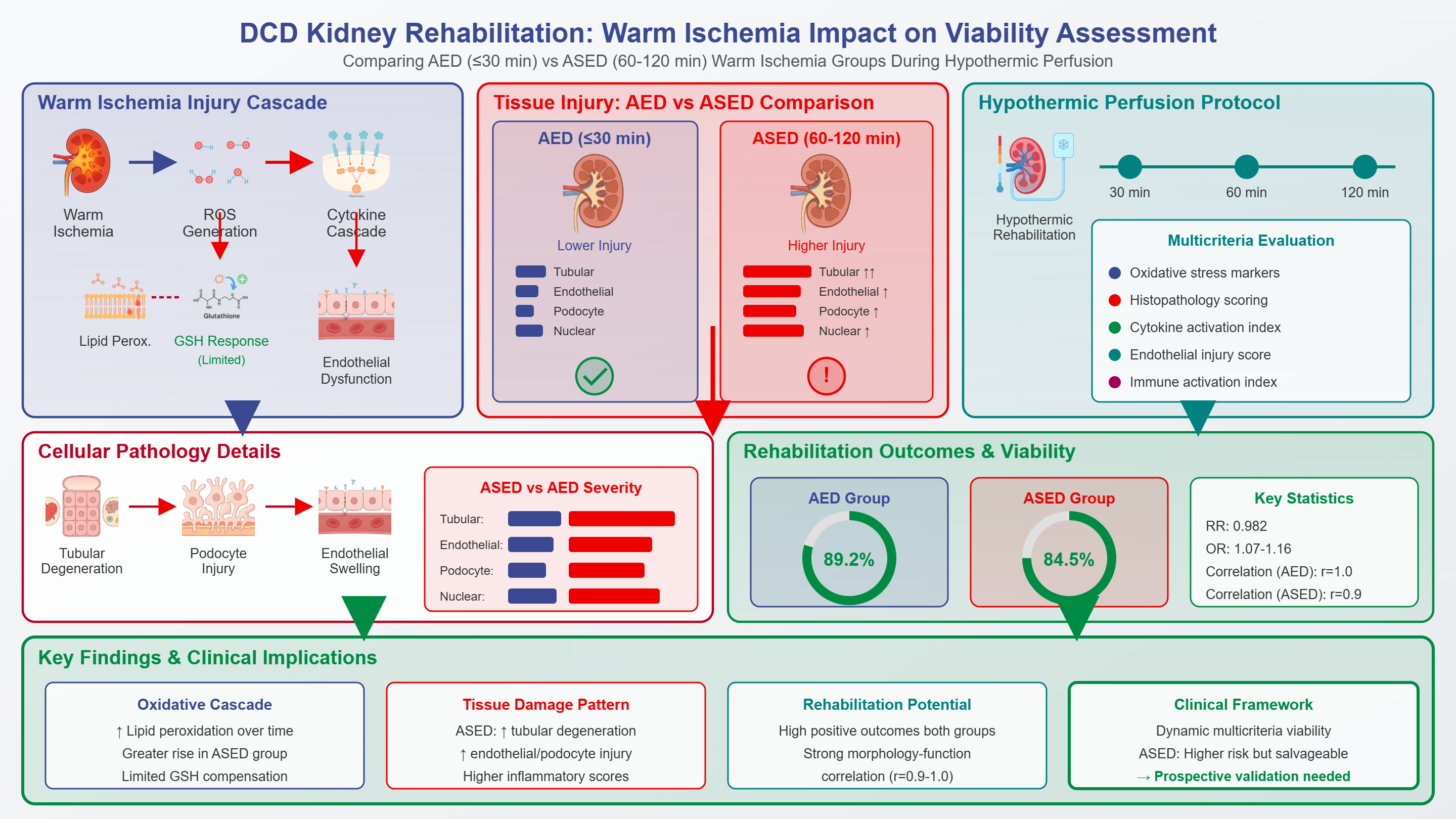
Global organ shortages have intensified interest in donation after circulatory death (DCD). However, DCD kidneys are affected by warm ischemia, which amplifies ischemia-reperfusion injury via a reactive oxygen species-damage-associated molecular pattern-cytokine-endothelial cascade, increasing the risk of microvascular dysfunction and delayed graft function. This study developed an objective postmortem ex vivo model to compare asystolic early donors/rapid death (AED; warm ischemia ≤30 min) and asystolic extended/delayed donors (ASED; 60–120 min) using integrated morphofunctional, biochemical, and immuno-inflammatory indicators during hypothermic perfusion. In an ex vivo design, 145 DCD renal allografts (71 AED, 74 ASED) underwent standardized hypothermic rehabilitation, with evaluations at 30, 60, and 120 min. Oxidative stress was quantified by lipid peroxidation and antioxidant capacity, in addition to histopathology (tubular, endothelial, podocyte, nuclear injury) and composite indices for cytokine activation, endothelial injury, and immune activation. A multicriteria scoring algorithm was used to categorize rehabilitation effectiveness, and group differences were assessed using comparative tests. These findings support a dynamic, multicriteria viability framework, indicating that ASED kidneys are at a higher risk yet potentially salvageable under comprehensive perfusion rehabilitation, warranting prospective transplantation-linked validation. Lipid peroxidation increased over time, rising more in the ASED group, whereas glutathione showed limited compensatory change. The ASED kidneys demonstrated greater tubular degeneration, endothelial swelling, podocyte injury, and nuclear alterations, with higher oxidative, inflammatory, and immune activation scores. Despite the higher biological burden, positive integrated outcomes remained frequent (AED 89.2% vs. ASED 84.5%; RR: 0.982; OR: 1.07–1.16), and morphology-function correlations were strong (AED r = 1.0; ASED r = 0.9). These findings support a dynamic, multicriteria viability framework, indicating that ASED kidneys are at a higher risk yet potentially salvageable under comprehensive perfusion rehabilitation, warranting prospective transplantation-linked validation.
Keywords:
Donation after Circulatory Death Ischemia-Reperfusion Injury Delayed Graft Function Hypothermic Machine Perfusion Normothermic Machine Perfusion Reactive Oxygen Species Toll-like ReceptorsReferences
- Talbot, D.; D'Alessandro, A.M.; Muiesan, P. Organ Donation and Transplantation after Cardiac Death. Ann. R. Coll. Surg. Engl. 2010, 92, 719.
- Caldwell, J.S.; Cheng, X.S.; Chertow, G.M.; et al. Kidney Transplant Wait Times Under Waiting List Expansion Scenarios. JAMA Netw. Open 2025, 8, e251665.
- Haque, O.; Yuan, Q.; Uygun, K.; et al. Evolving Utilization of Donation after Circulatory Death Livers in Liver Transplantation: The Day of DCD Has Come. Clin. Transplant. 2021, 35, e14211.
- Alghannam, K.; Fine, J.; Howard, B.; et al. Impact of Warm Ischemia Time on Donation after Circulatory Death Kidney Transplant Outcomes. Clin. Transplant. 2024, 38, e15436.
- Walls, D.O.; Lee-Riddle, G.S.; Bover Manderski, M.; et al. Kidney Transplant Outcomes from Donation after Circulatory Death Donors of Advanced Age. Clin. Transplant. 2020, 34, e13881.
- Kim, D.W.; Tsapepas, D.; King, K.L.; et al. Financial Impact of Delayed Graft Function in Kidney Transplantation. Clin. Transplant. 2020, 34, e14022.
- Negret, M.A.; Rodriguez, M.P.; Díaz-Brochero, C.; et al. Impact of Delayed Graft Function on Overall and Graft Survival in Recipients of Deceased Donor Kidney Transplants. BMC Nephrol. 2025, 26, 633.
- Tang, S.P.; Mao, X.L.; Chen, Y.H.; et al. Reactive Oxygen Species Induce Fatty Liver and Ischemia-Reperfusion Injury by Promoting Inflammation and Cell Death. Front. Immunol. 2022, 13, 870239.
- Liao, S.; Luo, J.; Kadier, T.; et al. Mitochondrial DNA Release Contributes to Intestinal Ischemia/Reperfusion Injury. Front. Pharmacol. 2022, 13, 854994.
- Hirao, H.; Dery, K.J.; Kageyama, S.; et al. Heme Oxygenase-1 in Liver Transplant Ischemia-Reperfusion Injury: From Bench-to-Bedside. Free Radic. Biol. Med. 2020, 157, 75–82.
- Nieuwenhuijs-Moeke, G.J.; Pischke, S.E.; Berger, S.P.; et al. Ischemia and Reperfusion Injury in Kidney Transplantation: Relevant Mechanisms in Injury and Repair. J. Clin. Med. 2020, 9, 253.
- Wang, L.; Vijayan, V.; Jang, M.S.; et al. Labile Heme Aggravates Renal Inflammation and Complement Activation After Ischemia Reperfusion Injury. Front. Immunol. 2019, 10, 2975.
- Wu, X.; You, D.; Cui, J.; et al. Reduced Neutrophil Extracellular Trap Formation During Ischemia Reperfusion Injury in C3 KO Mice: C3 Requirement for NETs Release. Front. Immunol. 2022, 13, 781273.
- Delaura, I.F.; Gao, Q.; Anwar, I.J.; et al. Complement-Targeting Therapeutics for Ischemia-Reperfusion Injury in Transplantation and the Potential for Ex Vivo Delivery. Front. Immunol. 2022, 13, 1000172.
- Kaltenmeier, C.; Yazdani, H.O.; Handu, S.; et al. The Role of Neutrophils as a Driver in Hepatic Ischemia-Reperfusion Injury and Cancer Growth. Front. Immunol. 2022, 13, 887565.
- Zaphiros, N.H.; Nie, J.; Alchaer, M.W.; et al. Outcomes of DCD Kidneys with CIT-Induced Delayed Graft Function. Clin. Transplant. 2023, 37, e14918.
- Zhang, M.; Liu, Q.; Meng, H.; et al. Ischemia-Reperfusion Injury: Molecular Mechanisms and Therapeutic Targets. Signal Transduct. Target. Ther. 2024, 9, 12.
- Asaka, M.; Imumura, H.; Sato, K.; et al. Ischemia–Reperfusion Injury as the Leading Cause of Primary Non-Function in Renal Transplantation Using Donors with Prolonged Warm Ischemic Time. Clin. Transplant. 2008, 22, 19–24.
- Heylen, L.; Pirenne, J.; Samuel, U.; et al. The Impact of Anastomosis Time During Kidney Transplantation on Graft Loss: A Eurotransplant Cohort Study. Am. J. Transplant. 2017, 17, 724–732.
- De Carlis, R.; Di Sandro, S.; Lauterio, A.; et al. Successful Donation After Cardiac Death Liver Transplants with Prolonged Warm Ischemia Time Using Normothermic Regional Perfusion. Liver Transpl. 2017, 23, 166–173.
- Savoye, E.; Legeai, C.; Branchereau, J.; et al. Optimal Donation of Kidney Transplants after Controlled Circulatory Death. Am. J. Transplant. 2021, 21, 2424–2436.
- Dondossola, D.; Ravaioli, M.; Lonati, C.; et al. The Role of Ex Situ Hypothermic Oxygenated Machine Perfusion and Cold Preservation Time in Extended Criteria Donation after Circulatory Death and Donation After Brain Death. Liver Transpl. 2021, 27, 1130–1143.
- Nagaraju, S.; Savilla, R.; Moore, M.; et al. Successful Transplantation of LUCAS Device Assisted Uncontrolled DCD Kidneys with Prolonged Relative Warm Ischemia Time: An Underutilized Option in North America. Clin. Transplant. 2023, 37, e15058.
- De Carlis, R.; Di Sandro, S.; Lauterio, A.; et al. Liver Grafts from Donors After Circulatory Death on Regional Perfusion with Extended Warm Ischemia Compared with Donors After Brain Death. Liver Transpl. 2018, 24, 1523–1535.
- Hameed, A.M.; Pleass, H.C.; Wong, G.; et al. Maximizing Kidneys for Transplantation Using Machine Perfusion: From the Past to the Future: A Comprehensive Systematic Review and Meta-Analysis. Medicine 2016, 95, e5083.
- Husen, P.; Boffa, C.; Jochmans, I.; et al. Oxygenated End-Hypothermic Machine Perfusion in Expanded Criteria Donor Kidney Transplant: A Randomized Clinical Trial. JAMA Surg. 2021, 156, 517–525.
- Horné, F.; Drefs, M.; Schirren, M.J.; et al. Hypothermic Oxygenated Machine Perfusion (HOPE) Prior to Liver Transplantation Mitigates Post-Reperfusion Syndrome and Perioperative Electrolyte Shifts. J. Clin. Med. 2022, 11, 7381.
- Lee, A.C.H.; Edobor, A.; Lysandrou, M.; et al. The Effect of Normothermic Machine Perfusion on the Immune Profile of Donor Liver. Front. Immunol. 2022, 13, 788935.
- Liu, W.; Fan, Y.; Ding, H.; et al. Normothermic Machine Perfusion Attenuates Hepatic Ischaemia-Reperfusion Injury by Inhibiting CIRP-Mediated Oxidative Stress and Mitochondrial Fission. J. Cell. Mol. Med. 2021, 25, 11310–11321.
- Mazilescu, L.I.; Urbanellis, P.; Kim, S.J.; et al. Normothermic Ex Vivo Kidney Perfusion for Human Kidney Transplantation: First North American Results. Transplantation 2022, 106, 1852–1859.
- Urbanellis, P.; Hamar, M.; Kaths, J.M.; et al. Normothermic Ex Vivo Kidney Perfusion Improves Early DCD Graft Function Compared with Hypothermic Machine Perfusion and Static Cold Storage. Transplantation 2020, 104, 947–955.
- Jager, N.M.; Venema, L.H.; Arykbaeva, A.S.; et al. Complement Is Activated During Normothermic Machine Perfusion of Porcine and Human Discarded Kidneys. Front. Immunol. 2022, 13, 831371.
- Boteon, Y.L.; Laing, R.W.; Schlegel, A.; et al. Combined Hypothermic and Normothermic Machine Perfusion Improves Functional Recovery of Extended Criteria Donor Livers. Liver Transpl. 2018, 24, 1699–1715.
- Li, J.; Peng, Q.; Yang, R.; et al. Application of Mesenchymal Stem Cells During Machine Perfusion: An Emerging Novel Strategy for Organ Preservation. Front. Immunol. 2021, 12, 713920.
- Dengu, F.; Abbas, S.H.; Ebeling, G.; et al. Normothermic Machine Perfusion (NMP) of the Liver as a Platform for Therapeutic Interventions during Ex-Vivo Liver Preservation: A Review. J. Clin. Med. 2020, 9, 1046.
- Tuladhar, A.; Carter, C.; Vaughan, E.; et al. Multimodal Preclinical Assessment of Glucocorticoid-Induced Disruption of Bone Remodeling in Sprague-Dawley Rats. Toxicol. Sci. 2026, 209, kfag026.
- Tuladhar, A.; Guffroy, M.; Finnema, S.J.; et al. Investigation of Bone Toxicity in Drug Development: Review of Current and Emerging Technologies. Toxicol. Sci. 2025, 208, 207–224.
- Li, Q.; Lan, P. Activation of Immune Signals During Organ Transplantation. Signal Transduct. Target. Ther. 2023, 8, 110.
- Wang, S.; Zhang, K.; Huang, Q.; et al. TLR4 Signalling in Ischemia/Reperfusion Injury: A Promising Target for Linking Inflammation, Oxidative Stress and Programmed Cell Death to Improve Organ Transplantation Outcomes. Front. Immunol. 2024, 15, 1447060.
- Dery, K.J.; Chiu, R.; Kasargod, A.; et al. Feedback Loops Shape Oxidative and Immune Interactions in Hepatic Ischemia-Reperfusion Injury. Antioxidants (Basel) 2025, 14, 944.
- Rao, J.; Yue, S.; Fu, Y.; et al. ATF6 Mediates a Pro-Inflammatory Synergy Between ER Stress and TLR Activation in the Pathogenesis of Liver Ischemia-Reperfusion Injury. Am. J. Transplant. 2014, 14, 1552–1661.
- Guo, Y.; Dong, L.; Gong, A.; et al. Damage to the Blood Brain Barrier and Activation of Neuroinflammation by Focal Cerebral Ischemia Under Hyperglycemic Condition. Int. J. Mol. Med. 2021, 48, 142.
- Wu, M.; Rowe, J.M.; Fleming, S.D. Complement Initiation Varies by Sex in Intestinal Ischemia Reperfusion Injury. Front. Immunol. 2021, 12, 649882.
- Ampofo, E.; Berg, J.J.; Menger, M.D.; et al. Maslinic Acid Alleviates Ischemia/Reperfusion-Induced Inflammation by Downregulation of NFκB-Mediated Adhesion Molecule Expression. Sci. Rep. 2019, 9, 6119.
- Sun, Y.; Lu, Y.; Ge, F.; et al. Deciphering the Anti-Atherosclerotic Mechanisms of Danggui-Chuanxiong Herb Pair: A Synergistic Approach Combining Computational Prediction and In Vivo Verification. Front. Cardiovasc. Med. 2026, 13, 1717999.
- Bongoni, A.K.; Lu, B.; McRae, J.L.; et al. Complement-Mediated Damage to the Glycocalyx Plays a Role in Renal Ischemia-Reperfusion Injury in Mice. Transplant Direct 2019, 5, e341.
- Mannon, R.B. Delayed Graft Function: The AKI of Kidney Transplantation. Nephron 2018, 140, 94–98.
- Arias-Cabrales, C.E.; Riera, M.; Pérez-Sáez, M.J.; et al. Activation of Final Complement Components After Kidney Transplantation as a Marker of Delayed Graft Function Severity. Clin. Kidney J. 2020, 14, 1190–1196.
- Collett, J.A.; Mehrotra, P.; Crone, A.; et al. Endothelial Colony-Forming Cells Ameliorate Endothelial Dysfunction via Secreted Factors Following Ischemia-Reperfusion Injury. Am. J. Physiol. Renal Physiol. 2017, 312, F897–F907.
- Zhao, H.; Perez, J.S.; Lu, K.; et al. Role of Toll-Like Receptor-4 in Renal Graft Ischemia-Reperfusion Injury. Am. J. Physiol. Renal Physiol. 2014, 306, F801–F811.
- Hou, W.; Yang, S.; Lu, J.; et al. Hypothermic Machine Perfusion Alleviates Ischemia-Reperfusion Injury of Intestinal Transplantation in Pigs. Front. Immunol. 2023, 14, 1117292.
- Zhylko, A.; Morawski, M.; Rykowski, P.; et al. Real-Time Biomarkers of Liver Graft Quality in Hypothermic Oxygenated Machine Perfusion. J. Clin. Med. 2025, 14, 471.