
Article
Immunological and Clinical Implications of Surgical Techniques in Primary Inguinal Hernia Repair: Autoplasty and Alloplasty Compared
 Download

This work is licensed under a Creative Commons Attribution 4.0 International License.
Copyright
The authors shall retain the copyright of their work but allow the Publisher to publish, copy, distribute, and convey the work.
License
Trends in Immunotherapy (TI) publishes accepted manuscripts under Creative Commons Attribution 4.0 International (CC BY 4.0). Authors who submit their papers for publication by TI agree to have the CC BY 4.0 license applied to their work, and that anyone is allowed to reuse the article or part of it free of charge for any purpose, including commercial use. As long as the author and original source are properly cited, anyone may copy, redistribute, reuse, and transform the content.
Authors
- Kanat Mamakeev Department of Scientific, National Surgical Center Named after M.M. Mamakeev, Ministry of Health of the Kyrgyz Republic, Bishkek 720000, Kyrgyzstan
- Zhanybek Ashimov Department of Scientific, National Surgical Center Named after M.M. Mamakeev, Ministry of Health of the Kyrgyz Republic, Bishkek 720000, Kyrgyzstan
- Urmat Aitiev Department of General Surgery, Kyrgyz State Medical Institute, Retraining/Advanced Training Named after S.B. Daniyarov, Bishkek 720017, Kyrgyzstan
- Batyrkhan Niyazov Department of General Surgery, Kyrgyz State Medical Institute, Retraining/Advanced Training Named after S.B. Daniyarov, Bishkek 720017, Kyrgyzstan
- Omar Dinlossan Department of Scientific, National Surgical Center Named after M.M. Mamakeev, Ministry of Health of the Kyrgyz Republic, Bishkek 720000, Kyrgyzstan
- Sardar Kayumov Department of Scientific, National Surgical Center Named after M.M. Mamakeev, Ministry of Health of the Kyrgyz Republic, Bishkek 720000, Kyrgyzstan
-
Tugolbai Tagaev
 Department of Hospital Internal Medicine, I.K. Akhunbaev Kyrgyz State Medical Academy, Bishkek 720020, Kyrgyzstan
Received: 31 March 2026; Revised: 23 April 2026; Accepted: 29 May 2026; Published: 11 June 2026
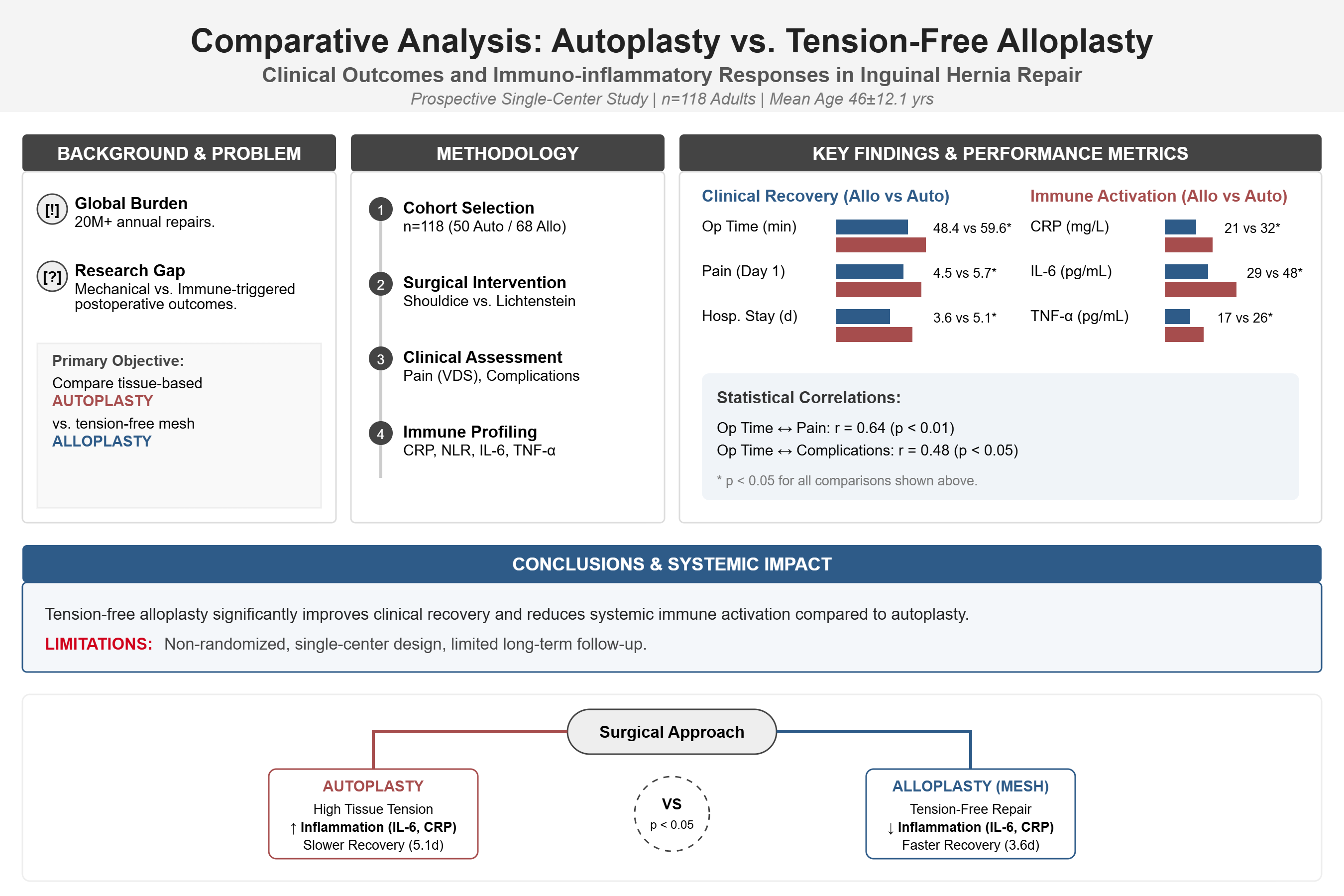
Inguinal hernia repair is performed over 20 million times annually, with outcomes reflecting mechanical reconstruction and immune activation. This study compared autoplasty and tension-free alloplasty for primary inguinal hernias, focusing on clinical outcomes and inflammatory responses. This prospective single-center study compared tissue-based autoplasty (Shouldice/Spasokukotsky) with tension-free mesh alloplasty (Lichtenstein) in 118 adults (mean age 46 ± 12.1 years; 93% male; autoplasty, n = 50; alloplasty, n = 68). Pain (verbal descriptor scale), complications, hospital stay, and systemic markers (C-reactive protein, neutrophil-to-lymphocyte ratio, interleukin-6, tumor necrosis factor-alpha, lymphocyte count) were assessed (p < 0.05). Alloplasty showed faster operation (48.4 ± 1.5 vs. 59.6 ± 2.6 min), less pain (day 1: 4.5 ± 0.5 vs. 5.7 ± 0.6; day 2: 1.1 ± 0.2 vs. 2.4 ± 0.3; day 5: 0.5 ± 0.1 vs. 1.2 ± 0.2), earlier walking (7.2 ± 2.1 vs. 21.4 ± 3.6 h), fewer complications (8.4% vs. 28.8%), and reduced hospitalization (3.6 ± 0.9 vs. 5.1 ± 1.2 days; all p < 0.05). Autoplasty showed higher inflammatory markers (C-reactive protein 32.5 ± 6.8 vs. 21.3 ± 5.4 mg/L; neutrophil-to-lymphocyte ratio 5.8 ± 1.2 vs. 3.9 ± 0.9; interleukin-6 48.7 ± 10.2 vs. 29.4 ± 8.6 pg/mL; tumor necrosis factor-alpha 26.5 ± 7.3 vs. 17.2 ± 5.8 pg/mL; all significant). Operative time was correlated with pain (r = 0.64; p < 0.01) and complications (r = 0.48; p < 0.05). Tension-free alloplasty improved recovery and reduced immune activation; however, non-randomization, single-center design, and limited follow-up constrain long-term inferences of the study.
Keywords:
Inguinal Hernia Repair Autoplasty Alloplasty Immune Activation Inflammatory Markers Postoperative OutcomesReferences
- Tigora, A.; Radu, P.A.; Garofil, D.N.; et al. Modern Perspectives on Inguinal Hernia Repair: A Narrative Review on Surgical Techniques, Mesh Selection and Fixation Strategies. J. Clin. Med. 2025, 14, 4875.
- Reinpold, W. Risk factors of chronic pain after inguinal hernia repair: A systematic review. Innov. Surg. Sci. 2017, 2, 61–68.
- Nikkolo, C.; Lepner, U. Chronic pain after open inguinal hernia repair. Postgrad. Med. 2016, 128, 69–75.
- Berndsen, M.R.; Gudbjartsson, T.; Berndsen, F.H. Is a Technically Challenging Procedure More Likely to Fail? A Prospective Single-Center Study on the Short- and Long-Term Outcomes of Inguinal Hernia Repair. Surg. Res. Pract. 2018, 2018, 7850671.
- Messias, B.A.; Nicastro, R.G.; Mocchetti, E.R.; et al. Lichtenstein technique for inguinal hernia repair: ten recommendations to optimize surgical outcomes. Hernia 2024, 28, 1467–1476.
- Meier, J.; Stevens, A.; Berger, M.; et al. Comparison of Postoperative Outcomes of Laparoscopic vs Open Inguinal Hernia Repair. JAMA Surg. 2023, 158, 172–180.
- Hietbrink, F.; Koenderman, L.; Rijkers, G.; et al. Trauma: The role of the innate immune system. World J. Emerg. Surg. 2006, 1, 15.
- Biffl, W.L.; Moore, E.E.; Moore, F.A.; et al. Interleukin-6 in the injured patient. Marker of injury or mediator of inflammation? Ann. Surg. 1996, 224, 647–664.
- Yang, C.; Chen, Y.; Huang, H.; et al. ROS-Eliminating Carboxymethyl Chitosan Hydrogel to Enhance Burn Wound-Healing Efficacy. Front. Pharmacol. 2021, 12, 679580.
- Choi, B.J.; Jeong, W.J.; Lee, S.C. Fibrin glue versus staple mesh fixation in single-port laparoscopic totally extraperitoneal inguinal hernia repair: A propensity score-matched analysis. Int. J. Surg. 2018, 53, 32–37.
- Pélissier, E.P.; Koning, G.G.; Ngo, P. Comment to: The transinguinal preperitoneal technique (TIPP) in inguinal hernia repair does not cause less chronic pain in relation to the ProGrip technique: A prospective double-blind randomized clinical trial comparing the TIPP technique, using the PolySoft mesh, with the ProGrip self-fixing semi-resorbable mesh. D. Čadanová, J. P. van Dijk, R. M. H. G. Mollen. Hernia 2017, 21, 819–820.
- Antoniadi, E.; Ferreira, N.M.; Vaz, M.F.; et al. Innovative Strategies in Hernia Mesh Design: Materials, Mechanics, and Modeling. Materials 2025, 18, 3509.
- Bakker, W.J.; Aufenacker, T.J.; Boschman, J.S.; et al. Heavyweight Mesh Is Superior to Lightweight Mesh in Laparo-endoscopic Inguinal Hernia Repair: A Meta-analysis and Trial Sequential Analysis of Randomized Controlled Trials. Ann. Surg. 2021, 273, 890–899.
- Zwaans, W.A.R.; Koning, G.G.; Gurusamy, K.S.; et al. Surgical interventions for the management of chronic groin pain after hernia repair (postherniorrhaphy inguinodynia) in adults. Cochrane Database Syst. Rev. 2017, 2017, CD012630.
- Yang, B.; Xie, C.; Lv, Y.; et al. Effect of Laparoscopic Inguinal Hernia Repairs on Inflammatory Factors, Oxidative Stress Levels and Postoperative Recovery. J. Inflamm. Res. 2024, 17, 7929–7937.
- Zwaans, W.A.R.; Verhagen, T.; Wouters, L.; et al. Groin Pain Characteristics and Recurrence Rates: Three-year Results of a Randomized Controlled Trial Comparing Self-gripping Progrip Mesh and Sutured Polypropylene Mesh for Open Inguinal Hernia Repair. Ann. Surg. 2018, 267, 1028–1033.
- Techapongsatorn, S.; Tansawet, A.; Pattanaprateep, O.; et al. Mesh-fixation technique for inguinal hernia repair: umbrella review. BJS Open 2022, 6, zrac084.
- Stabilini, C.; van Veenendaal, N.; Aasvang, E.; et al. Update of the international HerniaSurge guidelines for groin hernia management. BJS Open 2023, 7, zrad080.
- O'Brien, J.; Sinha, S.; Turner, R. Inguinal hernia repair: A global perspective. ANZ J. Surg. 2021, 91, 2288–2295.
- Jordan, S.W.; Fligor, J.E.; Janes, L.E.; et al. Implant Porosity and the Foreign Body Response. Plast. Reconstr. Surg. 2018, 141, 103e–112e.
- Riemenschneider, K.A.; Lund, H.; Pommergaard, H.C. No evidence for fixation of mesh in laparoscopic transabdominal preperitoneal (TAPP) inguinal hernia repair: A systematic review and meta-analysis of randomized controlled trials. Surg. Endosc. 2023, 37, 8291–8300.
- Chen, F.; Liu, M.; Jin, C.; et al. Tension-Free Mesh Repair for Incarcerated Groin Hernia: A Comparative Study. Surg. Innov. 2020, 27, 352–357.
- Yu, Y.; Tang, R.; Fenton-Lee, D. National survey of inguinal hernia mesh repair practices. ANZ J. Surg. 2020, 90, 2158–2159.
- Althaus, A.; Arránz Becker, O.; Moser, K.H.; et al. Postoperative Pain Trajectories and Pain Chronification-an Empirical Typology of Pain Patients. Pain Med. 2018, 19, 2536–2545.
- Rabbitts, J.A.; Zhou, C.; Groenewald, C.B.; et al. Trajectories of postsurgical pain in children: risk factors and impact of late pain recovery on long-term health outcomes after major surgery. Pain 2015, 156, 2383–2389.
- Yang, D.; Wang, X.; Li, X.; et al. Correlation between postoperative pain trajectories and recovery after day surgery: a protocol for a prospective cohort study. BMJ Open 2025, 15, e101636.
- Patterson, T.J.; Beck, J.; Currie, P.J.; et al. Meta-analysis of patient-reported outcomes after laparoscopic versus open inguinal hernia repair. Br. J. Surg. 2019, 106, 824–836.
- Ertekin, S.C.; Cetindag, O. Assessment of Surgical and Quality-of-Life Outcomes Between Laparoscopic Versus Open Inguinal Hernia Repair in Geriatric Patients. J. Laparoendosc. Adv. Surg. Tech. A 2023, 33, 872–878.
- Ivascu, R.; Torsin, L.I.; Hostiuc, L.; et al. The Surgical Stress Response and Anesthesia: A Narrative Review. J. Clin. Med. 2024, 13, 3017.
- Bai, Y.; Tan, D.; Deng, Q.; et al. Cinnamic acid alleviates endothelial dysfunction and oxidative stress by targeting PPARδ in obesity and diabetes. Chin. Med. 2025, 20, 13.
- Heo, K.S.; Phan, L.P.; Le, N.T.T.; et al. Mechanistic insights and emerging therapeutic strategies targeting endothelial dysfunction in cardiovascular diseases. Arch. Pharm. Res. 2025, 48, 305–332.
- Medrano-Bosch, M.; Simón-Codina, B.; Jiménez, W.; et al. Monocyte-endothelial cell interactions in vascular and tissue remodeling. Front. Immunol. 2023, 14, 1196033.
- Oishi, Y.; Manabe, I. Macrophages in inflammation, repair and regeneration. Int. Immunol. 2018, 30, 511–528.
- Wen, J.H.; Li, D.Y.; Liang, S.; et al. Macrophage autophagy in macrophage polarization, chronic inflammation and organ fibrosis. Front. Immunol. 2022, 13, 946832.
- Chen, C.; Liu, T.; Tang, Y.; et al. Epigenetic regulation of macrophage polarization in wound healing. Burns Trauma 2023, 11, tkac057.
- Lopez, T.; Wendremaire, M.; Lagarde, J.; et al. Wound Healing versus Metastasis: Role of Oxidative Stress. Biomedicines 2022, 10, 2784.
- Yu, K.; Tuladhar, A.; Dankberg, S.; et al. Integrating 3D Osteocyte Culture, Microgravity Simulation, and Fluid Flow Reveals Mechanisms of Osteocyte Mechanosensation and Calcium Signaling Altered by Disuse. Biomolecules 2025, 15, 1534.
- Aiolfi, A.; Cavalli, M.; Ferraro, S.D.; et al. Treatment of Inguinal Hernia: Systematic Review and Updated Network Meta-analysis of Randomized Controlled Trials. Ann. Surg. 2021, 274, 954–961.
- Chu, Z.; Zheng, B.; Yan, L. Incidence and predictors of chronic pain after inguinal hernia surgery: A systematic review and meta-analysis. Hernia 2024, 28, 967–987.
- Berndsen, M.R.; Gudbjartsson, T.; Berndsen, F.H. Inguinal hernia—Review. Laeknabladid 2019, 105, 385–391.
- Cucuk, O.C.; Barbaros, U. Comparison of the clinical outcomes of self-gripping mesh versus staple fixation mesh in laparoscopic inguinal hernia repair. Ann. Ital. Chir. 2023, 94, 82–89.
- Prabhu, A.S.; Carbonell, A.; Hope, W.; et al. Robotic Inguinal vs Transabdominal Laparoscopic Inguinal Hernia Repair: The RIVAL Randomized Clinical Trial. JAMA Surg. 2020, 155, 380–387.
- Aytaç, B.; Cakar, K.S.; Karamercan, A. Comparison of Shouldice and Lichtenstein repair for treatment of primary inguinal hernia. Acta Chir. Belg. 2004, 104, 418–421.
- Li, J.; Ji, Z.; Li, Y. The comparison of self-gripping mesh and sutured mesh in open inguinal hernia repair: The results of meta-analysis. Ann. Surg. 2014, 259, 1080–1085.
- Li, W.; Li, Y.; Ding, L.; et al. Using inferior epigastric vascular anatomical landmarks for anterior inguinal hernia repair. BMC Surg. 2019, 19, 159.
- Gutlic, A.; Petersson, U.; Rogmark, P.; et al. Long term inguinal pain comparing TEP to Lichtenstein repair: The TEPLICH RCT 8 years follow-up. Hernia 2024, 29, 49.
- Lomanto, D.; Katara, A.N. Managing intra-operative complications during totally extraperitoneal repair of inguinal hernia. J. Minim. Access Surg. 2006, 2, 165–170.
- Bringman, S.; Ramel, S.; Heikkinen, T.J.; et al. Tension-free inguinal hernia repair: TEP versus mesh-plug versus Lichtenstein: A prospective randomized controlled trial. Ann. Surg. 2003, 237, 142–147.
- Gao, J.S.; Wang, Z.J.; Zhao, B.; et al. Inguinal hernia repair with tension-free hernioplasty under local anesthesia. Saudi Med. J. 2009, 30, 534–536.
- Kalaba, S.; Gerhard, E.; Winder, J.S.; et al. Design Strategies and Applications of Biomaterials and Devices for Hernia Repair. Bioact. Mater. 2016, 1, 2–17.
- Balraju, A.; Siva Kumar, G.; Chintalapati, B.; et al. A comparative study of prolene vs vypro mesh repair for inguinal hernias in adults, in a tertiary care hospital. Int. J. Acad. Med. Pharm. 2023, 5, 1748–1751.
- Pulikkal Reghunandanan, R.; Ali Usman, A.; Basheer, S.; et al. Laparoscopic Versus Open Inguinal Hernia Repair: A Comparative Study. Cureus 2023, 15, e48619.
- Isaia, M.; Christou, D.; Kallis, P.; et al. Colocutaneous Fistula after Open Inguinal Hernia Repair. Case Rep. Surg. 2016, 2016, 2019212.
- Molegraaf, M.; Lange, J.; Wijsmuller, A. Uniformity of Chronic Pain Assessment after Inguinal Hernia Repair: A Critical Review of the Literature. Eur. Surg. Res. 2017, 58, 1–19.
- Matikainen, M.; Vironen, J.; Kössi, J.; et al. Impact of Mesh and Fixation on Chronic Inguinal Pain in Lichtenstein Hernia Repair: 5-Year Outcomes from the Finn Mesh Study. World J. Surg. 2021, 45, 459–464.
- Hagan, M.L.; Tuladhar, A.; Yu, K.; et al. Osteocyte Sptbn1 Deficiency Alters Cell Survival and Mechanotransduction Following Formation of Plasma Membrane Disruptions (PMD) from Mechanical Loading. Calcif. Tissue Int. 2024, 115, 725–743.
- Tuladhar, A.; Shaver, J.C.; McGee, W.A.; et al. Prkd1 regulates the formation and repair of plasma membrane disruptions (PMD) in osteocytes. Bone 2024, 186, 117147.
- Tuladhar, A.; Guffroy, M.; Finnema, S.J.; et al. Investigation of bone toxicity in drug development: review of current and emerging technologies. Toxicol. Sci. 2025, 208, 207–224.
- Tuladhar, A.; Carter, C.; Vaughan, E.; et al. Multimodal preclinical assessment of glucocorticoid-induced disruption of bone remodeling in Sprague-Dawley rats. Toxicol. Sci. 2026, 209, kfag026.