
Research Article
Systemic Immune-Inflammation Index and Depressive Symptoms in US Adults: Implications for Immunomodulatory Interventions—A Cross-Sectional Study from NHANES 2005–2020
 Download

This work is licensed under a Creative Commons Attribution 4.0 International License.
Copyright
The authors shall retain the copyright of their work but allow the Publisher to publish, copy, distribute, and convey the work.
License
Trends in Immunotherapy (TI) publishes accepted manuscripts under Creative Commons Attribution 4.0 International (CC BY 4.0). Authors who submit their papers for publication by TI agree to have the CC BY 4.0 license applied to their work, and that anyone is allowed to reuse the article or part of it free of charge for any purpose, including commercial use. As long as the author and original source are properly cited, anyone may copy, redistribute, reuse, and transform the content.
Authors

Received: 3 December 2025; Revised: 13 January 2026; Accepted: 27 January 2026; Published: 10 March 2026
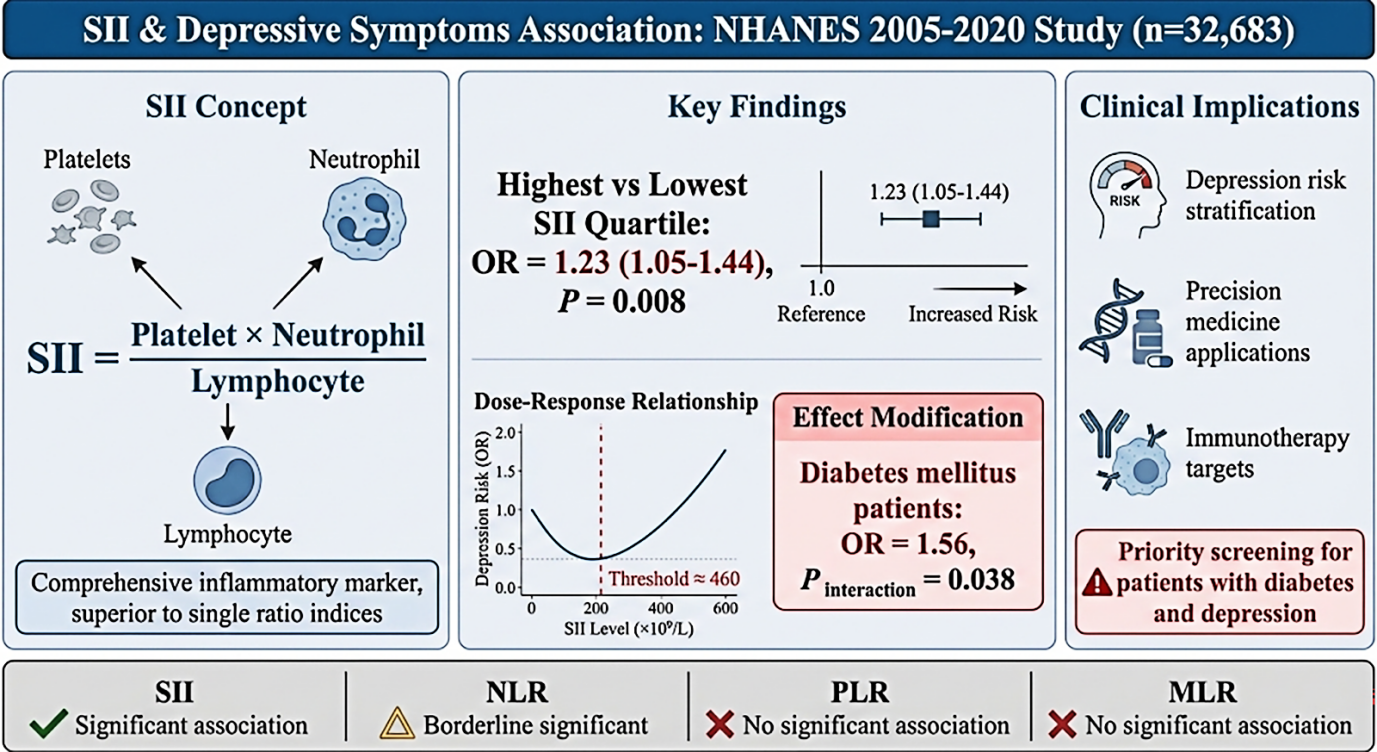
Inflammatory responses play a crucial role in the pathogenesis of depression. The Systemic Immune Inflammatory Index (SII) is a novel composite inflammatory marker that integrates the counts of neutrophils, lymphocytes, and platelets. However, the relationship between it and depressive symptoms is still not very clear at present. This exploratory study conducted in this article aims to investigate the relationship between SII and other immune inflammatory markers, such as the neutrophil-to-lymphocyte ratio (NLR), platelet-to-lymphocyte ratio (PLR), monocyte-to-lymphocyte ratio (MLR), and depressive symptoms. This can provide some epidemiological evidence for intervening in mental health through immune regulation. Data from the National Health and Nutrition Examination Survey (NHANES) 2005–2020, which included 32,683 adults 18 years of age and older, were used in this exploratory cross-sectional analysis. Because this study generated hypotheses, subgroup and sensitivity analyses were carried out, restricted cubic spline (RCS) analysis was utilized to investigate dose-response relationships, and weighted multivariable logistic regression was utilized to evaluate association strength. The highest quartile of SII was significantly associated with elevated depression risk (odds ratio (OR) = 1.23, 95% confidence interval (CI): 1.05–1.44, p for trend = 0.008), with a J-shaped dose-response relationship. The association was stronger among participants with diabetes (OR = 1.56, p for interaction = 0.038). NLR showed a borderline association, while PLR and MLR demonstrated no significant associations. SII was independently and positively associated with depressive symptoms and may serve as a potential biomarker for depression risk stratification, with implications for developing immunomodulatory intervention strategies.
Keywords:
Systemic Immune-Inflammation Index Depressive Symptoms NHANES Inflammation Dose-Response RelationshipReferences
- GBD 2019 Mental Disorders Collaborators. Global, regional, and national burden of 12 mental disorders in 204 countries and territories, 1990–2019: A systematic analysis for the Global Burden of Disease Study 2019. Lancet Psychiatry 2022, 9, 137–150.
- Brody, D.J.; Hughes, J.P. Depression Prevalence in Adolescents and Adults: United States, August 2021–August 2023. NCHS Data Brief. 2025, 527, 1–11.
- Pastis, I.; Santos, M.G.; Paruchuri, A. Exploring the role of inflammation in major depressive disorder: beyond the monoamine hypothesis. Front. Behav. Neurosci. 2024, 17, 1282242.
- Felger, J.C.; Lotrich, F.E. Inflammatory cytokines in depression: Neurobiological mechanisms and therapeutic implications. Neuroscience 2013, 246, 199–229.
- Kouba, B.R.; de Araujo Borba, L.; Borges de Souza, P.; et al. Role of inflammatory mechanisms in major depressive disorder: From etiology to potential pharmacological targets. Cells 2024, 13, 423.
- Berk, M.; Williams, L.J.; Jacka, F.N.; et al. So depression is an inflammatory disease, but where does the inflammation come from? BMC Med. 2013, 11, 200.
- Jiao, W.; Lin, J.; Deng, Y.; et al. The immunological perspective of major depressive disorder: Unveiling the interactions between central and peripheral immune mechanisms. J. Neuroinflammation 2025, 22, 10.
- Osimo, E.F.; Baxter, L.J.; Lewis, G.; et al. Prevalence of low-grade inflammation in depression: A systematic review and meta-analysis of CRP levels. Psychol. Med. 2019, 49, 1958–1970.
- Hu, B.; Yang, X.R.; Xu, Y.; et al. Systemic immune-inflammation index predicts prognosis of patients after curative resection for hepatocellular carcinoma. Clin. Cancer Res. 2014, 20, 6212–6222.
- Yang, R.; Chang, Q.; Meng, X.; et al. Prognostic value of systemic immune-inflammation index in cancer: A meta-analysis. J. Cancer 2018, 9, 3295–3302.
- Bai, Y.; Fang, Z.; Dai, H.; et al. The correlation between systemic immune-inflammation index and major depression in patients with depression. Front. Psychiatry 2025, 16, 1580151.
- Cui, S.; Li, J.; Liu, Y.; et al. Correlation of systemic immune-inflammation index and moderate/major depression in patients with depressive disorders: A large sample cross-sectional study. Front. Psychiatry 2023, 14, 1159889.
- Li, X.; Huan, J.; Lin, L.; et al. Association of systemic inflammatory biomarkers with depression risk: Results from national health and nutrition examination survey 2005–2018 analyses. Front. Psychiatry 2023, 14, 1097196.
- Zheng, Y.; Yin, K.; Li, L.; et al. Association between immune-inflammation-based prognostic index and depression: An exploratory cross-sectional analysis of NHANES data. J. Affect. Disord. 2024, 362, 75–85.
- Kroenke, K.; Spitzer, R.L.; Williams, J.B. The PHQ‐9: Validity of a brief depression severity measure. J. Gen. Intern. Med. 2001, 16, 606–613.
- Patel, J.S.; Oh, Y.; Rand, K.L.; et al. Measurement invariance of the Patient Health Questionnaire‐9 (PHQ‐9) depression screener in US adults across sex, race/ethnicity, and education level: NHANES 2005–2016. Depress. Anxiety 2019, 36, 813–823.
- Hu, J.; Wang, L.; Fan, K.; et al. The association between systemic inflammatory markers and post-stroke depression: A prospective stroke cohort. Clin. Interv. Aging 2021, 16, 1231–1239.
- Wang, M.; Peng, C.; Jiang, T.; et al. Association between systemic immune-inflammation index and post-stroke depression: A cross-sectional study of the national health and nutrition examination survey 2005–2020. Front. Neurol. 2024, 15, 1330338.
- Han, X.X.; Zhang, H.Y.; Kong, J.W.; et al. Systemic immune inflammation index is a valuable marker for predicting hemodialysis patients with depression: A cross-sectional study. Front. Psychiatry 2024, 15, 1423200.
- Cheng, Y.; Wang, Y.; Wang, X.; et al. Neutrophil-to-lymphocyte ratio, platelet-to-lymphocyte ratio, and monocyte-to-lymphocyte ratio in depression: An updated systematic review and meta-analysis. Front. Psychiatry 2022, 13, 893097.
- Su, M.; Ouyang, X.; Song, Y. Neutrophil to lymphocyte ratio, platelet to lymphocyte ratio, and monocyte to lymphocyte ratio in depression: A meta-analysis. J. Affect. Disord. 2022, 308, 375–383.
- Meng, F.; Yan, X.; Qi, J.; et al. Association of neutrophil to lymphocyte ratio, platelet to lymphocyte ratio, and monocyte to lymphocyte ratio with depression: A cross-sectional analysis of the NHANES data. J. Affect. Disord. 2022, 315, 168–173.
- Maes, M. The cytokine hypothesis of depression: Inflammation, oxidative & nitrosative stress (IO&NS) and leaky gut as new targets for adjunctive treatments in depression. Neuroendocrinol. Lett. 2008, 29, 287–291.
- Roohi, E.; Jaafari, N.; Hashemian, F. On inflammatory hypothesis of depression: What is the role of IL-6 in the middle of the chaos? J. Neuroinflammation 2021, 18, 45.
- Howren, M.B.; Lamkin, D.M.; Suls, J. Associations of depression with C-reactive protein, IL-1, and IL-6: A meta-analysis. Psychosom. Med. 2009, 71, 171–186.
- Valkanova, V.; Ebmeier, K.P.; Allan, C.L. CRP, IL-6 and depression: A systematic review and meta-analysis of longitudinal studies. J. Affect. Disord. 2013, 150, 736–744.
- Orsolini, L.; Pompili, S.; Tempia Valenta, S.; et al. C-reactive protein as a biomarker for major depressive disorder? Int. J. Mol. Sci. 2022, 23, 1616.
- Sforzini, L.; Cattaneo, A.; Ferrari, C.; et al. Higher immune-related gene expression in major depression is independent of CRP levels: Results from the BIODEP study. Transl. Psychiatry 2023, 13, 185.
- Cavanagh, J.T. Anti-inflammatory Drugs in the Treatment of Depression. Emerg. Neurobiol. Antidepress. Treat. 2023, 66, 217–231.
- Drevets, W.C.; Wittenberg, G.M.; Bullmore, E.T.; et al. Immune targets for therapeutic development in depression: Towards precision medicine. Nat. Rev. Drug Discov. 2022, 21, 224–244.
- Ninla-Aesong, P.; Kietdumrongwong, P.; Neupane, S.P.; et al. Relative value of novel systemic immune-inflammatory indices and classical hematological parameters in predicting depression, suicide attempts and treatment response. Sci. Rep. 2024, 14, 19018.
- Bai, Y.; Cai, Y.; Chang, D.; et al. Immunotherapy for depression: Recent insights and future targets. Pharmacol. Ther. 2024, 257, 108624.
- Yu, X.; Zheng, H.; Liu, M.; et al. Association of systemic immune-inflammation index with all-cause and cardiovascular mortality among adults with depression: Evidence from NHANES 2005–2018. BMC Psychiatry 2025, 25, 25.
- Liu, Q.; He, H.; Yang, J.; et al. Changes in the global burden of depression from 1990 to 2017: Findings from the Global Burden of Disease study. J. Psychiatr. Res. 2020, 126, 134–140.
- Yang, J.-S.; Zhang, L.-Y.; Yang, C.-H.; et al. Global, Regional, and National Epidemiology of Depression in Working-Age Individuals, 1990–2019. Depress. Anxiety 2024, 2024, 4747449.
- Lu, B.; Lin, L.; Su, X. Global burden of depression or depressive symptoms in children and adolescents: A systematic review and meta-analysis. J. Affect. Disord. 2024, 354, 553–562.
- Schumacher, A.; Tu, E.; Albaum, C.; et al. The systemic immune-inflammation index (SII) as a biomarker for depression in a community sample of adolescents. Compr. Psychoneuroendocrinol. 2025, 23, 100302.