
Article
Autologous Hair Follicle Transplantation Combined with NB-UVB Phototherapy for Stable Pubic Vitiligo: A Randomized Controlled Trial
 Download

This work is licensed under a Creative Commons Attribution 4.0 International License.
Copyright
The authors shall retain the copyright of their work but allow the Publisher to publish, copy, distribute, and convey the work.
License
Trends in Immunotherapy (TI) publishes accepted manuscripts under Creative Commons Attribution 4.0 International (CC BY 4.0). Authors who submit their papers for publication by TI agree to have the CC BY 4.0 license applied to their work, and that anyone is allowed to reuse the article or part of it free of charge for any purpose, including commercial use. As long as the author and original source are properly cited, anyone may copy, redistribute, reuse, and transform the content.
Authors

Received: 12 December 2025; Revised: 9 January 2026; Accepted: 14 January 2026; Published: 6 March 2026
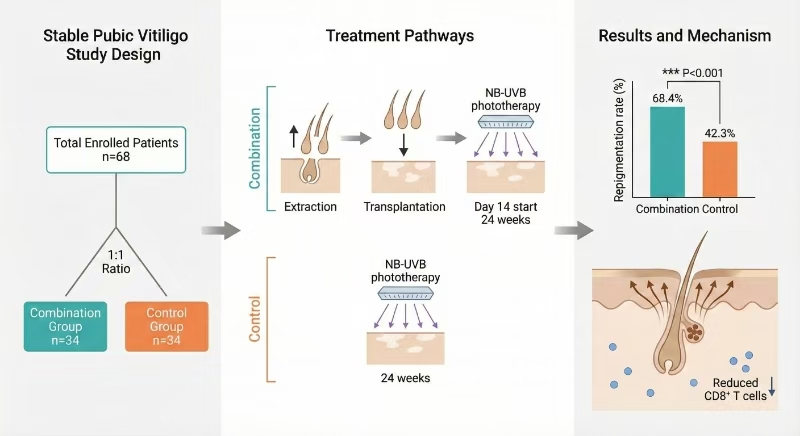
The challenge in the management of pubic vitiligo lies in the sensitive nature of the area and the relatively lower efficacy of the existing management approaches. This study aimed to evaluate the efficacy and safety of autologous hair follicle transplantation combined with narrow-band ultraviolet B (NB-UVB) phototherapy for stable pubic vitiligo. Sixty-eight patients were randomly assigned (1:1) to either a combination treatment (hair follicle transplantation followed by NB-UVB phototherapy) or to the control group with only NB-UVB phototherapy for 24 weeks. The key outcome measure was the repigmentation area, as estimated using the Vitiligo Area Scoring Index. The histopathological examination was also carried out on a sample of 40 patients. The combination therapy group demonstrated significantly higher repigmentation rates (68.4% versus 42.3%, p < 0.001). The effective response rate (≥50% repigmentation) was 80.6% versus 43.3% (p = 0.003). The onset of repigmentation occurred earlier in the combination group (4.2 versus 7.6 weeks, p < 0.001), where there was perifollicular repigmentation in 83.9% of patients. Histopathological examination revealed that there was a greater increase in the density of melanocytes (10.4 versus 4.8 cells/mm, p < 0.001) and a greater reduction in the density of CD8+ T cells in the combination group. Patient satisfaction was significantly higher among the combination group (87.1% versus 53.3%, p = 0.004). Tolerance of these two treatments is excellent, and there were no serious adverse events. This combination of hair follicle transplantation and NB-UVB appears to have a synergistic effect, as it offers an intact melanocyte reservoir and an immune microenvironment, and it may be a promising treatment approach for pubic vitiligo.
Keywords:
Vitiligo Hair Follicle Transplantation Narrow-Band Ultraviolet B Phototherapy Melanocyte Repopulation Immune PrivilegeReferences
- Ezzedine, K.; Eleftheriadou, V.; Whitton, M.; et al. Vitiligo. Lancet 2015, 386, 74–84.
- Akl, J.; Lee, S.; Ju, H.J.; et al. Estimating the burden of vitiligo: A systematic review and modelling study. Lancet. Public Health. 2024, 9, e386–e396.
- Seneschal, J.; Boniface, K.; D’Arino, A.; et al. An update on vitiligo pathogenesis. Pigment Cell Melanoma Res. 2021, 34, 236–243.
- Inoue, S. Pathogenesis of vitiligo: Integrating immune and non-immune cell crosstalk. J. Dermatol. 2025, in press.
- Strassner, J.P.; Rashighi, M.; Refat, M.A.; et al. Suction blistering the lesional skin of vitiligo patients reveals useful biomarkers of disease activity. J. Am. Acad. Dermatol. 2017, 76, 847–855.e5.
- Boniface, K.; Jacquemin, C.; Darrigade, A.S.; et al. Vitiligo skin is imprinted with resident memory CD8 T cells expressing CXCR3. J. Invest. Dermatol. 2018, 138, 355–364.
- Hamidizadeh, N.; Ranjbar, S.; Ghanizadeh, A.; et al. Evaluating prevalence of depression, anxiety and hopelessness in patients with Vitiligo on an Iranian population. Health Qual. Life Outcomes 2020, 18, 20.
- Dauendorffer, J.N.; Skayem, C.; Passeron, T. Male genital vitiligo. Ann. Dermatol. Venereol. 2022, 149, 92–98.
- Moradi, M.; Kavoussi, H.; Kavoussi, R. Successful treatment of penile vitiligo patches and their sexual dysfunction consequences by suction blister epidermal grafting. An. Bras. Dermatol. 2023, 98, 261–263.
- Picardo, M.; Huggins, R.H.; Jones, H.; et al. The humanistic burden of vitiligo: A systematic literature review of quality-of-life outcomes. J. Eur. Acad. Dermatol. Venereol. 2022, 36, 1507–1523.
- Zhou, Y.; Zhang, Y.-X.; Xiong, Y.-Y.; et al. Pathogenesis and regenerative therapy in vitiligo and alopecia areata: Focus on hair follicle. Front. Med. 2025, 11, 1510363.
- An, L.; Kim, D.; Donahue, L.R.; et al. Sexual dimorphism in melanocyte stem cell behavior reveals combinational therapeutic strategies for cutaneous repigmentation. Nat. Commun. 2024, 15, 796.
- Paus, R.; Bulfone-Paus, S.; Bertolini, M. Hair follicle immune privilege revisited: The key to alopecia areata management. J. Invest. Dermatol. Symp. Proc. 2018, 19, S12–S17.
- Fan, R.; Gao, J.; Chen, J. Hair follicle-derived melanocyte transplant as a promising treatment strategy for vitiligo. Stem Cell Res. Ther. 2025, 16, 280.
- Goldstein, N.B.; Koster, M.I.; Hoaglin, L.G.; et al. Narrow-band ultraviolet B treatment for human vitiligo is associated with proliferation, migration, and differentiation of melanocyte precursors. J. Invest. Dermatol. 2015, 135, 2068–2076.
- Bouceiro Mendes, R.; Alpalhão, M.; Filipe, P. UVB phototherapy in the treatment of vitiligo: State of the art and clinical perspectives. Photodermatol. Photoimmunol. Photomed. 2022, 38, 215–223.
- Li, Y.; Zhang, R.-Z. Mobilization of melanocytes during NB-UVB treatment of vitiligo. Int. J. Dermatol. Venereol. 2021, 4, 163–167.
- Wang, E.; Rodrigues, M. An update and review of narrowband ultraviolet B phototherapy for vitiligo. Dermatol. Rev. 2022, 3, 326–335.
- Shi, H.-X.; Zhang, R.-Z.; Xu, B.; et al. Experimental study and clinical observations of autologous hair follicle cell transplants to treat stable vitiligo. Indian J. Dermatol. Venereol. Leprol. 2020, 86, 124–133.
- Pourang, A.; Kohli, I.; Ezekwe, N.; et al. Reliability of the vitiligo area scoring index measurement tool for vitiligo. JAAD Int. 2024, 16, 206–213.
- Fekete, L.; Iantovics, L.B.; Fekete, G.L. Validation of the DLQI questionnaire in assessing the disease burden and principal aspects related to life quality of vitiligo patients. Front. Psychol. 2024, 15, 1333723.
- Ju, H.J.; Bae, J.M.; Lee, R.W.; et al. Surgical interventions for patients with vitiligo: A systematic review and meta-analysis. JAMA Dermatol. 2021, 157, 307–316.
- Iwanowski, T.; Szlązak, P.; Rustowska, A.; et al. Efficacy of suction blister epidermal grafting with concomitant phototherapy in vitiligo treatment. Adv. Dermatol. Allergol. 2018, 35, 592–598.
- Li, J.; Fu, W.W.; Zheng, Z.Z.; et al. Suction blister epidermal grafting using a modified suction method in the treatment of stable vitiligo: A retrospective study. Dermatol. Surg. 2011, 37, 999–1006.
- Ghasemi, M.; Bajouri, A.; Shafiiyan, S.; et al. Hair follicle as a source of pigment-producing cells for treatment of vitiligo: An alternative to epidermis? Tissue Eng. Regen. Med. 2020, 17, 815–827.
- Bishnoi, A.; Parsad, D. Phototherapy for vitiligo: A narrative review on the clinical and molecular aspects, and recent literature. Photodermatol. Photoimmunol. Photomed. 2024, 40, e12968.
- Goldstein, N.B.; Koster, M.I.; Jones, K.L.; et al. Repigmentation of human vitiligo skin by NBUVB is controlled by transcription of GLI1 and activation of the β-catenin pathway in the hair follicle bulge stem cells. J. Invest. Dermatol. 2018, 138, 657–668.
- Lin, X.; Meng, X.; Lin, J. The possible role of Wnt/β-catenin signalling in vitiligo treatment. J. Eur. Acad. Dermatol. Venereol. 2023, 37, 2208–2221.
- Birlea, S.A.; Costin, G.-E.; Roop, D.R.; et al. Trends in regenerative medicine: repigmentation in vitiligo through melanocyte stem cell mobilization. Med. Res. Rev. 2017, 37, 907–935.
- Kiselev, A.; Park, S. Immune niches for hair follicle development and homeostasis. Front. Physiol. 2024, 15, 1397067.
- Paus, R.; Ito, N.; Takigawa, M.; et al. The hair follicle and immune privilege. J. Invest. Dermatol. Symp. Proc. 2003, 8, 188–194.
- Ito, T.; Ito, N.; Bettermann, A.; et al. Collapse and restoration of MHC class-I-dependent immune privilege: Exploiting the human hair follicle as a model. Am. J. Pathol. 2004, 164, 623–634.
- Bhingradia, Y.M.; Gupta, S.; Ghia, D.; et al. Consensus statement on the surgical management of vitiligo. J. Cutan. Aesthet. Surg. 2025, 18, 27–33.
- Grochocka, M.; Wełniak, A.; Białczyk, A.; et al. Management of stable vitiligo—A review of the surgical approach. J. Clin. Med. 2023, 12, 1984.
- Ezzedine, K.; Tannous, R.; Pearson, T.F.; et al. Recent clinical and mechanistic insights into vitiligo offer new treatment options for cell-specific autoimmunity. J. Clin. Invest. 2025, 135, e185785.