
Article
Regulatory Effects of Fecal Microbiota Transplantation on Inflammatory Cytokines in a DSS-Induced Colitis Mouse Model
 Download

This work is licensed under a Creative Commons Attribution 4.0 International License.
Copyright
The authors shall retain the copyright of their work but allow the Publisher to publish, copy, distribute, and convey the work.
License
Trends in Immunotherapy (TI) publishes accepted manuscripts under Creative Commons Attribution 4.0 International (CC BY 4.0). Authors who submit their papers for publication by TI agree to have the CC BY 4.0 license applied to their work, and that anyone is allowed to reuse the article or part of it free of charge for any purpose, including commercial use. As long as the author and original source are properly cited, anyone may copy, redistribute, reuse, and transform the content.
Authors
-
Li Liu
 Medical College, Pingdingshan University, Pingdingshan 467000, China
- Yugui Xu Medical College, Pingdingshan University, Pingdingshan 467000, China
- Dongxu Chen Medical College, Pingdingshan University, Pingdingshan 467000, China
- Junjie Zhang Medical College, Pingdingshan University, Pingdingshan 467000, China
- Ao Zhang Medical College, Pingdingshan University, Pingdingshan 467000, China
-
Xianguang Bai
Medical College, Pingdingshan University, Pingdingshan 467000, China
Received: 31 October 2025; Revised: 4 December 2025; Accepted: 17 December 2025; Published: 25 February 2026
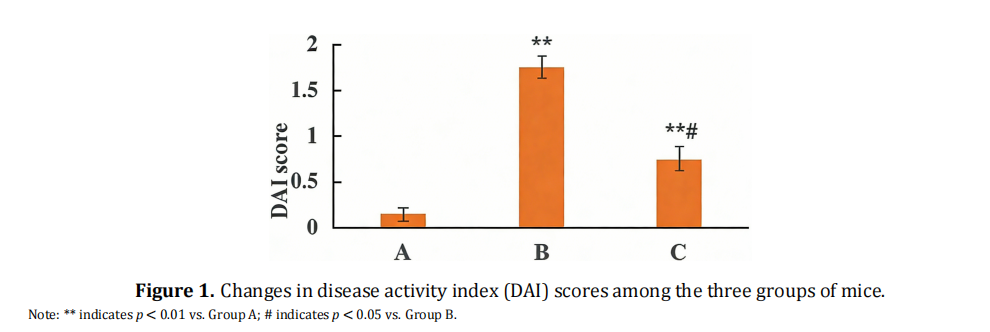
Ulcerative colitis (UC) is an immune-mediated inflammatory disease characterized by excessive pro-inflammatory cytokine activity and impaired immune regulation. Fecal microbiota transplantation (FMT) has emerged as a microbiome-based immunotherapeutic approach, yet its effects on systemic immune responses in UC remain incompletely understood. This study examined the immunomodulatory impact of FMT in a dextran sulfate sodium (DSS)–induced murine model of colitis. Forty-five male C57BL/6 mice were randomly assigned to control, DSS model, and FMT-treated groups (n = 15 per group). Colitis was induced with 3% DSS for seven days, followed by a seven-day intragastric administration of fecal suspension in the FMT group. Clinical disease activity, gross colonic morphology, and serum cytokine levels were assessed. DSS exposure resulted in pronounced colitis, evidenced by weight loss, elevated disease activity index scores, and macroscopic colonic injury. FMT significantly alleviated disease severity, improved body weight recovery, reduced disease activity, and partially restored colon length. Furthermore, FMT markedly reduced circulating pro-inflammatory cytokines (TNF-α, IL-6, and IL-1β) while increasing the levels of anti-inflammatory cytokines IL-4 and IL-10 (all p < 0.01). These findings suggest that FMT attenuates DSS-induced colitis and promotes a systemic shift toward an anti-inflammatory immune profile. Study limitations include the absence of quantitative histopathological scoring and immune-cell phenotyping. Further mechanistic studies are warranted to elucidate the immunological pathways underlying FMT-mediated protection in UC.
Keywords:
Fecal Microbiota Transplantation Ulcerative Colitis Inflammatory Cytokines Immune Regulation Gut MicrobiotaReferences
- Shi, R.; Li, J.X.; Shen, H.; et al. Expert consensus on the diagnosis and treatment of ulcerative colitis in traditional Chinese medicine (2023). Chin. J. Tradit. Chin. Med. 2024, 39, 288–296. Available online: https://kns.cnki.net/kcms2/article/abstract?v=hyKDWyHWvTv1aVeBRNaBFZOL4-AXEhx_Okq5RNfzpqX0VGaYxLosCb4tRSrjf5ko8F_Pm3Tgn6y-pb75P8CZzAlKkWERCMUmgOHbWaHR5KwYYjPBtbniGQwfhhe7jhNavVJxXGu1J0JzhBDIBIVjC-tIKAJJ5e8ZteTPj9S22MO2fDf6G0800g==&uniplatform=NZKPT&language=CHS (in Chinese)
- Ordás, I.; Eckmann, L.; Talamini, M.; et al. Ulcerative colitis. Lancet 2012, 380, 1606–1619. DOI: https://doi.org/10.1016/S0140-6736(12)60150-0
- Voelker, R. What is Ulcerative Colitis? JAMA 2024, 331, 716. DOI: https://doi.org/10.1001/jama.2023.23814
- Liang, X.; Yin, F.; Zhang, X. Interpretation of the consensus on diagnosis and management of inflammatory bowel disease (Beijing, 2018) from the perspective of diagnosis of ulcerative colitis. Clin. Focus 2018, 33, 987–990. Available online: https://kns.cnki.net/kcms2/article/abstract?v=hyKDWyHWvTt9HoZPsldGx86_TCCESPeUboqMK03VgyCCztzZZPDZhCF_w0ULxNU5yrn1VrY9mltYdX3jAQNHmxypun3oEV5PtcZNdf99ijycyLgcuCaZsy-QEwxDs08B_QcT6DP1TLJB81f7RuyinpRQ-dDsC3c7iRC9kL3zIul8FpVuacdO6w==&uniplatform=NZKPT&language=CHS (in Chinese)
- Yamamoto-Furusho, J.K.; Gutierrez-Herrera, F.D. Molecular mechanisms and clinical aspects of colitis-associated cancer in ulcerative colitis. Cells 2025, 14, 162. DOI: https://doi.org/10.3390/cells14030162
- Du, L.; Ha, C. Epidemiology and pathogenesis of ulcerative colitis. Gastroenterol. Clin. North Am. 2020, 49, 643–654. DOI: https://doi.org/10.1016/j.gtc.2020.07.005
- Kobayashi, T.; Siegmund, B.; Le Berre, C.; et al. Ulcerative colitis. Nat. Rev. Dis. Primers 2020, 6, 74. DOI: https://doi.org/10.1038/s41572-020-0205-x
- Zhang, S.; Zhong, R.; Tang, S.; et al. Metabolic regulation of the Th17/Treg balance in inflammatory bowel disease. Pharmacol. Res. 2024, 203, 107184. DOI: https://doi.org/10.1016/j.phrs.2024.107184
- Long, Y.; Xia, C.; Zheng, X.; et al. Functional alterations in colonic CD4⁺ T and regulatory T cells drive immune imbalance in ulcerative colitis. Immunol. Lett. 2025, 275, 107010. DOI: https://doi.org/10.1016/j.imlet.2025.107010
- Ma, Z.; Wang, Z.; Cao, J.; et al. Regulatory roles of intestinal CD4 T cells in inflammation and their modulation by the intestinal microbiota. Gut Microbes 2025, 17, 2560019. DOI: https://doi.org/10.1080/19490976.2025.2560019
- Salvatori, S.; Marafini, I.; Fonsi, A.; et al. Advanced therapies targeting IL-23: Clinical outcomes in ulcerative colitis. Expert Opin. Biol. Ther. 2025, 25, 873–885. DOI: https://doi.org/10.1080/14712598.2025.2539423
- Patik, I.; Redhu, N.S.; Eran, A.; et al. The IL-10 receptor inhibits cell extrinsic signals necessary for STAT1-dependent macrophage accumulation during colitis. Mucosal Immunol. 2023, 16, 233–249. DOI: https://doi.org/10.1016/j.mucimm.2023.02.006
- Kou, R.; Guo, Y.; Qin, Z.; et al. Systemic dysregulation of the gut microenvironment plays a pivotal role in the onset and progression of inflammatory bowel disease. Front. Immunol. 2025, 16, 1661386. DOI: https://doi.org/10.3389/fimmu.2025.1661386
- Zou, L.E.; Yang, Y.N.; Zhan, J.; et al. Gut microbiota-based discovery of Houttuyniae Herba as a novel prebiotic of Bacteroides thetaiotaomicron with anti-colitis activity. Biomed. Pharmacother. 2024, 172, 116302. DOI: https://doi.org/10.1016/j.biopha.2024.116302
- Kennedy, J.M.; De Silva, A.; Walton, G.E.; et al. A review on the use of prebiotics in ulcerative colitis. Trends Microbiol. 2024, 32, 507–515. DOI: https://doi.org/10.1016/j.tim.2023.11.007
- Dalal, R.; Sadhu, S.; Batra, A.; et al. Gut commensals-derived succinate impels colonic inflammation in ulcerative colitis. NPJ Biofilms Microbiomes 2025, 11, 44. DOI: https://doi.org/10.1038/s41522-025-00672-3
- Yan, S.; Chang, J.; Hao, X.; et al. Berberine regulates short-chain fatty acid metabolism and alleviates the colitis-associated colorectal tumorigenesis through remodeling intestinal flora. Phytomedicine 2022, 102, 154217. DOI: https://doi.org/10.1016/j.phymed.2022.154217
- Liu, Y.J.; Tang, B.; Wang, F.C.; et al. Parthenolide ameliorates colon inflammation through regulating Treg/Th17 balance in a gut microbiota-dependent manner. Theranostics 2020, 10, 5225–5241. DOI: https://doi.org/10.7150/thno.43716
- Letz, P.; Huber, S.; Velasquez, L.N. Crosstalk between the microbiota and intestinal dendritic cells in IBD. Semin. Immunopathol. 2025, 47, 37. DOI: https://doi.org/10.1007/s00281-025-01062-9
- Abbas, A.; Di Fonzo, D.M.P.; Wetwittayakhlang, P.; et al. Management of ulcerative colitis: where are we at and where are we heading? Expert Rev. Gastroenterol. Hepatol. 2024, 18, 567–574. DOI: https://doi.org/10.1080/17474124.2024.2422370
- Sutanto, H.; Elisa, E.; Rachma, B.; et al. Gut microbiome modulation in allergy treatment: the role of fecal microbiota transplantation. Am. J. Med. 2025, in press. DOI: https://doi.org/10.1016/j.amjmed.2025.01.005
- Fanizzi, F.; D'Amico, F.; Zanotelli Bombassaro, I.; et al. The role of fecal microbiota transplantation in IBD. Microorganisms 2024, 12, 1755. DOI: https://doi.org/10.3390/microorganisms12091755
- Hemachandra, S.; Rathnayake, S.N.; Jayamaha, A.A.; et al. Fecal microbiota transplantation as an alternative method in the treatment of obesity. Cureus 2025, 17, e76858. DOI: https://doi.org/10.7759/cureus.76858
- Ciccia, F.; Gandolfo, S. Will fecal microbiota transplantation eventually be an effective therapeutic strategy for systemic lupus erythematosus? Clin. Immunol. 2022, 242, 109096. DOI: https://doi.org/10.1016/j.clim.2022.109096
- Zhang, L.; Ma, X.; Liu, P.; et al. Treatment and mechanism of fecal microbiota transplantation in mice with experimentally induced ulcerative colitis. Exp. Biol. Med. 2021, 246, 1563–1575. DOI: https://doi.org/10.1177/15353702211006044
- Wang, J.; Zhang, C.; Guo, C.; et al. Chitosan ameliorates DSS-induced ulcerative colitis mice by enhancing intestinal barrier function and improving microflora. Int. J. Mol. Sci. 2019, 20, 5751. DOI: https://doi.org/10.3390/ijms20225751
- Wen, X.; Wang, H.G.; Zhang, M.N.; et al. Fecal microbiota transplantation ameliorates experimental colitis gut microbiota and T-cell modulation. World J. Gastroenterol. 2021, 27, 2834–2849. DOI: https://doi.org/10.3748/wjg.v27.i21.2834
- Huang, C.; Mei, Q.; Lou, L.; et al. Ulcerative colitis in response to fecal microbiota transplantation via modulation of gut microbiota and Th17/Treg cell balance. Cells 2022, 11, 1851. DOI: https://doi.org/10.3390/cells11111851
- Hu, Y.; Tang, J.; Xie, Y.; et al. Gegen Qinlian decoction ameliorates TNBS-induced ulcerative colitis by regulating Th2/Th1 and Tregs/Th17 cell balance, inhibiting NLRP3 inflammasome activation and reshaping gut microbiota. J. Ethnopharmacol. 2024, 328, 117956. DOI: https://doi.org/10.1016/j.jep.2024.117956
- Borody, T.; Wettstein, A.; Campbell, J.; et al. Fecal microbiota transplantation in ulcerative colitis: review of 24 years experience. Am. J. Gastroenterol. 2012, 107, S665.
- Paramsothy, S.; Kamm, M.A.; Kaakoush, N.O.; et al. Multidonor intensive faecal microbiota transplantation for active ulcerative colitis: a randomised placebo-controlled trial. Lancet 2017, 389, 1218–1228.
- Sun, L.L.; Xue, Q. Effects of fecal microbiota transplantation combined with sulfasalazine on serum inflammatory factors and T cell subsets in patients with ulcerative colitis. Clin. Transfus. Lab. Med. 2021, 23, 497–501. Available online: http://www.lcsxyjy.com/CN/10.3969/j.issn.1671-2587.2021.04.019 (in Chinese)
- Okayasu, I.; Hatakeyama, S.; Yamada, M.; et al. A novel method in the induction of reliable experimental acute and chronic ulcerative colitis in mice. Gastroenterology 1990, 98, 694–702.
- Le Berre, C.; Honap, S.; Peyrin-Biroulet, L. Ulcerative colitis. Lancet 2023, 402, 571–584. DOI: https://doi.org/10.1016/S0140-6736(23)00966-2
- de Oliveira, N.M.T.; Schneider, V.S.; Bueno, L.R.; et al. CPW partially attenuates DSS-induced ulcerative colitis in mice. Food Res. Int. 2023, 173, 113334. DOI: https://doi.org/10.1016/j.foodres.2023.113334
- Gupta, M.; Mishra, V.; Gulati, M.; et al. Natural compounds as safe therapeutic options for ulcerative colitis. Inflammopharmacology 2022, 30, 397–434. DOI: https://doi.org/10.1007/s10787-022-00931-1
- Zhou, J.; Zhou, Z.; Ji, P.; et al. Effect of fecal microbiota transplantation on experimental colitis in mice. Exp. Ther. Med. 2019, 17, 2581–2586. DOI: https://doi.org/10.3892/etm.2019.7263
- Kałużna, A.; Olczyk, P.; Komosińska-Vassev, K. The role of innate and adaptive immune cells in the pathogenesis and development of the inflammatory response in ulcerative colitis. J. Clin. Med. 2022, 11, 400. DOI: https://doi.org/10.3390/jcm11020400
- Liu, A.; Liang, X.; Wang, W.; et al. Human umbilical cord mesenchymal stem cells ameliorate colon inflammation via modulation of gut microbiota-SCFAs-immune axis. Stem Cell Res. Ther. 2023, 14, 271. DOI: https://doi.org/10.1186/s13287-023-03471-9
- Wei, Y.Y.; Fan, Y.M.; Ga, Y.; et al. Shaoyao decoction attenuates DSS-induced ulcerative colitis, macrophage and NLRP3 inflammasome activation through the MKP1/NF-κB pathway. Phytomedicine 2021, 92, 153743. DOI: https://doi.org/10.1016/j.phymed.2021.153743
- Qiu, X.; Luo, W.; Li, H.; et al. A traditional Chinese medicine, Zhenqi Granule, potentially alleviates dextran sulfate sodium-induced mouse colitis symptoms. Biology 2024, 13, 427. DOI: https://doi.org/10.3390/biology13060427
- Wu, H.; Tu, S.; Zhuo, Z.; et al. Investigating the mechanisms of bisdemethoxycurcumin in ulcerative colitis: network pharmacology and experimental verification. Molecules 2022, 28, 68. DOI: https://doi.org/10.3390/molecules28010068
- Tang, X.Y. Protective Effects and Mechanisms of Fecal Microbiota Transplantation on Dextran Sulfate Sodium-Induced Ulcerative Colitis in Mice. PhD Thesis, Henan University, Kaifeng, China, 2019. Available online: https://kns.cnki.net/kcms2/article/abstract?v=hyKDWyHWvTuBO89B362ktC2IVzNkJcmUoGt7onLOBxhcrpWkhNjcpqpJimLZstfBbdD57viPy92pOR-0znw8iPxTXY6ObhnS60nNwq3VyPAFLmzu5lB8R42pDG2O3tqS4alAg2WCQASGXokP4Sn1G3JiO4zpHEDjdD961SV-9pa1BVHDaLnzdAVDYThhl5i2&uniplatform=NZKPT&language=CHS (in Chinese)
- Wang, Z.; Liu, T.; Liu, L.; et al. Lactobacillus vaginalis alleviates DSS-induced colitis by regulating the gut microbiota and increasing the production of 3-indoleacrylic acid. Pharmacol. Res. 2025, 213, 107663. DOI: https://doi.org/10.1016/j.phrs.2025.107663
- Morshedbak, M.; Rahimi, K.; Tabandeh, M.R. Effect of fecal microbiota transplantation on ulcerative colitis model in rats: the gut-brain axis. Heliyon 2025, 11, e42430. DOI: https://doi.org/10.1016/j.heliyon.2025.e42430
- Xu, N.; Bai, X.; Cao, X.; et al. Changes in intestinal microbiota and correlation with TLRs in ulcerative colitis in the coastal area of northern China. Microb. Pathog. 2021, 150, 104707. DOI: https://doi.org/10.1016/j.micpath.2020.104707
- Liu, C.; Wang, H.; Han, L.; et al. Targeting P2Y14R protects against necroptosis of intestinal epithelial cells through PKA/CREB/RIPK1 axis in ulcerative colitis. Nat. Commun. 2024, 15, 2083. DOI: https://doi.org/10.1038/s41467-024-46365-x
- Huang, Y.; Ma, Z.; Xu, X.; et al. Mechanism of morbidity based on ulcerative colitis: a review of traditional Chinese medicine treatment of ulcerative colitis. Int. J. Gen. Med. 2025, 18, 5811–5829. DOI: https://doi.org/10.2147/IJGM.S532534
- Yu, F.; Wang, X.; Ren, H.; et al. Lactobacillus paracasei Jlus66 relieves DSS-induced ulcerative colitis in a murine model by maintaining intestinal barrier integrity, inhibiting inflammation, and improving intestinal microbiota structure. Eur. J. Nutr. 2024, 63, 2185–2197. DOI: https://doi.org/10.1007/s00394-024-03419-6
- Ishihara, S.; Sato, T.; Fujikado, N.; et al. Rap1 prevents colitogenic Th17 cell expansion and facilitates Treg cell differentiation and distal TCR signaling. Commun. Biol. 2022, 5, 206. DOI: https://doi.org/10.1038/s42003-022-03129-x
- Kapoor, K.; Eissa, N.; Tshikudi, D.; et al. Impact of intrarectal chromofungin treatment on dendritic cells-related markers in different immune compartments in colonic inflammatory conditions. World J. Gastroenterol. 2021, 27, 8138–8155. DOI: https://doi.org/10.3748/wjg.v27.i47.8138