
Article
Reprogramming the Tumor Ecosystem via Computational Intelligence-Guided Nanoplatforms for Targeted Oncological Interventions
 Download

This work is licensed under a Creative Commons Attribution 4.0 International License.
Copyright
The authors shall retain the copyright of their work but allow the Publisher to publish, copy, distribute, and convey the work.
License
Trends in Immunotherapy (TI) publishes accepted manuscripts under Creative Commons Attribution 4.0 International (CC BY 4.0). Authors who submit their papers for publication by TI agree to have the CC BY 4.0 license applied to their work, and that anyone is allowed to reuse the article or part of it free of charge for any purpose, including commercial use. As long as the author and original source are properly cited, anyone may copy, redistribute, reuse, and transform the content.
Authors
-
Sachin Jadhav
 School of Engineering and Technology, Pimpri Chinchwad University Pune, Maharashtra 412106, India
-
Chittineni Aruna
Department of Computer Science and Engineering, KKR & KSR Institute of Technology and Sciences, Vinjanam‑ padu, Guntur, Andhra Pradesh 522107, India
-
Vijay Choudhary
IPS Academy Institute of Engineering and Science, Indore, Madhya Pradesh 452012, India
-
Sridevi Gamini
Department of Electronics and Communication Engineering, Aditya University, Surampalem, Andhra Pradesh 533437, India
-
Dhiraj Kapila
Department of Computer Science & Engineering, Lovely Professional University, Phagwara, Punjab 144411, India
-
C. S. Preetham Reddy
Department of Electronics and Communication Engineering, K L Deemed to be University, Guntur, Andhra Pradesh 522302, India
Received: 31 May 2025; Revised: 16 June 2025; Accepted: 09 July 2025; Published: 5 September 2025
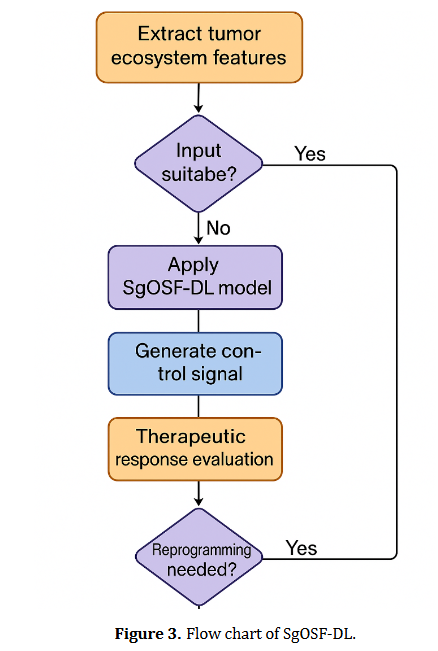
The Tumor Microenvironment (TME) resists conventional treatments by sending out signals that weaken the immune system. Tumor cells vary significantly, and treatments can lead to resistance. This paper focuses on constructing an effective module for reprogramming the tumor ecosystem using Computational Intelligence-Guided Nanoplatforms. It hypothesizes that computationally optimized fuzzy deep learning, integrated with nanoplatform-mediated drug delivery, can dynamically reprogram tumor-infiltrating T-cells to overcome immunosuppression in the TME, thereby enhancing cytotoxicity and therapeutic response. A novel nanotechnology-integrated deep fuzzy learning framework—Seagull Optimized Sugeno Fuzzy Deep Learning (SgOSF-DL)—is proposed to reprogram T-cell behavior in real-time. Multi-omic data from tumor-infiltrating T-cells are encoded and analyzed using fuzzy logic to determine their immune state (suppressed, exhausted, or active), guided by key biomarkers such as Granzyme B and PD-1. The optimized model governs the release of IL-21 and checkpoint inhibitors via nanoplatforms composed of PLGA, gold nanoshells, and iron oxide particles. Fuzzy rules are formulated using optimized parameters to evaluate the TME. Simulation results confirm that the proposed SgOSF-DL model accurately distinguishes between cancer and healthy cells. It alters cancer behavior by reducing tumor burden, lowering PD-1, and boosting Granzyme B expression. The model achieves 96.5% accuracy in classifying T-cell states, reduces tumor count by 69.2%, and decreases PD-1 expression by 61% for active immune function. It also offers faster therapeutic classification (0.017 seconds) with an activation consistency of 92.8%. Fuzzy logic enables transparent decision-making, aiding clinicians in understanding the treatment rationale.
Keywords:
Tumor Microenvironment (TEM) Seagull Deep Learning Oncology T‑Cells ReprogrammingReferences
- Joyce, J.A. Reprogramming the Tumor Immune Microenvironment to Treat Glioblastoma. Nat. Med. 2025, 31, 1048–1049.
- Zhang, F.; Ma, Y.; Li, D.; et al. Cancer-Associated Fibroblasts and Metabolic Reprogramming: Unraveling the Intricate Crosstalk in Tumor Evolution. J. Hematol. Oncol. 2024, 17, 80.
- Bantug, G.R.; Hess, C. The Immunometabolic Ecosystem in Cancer. Nat. Immunol. 2023, 24, 2008–2020.
- Wang, J.; He, Y.; Hu, F.; et al. Metabolic Reprogramming of Immune Cells in the Tumor Microenvironment. Int. J. Mol. Sci. 2024, 25, 12223.
- Kay, E.J.; Zanivan, S. The Tumor Microenvironment is an Ecosystem Sustained by Metabolic Interactions. Cell Rep. 2025, 44.
- Xu, S.; Wang, Q.; Ma, W. Cytokines and Soluble Mediators as Architects of Tumor Microenvironment Reprogramming in Cancer Therapy. Cytokine Growth Factor Rev. 2024, 76, 12–21.
- Elghetany, M.T.; Pan, J.L.; Sekar, K.; et al. Re-Programming by a Six-Factor-Secretome in the Patient Tumor Ecosystem During Nutrient Stress and Drug Response. iScience 2024, 27.
- Saw, P.E.; Song, E. Introduction to Tumor Ecosystem. In Tumor Ecosystem: An Ecological View of Cancer Growth and Survival; Song, E., Ed.; Springer Nature: Singapore, 2023; pp. 3–32.
- Zhang, F.; Guo, J.; Yu, S.; et al. Cellular Senescence and Metabolic Reprogramming: Unraveling the Intricate Crosstalk in the Immunosuppressive Tumor Microenvironment. Cancer Commun. 2024, 44, 929–966.
- Kim, M.; Lee, N.K.; Wang, C.P.J.; et al. Reprogramming the Tumor Microenvironment With Biotechnology. Biomater. Res. 2023, 27, 5.
- Kloosterman, D.J.; Akkari, L. Macrophages at the Interface of the Co-Evolving Cancer Ecosystem. Cell 2023, 186, 1627–1651.
- Martino, F.; Lupi, M.; Giraudo, E.; et al. Breast Cancers as Ecosystems: A Metabolic Perspective. Cell. Mol. Life Sci. 2023, 80, 244.
- Liu, Z.L.; Meng, X.Y.; Bao, R.J.; et al. Single Cell Deciphering of Progression Trajectories of the Tumor Ecosystem in Head and Neck Cancer. Nat. Commun. 2024, 15, 2595.
- Zhang, X.; Li, S.; Malik, I.; et al. Reprogramming Tumour-Associated Macrophages to Outcompete Cancer Cells. Nature 2023, 619, 616–623.
- Zhong, H.; Zhou, S.; Yin, S.; et al. Tumor Microenvironment as Niche Constructed by Cancer Stem Cells: Breaking the Ecosystem to Combat Cancer. J. Adv. Res. 2025, 71, 279–296.
- Sharma, N.K.; Sarode, S.C. Artificial Intelligence vs. Evolving Super-Complex Tumor Intelligence: Critical Viewpoints. Front. Artif. Intell. 2023, 6, 1220744.
- Liang, J.; Lin, Y.; Liu, Y.; et al. Deciphering Two Decades of Cellular Reprogramming in Cancer: A Bibliometric Analysis of Evolving Trends and Research Frontiers. Heliyon 2024, 10, e31400.
- Cavazzoni, A.; Digiacomo, G. Role of Cytokines and Other Soluble Factors in Tumor Development: Rationale for New Therapeutic Strategies. Cells 2023, 12, 2532.
- McDonnell, K.J. Leveraging the Academic Artificial Intelligence Silecosystem to Advance the Community Oncology Enterprise. J. Clin. Med. 2023, 12, 4830.
- Gui, Y.; He, X.; Yu, J.; et al. Artificial Intelligence-Assisted Transcriptomic Analysis to Advance Cancer Immunotherapy. J. Clin. Med. 2023, 12, 1279.
- Cohen, Y.; Valdés-Mas, R.; Elinav, E. The Role of Artificial Intelligence in Deciphering Diet–Disease Relationships: Case Studies. Annu. Rev. Nutr. 2023, 43, 225–250.
- Wu, X.; Li, W.; Tu, H. Big Data and Artificial Intelligence in Cancer Research. Trends Cancer 2024, 10, 147–160.
- Lorenzo, G.; Ahmed, S.R.; Hormuth, D.A.; et al. Patient-Specific, Mechanistic Models of Tumor Growth Incorporating Artificial Intelligence and Big Data. Annu. Rev. Biomed. Eng. 2024, 26, 529–560.
- Wang, H.; Xu, F.; Wang, C. Metabolic Reprogramming of Tumor Microenvironment by Engineered Bacteria. Semin. Cancer Biol. 2025, 112, 58–70.
- Lobel, G.P.; Jiang, Y.; Simon, M.C. Tumor Microenvironmental Nutrients, Cellular Responses, and Cancer. Cell Chem. Biol. 2023, 30, 1015–1032.