Research Article Article ID: 2290
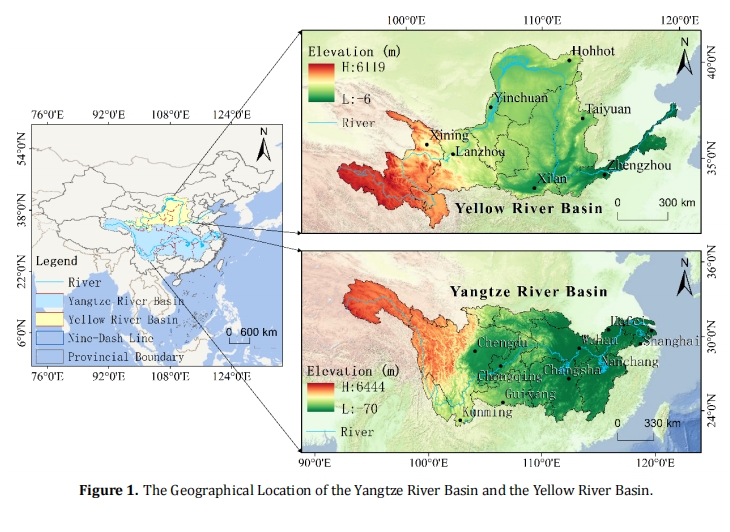
Against the backdrop of China’s ongoing regional coordinated development strategies, clarifying the spatiotemporal evolution and driving mechanisms of Production–Living–Ecological Spaces (PLES) in the Yangtze and Yellow River basins is crucial for optimizing territorial spatial governance and achieving synergies between ecological protection and high-quality development. Using PLES data from 2000 to 2023, this study integrates land use transfer matrices, chord diagram visualization, and random forest modeling to conduct a systematic comparative analysis of spatiotemporal patterns and driving factors. Results show two key findings. First, both basins exhibit a common trajectory of “agricultural production space contraction–urban living space expansion–ecological space stabilization,” yet with distinct differences in spatial configuration, temporal rhythm, and structural transformation pathways. The Yangtze Basin is characterized by production space clustering along urban corridors and notable ecological restoration, whereas the Yellow River Basin demonstrates fragmented expansion of production and living spaces, with ecological space showing a coexistence of recovery and degradation. Second, population density, nighttime light intensity, slope, and Normalized Difference Vegetation Index (NDVI) emerge as dominant drivers, but their effects differ markedly between the two basins, reflecting the differentiated impacts of policy orientations under the “ecological priority” strategy in the Yangtze Basin and the “high-quality development” strategy in the Yellow River Basin. These findings highlight the complexity of multi-dimensional drivers at the basin scale and provide theoretical and methodological insights for advancing regionally differentiated spatial governance.


 287 (Views)
  233 (Downloads)