
Research Article
The Proactive Impacts of Metolong Dam Project on Society and Environment
 Download

This work is licensed under a Creative Commons Attribution-NonCommercial 4.0 International License.
Copyright
The authors shall retain the copyright of their work but allow the Publisher to publish, copy, distribute, and convey the work.
License
Land Management and Utilization (LMU) publishes accepted manuscripts under Creative Commons Attribution 4.0 International (CC BY 4.0). Authors who submit their papers for publication by Land Management and Utilization (LMU) agree to have the CC BY 4.0 license applied to their work, and that anyone is allowed to reuse the article or part of it free of charge for any purpose, including commercial use. As long as the author and original source is properly cited, anyone may copy, redistribute, reuse and transform the content.
Authors

Received: 5 August 2025 | Revised: 30 September 2025 | Accepted: 2 October 2025 | Published Online: 20 November 2025
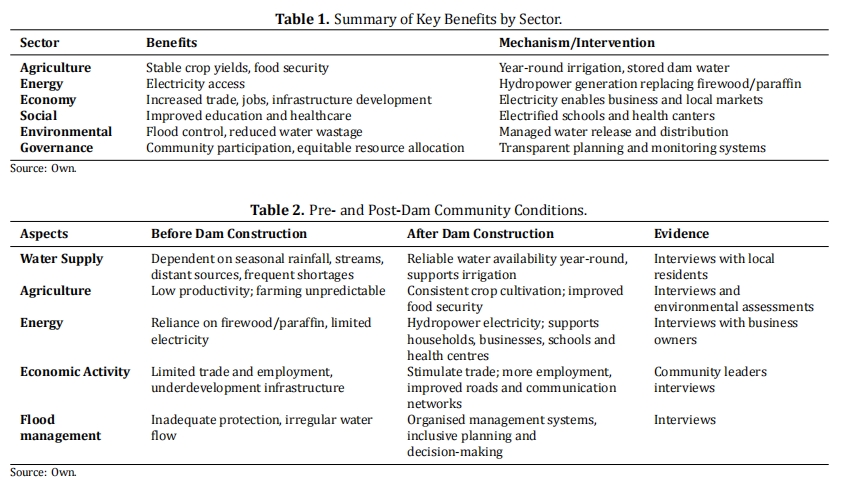
This research examined how the Metolong Dam has affected nearby communities and the surrounding environment while supporting long-term development. The findings show that the dam has improved the water supply reliability, strengthened agricultural activities, and supported the production of renewable electricity. With water now available more consistently throughout the year, many farmers can irrigate their crops regularly rather than relying solely on seasonal rainfall. This has increased crop production and improved household food security. Reliable water access also enables farmers to plan their activities more effectively, supporting more stable livelihoods. Another key benefit is improved access to electricity. Many households now depend less on traditional energy sources such as firewood. This change has made daily life easier, especially for cooking, lighting, and using small appliances. Access to electricity has also created new opportunities for small businesses and local economic activities. Shops and service providers can now operate more efficiently, contributing to economic growth within the community. The study gathered data through interviews and discussions with community members, government officials, and environmental experts. It also reviewed official reports and related documents to understand the social, economic, and environmental impacts of the project. Although clear benefits were reported by participants, some concerns were raised about environmental disturbances and the relocation of households during construction. These concerns highlight the need for ongoing environmental monitoring and stronger community involvement in future development planning.
Keywords:
Hydroelectric Power Renewable Energy Water Supply Growth of the Economy Employment Opportunities and Leisure ActivitiesReferences
- Pradhan, A., Srinivasan, V., 2022. Do dams improve water security in India? A review of post facto assessments. Water Security. 15, 100112.
- Chakraborty, S.K., 2021. Land-use changes: Floodplains, dams, and reservoirs–integrated river basins management. In Riverine Ecology Volume 2: Biodiversity Conservation, Conflicts and Resolution. Springer International Publishing: Cham, Switzerland. pp. 531–607.
- Albou, E.M., Abdellaoui, M., Abdaoui, A., et al., 2024. Agricultural practices and their impact on aquatic ecosystems—A mini-review. Ecological Engineering & Environmental Technology. 25(1), 321–331.
- Adams, J.B., Taljaard, S., Van Niekerk, L., 2023. Water releases from dams improve ecological health and societal benefits in downstream estuaries. Estuaries and Coasts. 46(8), 2244–2258.
- Bang, H.N., 2024. Sustainable development goals, disaster risk management, and indigenous knowledge: A critical assessment of the interlinkages. Sustainable Earth Reviews. 7(1), 29.
- Wang, R., Cui, S., Gao, M., 2024. Systematic scenario modeling for priority assessment of sustainable development goals in China under interaction and uncertainty. Environment, Development and Sustainability. 27(7), 158511–15886.
- Basha, J.Y., 2024. The negative impacts of AI tools on students in academic and real-life performance. International Journal of Social Sciences and Commerce. 1(3), 1–16.
- Jordana, J., Triviño-Salazar, J.C., 2025. Turning vulnerability into strength: how independent regulatory agencies enhance accountability and build stakeholder trust. Regulation & Governance. DOI: https://doi.org/10.1111/rego.70053
- Smith, K., Fearnley, C.J., Dixon, D., et al., 2023. Environmental Hazards: Assessing Risk and Reducing Disaster, 7th ed. Routledge: London, UK.
- Kermanshachi, S., Pamidimukkala, A., 2023. Robustness analysis of total project cost and schedule delay and overrun indicators of heavy industrial projects. Journal of Legal Affairs and Dispute Resolution in Engineering and Construction. 15(2), 04523005.
- Head, B.W., 2022. Wicked Problems in Public Policy: Understanding and Responding to Complex Challenges. Springer Nature: Cham, Switzerland.
- Schmid-Petri, H., Bienzeisler, N., Beseler, A., 2022. Effects of politicization on the practice of science. Progress in Molecular Biology and Translational Science. 188(1), 45–63.
- Islamoglu, M., 2024. Decision-Making During International Crisis: The Role of National Security Institutions [Master’s Thesis]. The University of Texas at San Antonio: San Antonio, TX, USA.
- Sánchez, L.E., Duarte, C.G., 2022. Environmental impact assessment in Brazil: A review of its rise (and fall?). In Handbook of Environmental Impact Assessment. Edward Elgar Publishing: Cheltenham, UK. pp. 383–403.
- Chai, J., 2025. The Role of Law in Shaping Resettled Identity: A Case Study of the Three Gorges Project [Master's Thesis]. Lund University: Lund, Sweden.
- Leal Filho, W., Sigahi, T.F., Anholon, R., et al., 2025. Promoting sustainable development via stakeholder engagement in higher education. Environmental Sciences Europe. 37(1), 64.
- Shukla, K., Mishra, V., Singh, J., et al., 2024. Nanotechnology in sustainable agriculture: A double-edged sword. Journal of the Science of Food and Agriculture. 104(10), 5675–5688.
- Biró, K., Woon, K.S., Ounsaneha, W., et al., 2025. A global perspective on sustainable pathways for biogas adoption. Global Journal of Environmental Science and Management. 11(2), 825–856.
- Chand, S.P., 2025. Methods of data collection in qualitative research: Interviews, focus groups, observations, and document analysis. Advances in Educational Research and Evaluation. 6(1), 303–317.
- Meydan, C.H., Akkaş, H., 2024. The role of triangulation in qualitative research: Converging perspectives. In Principles of Conducting Qualitative Research in Multicultural Settings. IGI Global: Hershey, PA, USA. pp. 98–129.
- Zhu, J.J., Yang, M., Ren, Z.J., 2023. Machine learning in environmental research: Common pitfalls and best practices. Environmental Science & Technology. 57(46), 17671–17689.
- Merkebu, J., Geringer, J., Samuel, A., 2025. Sampling thoughtfully in qualitative research: Hallmarks of Rigour in health professions education. The Clinical Teacher. 22(4), e70145.
- Saharan, V.A., Kulhari, H., Jadhav, H., et al., 2024. Introduction to research methodology. In: Elhami, A., Roshan, A., Chandan H. (Eds.). Principles of Research Methodology and Ethics in Pharmaceutical Sciences. CRC Press: Boca Raton, FL, USA. pp. 1–46.
- Adebayo, W.G., 2025. Resilience in the face of ecological challenges: Strategies for integrating environmental considerations into social policy planning in Africa. Sustainable Development. 33(1), 203–220.
- Ahmed, M., Othman, R., Noordin, M.F., et al., 2025. Factors influencing open science participation through research data sharing and reuse among researchers: A systematic literature review. Knowledge and Information Systems. 67(3), 2801–2853.
- Ayalu, G., Abbay, A.G., Azadi, H., 2023. The role of micro- and small-scale enterprises in enhancing sustainable community livelihood: Tigray, Ethiopia. Environment, Development and Sustainability. 25(8), 7561–7584.