
Article
Exploring Task-Based Language Teaching in EFL Contexts: Instructor Perspectives on Challenges and Effective Strategies for Enhancing Speaking Skills
 Download

This work is licensed under a Creative Commons Attribution 4.0 International License.
Copyright
The authors shall retain the copyright of their work but allow the Publisher to publish, copy, distribute, and convey the work.
License
Journal of Qualitative Research in Education (ENAD) publishes accepted manuscripts under Creative Commons Attribution 4.0 International (CC BY 4.0). Authors who submit their papers for publication by ENAD agree to have the CC BY 4.0 license applied to their work, and that anyone is allowed to reuse the article or part of it free of charge for any purpose, including commercial use. As long as the author and original source are properly cited, anyone may copy, redistribute, reuse, and transform the content.
Authors

Received: 12 January 2026; Revised: 1 February 2026; Accepted: 27 February 2026; Published: 27 March 2026
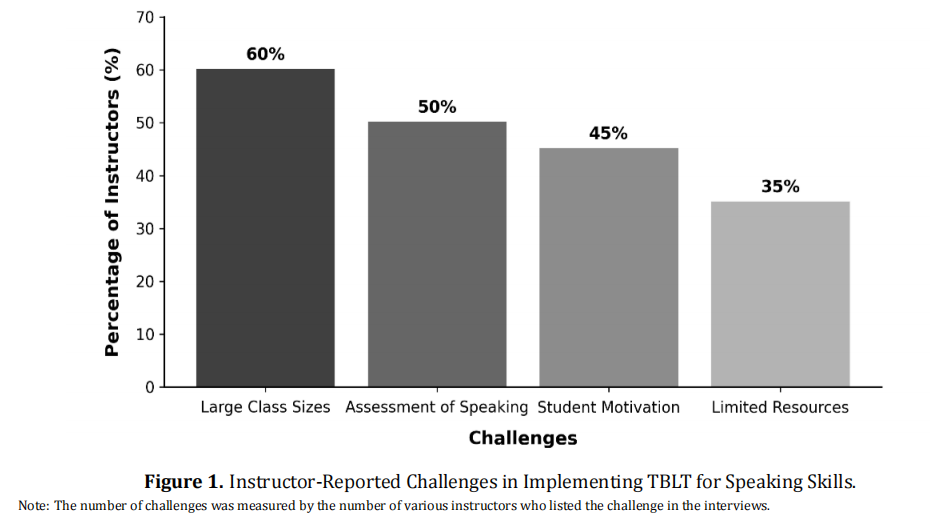
This paper discusses how English as a Foreign Language (EFL) instructors perceive the use of Task-Based Language Teaching (TBLT) in facilitating speaking skills in Chinese EFL contexts. The study employs a qualitative descriptive research design because it seeks to explore the perceived barriers and effective teaching methods associated with task-based speaking instruction. Semi-structured interviews were used to collect data by interviewing twelve EFL instructors in universities and language institutions in China, which was complemented by reflective notes. Thematic analysis was employed to analyze the data. The results have shown that instructors are struggling with a number of problems, such as large class sizes, difficulties in assessing speaking achievement, lack of motivation among students, and limited institutional resources. Regardless of these limitations, the instructors mentioned using successful strategies such as task adaptation and scaffolding, flexible grouping techniques, and formative feedback practices to support student participation and communicative engagement. The findings indicate that TBLT has great potential to enhance speaking skills, but its effectiveness is highly reliant on whether the instructors can adapt the principles of tasks to the reality of contexts. The paper highlights the need to synchronize assessment activities with communicative purposes and institutional support of task-based pedagogy. Curriculum designers and policymakers are encouraged to develop flexible assessment systems and professional development programs that focus on enhancing the effective implementation of TBLT in EFL speaking instruction.
Keywords:
Task-Based Language Teaching Speaking Skills EFL Instructors Thematic Analysis ChinaReferences
- Bhandari, L.P.; Dahal, N.; Awasthi, J.R.; et al. Technology-mediated task-based language teaching: a systematic review. Cogent Educ. 2025, 12, 2560051. DOI: https://doi.org/10.1080/2331186X.2025.2560051
- Yaqobi, S.T. The Effectiveness of Communicative Language Teaching and Task-Based Technology in Promoting International Graduate Students’ Communicative Competence and Willingness to Communicate in English: A Case Study. PhD Thesis, Texas Tech University, Lubbock, TX, USA, 2022.
- Kim, E. Sociocultural Theory and Second Language Developmental Education. Appl. Linguist. 2026, 46, 983–986. DOI: https://doi.org/10.1093/applin/amaf068
- Nasir, A.R. The Effectiveness of Task-Based Language Teaching in Enhancing High School Students’ Communicative Competence. Lang. Inq. Explor. Rev. 2025, 2, 35–43. DOI: https://doi.org/10.71435/639192
- Zhang, Z. A Review of the Impact of Task-Based Language Teaching (TBLT) on Oral Proficiency. Lect. Notes Educ. Psychol. Public Media 2025, 87, 83–90. DOI: https://doi.org/10.54254/2753-7048/2025.bo23942
- Graciano, J.C. Action Research for Implementing Task-Based Language Teaching and Enhancing Speaking Skills in a Class of 12th Grade English Students in an Angolan School. Open J. Mod. Linguist. 2025, 15, 473–496. DOI: https://doi.org/10.4236/ojml.2025.153027
- Abd Rahman, N. Impact of Task-Based Language Teaching (TBLT) on English Spoken Production and Interaction Among Malaysian Pre-University Students. Issues Lang. Stud. 2024, 13, 103–122. DOI: https://doi.org/10.33736/ILS.6203.2024
- Chang, P.; Zhou, L.; Zhang, L.J. The roles of task-specific self-efficacy and enjoyment in EFL learners’ development of speaking CALF: A longitudinal study. System 2024, 127, 103539. DOI: https://doi.org/10.1016/j.system.2024.103539
- Khan, A.K.; Wong, S.; Chen, M. The role of task-based language teaching (TBLT) in enhancing students’ speaking skills in English as a second language. Res. Stud. Engl. Lang. Teach. Learn. 2023, 1, 45–52. DOI: https://doi.org/10.62583/rseltl.v1i1.7
- Lili, R.; Sujarwo, S.; Ibrahim, M.; et al. The impact of task-based language teaching (TBLT) method on students’ speaking ability at senior high school. Ethical Lingua 2025, 12, 1. DOI: https://doi.org/10.30605/25409190.775
- Yu, Y.; Mofreh, S.A.M.; Salem, S. Speak Beyond Borders: A Systematic Review of Task-Based Language Teaching for EFL Speaking Proficiency. Engl. Lang. Teach. 2024, 17, 15. DOI: https://doi.org/10.5539/ELT.V17N7P15
- Adiantika, H.N.; Purnomo, H. The Implementation of Task-Based Instruction in EFL Teaching Speaking Skill. Indones. EFL J. 2018, 4, 12. DOI: https://doi.org/10.25134/IEFLJ.V4I2.1371
- Albino, G. Improving Speaking Fluency in a Task-Based Language Teaching Approach: The Case of EFL Learners at PUNIV-Cazenga. SAGE Open 2017, 7. DOI: https://doi.org/10.1177/2158244017691077
- Zúñiga, E.C.; Mayorga, E.; Ruiz, N. Potential Implications of Task-Based Language Teaching on Developing EFL Learners’ Oral Fluency. Int. J. Learn. Teach. Educ. Res. 2023, 22, 130–149. DOI: https://doi.org/10.26803/IJLTER.22.11.8
- Kessler, M.; Solheim, I.; Zhao, M. Can task-based language teaching be “authentic” in foreign language contexts? Exploring the case of China. TESOL J. 2021, 12, e534. DOI: https://doi.org/10.1002/TESJ.534
- Liu, Y.; Mishan, F.; Chambers, A. Investigating EFL teachers’ perceptions of task-based language teaching in higher education in China. Lang. Learn. J. 2021, 49, 131–146. DOI: https://doi.org/10.1080/09571736.2018.1465110
- Budiyanto, D.; Jaya, A.; Saputri, K. Revisiting Translation in EFL Classrooms: Teachers’ Perspectives Under Indonesia’s New Curriculum. Indones. EFL J. 2026, 12, 13–28. DOI: https://doi.org/10.25134/ieflj.v12i1.59
- Wang, S.; Wang, Y.; Solhi, M. Teacher-Student Interpersonal Behaviours and GenAI Feedback on Students’ Achievement Emotions in EFL Writing: An Intervention Study. Eur. J. Educ. 2026, 61, e70395. DOI: https://doi.org/10.1111/EJED.70395
- Palta, E.; Yakışık, B.Y. Bridging the Gap Between Preparatory English Education for Business Students and Professional Goals. ELT Res. J. 2026, 14, 124–151. DOI: https://doi.org/10.71362/ELTRJ.1702372
- Anjum, S. Impact of internship programs on professional and personal development of business students: A case study from Pakistan. Future Bus. J. 2020, 6, 2. DOI: https://doi.org/10.1186/S43093-019-0007-3
- Aljohani, N.J. ChatGPT in language learning: A systematic review of applications and challenges. Soc. Sci. Humanit. Open 2026, 13, 102357. DOI: https://doi.org/10.1016/J.SSAHO.2025.102357
- Han, D.-E. The Effects of Voice-based AI Chatbots on Korean EFL Middle School Students’ Speaking Competence and Affective Domains. Asia-Pac. J. Converg. Res. Interchange 2020, 6, 71–80.
- Wang, W.; Bale, J. Mentoring for new secondary Chinese language teachers in the United States. System 2019, 84, 53–63. DOI: https://doi.org/10.1016/j.system.2019.05.002
- Harfitt, G.J. An examination of the impact of class size on the teaching and learning of English as a foreign language. System 2012, 40, 412–422.
- Papi, M.; Khajavy, H. Second language anxiety: Construct, effects, and sources. Annu. Rev. Appl. Linguist. 2023, 43, 127–139. DOI: https://doi.org/10.1017/S0267190523000028
- Sun, X.; Ye, W. A Comprehensive Approach to L2 Drama-Based Pedagogy: Students’ Perceptions and Reflections. J. Adolesc. Adult Lit. 2026, 69, e70026. DOI: https://doi.org/10.1002/JAAL.70026
- East, M. Taking communication to task once more—A further decade on. Lang. Learn. J. 2025, 53, 71–83. DOI: https://doi.org/10.1080/09571736.2024.2305424
- Pham, I.-I. Using Task-Based Language Teaching to Improve English Speaking Fluency: An Action Research Study with Vietnamese Non-English-Majored University Students. Int. J. TESOL Educ. 2025, 5, 16–31. DOI: https://doi.org/10.54855/ijte.25542
- Zheng, Y.; Liu, C.; Yu, S. “How should I assess their writing? It’s a headache for me.”: Understanding teacher assessment literacy in the collaborative writing context. Teach. Teach. Educ. 2026, 171, 105343. DOI: https://doi.org/10.1016/J.TATE.2025.105343
- Chen, Y.; Binti, N.A. Bridging Second Language Acquisition Theory and Pedagogy in English Education for TVET Learners. Foro Educ. 2026, 24, 1–19.
- Liu, Y.; Ren, W. Task-based language teaching in a local EFL context: Chinese university teachers’ beliefs and practices. Lang. Teach. Res. 2024, 28, 2234–2250. DOI: https://doi.org/10.1177/13621688211044247