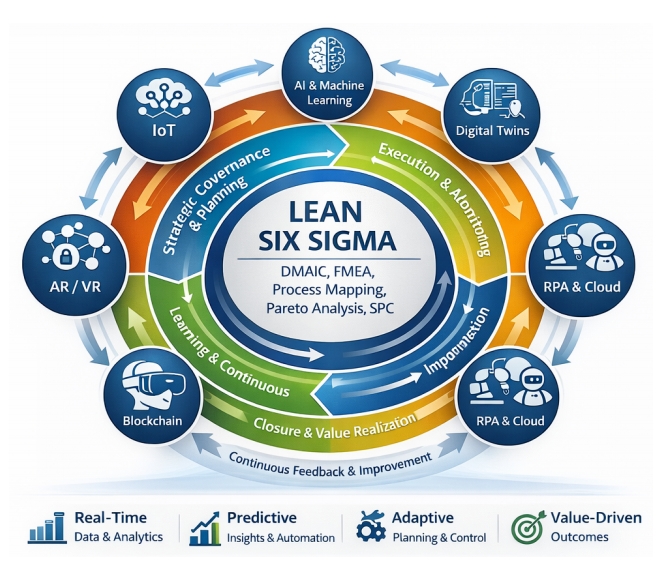
Modern projects operate in environments of increasing complexity, uncertainty, and digital transformation, exposing the limitations of traditional project management. Projects now face dynamic stakeholder demands, complex interdependencies, and intense performance pressures, requiring integrated, adaptive, and data-driven management approaches. While Lean Six Sigma (LSS) provides structured methods for process efficiency, waste reduction, and variability control, Industry 4.0 technologies—including AI, IoT, digital twins, RPA, and cloud platforms—enable real-time data, predictive analytics, and intelligent decision support. Current research often examines these domains separately, resulting in fragmented insights and limited practical guidance. To address this gap, this study proposes Project Management 4.0 (PM 4.0), an integrative framework that aligns LSS principles, tools, and DMAIC phases with Industry 4.0 technologies across the project lifecycle. PM 4.0 enables adaptive, value-focused project execution, embedding continuous improvement, strategic alignment, and performance transparency. By combining methodological rigor with digital intelligence, it enhances planning, execution, monitoring, and control, improving efficiency, agility, decision quality, and resilience. This research advances PM 4.0 theory and provides actionable guidance for managers, practitioners, and researchers seeking intelligent, high-performing project management systems. It also identifies future research directions, including empirical validation, human-centric digital integration, and intelligent governance.


 264 (Views)
  61 (Downloads)