
Review
Optimizing Project Management through Lean Six Sigma and Industry 4.0: A Review, Gap Analysis, and Conceptual Mapping for Project Management 4.0
 Download
Authors

Received: 28 August 2025; Revised: 14 October 2025; Accepted: 27 November 2025; Published: 13 December 2025
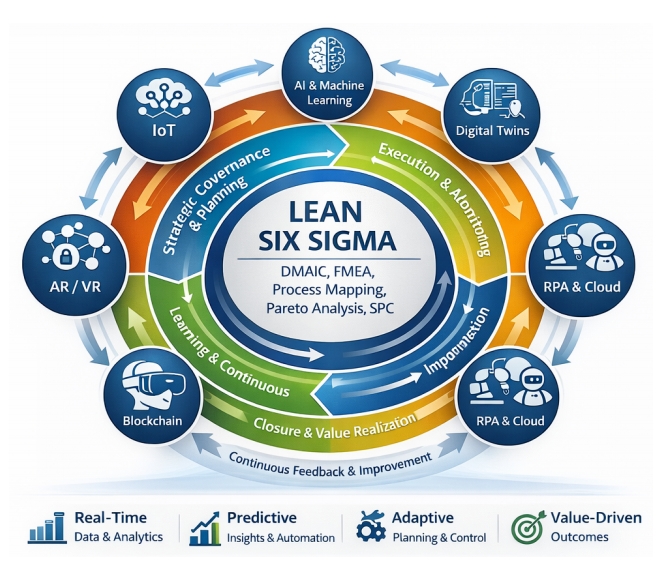
Modern projects operate in environments of increasing complexity, uncertainty, and digital transformation, exposing the limitations of traditional project management. Projects now face dynamic stakeholder demands, complex interdependencies, and intense performance pressures, requiring integrated, adaptive, and data-driven management approaches. While Lean Six Sigma (LSS) provides structured methods for process efficiency, waste reduction, and variability control, Industry 4.0 technologies—including AI, IoT, digital twins, RPA, and cloud platforms—enable real-time data, predictive analytics, and intelligent decision support. Current research often examines these domains separately, resulting in fragmented insights and limited practical guidance. To address this gap, this study proposes Project Management 4.0 (PM 4.0), an integrative framework that aligns LSS principles, tools, and DMAIC phases with Industry 4.0 technologies across the project lifecycle. PM 4.0 enables adaptive, value-focused project execution, embedding continuous improvement, strategic alignment, and performance transparency. By combining methodological rigor with digital intelligence, it enhances planning, execution, monitoring, and control, improving efficiency, agility, decision quality, and resilience. This research advances PM 4.0 theory and provides actionable guidance for managers, practitioners, and researchers seeking intelligent, high-performing project management systems. It also identifies future research directions, including empirical validation, human-centric digital integration, and intelligent governance.
Keywords:
Project Management Optimization Project Management 4.0 Lean Six Sigma Industry 4.0 Digital Transformation Agile Project Management Project Performance ImprovementReferences
- Gomaa, A.H. Advancing project management excellence: A comprehensive framework integrating Value Engineering, Lean Six Sigma, and proven best practices. Value, Funct., Cost 2025, 5, 3731. DOI: https://doi.org/10.54517/vfc.v5i1.3731
- The Future of Lean Six Sigma: Innovations and Trends Impacting Engineering Project Management. Available online: https://www.researchgate.net/publication/387832410_The_Future_of_Lean_Six_Sigma_Innovations_and_Trends_Impacting_Engineering_Project_Management (accessed on 20 August 2025).
- Gomaa, A.H. Achieving project management excellence through Lean Six Sigma. Middle East Res. J. Eng. Technol. 2025, 5, 18–32. DOI: https://doi.org/10.36348/merjet.2025.v05i02.001
- Alaloul, W.S.; Liew, M.S.; Zawawi, N.A.W.A.; et al. Industry revolution IR 4.0: Future opportunities and challenges in construction industry. MATEC Web Conf. 2018, 203, 02010. DOI: https://doi.org/10.1051/matecconf/201820302010
- Alaloul, W.S.; Liew, M.S.; Zawawi, N.A.W.A.; et al. Industrial Revolution 4.0 in the construction industry: Challenges and opportunities for stakeholders. Ain Shams Eng. J. 2020, 11, 225–230. DOI: https://doi.org/10.1016/j.asej.2019.08.010
- Gomaa, A.H. LSS 4.0: A Conceptual Framework for Integrating Lean Six Sigma and Industry 4.0 for Smart Manufacturing Excellence. Indian J. Manag. Lang. 2025, 5, 8–29. DOI: https://doi.org/10.54105/ijml.H1810.05010425
- Azhar, S.; Khalfan, M.; Maqsood, T. Building information modeling (BIM): Now and beyond. Australas. J. Constr. Econ. Build. 2012, 12, 15–28. DOI: https://doi.org/10.5130/AJCEB.v12i4.3032
- López, F.J.; Lerones, P.M.; Llamas, J.; et al. A review of heritage building information modeling (H-BIM). Multimodal Technol. Interact. 2018, 2, 21. DOI: https://doi.org/10.3390/mti2020021
- Wang, T.; Chen, H.M. Integration of building information modeling and project management in construction project life cycle. Autom. Constr. 2023, 150, 104832. DOI: https://doi.org/10.1016/j.autcon.2023.104832
- Almatari, H.A.Q.; Chan, M.; Masrom, M.A.N. Factors inhibiting the adoption of industrial revolution 4.0 in Malaysian construction industry. Smart Sustain. Built Environ. 2024, 13, 1041–1065. DOI: https://doi.org/10.1108/SASBE-10-2022-0232
- Gomaa, A.H. Leading with excellence: Critical leadership dimensions in Lean Six Sigma for business excellence. Hum. Resour. Manag. Serv. 2025, 7, 4399. DOI: https://doi.org/10.18282/hrms4399
- Gomaa, A.H. Strategic Lean Leadership in Lean Six Sigma Projects for Manufacturing Excellence. Int. Bus. Econ. Stud. 2025, 7, 125. DOI: https://doi.org/10.22158/ibes.v7n2p125
- Abideen, A.Z.; Mohamad, F.B.; Fernando, Y. Lean simulations in production and operations management—A systematic literature review and bibliometric analysis. J. Model. Manag. 2021, 16, 623–650. DOI: https://doi.org/10.1108/JM2-05-2019-0103
- Tamalika, T.; Maryadi, D. Unpacking Lean Six Sigma Practice: A Systematic Literature Review of Performance Outcomes and Implementation Challenges (2020–2025). Ind. Syst. Eng. J. 2025, 4, 860. DOI: https://doi.org/10.37477/isejou.v4i1.860
- Akanmu, M.D.; Nordin, N.; Gunasilan, U. Lean Manufacturing Practices and Integration of IR 4.0 Technologies for Sustainability in the Healthcare Manufacturing Industry. Int. J. Serv. Manag. Sustain. 2022, 7, 21–48.
- Maqbool, R.; Saiba, M.R.; Ashfaq, S. Emerging industry 4.0 and Internet of Things (IoT) technologies in the Ghanaian construction industry: Sustainability, implementation challenges, and benefits. Environ. Sci. Pollut. Res. 2023, 30, 37076–37091. DOI: https://doi.org/10.1007/s11356-022-24764-1
- Arcidiacono, G.; Antonacci, A.; Antony, J. The r-evolution of Lean Six Sigma from Industry 4.0 to Society 5.0: Excellence 5.0. Int. J. Qual. Reliab. Manag. 2025, 42, 2328–2349. DOI: https://doi.org/10.1108/IJQRM-11-2024-0415
- Channappagoudar, S.; Bhat, S.; Gijo, E.V. Integrating Industry 4.0 tools into the Six Sigma DMAIC phases: A pathway to digital-driven quality improvement. TQM J. 2025, 1–31. DOI: https://doi.org/10.1108/TQM-04-2025-0247
- Moeuf, A.; Lamouri, S.; Pellerin, R.; et al. Identification of critical success factors, risks and opportunities of Industry 4.0 in SMEs. Int. J. Prod. Res. 2020, 58, 1384–1400. DOI: https://doi.org/10.1080/00207543.2019.1636323
- Albayrak, Ö.; Erkayman, B. A multi-criteria analysis for critical success factors through Industry 4.0. Int. J. Fuzzy Syst. 2023, 25, 1530–1545. DOI: https://doi.org/10.1007/s40815-023-01464-7
- Sahoo, P.; Saraf, P.K.; Uchil, R. Identification of critical success factors for leveraging Industry 4.0 technology and research agenda: A systematic literature review using PRISMA protocol. Asia-Pac. J. Bus. Adm. 2024, 16, 457–481. DOI: https://doi.org/10.1108/APJBA-03-2022-0105
- Stelmach, A. Digital Transformation: Impact of Modern Technologies and Project Management on Optimization of Production Processes in Era of Industry 4.0. Decis. Mak. Manuf. Serv. 2024, 39–47. DOI: https://doi.org/10.7494/dmms.2024.si.6650
- Gomaa, A.H. Value Engineering in the Era of Industry 4.0: From Gap Analysis to Research Methodologies and Strategic Framework. Intell. Sustain. Manuf. 2025, 2, 10029. DOI: https://doi.org/10.70322/ism.2025.10029
- Adebayo, Y.; Udoh, P.; Kamudyariwa, X.B.; et al. Artificial Intelligence in Construction Project Management: A Structured Literature Review of Its Evolution in Application and Future Trends. Digital 2025, 5, 26. DOI: https://doi.org/10.3390/digital5030026
- Pozzi, R.; Rossi, T.; Secchi, R. Industry 4.0 technologies: Critical success factors for implementation and improvements in manufacturing companies. Prod. Plann. Control 2023, 34, 139–158. DOI: https://doi.org/10.1080/09537287.2021.1891481
- Qureshi, A.H.; Alaloul, W.S.; Wing, W.K.; et al. Automated progress monitoring technological model for construction projects. Ain Shams Eng. J. 2023, 14, 102165. DOI: https://doi.org/10.1016/j.asej.2023.102165
- Musarat, M.A.; Alaloul, W.S.; Zainuddin, S.M.B.; et al. Digitalization in Malaysian construction industry: Awareness, challenges and opportunities. Results Eng. 2024, 21, 102013. DOI: https://doi.org/10.1016/j.rineng.2024.102013
- Taboada, I.; Daneshpajouh, A.; Toledo, N.; et al. Artificial intelligence enabled project management: A systematic literature review. Appl. Sci. 2023, 13, 5014. DOI: https://doi.org/10.3390/app13085014
- Simion, C.P.; Popa, S.C.; Albu, C. Project Management 4.0 – Project Management in the Digital Era. Proc. Int. Manag. Conf. 2018, 12, 93–100.
- Kumar, P.; Bhadu, J.; Singh, D.; et al. Integration between lean, six sigma and Industry 4.0 technologies. Int. J. Six Sigma Compet. Adv. 2021, 13, 19–37. DOI: https://doi.org/10.1504/IJSSCA.2021.120224
- Gomaa, A.H. Lean 4.0: A Strategic Roadmap for Operational Excellence and Innovation in Smart Manufacturing. Int. J. Emerg. Sci. Eng. 2025, 13, 1–14. DOI: https://doi.org/10.35940/ijese.D2592.13050425
- Garza-Reyes, J.A. Green lean and the need for Six Sigma. Int. J. Lean Six Sigma 2015, 6, 226–248. DOI: https://doi.org/10.1108/IJLSS-04-2014-0010
- Gutierrez-Gutierrez, L.; de Leeuw, S.; Dubbers, R. Logistics services and Lean Six Sigma implementation: A case study. Int. J. Lean Six Sigma 2016, 7, 324–342. DOI: https://doi.org/10.1108/IJLSS-05-2015-0019
- Rukiye, N.; Dilek, I.E. The evaluation of analytical performance of immunoassay tests by using the Six Sigma method. J. Med. Biochem. 2017, 36, 301–308. DOI: https://doi.org/10.1515/jomb-2017-0026 (in Bosnian)
- Sony, M.; Naik, S.; Antony, J. Lean Six Sigma and social performance: A review and synthesis of current evidence. Qual. Manag. J. 2020, 27, 21–36. DOI: https://doi.org/10.1080/10686967.2019.1689799
- Raza, A.; Saeed, A.; Iqbal, M.K.; et al. Linking corporate social responsibility to customer loyalty through co-creation and customer company identification: Exploring sequential mediation mechanism. Sustainability 2020, 12, 2525. DOI: https://doi.org/10.3390/su12062525
- Sodhi, H.S.; Singh, D.; Singh, B.J. Developing a Lean Six Sigma conceptual model and its implementation: A case study. Ind. Eng. J. 2019, 12, 1–19.
- Tuan, L.T.; Rajendran, D.; Rowley, C.; et al. Customer value co-creation in the business-to-business tourism context: The roles of corporate social responsibility and customer empowering behaviors. J. Hosp. Tour. Manag. 2019, 39, 137–149. DOI: https://doi.org/10.1016/j.jhtm.2019.04.002
- Byrne, B.; McDermott, O.; Noonan, J. Applying lean six sigma methodology to a pharmaceutical manufacturing facility: A case study. Processes 2021, 9, 550. DOI: https://doi.org/10.3390/pr9030550
- McDermott, O.; Antony, J.; Bhat, S.; et al. Lean six sigma in healthcare: A systematic literature review on challenges, organisational readiness and critical success factors. Processes 2022, 10, 1945. DOI: https://doi.org/10.3390/pr10101945
- Ndrecaj, V.; Mohamed Hashim, M.A.; Mason-Jones, R.; et al. Exploring Lean Six Sigma as dynamic capability to enable sustainable performance optimisation in times of uncertainty. Sustainability 2023, 15, 16542. DOI: https://doi.org/10.3390/su152316542
- Shirsha, S.; Faruk, A.; Lamisha Lubana, F. Strategic Implementation of Lean Six Sigma: A Holistic Approach towards Achieving Business Excellence. In Proceedings of the 7th IEOM Bangladesh International Conference on Industrial Engineering and Operations Management, Dhaka, Bangladesh, 21–22 December 2024.
- Yadav, G.; Desai, T.N. Lean Six Sigma: A Categorized Review of the Literature. Int. J. Lean Six Sigma 2016, 7, 2–24. DOI: https://doi.org/10.1108/IJLSS-05-2015-0015
- Sreedharan, V.R.; Sunder, M.V.; R, R. Critical Success Factors of TQM, Six Sigma, Lean and Lean Six Sigma: A Literature Review and Key Findings. Benchmarking: Int. J. 2018, 25, 3479–3504. DOI: https://doi.org/10.1108/BIJ-08-2017-0223
- Trehan, R.; Gupta, A.; Handa, M. Implementation of Lean Six Sigma framework in a large scale industry: A case study. Int. J. Six Sigma Compet. Adv. 2019, 11, 23–41. DOI: https://doi.org/10.1504/IJSSCA.2019.098710
- Garza-Reyes, J.A.; Al-Balushi, M.; Antony, J.; et al. A Lean Six Sigma framework for the reduction of ship loading commercial time in the iron ore pelletising industry. Prod. Plann. Control 2016, 27, 1092–1111. DOI: https://doi.org/10.1080/09537287.2016.1185188
- De Felice, F.; Petrillo, A.; De Luca, C.; et al. Artificial Intelligence or Augmented Intelligence? Impact on our lives, rights and ethics. Procedia Comput. Sci. 2022, 200, 1846–1856. DOI: https://doi.org/10.1016/j.procs.2022.01.385
- Swarnakar, V.; Singh, A.R.; Antony, J.; et al. A multiple integrated approach for modelling critical success factors in sustainable LSS implementation. Comput. Ind. Eng. 2020, 150, 106865. DOI: https://doi.org/10.1016/j.cie.2020.106865
- Kamble, S.S.; Gunasekaran, A.; Gawankar, S.A. Sustainable Industry 4.0 Framework: A Systematic Literature Review Identifying the Current Trends and Future Perspectives. Process Saf. Environ. Prot. 2018, 117, 408–425. DOI: https://doi.org/10.1016/j.psep.2018.05.009
- Hariyani, D.; Mishra, S. Barriers to the adoption of integrated sustainable-green-lean-six sigma-agile manufacturing system (ISGLSAMS): A literature review. Benchmarking: Int. J. 2023, 30, 3590–3636. DOI: https://doi.org/10.1108/BIJ-10-2021-0585
- Hariyani, D.; Mishra, S. An analysis of drivers for the adoption of integrated sustainable-green-lean-six sigma-agile manufacturing system (ISGLSAMS) in Indian manufacturing industries. Benchmarking: Int. J. 2023, 30, 1073–1109. DOI: https://doi.org/10.1108/BIJ-08-2021-0488
- Chugani, N.; Kumar, V.; Garza-Reyes, J.A.; et al. Investigating the green impact of Lean, Six Sigma and Lean Six Sigma: A systematic literature review. Int. J. Lean Six Sigma 2017, 8, 7–32. DOI: https://doi.org/10.1108/IJLSS-11-2015-0043
- Farrukh, A.; Mathrani, S.; Sajjad, A. A DMAIC approach to investigate the green lean six sigma tools for improving environmental performance. In Proceedings of the 2021 IEEE Asia-Pacific Conference on Computer Science and Data Engineering (CSDE), Brisbane, Australia, 8–10 December 2021. DOI: https://doi.org/10.1109/CSDE53843.2021.9718462
- Gholami, H.; Jamil, N.; Mat Saman, M.Z.; et al. The application of Green Lean Six Sigma. Bus. Strategy Environ. 2021, 30, 1913–1931. DOI: https://doi.org/10.1002/bse.2724
- Yadav, V.; Gahlot, P. Green Lean Six Sigma sustainability-oriented framework for small and medium enterprises. Int. J. Qual. Reliab. Manag. 2022, 39, 1787–1807. DOI: https://doi.org/10.1108/IJQRM-08-2021-0297
- Rathi, R.; Kaswan, M.S.; Garza-Reyes, J.A.; et al. Green Lean Six Sigma for improving manufacturing sustainability: Framework development and validation. J. Clean. Prod. 2022, 345, 131130. DOI: https://doi.org/10.1016/j.jclepro.2022.131130
- Aravindh, M.D.; Nakkeeran, G.; Krishnaraj, L.; et al. Evaluation and optimization of lean waste in construction industry. Asian J. Civ. Eng. 2022, 23, 741–752. DOI: https://doi.org/10.1007/s42107-022-00453-9
- Babalola, O.; Ibem, E.O.; Ezema, I.C. Implementation of lean practices in the construction industry: A systematic review. Build. Environ. 2019, 148, 34–43. DOI: https://doi.org/10.1016/j.buildenv.2018.10.051
- Durai-Aravindh, M.; Nakkeeran, G.; PremKumar, G.; et al. Exploring the Application of Lean Tools for Sustainable Construction: A Strategy Based on Analytic Hierarchy Process Model. In EcoTech Urbanism: Pioneering Sustainable Technologies for Developing Cities; Baskaran, V., Renuka, S., Velkennedy, R., Eds.; Springer: Cham, Switzerland, 2025; pp. 295–310. DOI: https://doi.org/10.1007/978-3-031-83833-0_19
- Singh, S.; Kumar, K. Review of literature of lean construction and lean tools using systematic literature review technique (2008–2018). Ain Shams Eng. J. 2020, 11, 465–471. DOI: https://doi.org/10.1016/j.asej.2019.08.012
- Garcés, G.; Forcael, E.; Osorio, C.; et al. Systematic review of Lean Construction: An approach to sustainability and efficiency in construction management. J. Infrastruct. Preserv. Resil. 2025, 6, 6. DOI: https://doi.org/10.1186/s43065-025-00119-1
- Wattana, K.; Koschanin, J.; Luanghan, I.; et al. An exploratory factor analysis of lean construction elements reflecting project management performance among local construction enterprises. Sci. Eng. Connect. 2025, 48, 251–280.
- Agyekum-Mensah, G.; Knight, A.D. The professionals' perspective on the causes of project delay in the construction industry. Eng. Constr. Archit. Manag. 2017, 24, 828–841. DOI: https://doi.org/10.1108/ECAM-03-2016-0085
- Deng, M.; Menassa, C.C.; Kamat, V.R. From BIM to digital twins: A systematic review of the evolution of intelligent building representations in the AEC-FM industry. J. Inf. Technol. Constr. 2021, 26, 58–83.
- Manzoor, B.; Othman, I.; Gardezi, S.S.S.; et al. BIM-based research framework for sustainable building projects: A strategy for mitigating BIM implementation barriers. Appl. Sci. 2021, 11, 5397.
- Zhao, X.; Saeed, O. Intelligent Financial Processing Based on Artificial Intelligence‐Assisted Decision Support System. Mob. Inf. Syst. 2022, 2022, 6974246. DOI: https://doi.org/10.1155/2022/6974246
- Aburumman, M.O.; Sweis, R.; Sweis, G.J. Investigating building information modelling (BIM) and lean construction: The potential BIM-lean interactions synergy and integration in the Jordanian construction industry. Int. J. Lean Six Sigma 2024, 15, 400–438. DOI: https://doi.org/10.1108/IJLSS-01-2023-0013
- Linglin, Z. A bibliometric review of zero waste in the built environment using VOSviewer: Evolution, hotspots, and prospects. Front. Environ. Sci. 2024, 11, 1326458. DOI: https://doi.org/10.3389/fenvs.2023.1326458
- Udomsap, A.D.; Hallinger, P. A bibliometric review of research on sustainable construction, 1994–2018. J. Clean. Prod. 2020, 254, 120073. DOI: https://doi.org/10.1016/j.jclepro.2020.120073
- Zeadat, Z.F. Implementing sustainable construction practices in the Jordanian housing industry. J. Sustain. Real Estate 2024, 16, 2298554. DOI: https://doi.org/10.1080/19498276.2023.2298554
- Hussain, K.; He, Z.; Ahmad, N.; et al. Green, lean, six sigma barriers at a glance: A case from the construction sector of Pakistan. Build. Environ. 2019, 161, 106225. DOI: https://doi.org/10.1016/j.buildenv.2019.106225
- Kaswan, M.S.; Rathi, R. Green Lean Six Sigma for sustainable development: Integration and framework. Environ. Impact Assess. Rev. 2020, 83, 106396. DOI: https://doi.org/10.1016/j.eiar.2020.106396
- Kaswan, M.S.; Rathi, R.; Antony, J.; et al. Integrated Green Lean Six Sigma-Industry 4.0 approach to combat COVID-19: From literature review to framework development. Int. J. Lean Six Sigma 2024, 15, 50–79. DOI: https://doi.org/10.1108/IJLSS-11-2022-0227
- Yadav, G.; Seth, D.; Desai, T.N. Prioritising solutions for Lean Six Sigma adoption barriers through fuzzy AHP-modified TOPSIS framework. Int. J. Lean Six Sigma 2018, 9, 270–300. DOI: https://doi.org/10.1108/IJLSS-06-2016-0023
- Yadav, V.; Gahlot, P.; Rathi, R.; et al. Integral measures and framework for green lean six sigma implementation in manufacturing environment. Int. J. Sustain. Eng. 2021, 14, 1319–1331. DOI: https://doi.org/10.1080/19397038.2021.1970855
- Yadav, V.; Kaswan, M.S.; Gahlot, P.; et al. Green Lean Six Sigma for sustainability improvement: A systematic review and future research agenda. Int. J. Lean Six Sigma 2023, 14, 759–790. DOI: https://doi.org/10.1108/IJLSS-06-2022-0132
- Mohan, J.; Kaswan, M.S.; Rathi, R. An analysis of green lean six sigma deployment in MSMEs: A systematic literature review and conceptual implementation framework. TQM J. 2025, 37, 747–777. DOI: https://doi.org/10.1108/TQM-06-2023-0197
- Shokri, A.; Antony, J.; Garza-Reyes, J.A. A new way of environmentally sustainable manufacturing with assessing transformation through the green deployment of Lean Six Sigma projects. J. Clean. Prod. 2022, 351, 131510. DOI: https://doi.org/10.1016/j.jclepro.2022.131510
- Parmar, P.S.; Desai, T.N. A systematic literature review on Sustainable Lean Six Sigma: Current status and future research directions. Int. J. Lean Six Sigma 2020, 11, 429–461. DOI: https://doi.org/10.1108/IJLSS-08-2018-0092
- Parmar, P.S.; Desai, T.N. Evaluating Sustainable Lean Six Sigma enablers using fuzzy DEMATEL: A case of an Indian manufacturing organization. J. Clean. Prod. 2020, 265, 121802. DOI: https://doi.org/10.1016/j.jclepro.2020.121802
- Mahmudnia, D.; Arashpour, M.; Yang, R. Blockchain in Construction Management: Applications, Advantages and Limitations. Autom. Constr. 2022, 140, 104379. DOI: https://doi.org/10.1016/j.autcon.2022.104379
- Makarov, V.A.; Stouch, T.; Allgood, B.; et al. Best practices for artificial intelligence in life sciences research. Drug Discov. Today 2021, 26, 1107–1110. DOI: https://doi.org/10.1016/j.drudis.2021.01.017
- Oesterreich, T.D.; Teuteberg, F. Understanding the implications of digitisation and automation in the context of Industry 4.0: A triangulation approach and elements of a research agenda for the construction industry. Comput. Ind. 2016, 83, 121–139. DOI: https://doi.org/10.1016/j.compind.2016.09.006
- Tao, F.; Zhang, H.; Liu, A.; et al. Digital twin in industry: State-of-the-art. IEEE Trans. Ind. Inf. 2018, 15, 2405–2415. DOI: https://doi.org/10.1109/TII.2018.2873186
- Pinto, A.; Nunes, I.L.; Ribeiro, R.A. Occupational risk assessment in construction industry—Overview and reflection. Saf. Sci. 2011, 49, 616–624. DOI: https://doi.org/10.1016/j.ssci.2011.01.003
- Chen, X.; Chang-Richards, A.Y.; Pelosi, A.; et al. Implementation of technologies in the construction industry: A systematic review. Eng. Constr. Archit. Manag. 2022, 29, 3181–3209. DOI: https://doi.org/10.1108/ECAM-02-2021-0172
- Sawhney, A.; Riley, M.; Irizarry, J. Construction 4.0: An Innovation Platform for the Built Environment; Routledge: London, UK, 2020. DOI: https://doi.org/10.1201/9780429398100
- Perrier, N.; Bled, A.; Bourgault, M.; et al. Construction 4.0: A survey of research trends. J. Inf. Technol. Constr. 2020, 25, 416–437. DOI: https://doi.org/10.36680/j.itcon.2020.024
- El Jazzar, M.; Schranz, C.; Urban, H.; et al. Integrating construction 4.0 technologies: A four-layer implementation plan. Front. Built Environ. 2021, 7, 671408. DOI: https://doi.org/10.3389/fbuil.2021.671408
- Forcael, E.; Ferrari, I.; Opazo-Vega, A.; et al. Construction 4.0: A literature review. Sustainability 2020, 12, 9755. DOI: https://doi.org/10.3390/su12229755
- Osunsanmi, T.O.; Aigbavboa, C.O.; Emmanuel Oke, A.; et al. Appraisal of stakeholders' willingness to adopt construction 4.0 technologies for construction projects. Built Environ. Proj. Asset Manag. 2020, 10, 547–565. DOI: https://doi.org/10.1108/BEPAM-12-2018-0159
- Kozlovska, M.; Klosova, D.; Strukova, Z. Impact of Industry 4.0 platform on the formation of Construction 4.0 concept: A literature review. Sustainability 2021, 13, 2683. DOI: https://doi.org/10.3390/su13052683
- Charef, R.; Lu, W.; Hall, D. The transition to the circular economy of the construction industry: Insights into sustainable approaches to improve the understanding. J. Clean. Prod. 2022, 364, 132421. DOI: https://doi.org/10.1016/j.jclepro.2022.132421
- Murtagh, N.; Scott, L.; Fan, J. Sustainable and resilient construction: Current status and future challenges. J. Clean. Prod. 2020, 268, 122264. DOI: https://doi.org/10.1016/j.jclepro.2020.122264
- Balasubramanian, S.; Shukla, V.; Islam, N.; et al. Construction industry 4.0 and sustainability: An enabling framework. IEEE Trans. Eng. Manag. 2021, 71, 1–19. DOI: https://doi.org/10.1109/TEM.2021.3110427
- Trauer, J.; Schweigert-Recksiek, S.; Engel, C.; et al. What is a digital twin?—Definitions and insights from an industrial case study in technical product development. Proc. Des. Soc. Des. Conf. 2020, 1, 757–766. DOI: https://doi.org/10.1017/dsd.2020.15
- Agrawal, A.; Thiel, R.; Jain, P.; et al. Digital Twin: Where do humans fit in? Autom. Constr. 2023, 148, 104749. DOI: https://doi.org/10.1016/j.autcon.2023.104749
- Kan, C.; Anumba, C.J. Digital twins as the next phase of cyber-physical systems in construction. In Proceedings of the ASCE International Conference on Computing in Civil Engineering 2019, Atlanta, GA, USA, 17–19 June 2019; pp. 256–264. DOI: https://doi.org/10.1061/9780784482438.033
- Boje, C.; Guerriero, A.; Kubicki, S. Towards a semantic Construction Digital Twin: Directions for future research. Autom. Constr. 2020, 114, 103179. DOI: https://doi.org/10.1016/j.autcon.2020.103179
- Yu, W.; Patros, P.; Young, B.; et al. Energy digital twin technology for industrial energy management: Classification, challenges and future. Renew. Sustain. Energy Rev. 2022, 161, 112407. DOI: https://doi.org/10.1016/j.rser.2022.112407
- Rane, N. Integrating leading-edge artificial intelligence (AI), internet of things (IOT), and big data technologies for smart and sustainable architecture, engineering and construction (AEC) industry: Challenges and future directions. SSRN 2023. DOI: https://doi.org/10.2139/ssrn.4616049
- Wong, B.P.; Kerkez, B. Real-time environmental sensor data: An application to water quality using web services. Environ. Model. Softw. 2016, 84, 505–517. DOI: https://doi.org/10.1016/j.envsoft.2016.07.020
- Min, Q.; Lu, Y.; Liu, Z.; et al. Machine learning based digital twin framework for production optimization in petrochemical industry. Int. J. Inf. Manage. 2019, 49, 502–519. DOI: https://doi.org/10.1016/j.ijinfomgt.2019.05.020
- Khallaf, R.; Khallaf, L.; Anumba, C.J.; et al. Review of digital twins for constructed facilities. Buildings 2022, 12, 2029. DOI: https://doi.org/10.3390/buildings12112029
- Fridgeirsson, T.V.; Ingason, H.T.; Jonasson, H.I.; et al. An authoritative study on the near future effect of artificial intelligence on project management knowledge areas. Sustainability 2021, 13, 2345. DOI: https://doi.org/10.3390/su13042345
- Chinta, S. The impact of AI-powered automation on agile project management: Transforming traditional practices. Int. Res. J. Eng. Technol. 2021, 8, 2025–2036.
- Manu, B.A. Leveraging Artificial Intelligence for Optimized Project Management and Risk Mitigation in Construction Industry. World J. Adv. Res. Rev. 2024, 24, 2924–2940. DOI: https://doi.org/10.30574/wjarr.2024.24.3.4026
- Fernández-Rodríguez, J.C; Martínez, D.M. Artificial intelligence applied to project success: A literature review. Int. J. Interact. Multimed. Artif. Intell. 2015, 3, 77–84. DOI: https://doi.org/10.9781/ijimai.2015.3510
- Afzal, F.; Yunfei, S.; Nazir, M.; et al. A review of artificial intelligence-based risk assessment methods for capturing complexity-risk interdependencies: Cost overrun in construction projects. Int. J. Manag. Proj. Bus. 2021, 14, 300–328. DOI: https://doi.org/10.1108/IJMPB-02-2019-0047
- Naim, A. Role of artificial intelligence in business risk management. Am. J. Bus. Manage. Econ. Bank. 2022, 1, 55–66.
- Project Management Institute (PMI). The Standard for Project Management and a Guide to the Project Management Body of Knowledge, 7th ed.; PMI: Newtown Square, PA, USA, 2021.
- Nguyen, V.T.; Do, P.; Vosin, A.; et al. Artificial-intelligence-based maintenance decision-making and optimization for multi-state component systems. Reliab. Eng. Syst. Saf. 2022, 228, 108757. DOI: https://doi.org/10.1016/j.ress.2022.108757
- Nishimwe, A.; Ruranga, C.; Musanabaganwa, C.; et al. Leveraging artificial intelligence and data science techniques in harmonizing, sharing, accessing and analyzing SARS-COV-2/COVID-19 data in Rwanda (LAISDAR Project): Study design and rationale. BMC Med. Inform. Decis. Mak. 2022, 22, 214. DOI: https://doi.org/10.1186/s12911-022-01965-9
- Statsenko, L.; Samaraweera, A.; Bakhshi, J.; et al. Construction 4.0 Technologies and Applications: A Systematic Literature Review of Trends and Potential Areas for Development. Constr. Innov. 2023, 23, 961–993. DOI: https://doi.org/10.1108/CI-07-2021-0135
- Kineber, A.F.; Singh, A.K.; Fazeli, A.; et al. Modelling the relationship between digital twins implementation barriers and sustainability pillars: Insights from building and construction sector. Sustain. Cities Soc. 2023, 99, 104930. DOI: https://doi.org/10.1016/j.scs.2023.104930
- Opoku, D.-G.J.; Perera, S.; Osei-Kyei, R.; et al. Barriers to the adoption of digital twin in the construction industry: A literature review. Informatics 2023, 10, 14. DOI: https://doi.org/10.3390/informatics10010014
- Zheng, T.; Ardolino, M.; Bacchetti, A.; et al. The Applications of Industry 4.0 Technologies in Manufacturing Context: A Systematic Literature Review. Int. J. Prod. Res. 2021, 59, 1922–1954. DOI: https://doi.org/10.1080/00207543.2020.1824085
- Abdul-Samad, Z.; Xin, L.L.; Alaloul, W.S.; et al. Towards Industrial Revolution (IR) 4.0 in the construction industry: Readiness of contractors. Results Eng. 2024, 22, 102321. DOI: https://doi.org/10.1016/j.rineng.2024.102321
- Singh, A.; Kumar, V.; Verma, P.; et al. Identification and severity assessment of challenges in the adoption of Industry 4.0 in Indian construction industry. Asia Pac. Manage. Rev. 2023, 28, 299–315. DOI: https://doi.org/10.1016/j.apmrv.2022.10.007
- Demirkesen, S.; Tezel, A. Investigating major challenges for Industry 4.0 adoption among construction companies. Eng. Constr. Archit. Manag. 2022, 29, 1470–1503. DOI: https://doi.org/10.1108/ECAM-12-2020-1059
- Abioye, S.O.; Oyedele, L.O.; Akanbi, L.; et al. Artificial intelligence in the construction industry: A review of present status, opportunities and future challenges. J. Build. Eng. 2021, 44, 103299. DOI: https://doi.org/10.1016/j.jobe.2021.103299
- Khanzode, A.G.; Sarma, P.R.S.; Goswami, M. Modelling interactions of select enablers of Lean Six-Sigma considering sustainability implications: An integrated circular economy and Industry 4.0 perspective. Prod. Plann. Control 2023, 34, 1020–1036. DOI: https://doi.org/10.1080/09537287.2021.1980908
- Nenni, M.E.; De Felice, F.; De Luca, C.; et al. How artificial intelligence will transform project management in the age of digitization: A systematic literature review. Manage. Rev. Q. 2025, 75, 1669–1716. DOI: https://doi.org/10.1007/s11301-024-00418-z
- Sanni-Anibire, M.O.; Zin, R.M.; Olatunji, S.O. Machine learning-based framework for construction delay mitigation. J. Inf. Technol. Constr. 2021, 26, 303–318. DOI: https://doi.org/10.36680/j.itcon.2021.017