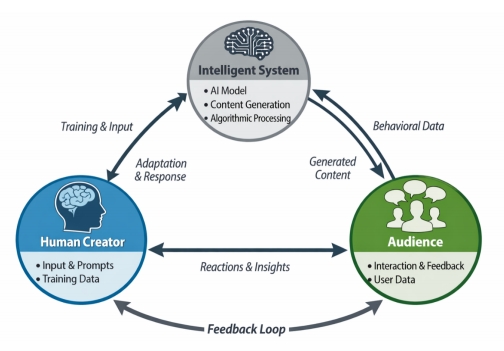
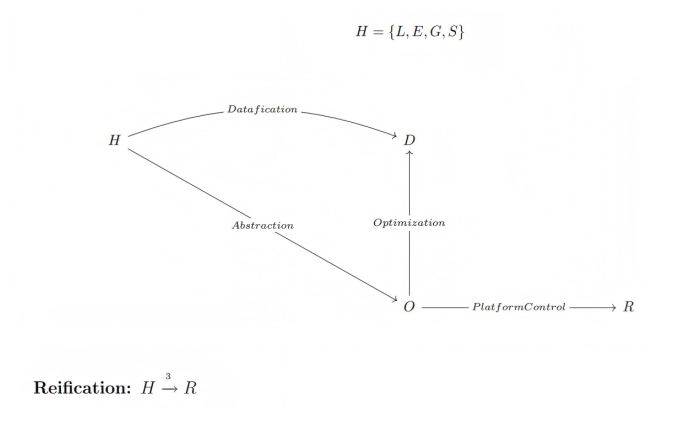
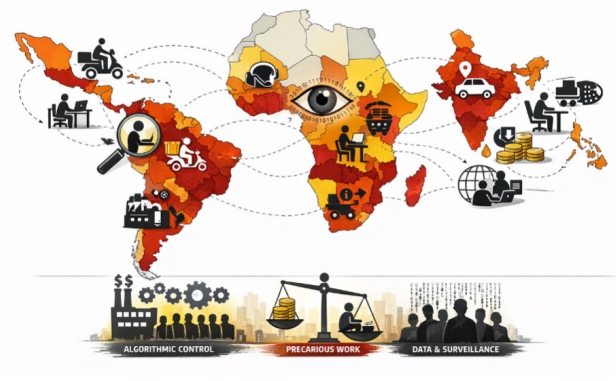
The contemporary expansion of platform economies has produced labor landscapes in the Global South that are at once hyper-visible and profoundly obscured. Workers such as drivers, content moderators, and microtaskers perform essential functions that sustain digital infrastructures, yet their contributions remain largely invisible, rendered abstract within algorithmic systems. This paper interrogates the mechanisms through which invisibility is produced, tracing the interlocking layers of digital labor, platform governance, and socio-economic precarity. Employing a conceptual-analytical methodology, it examines case studies from ride-hailing, crowdwork, and content moderation platforms, highlighting the asymmetrical distribution of agency between platforms and laborers. Analytical attention focuses on three layers: input labor, algorithmic mediation, and economic output, revealing how platforms simultaneously operationalize, quantify, and obscure human work. Methodologically, the paper adopts a conceptual-analytical approach grounded in secondary empirical literature and comparative case illustrations from the Global South. Diagrams illustrate labor flows and visibility gradients, situating worker contributions within broader computational and economic structures. Findings indicate that invisibility is not incidental but structurally embedded: it serves both profit maximization and epistemic obfuscation, reshaping perceptions of labor value and authorship. Beyond empirical description, the paper engages critically with ethical, cultural, and epistemological implications, emphasizing how platform-mediated work reproduces pre-existing social hierarchies while generating novel forms of digital inequality. In conclusion, the study advances a framework for understanding platform labor as emergent, distributed, and algorithmically conditioned, urging further research on governance, regulation, and labor rights in digitally mediated economies. The study contributes a fourfold typology of invisible labor and develops a comparative framework linking algorithmic governance, labor invisibility, and socio-economic inequality.


 131 (Views)
  95 (Downloads)