
Articles
Digital Narratives in the Age of Intelligent Systems
 Download
Authors

Received: 1 February 2026; Revised: 9 April 2026; Accepted: 15 May 2026; Published: 26 May 2026
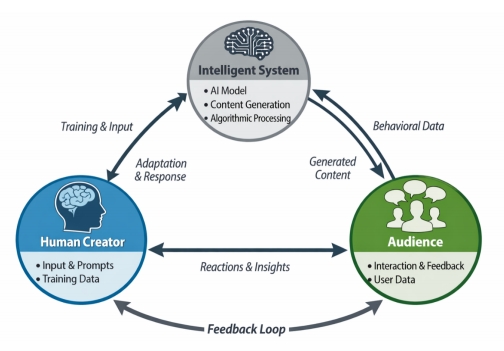
Digital narratives no longer emerge solely from human intention; they are increasingly co-constructed within ecosystems shaped by intelligent systems. This paper interrogates how algorithmic processes, particularly those driven by artificial intelligence, reconfigure narrative authority, temporality, and meaning-making. Rather than treating technology as a neutral conduit, the study positions intelligent systems as active narrative agents that influence both the production and circulation of stories. The inquiry begins by re-examining foundational assumptions in narrative theory, where authorship was historically singular and linear, and contrasts this with contemporary, data-driven storytelling environments. Through a conceptual-analytical approach, the paper traces the shift from static digital storytelling to adaptive, generative, and interactive narrative forms. It argues that narratives produced within intelligent systems operate through probabilistic logic, introducing fluidity and indeterminacy that challenge traditional notions of coherence and authenticity. A proposed conceptual diagram illustrates the triadic relationship between human creators, algorithmic systems, and audiences, emphasizing feedback loops that continuously reshape narrative outputs. This transformation carries significant implications for cultural production, epistemology, and ethical accountability. The paper concludes by calling for a re-theorization of narrative frameworks within digital humanities to accommodate the agency of intelligent systems.
Keywords:
Digital Narratives Intelligent Systems Algorithmic Storytelling Human–AI Interaction Digital HumanitiesReferences
- Magarelli, E. Narrating survival: Exploring digital storytelling as a tool for language mediation practices. Cross-Media Lang. Appl. Res. Digit. Tools Methodol. 2025, 3, 87–98. DOI: https://doi.org/10.15162/2974-8933/2205
- Striphas, T. Algorithmic culture. Eur. J. Cult. Stud. 2015, 18, 395–412. DOI: https://doi.org/10.1177/1367549415577392
- Alhussain, A.; Azmi, A. Automatic story generation: A survey of approaches. ACM Comput. Surv. 2021, 54, 1–38. DOI: https://doi.org/10.1145/3453156
- George, R.A. Narrative generation in entertainment: Using artificial intelligence planning. Fields J. Huddersfield Stud. Res. 2015, 1, 1–10. DOI: https://doi.org/10.5920/fields.2015.118
- Azaizia, A.M.; Merzougui, H.E. Reimagining digital narratives: The role of AI and immersive technologies in transforming storytelling. Akofena Rev. Sci. Sci. Lang. Lett. Lang. Commun. 2024, 5, 369–380. DOI: https://doi.org/10.48734/akofena.n013.vol.5.30.2024
- Harahap, K.; Muhtar; Sakarina, S.; et al. Digital narratives and AI in modern media: A systematic literature review. In Tech Fusion in Business and Society; Springer: Cham, Switzerland, 2025; pp. 197–205. DOI: https://doi.org/10.1007/978-3-031-84636-6_16
- Simon-Shoshan, M. Narrativity and Textuality in the Study of Stories. In Proceedings of the 2013 Workshop on Computational Models of Narrative, Hamburg, Germany, 4–6 August 2013. DOI: https://doi.org/10.4230/OASIcs.CMN.2013.228
- Molnar, A.; Kostkova, P. Learning through interactive digital narratives. In Interactive Digital Narrative: History, Theory and Practice; Koenitz, H., Ferri, G., Haahr, M., et al., Eds.; Routledge: London, UK, 2015; pp. 197–210. DOI: https://doi.org/10.4324/9781315769189-16
- Ryan, M.L. Narrative as Virtual Reality 2: Revisiting Immersion and Interactivity in Literature and Electronic Media; Johns Hopkins University Press: Baltimore, MD, USA, 2015.
- Boden, M.A. The Creative Mind: Myths and Mechanisms, 2nd ed.; Routledge: London, UK, 2004.
- Gondek, P. Creativity and intentionality: A philosophical attempt at reconstructing a creative process. Creat. Stud. 2021, 14, 419–429. DOI: https://doi.org/10.3846/cs.2021.12893
- Cropley, D.H.; Cropley, A. Functional creativity: Products and the generation of effective novelty. In The Cambridge Handbook of Creativity; Kaufman, J.C., Sternberg, R.J., Eds.; Cambridge University Press: Cambridge, UK, 2010; pp. 301–317. DOI: https://doi.org/10.1017/CBO9780511763205.019
- Shneiderman, B. Human-Centered AI; Oxford University Press: Oxford, UK, 2022.
- Mergen, A.; Kılıç, N.Ç.; Ozbilgin, M.F. Artificial intelligence and bias towards marginalized groups: Theoretical roots and challenges. In AI and Diversity in a Datafied World of Work: Will the Future of Work be Inclusive; Vassilopoulou, J., Kyriakidou, O., Eds.; Emerald Publishing Limited: Leeds, UK, 2025. DOI: https://doi.org/10.1108/S2051-233320250000012004
- Alon, L.; Shoval, D.H.; Levkovich, I. Bias and representation in AI-generated text-to-image in education: A systematic review. Comput. Educ. Artif. Intell. 2026, 10, 100587. DOI: https://doi.org/10.1016/j.caeai.2026.100587
- Kruk, M. Legal meaning as a shared enterprise: The judiciary-scholarship dynamic through the social division of linguistic labour. Stud. Iuridica 2025, 106, 1–15.
- Katsampoxaki-Hodgetts, K.; Kotsidis, K.; Papadakis, S.; et al. Reimagining preschool pedagogy: AI-enhanced teaching through multiliteracies-informed curriculum innovation. In Proceedings of the 6th International Baltic Symposium on Science and Technology Education (BalticSTE2025), Šiauliai, Lithuania, 16–19 June 2025; pp. 104–119. DOI: https://doi.org/10.33225/BalticSTE/2025.104
- Gurung, M.I.; Agarwal, N. Narrative diffusion in social networks: A survey. Soc. Netw. Anal. Min. 2026, 16, 19. DOI: https://doi.org/10.1007/s13278-025-01565-1
- Nguyen, Q.N.; Doan, D.T.H. Idiographic self-regulated affordance uptake in AI-mediated language learning. Cogent Educ. 2025, 12, 2581414. DOI: https://doi.org/10.1080/2331186X.2025.2581414
- Oke, T. Algorithmic narrativity as a new narrative mode. AI Soc. 2025, 40, 5457–5468. DOI: https://doi.org/10.1007/s00146-025-02297-8
- Joyeux-Prunel, B. Digital humanities in the era of digital reproducibility: towards a fairest and post-computational framework. Int. J. Digit. Humanit. 2024, 6, 23–43. DOI: https://doi.org/10.1007/s42803-023-00079-6
- Fairclough, N. Critical Discourse Analysis: The Critical Study of Language, 2nd ed.; Routledge: London, UK, 2010.
- Abroshan, H. AI to protect AI: A modular pipeline for detecting label-flipping poisoning attacks. Mach. Learn. Appl. 2025, 22, 100768. DOI: https://doi.org/10.1016/j.mlwa.2025.100768
- Matter, N.M.; Gado, N. Artificial intelligence in architecture: Integration into architectural design process. Eng. Res. J. 2024, 181, 1–16.
- Meretoja, H. Metanarrative autofiction: Critical engagement with cultural narrative models. In The Autofictional; Springer: Cham, Switzerland, 2022; pp. 121–140. DOI: https://doi.org/10.1007/978-3-030-78440-9_7
- Cohn, N. Visual narrative comprehension: Universal or not? Psychon. Bull. Rev. 2019, 27, 266–285. DOI: https://doi.org/10.3758/s13423-019-01670-1
- Morgan, M.S. Narrative ordering and explanation. Stud. Hist. Philos. Sci. A 2017, 62, 86–97. DOI: https://doi.org/10.1016/j.shpsa.2017.03.006
- Manrai, L.A.; Manrai, A.K.; Lascu, D.; et al. Determinants and effects of cultural context: A review, conceptual model, and propositions. J. Glob. Mark. 2019, 32, 67–82.
- Freire, M. Transmedia storytelling: From convergence to transliteracy. DELTA Doc. Estud. Ling. Teor. Apl. 2020, 36, 309–328. DOI: https://doi.org/10.1590/1678-460x2020360309
- Lin, W. Fostering creativity through interactive digital narratives: a multidimensional learning framework for animation education. Interact. Learn. Environ. 2026, 1–14. DOI: https://doi.org/10.1080/10494820.2025.2611121
- Gillespie, T. The relevance of algorithms. In Media Technologies: Essays on Communication, Materiality, and Society; MIT Press: Cambridge, MA, USA, 2013. DOI: https://doi.org/10.7551/mitpress/9780262525374.003.0009
- Triantafyllopoulos, L.; Paxinou, E.; Tzanoulinou, D.; et al. The value alignment problem in advisory AI: A systematic literature review. AI Ethics 2026, 6, 147.
- Seyfert, R.; Roberge, J., Eds. Algorithmic Cultures: Essays on Meaning, Performance and New Technologies; Routledge: Abingdon, UK, 2016. DOI: https://doi.org/10.4324/9781315658698
- Abokhodair, N.; Skop, Y.; Rüller, S.; et al. Opaque algorithms, transparent biases: Automated content moderation during the Sheikh Jarrah crisis. First Monday 2024, 29, 4. DOI: https://doi.org/10.5210/fm.v29i4.13620
- Gagrčin, E.; Naab, T.; Grub, M.F. Algorithmic media use and algorithm literacy: An integrative literature review. New Media Soc. 2024, 28, 423–447. DOI: https://doi.org/10.1177/14614448241291137
- Adelusola, M.; Adenekan, T.K. Algorithmic Governance and the Redefinition of Bureaucratic Accountability in Digital States. Available online: https://www.researchgate.net/publication/392596320 (accessed on 2 January 2026).
- Bouizegarene, N.; Ramstead, M.J.D.; Constant, A.; et al. Narrative as active inference: An integrative account of cognitive and social functions in adaptation. Front. Psychol. 2024, 15, 1345480. DOI: https://doi.org/10.3389/fpsyg.2024.1345480
- Gaffar, A. AI analysis in digital cultural transformation: Theories, cases, and implications for society. J. Soc. Res. 2025, 4, 977–984. DOI: https://doi.org/10.55324/josr.v4i6.2567