
Articles
Artificial Intelligence, Structural Transformation, and the Rethinking of Labour-Intensive Growth in India
 Download

This work is licensed under a Creative Commons Attribution 4.0 International License.
Authors

Received: 16 February 2026; Revised: 28 March 2026; Accepted: 11 April 2026; Published: 18 June 2026
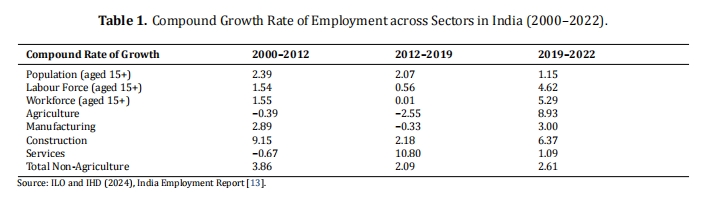
This study examines how artificial intelligence (AI) interacts with structural transformation to shape labour market outcomes in India, with particular focus on whether labour-intensive growth remains a viable strategy for inclusive development. India's demographic advantage demands large-scale productive employment, yet traditional pathways through manufacturing-led industrialisation are being disrupted by AI and automation technologies that affect both routine and cognitive tasks across sectors. Using a descriptive-analytical method, this paper draws on secondary data from the Periodic Labour Force Survey (PLFS), the India Employment Report (2024), World Bank indicators, OECD (Organization for Economic Co-operation and Development) publications, and IMF (International Monetary Fund) research to examine sectoral employment trends, AI adoption patterns, and workforce exposure across skill levels and regions. The findings reveal that India's structural transformation remains incomplete: employment growth is concentrated in low-productivity construction and informal services rather than in manufacturing. AI adoption follows a highly uneven trajectory, confined largely to formal, urban, high-skill environments, while the majority of workers remain in low-exposure, low-complementarity occupations that are bypassed by technological productivity gains. This creates a form of technological dualism that reinforces existing labour market segmentation. The study concludes that while labour-intensive growth retains developmental relevance, its viability depends on the simultaneous pursuit of technological upgrading, broad-based skill development, and supportive institutional frameworks. India's challenge lies not in choosing between employment and technology, but in redesigning its growth strategy so that both reinforce each other.
Keywords:
Artificial Intelligence Structural Transformation Labour-Intensive Growth Employment India Technological Change Informal EconomyReferences
- Acemoglu, D.; Restrepo, P. Automation and new tasks: How technology displaces and reinstates labour. J. Econ. Perspect. 2019, 33, 3–30.
- Autor, D.H. Why are there still so many jobs? The history and future of workplace automation. J. Econ. Perspect. 2015, 29, 3–30.
- Brynjolfsson, E.; Mitchell, T.; Rock, D. What can machines learn and what does it mean for occupations and the economy? AEA Pap. Proc. 2018, 108, 43–47.
- Cazzaniga, M.; Jaumotte, F.; Li, L.; et al. Gen-AI: Artificial Intelligence and the Future of Work; International Monetary Fund: Washington, DC, USA, 2024.
- World Bank. Digital Progress and Trends Report 2025: Strengthening AI for Development; World Bank: Washington, DC, USA, 2025.
- International Labour Organization (ILO). World Employment and Social Outlook: Trends 2024; ILO: Geneva, Switzerland, 2024.
- Dosi, G.; Virgillito, M.E. In search of the Holy Grail: Project and method in evolutionary economics. Ind. Corp. Change 2019, 28, 195–226.
- Rodrik, D.; Stiglitz, J.E. A New Growth Strategy for Developing Nations; IEA (International Energy Agency): Paris, France; ERIA (Economic Research Institute for ASEAN and East Asia): Jakarta, Indonesia, 2024.
- Lewis, W.A. Economic development with unlimited supplies of labour. Manchester Sch. 1954, 22, 139–191.
- Bessen, J.E. AI and Jobs: The Role of Demand; NBER: Cambridge, MA, USA, 2018.
- Acemoglu, D.; Restrepo, P. The wrong kind of AI? Artificial intelligence and the future of labour demand. Camb. J. Reg. Econ. Soc. 2020, 13, 25–35.
- Rodrik, D. Premature deindustrialisation. J. Econ. Growth 2016, 21, 1–33.
- International Labour Organisation (ILO); Institute for Human Development (IHD). India Employment Report 2024: Youth Employment, Education and Skills; ILO: Geneva, Switzerland, 2024.
- Mehrotra, S.; Parida, J.K. Why is the labour force participation of women declining in India? World Dev. 2017, 98, 360–380.
- Acemoglu, D.; Restrepo, P. Robots and jobs: Evidence from US labour markets. J. Polit. Econ. 2020, 128, 2188–2244.
- Huang, Y. The Labour Market Impact of Artificial Intelligence: Evidence from US Regions; International Monetary Fund: Washington, DC, USA, 2024.
- Green, A.; Lamby, E.; Squicciarini, M. Artificial Intelligence and the Changing Demand for Skills in the Labour Market; OECD Publishing: Paris, France, 2024.
- OECD. Employment Outlook 2023: Artificial Intelligence and the Labour Market; OECD Publishing: Paris, France, 2023.
- Demombynes, G.; Langbein, J.; Weber, M. The Exposure of Workers to Artificial Intelligence in Low- and Middle-Income Countries; World Bank: Washington, DC, USA, 2025.
- International Labour Organization (ILO). Emerging Technologies and the Future of Work in India; ILO: Geneva, Switzerland, 2018.
- Malik, A.; Jain, R. Interactions of Artificial Intelligence with India's Labour Market; ICRIER: New Delhi, India, 2026.
- Copestake, A.; Marczinek, M.; Pople, A.; et al. AI and Services-Led Growth: Evidence from Indian Job Adverts; World Bank: Washington, DC, USA, 2024.
- World Bank. World Development Indicators; World Bank: Washington DC, USA, 2023.
- Kochhar, K. India's Labour Market: A New Paradigm; IMF: Washington, DC, USA, 2022.
- OECD. Using Artificial Intelligence in the Workplace; OECD Publishing: Paris, France, 2024.