
Articles
Health Professionals’ Peer Engagement in the Digital Age: Exploring the Use of Online Platforms and Communities
 Download

This work is licensed under a Creative Commons Attribution 4.0 International License.
Authors
- Lillian Li Faculty of Medicine and Health, The University of Sydney, Sydney 2006, Australia
-
Rowena Forsyth
 Cyberpsychology Research Group, Faculty of Medicine and Health, The University of Sydney, Sydney 2006, Australia
-
Brad Ridout
Cyberpsychology Research Group, Faculty of Medicine and Health, The University of Sydney, Sydney 2006, Australia
-
Krestina Len Amon
Cyberpsychology Research Group, Faculty of Medicine and Health, The University of Sydney, Sydney 2006, Australia
Received: 28 January 2026; Revised: 30 April 2026; Accepted: 14 May 2026; Published: 29 May 2026
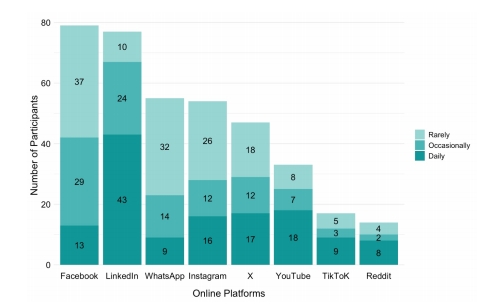
Online communities are valuable tools for information exchange, professional networking, and peer support for health professionals. However, evidence of how and why health professionals are engaging with their peers online is lacking. This study aimed to identify the types and frequency of peer online interactions conducted by health professionals across a broad range of online platforms and identify factors influencing their use. We used online questionnaires to capture health professionals’ online behaviours, digital competency, feelings of online social connectedness, and well-being. Participants (n = 119) used an average of 3.4 platforms. Facebook (66.39%), LinkedIn (64.71%), and WhatsApp (46.22%) were the platforms with the highest account ownership relative to Instagram (45.38%), X (39.50%), YouTube (27.73%), TikTok (14.29%), and Reddit (11.76%). The types of interaction (active vs. passive) health professionals used to engage with their peers varied by platform. A key factor motivating participants to engage in online communities was that our participants possessed the knowledge and skills to leverage the online resources provided by their collective peers for professional benefits. The study revealed a positive association between broader online platform use and greater feelings of social connectedness, while the relationship between social connectedness and well-being was more complex after adjustment for demographic factors. The results of this study highlight the benefits of online peer engagement but also identify strategies that can be implemented to support and enhance the use of online communities for health professionals. Continuing work in this field will enhance understanding of the professional and social benefits provided by online communities for health professionals.
Keywords:
Online Communities Social Media Health Professionals Communication Health InformationReferences
- Rains, S.A. Groups in Health Contexts: Online Health Communities. In Group Communication; Reimer, T., Park, E.S., Bonito, J.A., Eds.; Routledge: New York, NY, USA, 2023; pp. 293–304.
- Farsi, D.; Martinez-Menchaca, H.R.; Ahmed, M.; et al. Social Media and Health Care (Part II): Narrative Review of Social Media Use by Patients. J. Med. Internet Res. 2022, 24, e30379. DOI: https://doi.org/10.2196/30379
- Bernardi, R.; Wu, P.F. Online health communities and the patient-doctor relationship: An institutional logistics perspective. Soc. Sci. Med. 2022, 314, 115494. DOI: https://doi.org/10.1016/j.socscimed.2022.115494
- Anawade, P.A.; Sharma, D.; Gahane, S. Connecting Health and Technology: A Comprehensive Review of Social Media and Online Communities in Healthcare. Cureus 2024, 16, e55361. DOI: https://doi.org/10.7759/cureus.55361
- Al Adwan, M.N.; Safori, A.; Habes, M.; et al. Why New Media app during the Healthcare Crisis? WhatsApp Based Study. Stud. Media Commun. 2023, 11, 5985. DOI: https://doi.org/10.11114/smc.v11i3.5985
- Fazil, A.W.; Hakimi, M.; Akrami, K.; et al. Exploring the Role of Social Media in Bridging Gaps and Facilitating Global Communication. Stud. Media, Journalism Comm. 2024, 2, 13–21. DOI: https://doi.org/10.32996/smjc.2024.2.1.2
- Dong, C.; Cheema, M.; Samarasekera, D.; et al. Using LinkedIn for continuing community of practice among hand surgeons worldwide. J. Contin. Educ. Health Prof. 2015, 35, 185–191. DOI: https://doi.org/10.1002/chp.21300
- Guerra, F.; Linz, D.; Garcia, R.; et al. The use of social media for professional purposes by healthcare professionals: The #intEHRAct survey. EP Europace 2022, 24, 691–696. DOI: https://doi.org/10.1093/europace/euab244
- Panahi, S.; Watson, J.; Partridge, H. Social media and physicians: Exploring the benefits and challenges. Health Informatics J. 2014, 22, 99–112. DOI: https://doi.org/10.1177/1460458214540907
- Amon, K.L.; Brunner, M.; Campbell, A.J. The Reel Health Care Professionals of Instagram: A Systematic Review. Cyberpsychol. Behav. Soc. Netw. 2024, 27, 172–186. DOI: https://doi.org/10.1089/cyber.2023.0311
- Fox, K.; Singh, P. What are dental professionals posting on Facebook? A cross-sectional content analysis. J. Orthod. 2022, 49, 185–194. DOI: https://doi.org/10.1177/14653125211033302
- Nikiphorou, E.; Studenic, P.; Ammitzbøll, C.G.; et al. Social media use among young rheumatologists and basic scientists: Results of an international survey by the Emerging EULAR Network (EMEUNET). Ann. Rheum. Dis. 2017, 76, 712–715. DOI: https://doi.org/10.1136/annrheumdis-2016-209718
- Shaw, L.; Jazayeri, D.; Kiegaldie, D.; et al. Implementation of Virtual Communities of Practice in Healthcare to Improve Capability and Capacity: A 10-Year Scoping Review. Int. J. Environ. Res. Public Health 2022, 19, 7994. DOI: https://doi.org/10.3390/ijerph19137994
- Hara, N.; Foon Hew, K. Knowledge-sharing in an online community of health-care professionals. Inform. Technol. People 2007, 20, 235–261. DOI: https://doi.org/10.1108/09593840710822859
- Chang, J.B.; Woo, S.L.; Cederna, P.S. Worth the "likes"? The use of Facebook among plastic surgeons and its perceived impact. Plast. Reconstr. Surg. 2015, 135, 909e–918e. DOI: https://doi.org/10.1097/prs.0000000000001318
- Antheunis, M.L.; Tates, K.; Nieboer, T.E. Patients’ and health professionals’ use of social media in health care: Motives, barriers and expectations. Patient Educ. Couns. 2013, 92, 426–431. DOI: https://doi.org/10.1016/j.pec.2013.06.020
- Barry, A.R.; Pearson, G.J. Professional use of social media by pharmacists. Can. J. Hosp. Pharm. 2015, 68, 22–27. DOI: https://doi.org/10.4212/cjhp.v68i1.1421
- Campbell, L.; Evans, Y.; Pumper, M.; et al. Social media use by physicians: A qualitative study of the new frontier of medicine. BMC Med. Inform. Decis. Mak. 2016, 16, 91. DOI: https://doi.org/10.1186/s12911-016-0327-y
- Bhuiyan, M.N.; Medina-Inojosa, J.R.; Croghan, I.T.; et al. Internal medicine physicians and social media: Knowledge, skills, and attitudes. J. Prim. Care Community Health 2020, 11, 2150132720969022. DOI: https://doi.org/10.1177/2150132720969022
- Jeyaraman, M.; Ramasubramanian, S.; Kumar, S.; et al. Multifaceted Role of Social Media in Healthcare: Opportunities, Challenges, and the Need for Quality Control. Cureus 2023, 15, 39111. DOI: https://doi.org/10.7759/cureus.39111
- Economides, J.M.; Fan, K.L.; Pittman, T.A. An analysis of plastic surgeons’ social media use and perceptions. Aesthetic Surg. J. 2018, 39, 794–802. DOI: https://doi.org/10.1093/asj/sjy209
- Ikioda, F.; Kendall, S.; Brooks, F.; et al. Factors that influence healthcare professionals’ online interaction in a virtual community of practice. Soc. Networking 2013, 2, 174–184. DOI: https://doi.org/10.4236/sn.2013.24017
- Rolls, K.; Hansen, M.; Jackson, D.; et al. How health care professionals use social media to create virtual communities: An integrative review. J. Med. Internet Res. 2016, 18, e166. DOI: https://doi.org/10.2196/jmir.5312
- Stewart, S.A.; Abidi, S.S.R. Applying social network analysis to understand the knowledge sharing behaviour of practitioners in a clinical online discussion forum. J. Med. Internet Res. 2012, 14, e170. DOI: https://doi.org/10.2196/jmir.1982
- Sheehan, J.; Laver, K.; Bhopti, A.; et al. Methods and effectiveness of communication between hospital allied health and primary care practitioners: A systematic narrative review. J. Multidiscip. Healthcare 2021, 14, 493–511. DOI: https://doi.org/10.2147/JMDH.S295549
- Tasselli, S. Social networks and inter-professional knowledge transfer: The case of healthcare professionals. Organ. Stud. 2015, 36, 841–872. DOI: https://doi.org/10.1177/0170840614556917
- Barnett, S.; Jones, S.C.; Bennett, S.; et al. Usefulness of a virtual community of practice and Web 2.0 tools for general practice training: Experiences and expectations of general practitioner registrars and supervisors. Australas. J. Primary Health 2013, 19, 292–296. DOI: https://doi.org/10.1071/py13024
- Deane, J.A.; Clunie, G. Healthcare professionals in research (HPiR) Facebook community: A survey of U.K. doctoral and postdoctoral healthcare professionals outside of medicine. BMC Med. Educ. 2021, 21, 236. DOI: https://doi.org/10.1186/s12909-021-02672-1
- Berthelsen, M.; Pallesen, S.; Magerøy, N.; et al. Effects of psychological and social factors in shiftwork on symptoms of anxiety and depression in nurses: A 1-year follow-up. J. Occup. Environ. Med. 2015, 57, 1127–1137. DOI: https://doi.org/10.1097/jom.0000000000000532
- Feldman, T.R.; Carlson, C.L.; Rice, L.K.; et al. Factors predicting the development of psychopathology among first responders: A prospective, longitudinal study. Psychol. Trauma 2021, 13, 75–83. DOI: https://doi.org/10.1037/tra0000957
- Grieve, R.; Kemp, N. Individual differences predicting social connectedness derived from Facebook: Some unexpected findings. Comput. Human Behav. 2015, 51, 239–243. DOI: https://doi.org/10.1016/j.chb.2015.04.034
- Calica, K.A.N.; Paterson, R.E. The listening project: A qualitative study on the experiences of pre-registered nurses during the Covid-19 pandemic in Scotland. Heliyon 2023, 9, e12664. DOI: https://doi.org/10.1016/j.heliyon.2022.e12664
- Whitesman, S.; Mash, R. Examining the effects of a mindfulness-based distance learning professional training module on personal and professional functioning: A qualitative study. BMC Med. Educ. 2016, 16, 287. DOI: https://doi.org/10.1186/s12909-016-0810-2
- De Cieri, H.; Shea, T.; Cooper, B.; et al. Effects of Work-Related Stressors and Mindfulness on Mental and Physical Health Among Australian Nurses and Healthcare Workers. J. Nurs. Scholarsh. 2019, 51, 580–589. DOI: https://doi.org/10.1111/jnu.12502
- Tang, Y.; Zhang, M.; Huang, Y.; et al. The dose-response relationship between work hours and mental health in healthcare workers: A cross-sectional study in a Chinese medical consortium. Saf. Sci. 2026, 196, 107093. DOI: https://doi.org/10.1016/j.ssci.2025.107093
- Zeinolabedini, M.; Motlagh, M.E.; Heidarnia, A.; et al. From source identification to preferential interventions: Determinants of a workplace mental health promotion program to control workplace stress among health care workers based on a qualitative study. PLoS One 2026, 21, e0340575. DOI: https://doi.org/10.1371/journal.pone.0340575
- McGowan, B.S.; Wasko, M.; Vartabedian, B.S.; et al. Understanding the factors that influence the adoption and meaningful use of social media by physicians to share medical information. J. Med. Internet Res. 2012, 14, e117. DOI: https://doi.org/10.2196/jmir.2138
- Grieve, R.; Indian, M.; Witteveen, K.; et al. Face-to-face or Facebook: Can social connectedness be derived online? Comput. Human Behav. 2013, 29, 604–609. DOI: https://doi.org/10.1016/j.chb.2012.11.017
- Dyrbye, L.N.; Satele, D.; Sloan, J.; et al. Ability of the physician well-being index to identify residents in distress. J. Grad. Med. Educ. 2014, 6, 78–84. DOI: https://doi.org/10.4300/jgme-d-13-00117.1
- Trifiro, B.M.; Gerson, J. Social media usage patterns: Research note regarding the lack of universal validated measures for active and passive use. Social Media + Society 2019, 5, 2056305119848743. DOI: https://doi.org/10.1177/2056305119848743
- Dzienny, A.C.; Toal, C.T.; Fitzgerald, J.J.; et al. Who's posting what? A qualitative, cross-sectional study comparing Twitter and Instagram patterns between health care professionals and patients. Urogynecology 2022, 28, 492–499. DOI: https://doi.org/10.1097/spv.0000000000001206
- Koya, K.D.; Bhatia, K.R.; Hsu, J.T.; et al. YouTube and the expanding role of videos in dermatologic surgery education. Semin. Cutan. Med. Surg. 2012, 31, 163–167.
- Araujo, T.; Wonneberger, A.; Neijens, P.; et al. How much time do you spend online? Understanding and improving the accuracy of self-reported measures of internet use. Commun. Methods Meas. 2017, 11, 173–190. DOI: https://doi.org/10.1080/19312458.2017.1317337
- Hazzam, J.; Lahrech, A. Health care professionals’ social media behavior and the underlying factors of social media adoption and use: Quantitative study. J. Med. Internet Res. 2018, 20, e12035. DOI: https://doi.org/10.2196/12035
- Casemajor, N.; Couture, S.; Delfin, M.; et al. Non-participation in digital media: Toward a framework of mediated political action. Media Culture Society 2015, 37, 850–866. DOI: https://doi.org/10.1177/0163443715584098
- Lutz, C.; Hoffmann, C.P. The dark side of online participation: Exploring non-, passive and negative participation. Inform. Commun. Society 2017, 20, 876–897. DOI: https://doi.org/10.1080/1369118X.2017.1293129
- Lee, A.Y.; Katz, R.; Hancock, J. The role of subjective construals on reporting and reasoning about social media use. Social Media + Society 2021, 7, 2056305211035350. DOI: https://doi.org/10.1177/20563051211035350
- Shrestha, A.; Graham, D.M.; Dumaru, P.; et al. Understanding the Behavior, Challenges, and Privacy Risks in Digital Technology Use by Nursing Professionals. Proc. ACM Hum.-Comput. Interact. 2022, 6, 343. DOI: https://doi.org/10.1145/3555763
- Brown, J.; Ryan, C.; Harris, A. How doctors view and use social media: A national survey. J. Med. Internet Res. 2014, 16, e267. DOI: https://doi.org/10.2196/jmir.3589
- Tunnecliff, J.; Ilic, D.; Morgan, P.; et al. The acceptability among health researchers and clinicians of social media to translate research evidence to clinical practice: Mixed-methods survey and interview study. J. Med. Internet Res. 2015, 17, e119. DOI: https://doi.org/10.2196/jmir.4347
- Kuek, A.; Hakkennes, S. Healthcare staff digital literacy levels and their attitudes towards information systems. Health Informatics J. 2020, 26, 592–612. DOI: https://doi.org/10.1177/1460458219839613
- Ma, S.; Chen, C. Are digital natives overconfident in their privacy literacy? Discrepancy between self-assessed and actual privacy literacy, and their impacts on privacy protection behavior. Front. Psychol. 2023, 14, 1224168. DOI: https://doi.org/10.3389/fpsyg.2023.1224168
- Lee, R.; Robbins, S. Measuring belongingness: The social connectedness and the social assurance scales. J. Couns. Psychol. 1995, 42, 232–241. DOI: https://doi.org/10.1037/0022-0167.42.2.232
- McMillan, D.W.; Chavis, D.M. Sense of community: A definition and theory. J. Community Psychol. 1986, 14, 6–23. DOI: https://doi.org/10.1002/1520-6629(198601)14:1<6::AID-JCOP2290140103>3.0.CO;2-I
- Burke, M.; Marlow, C.; Lento, T. Social network activity and social well-being. In Proceedings of the Proceedings of the SIGCHI Conference on Human Factors in Computing Systems, Atlanta, GA, USA, 10–15 April 2010; pp. 1909–1912. DOI: https://doi.org/10.1145/1753326.1753613
- Voggenreiter, A.; Brandt, S.; Putterer, F.; et al. The role of likes: How online feedback impacts users' mental health. In Proceedings of the 16th ACM Web Science Conference, Stuttgart, Germany, 21–24 May 2024; pp. 302–310. DOI: https://doi.org/10.1145/3614419.3643995
- Zell, A.L.; Moeller, L. Are you happy for me … on Facebook? The potential importance of “likes” and comments. Comput. Human Behav. 2018, 78, 26–33. DOI: https://doi.org/10.1016/j.chb.2017.08.050
- Ryan, R.M.; Deci, E.L. Self-determination theory and the facilitation of intrinsic motivation, social development, and well-being. Am. Psychol. 2000, 55, 68–78. DOI: https://doi.org/10.1037/0003-066X.55.1.68
- Deters, F.G.; Mehl, M.R. Does posting Facebook status updates increase or decrease loneliness? An online social networking experiment. Soc. Psychol. Personal. Sci. 2013, 4, 579–586. DOI: https://doi.org/10.1177/1948550612469233
- Liu, C.-Y.; Yu, C.-P. Can Facebook use induce well-being? Cyberpsychol. Behav. Soc. Netw. 2013, 16, 674–678. DOI: https://doi.org/10.1089/cyber.2012.0301
- Tifferet, S. Gender Differences in Social Support on Social Network Sites: A Meta-Analysis. Cyberpsychol. Behav. Soc. Netw. 2020, 23, 199–209. DOI: https://doi.org/10.1089/cyber.2019.0516
- Shin, H.; Park, C. Gender differences in social networks and physical and mental health: Are social relationships more health protective in women than in men? Front. Psychol. 2023, 14, 1216032. DOI: https://doi.org/10.3389/fpsyg.2023.1216032
- Gagnon, K.; Sabus, C. Professionalism in a Digital Age: Opportunities and Considerations for Using Social Media in Health Care. Phys. Ther. 2015, 95, 406–414. DOI: https://doi.org/10.2522/ptj.20130227
- Bitter, J.; van Veen‐Berkx, E.; Gooszen, H.G.; et al. Multidisciplinary teamwork is an important issue to healthcare professionals. Team Perform. Manage. 2013, 19, 263–278. DOI: https://doi.org/10.1108/TPM-11-2012-0041
- Shaleha, R.; Roque, N.; Andrews, H.; et al. Screen Use Measurement Tools: A Mapping of Instruments, Gaps, and Future Directions. Cyberpsychol. Behav. Soc. Netw. 2026, 29, 140–150.
- World Health Organization. Delivered by Women, Led by Men: A Gender and Equity Analysis of the Global Health and Social Workforce; World Health Organization: Geneva, Switzerland, 2019. Available online: https://www.who.int/publications/i/item/9789241515467