
Articles
Platform Economies and Invisible Labor in the Global South
 Download

This work is licensed under a Creative Commons Attribution 4.0 International License.
Authors

Received: 1 March 2026; Revised: 2 May 2026; Accepted: 22 May 2026; Published: 24 June 2026
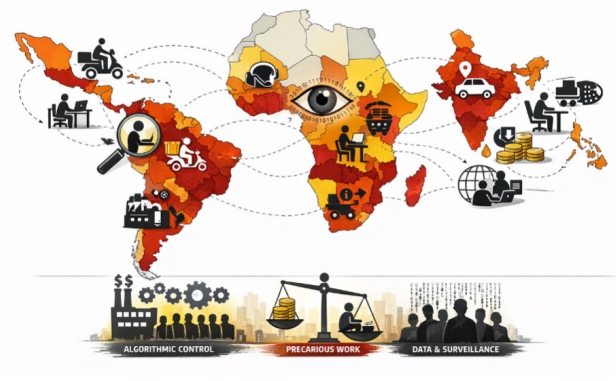
The contemporary expansion of platform economies has produced labor landscapes in the Global South that are at once hyper-visible and profoundly obscured. Workers such as drivers, content moderators, and microtaskers perform essential functions that sustain digital infrastructures, yet their contributions remain largely invisible, rendered abstract within algorithmic systems. This paper interrogates the mechanisms through which invisibility is produced, tracing the interlocking layers of digital labor, platform governance, and socio-economic precarity. Employing a conceptual-analytical methodology, it examines case studies from ride-hailing, crowdwork, and content moderation platforms, highlighting the asymmetrical distribution of agency between platforms and laborers. Analytical attention focuses on three layers: input labor, algorithmic mediation, and economic output, revealing how platforms simultaneously operationalize, quantify, and obscure human work. Methodologically, the paper adopts a conceptual-analytical approach grounded in secondary empirical literature and comparative case illustrations from the Global South. Diagrams illustrate labor flows and visibility gradients, situating worker contributions within broader computational and economic structures. Findings indicate that invisibility is not incidental but structurally embedded: it serves both profit maximization and epistemic obfuscation, reshaping perceptions of labor value and authorship. Beyond empirical description, the paper engages critically with ethical, cultural, and epistemological implications, emphasizing how platform-mediated work reproduces pre-existing social hierarchies while generating novel forms of digital inequality. In conclusion, the study advances a framework for understanding platform labor as emergent, distributed, and algorithmically conditioned, urging further research on governance, regulation, and labor rights in digitally mediated economies. The study contributes a fourfold typology of invisible labor and develops a comparative framework linking algorithmic governance, labor invisibility, and socio-economic inequality.
Keywords:
Platform Economies Invisible Labor Digital Labor Socio-Economic InequalityReferences
- O’Farrell, R.; Montagnier, P. Measuring Platform Mediated Workers; OECD Publishing: Paris, France, 2019. DOI: https://doi.org/10.1787/170a14d9-en
- Gussek, L.; Wiesche, M. Understanding the Careers of Freelancers on Digital Labor Platforms: The Case of IT Work. Inf. Syst. J. 2024, 34, 1664–1702. DOI: https://doi.org/10.1111/isj.12509
- Jones, S.; Sen, K. The Gendered Impact of Digital Jobs Platforms: Experimental Evidence from Mozambique. World Bank Econ. Rev. 2025, 39, 143–163. DOI: https://doi.org/10.1093/wber/lhae019
- Rogan, M.; Roever, S.; Chen, M.A.; et al. Informal Employment in the Global South: Globalization, Production Relations, and “Precarity”. In Research in the Sociology of Work; Emerald Publishing: Bingley, UK, 2017; 31, pp. 307–333. DOI: https://doi.org/10.1108/S0277-283320170000031010
- Gray, M.L.; Suri, S. Ghost Work: How to Stop Silicon Valley from Building a New Global Underclass; Houghton Mifflin Harcourt: Boston, MA, USA, 2019.
- Irani, L.; Silberman, M.S. Turkopticon: Interrupting Worker Invisibility in Amazon Mechanical Turk. In Proceedings of the SIGCHI Conference on Human Factors in Computing Systems, Paris, France, 27 April–2 May 2013; pp. 611–620.
- Bearson, D.; Kenney, M.; Zysman, J. Measuring the Impacts of Labor in the Platform Economy: New Work Created, Old Work Reorganized, and Value Creation Reconfigured. Ind. Corp. Change 2021, 30, 536–563. DOI: https://doi.org/10.1093/icc/dtaa046
- Papadimitropoulos, V. Platform Capitalism, Platform Cooperativism, and the Commons. Rethink. Marx. 2021, 33, 246–262. DOI: https://doi.org/10.1080/08935696.2021.1893108
- Wagh, R.K.; Packirisamy, P. Emotional Labor in the Digital Workplace: A Study of Its Effects on Job Satisfaction among Remote Professionals. Int. J. Res. Innov. Soc. Sci. 2025, 9, 4523–4529. DOI: https://doi.org/10.47772/IJRISS.2025.903SEDU0324
- Adekoya, O.; Mordi, C.; Ajonbadi, H.A.; et al. Implications of Algorithmic Management on Careers and Employment Relationships in the Gig Economy—A Developing Country Perspective. Inf. Technol. People 2023, 38, 686–713. DOI: https://doi.org/10.1108/ITP-01-2023-0064
- Van Belle, J.P.; Howson, K.; Graham, M.; et al. Fair Work in South Africa's Gig Economy: A Journey of Engaged Scholarship. Digit. Geogr. Soc. 2023, 5, 100064. DOI: https://doi.org/10.1016/j.diggeo.2023.100064
- Umney, C.; Stuart, M.; Bessa, I.; et al. Platform Labour Unrest in a Global Perspective: How, Where and Why Do Platform Workers Protest? Work Employ. Soc. 2024, 38. DOI: https://doi.org/10.1177/09500170231209676
- Alturkey, Y.A. The Gig Economy: Insights into Worker Experiences in the UK and Saudi Arabia. Open J. Bus. Manag. 2024, 12. DOI: https://doi.org/10.4236/ojbm.2024.123094
- Fuchs, C.; Sandoval, M. Digital Workers of the World Unite! A Framework for Critically Theorising and Analysing Digital Labour. tripleC 2014, 12, 486–563. DOI: https://doi.org/10.31269/triplec.v12i2.549
- Lünenborg, M.; Röttger-Rössler, B. Affective Formation of Publics: Places, Networks, and Media; Routledge: London, UK, 2023. DOI: https://doi.org/10.4324/9781003365426
- Gao, Y. AI-Driven Transformation in Employment and Labor Income: A Global Analysis of Workforce Dynamics. Sci. Ann. Econ. Bus. 2025, 72, 165–183. DOI: https://doi.org/10.47743/saeb-2025-0021
- Zandieh, A. Artificial Intelligence, Economic Inequality, and the Financial Hurdles to Sustainable Peace: Navigating the Interconnected Challenges of the 21st Century. Soc. Sci. Humanit. Open 2026, 13, 102687. DOI: https://doi.org/10.1016/j.ssaho.2026.102687
- Zhang, Z. The Transformation from Human Surplus Value to AI Algorithmic Surplus Value: Logic of the Critique of Capital in the Era of AI. Humanit. Soc. Sci. Commun. 2025, 13, 113. DOI: https://doi.org/10.1057/s41599-025-06420-4
- Jiang, J.; Lippert, I.; Alizadeh, A. Workers' Perceived Algorithmic Exploitation on Online Labor Platforms. In Proceedings of the Forty-Fourth International Conference on Information Systems, Hyderabad, India, 10–13 December 2023.
- Perrotta, C.; Selwyn, N.; Ewin, C. Artificial Intelligence and the Affective Labour of Understanding: The Intimate Moderation of a Language Model. New Media Soc. 2024, 26, 1585–1609. DOI: https://doi.org/10.1177/14614448221075296
- Jarrahi, M.H.; Newlands, G.; Lee, M.K.; et al. Algorithmic Management in a Work Context. Big Data Soc. 2021, 8, 1–14. DOI: https://doi.org/10.1177/20539517211020332
- Lee, M.K.; Kusbit, D.; Metsky, E.; et al. Working with Machines: The Impact of Algorithmic and Data-Driven Management on Human Workers. In Proceedings of the 33rd Annual ACM Conference on Human Factors in Computing Systems, Seoul, Republic of Korea, 18–23 April 2015; pp. 1603–1612. DOI: https://doi.org/10.1145/2702123.2702548
- Steiger, M.; Bharucha, T.J.; Venkatagiri, S.; et al. The Psychological Well-Being of Content Moderators: The Emotional Labor of Commercial Moderation and Avenues for Improving Support. In Proceedings of the CHI Conference on Human Factors in Computing Systems, Yokohama, Japan, 8–13 May 2021; pp. 1–14. DOI: https://doi.org/10.1145/3411764.3445092
- Shrestha, Y.R.; Ben-Menahem, S.; von Krogh, G. Organizational Decision-Making Structures in the Age of Artificial Intelligence. Calif. Manage. Rev. 2019, 61, 66–83. DOI: https://doi.org/10.1177/0008125619862257
- Hammerschmidt, T.; Stolz, K.; Posegga, O. Bridging the Gap: Inequalities That Divide Those Who Can and Cannot Create Sustainable Outcomes with AI. Behav. Inf. Technol. 2025, 44, 1–30. DOI: https://doi.org/10.1080/0144929X.2025.2500451
- Hasan, T.M.R. Automation and Editorial Judgment: Assessing AI’s Influence on News Production in the Digital Era. Integr. J. Res. Arts Humanit. 2026, 6, 39–45. DOI: https://doi.org/10.55544/ijrah.6.2.7
- Bantugan, B. “Artificial but Not Intelligent”: The Essence of Ground-Level Artificial Intelligence (AI) Labor Experience and the Ontology of Intelligence. Int. J. Arts Soc. Sci. 2026, 9, 214–241.
- Tarafdar, M.; Page, X.; Marabelli, M. Algorithms as Co-Workers: Human-Algorithm Role Interactions in Algorithmic Work. Inf. Syst. J. 2022, 33, 232–267. DOI: https://doi.org/10.1111/isj.12389
- Javokhir, M.; Ainura, I.; Tekhron, S.; et al. The Rise of Gig Economies: How Freelancing Is Reshaping Labor Markets. Asian J. Econ. Bus. Account. 2025, 25, 1–18. DOI: https://doi.org/10.9734/ajeba/2025/v25i51819
- Ponce Del Castillo, A., Ed. Artificial Intelligence, Labour and Society; European Trade Union Institute: Brussels, Belgium, 2024.
- Gillespie, T. Content Moderation, AI, and the Question of Scale. Big Data Soc. 2020, 7. DOI: https://doi.org/10.1177/2053951720943234
- Jia, W.; Yan, W. Labor Control in Cognitive Labor and Data Labeling: The Case of AI Company N. J. Chin. Sociol. 2026, 13, 5. DOI: https://doi.org/10.1186/s40711-025-00253-z
- Prabha, C.S. Digital Flesh: Posthuman Embodiment, Surveillance, and the Ethics of Datafied Selves. Glob. Humanit. Res. Forum 2026, 1. DOI: https://doi.org/10.5281/zenodo.19945907
- Cram, W.A.; Wiener, M.; Tarafdar, M.; et al. Examining the Impact of Algorithmic Control on Uber Drivers’ Technostress. J. Manag. Inf. Syst. 2022, 39, 426–453. DOI: https://doi.org/10.1080/07421222.2022.2063556