
Article
Diligence as a Value
 Download

This work is licensed under a Creative Commons Attribution 4.0 International License.
Copyright
The authors shall retain the copyright of their work but allow the Publisher to publish, copy, distribute, and convey the work.
License
Journal of Qualitative Research in Education (ENAD) publishes accepted manuscripts under Creative Commons Attribution 4.0 International (CC BY 4.0). Authors who submit their papers for publication by ENAD agree to have the CC BY 4.0 license applied to their work, and that anyone is allowed to reuse the article or part of it free of charge for any purpose, including commercial use. As long as the author and original source are properly cited, anyone may copy, redistribute, reuse, and transform the content.
Authors
-
Esra Nihlenur Şen
 Necatibey Faculty of Education, Balıkesir University, Balıkesir 10100, Türkiye
-
Eylem Çoban
Nizip Faculty of Education, Gaziantep University, Gaziantep 27700, Türkiye
-
Bayram Tay
Faculty of Education, Kırşehir Ahi Evran University, Kırşehir 40100, Türkiye
-
Nazire Çiçek
Ministry of National Education, Kırşehir 40100, Türkiye
Received: 8 July 2025; Revised: 6 January 2026; Accepted: 8 April 2026; Published: 24 April 2026
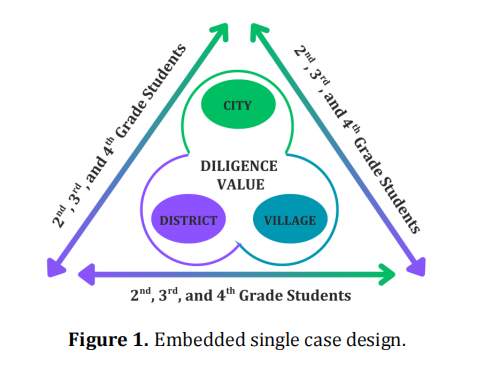
Diligence is a value that encompasses consistent and meticulous effort toward achieving a set goal, effective time management, openness to lifelong learning, acting with a sense of responsibility, maintaining self-confidence and self-regulation, and the integration of these traits into daily life; it is influenced by achievement, biological potential, and the desire for recognition. This study aims to describe the views of primary school students regarding the value of diligence. The study employed an embedded single case study design, a qualitative research method, in which the value of diligence was examined through the analytical units of city, district, and village. Data were collected from 249 primary school students in 2nd, 3rd, and 4th grades through a semi-structured interview form, which included both written expressions and drawings. The data were analyzed using content analysis methods, including frequency analysis, categorical analysis, and contingency (relational) analysis. According to the research findings, the students’ descriptions of the value of diligence were evaluated under the categories of school life, achievement, determination, socialization, time management, personal development, biological potential, external influence, internal influence, health, studying, and peer bullying. It may be recommended that these categories be taken into consideration in the education of the value of diligence.
Keywords:
Value Value Education Diligence Primary School StudentsReferences
- Vuong, Q.H.; La, V.P.; Nguyen, M.H. Informational entropy-based value formation: A new paradigm for a deeper understanding of value. Eval. Rev. 2025, 1–25. DOI: https://doi.org/10.1177/0193841X251396210
- Rokeach, M. The Nature of Human Values, 1st ed.; The Free: New York, NY, USA, 1973.
- Schwartz, S.H. An overview of the Schwartz theory of basic values. Online Readings in Psychol. Cult. 2012, 2, 1–25. DOI: https://doi.org/10.9707/2307-0919.1116
- Hodgkinson, C. The Philosophy of Leadership, 1st ed.; Blackwell: New York, NY, USA, 1983.
- Thornburg, H.D.; Glider, P. Dimensions of early adolescent social perceptions and preferences. J. Early Adolesc. 1984, 4, 387–406. DOI: https://doi.org/10.1177/0272431684044008
- Gomez, E.C. Impact of values education in daily lives of students: A qualitative study. Southeast Asian J. Multidiscip. Stud. 2024, 4.
- Tutikhon. M. A modern model of educating young people based on universal human values. Universal Insights Conf. Sci. Soc. 2026, 4, 3–11.
- Şen, E.N.; Tay, B. Examination of “Coco” animated movie in terms of the value of giving importance to family unity. Int. J. Life Sci. Soc. Stud. Educ. 2023, 1, 1–40. DOI: https://doi.org/10.29329/ijlssse.2023.1074.01
- Nathi, Y.; Nagunuri, R.; Bonakurthy, S. Foundations of values: A philosophical, sociological and psychological inquiry. Int. J. Creat. Res. Thoughts. 2026, 14, a133–a136.
- Inkeles, A. What Is Sociology? An Introduction to the Discipline and Profession, 1st ed.; Prentice-Hall: Englewood Cliffs, NJ, USA, 1964.
- Merma, G.; Ávalos, M.A. The importance of values education in the training of physical activity and sport sciences students. ICERI2014 Proc. 2014, 5236–5243.
- Yılmaz, Z.B.; Yarar Kaptan, S. Analyzing 2nd grade life studies objectives for root values and identifying 2nd graders’ perceptions of root values. TAY J. 2023, 7, 181–215.
- Zajda, J. Values education to overcome classroom discrimination. In Overcoming Discrimination in Schools Globally, 1st ed.; Springer: Cham, Switzerland, 2025; pp. 87–106.
- Trang, N.T.N. On culture and cultural value. Int. J. Soc. Sci. Hum. Res. 2024, 7, 4427–4431. DOI: https://doi.org/10.47191/ijsshr/v7-i06-104
- Taylor, M. Overview of values education in 26 European countries. In Values Education in Europe: A Comparative Overview of a Survey of 26 Countries in 1993, 1st ed.; Taylor, M., Ed.; Scottish Consultative Council on the Curriculum: Dundee, UK, 1994; pp. 1–66.
- Grümme, B. Values education, politics and religion. In Values–Politics–Religion: The European Values Study. Philosophy and Politics-Critical Explorations, 1st ed.; Polak, R., Rohs, P., Eds.; Springer: Cham, Switzerland, 2023; pp. 449–474.
- Cheng, E.W.L. Revisiting the concept of values taught in education through Carroll’s corporate social responsibility. Sustainability 2022, 14, 11280.
- Gellel, A.M. Teachers as key players in values education. In Second International Research Handbook on Values Education and Student Wellbeing, 1st ed.; Lovat, T., Toomey, R., Clement, N., et al., Eds.; Springer: Cham, Switzerland, 2023; pp. 683–698.
- Dönmez, Ö.; Uyanık, G. Values education in different countries and examples from values education. J. Res. Elem. Educ. 2022, 2, 74–88. DOI: https://doi.org/10.55008/te-ad.1099697 (in Turkish)
- Ballı, M.N.; Deveci, H. Family involvement in social studies course value education activities: Teacher opinions and practices. Mehmet Akif Ersoy Univ. J. Educ. Fac. 2023, 249–281. DOI: https://doi.org/10.21764/maeuefd.1320680 (in Turkish)
- Göçer, V.; Kaya, F. Investigation of primary school curricula in the context of values education. E-Int. J. Educ. Res. 2022, 14, 274–295.
- Aslan, M.; Gökçen, E. The role of values education in primary school Turkish teaching programs. J. Int. Lang. Lit. Cult. Hist. Art Educ. Res. 2024, 14, 1094–1114. (in Turkish)
- Ağca, C.; Meydan, H. Examination of seventh grade religious culture and ethics textbook in terms of teaching root values. Recep Tayyip Erdogan Univ. J. Soc. Sci. 2022, 9, 94–116. DOI: https://doi.org/10.34086/rteusbe.1114158 (in Turkish)
- Özdemir, C.; Erdoğan, T. The effect of the mantle of the expert approach in acquisition of the value of responsibility and collaborative skills in life science course. Kocaeli Univ. J. Educ. 2025, 8, 27–49.
- Aydın, Y. A meta-synthesis study on research conducted in the context of values education in life sciences course. Electron. J. Educ. Sci. 2024, 13, 96–120. DOI: https://doi.org/10.55605/ejedus.1521330 (in Turkish)
- Aşkan, A.; Tay, B.; Öztürk, D. Skills and values concepts in life science course curriculum. J. Int. Soc. Stud. Educ. 2022, 4, 44–77. (in Turkish)
- Aliç, İ.; Yazıcı, K. Social studies teachers’ opinions on values education. Pedagog. Perspect. 2025, 4, 424–436. DOI: https://doi.org/10.29329/pedper.2025.135
- Alaca, E. Values in social studies curriculum: Case of Turkey. Open J. Educ. Res. 2022, 6, 155–164. DOI: https://doi.org/10.32591/coas.ojer.0602.04155a
- Living values education. Available online: https://livingvalues.net/values/ (accessed on 25 May 2025).
- Elsayed, W. Building a better society: The vital role of family’s social values in creating a culture of giving in young children’s minds. Heliyon 2024, 10, e29208.
- Amos, C.; Zhang, L.; Read, D. Hardworking as a heuristic for moral character: Why we attribute moral values to those who work hard and its implications. J. Bus. Ethics 2019, 158, 1047–1062. DOI: https://doi.org/10.1007/s10551-017-3725-x
- Deveci, H.; Selanik Ay, T. Values in daily life according to diaries of primary school students. J. Int. Soc. Res. 2009, 2, 167–181.
- Hökelekli, H. A new paradigm in modern education: Values education. Eğit. Bakış Derg. 2010, 6, 4–9. (in Turkish)
- Rinpoche, T. Open Heart, Open Mind: A Guide to Inner Transformation, 1st ed.; Rider: London, UK, 2012.
- Usmanovna, X.A. Pedagogical technologies for fostering diligence in primary school students. Stanf. Database Libr. Int. J. Pedagog. 2026, 6, 171–174. DOI: https://doi.org/10.37547/ijp/Volume06Issue03-33
- Gül, Y.E.; Alimbekov, A. Common characteristics of “hardworking” in proverbs of Anatolian and Kyrgyz Turks. Int. J. Turk. Lit. Cult. Educ. 2020, 9, 692–705. (in Turkish)
- Shanmugam, P.; Sarudin, A.; Redzwan, H.F.M.; et al. The conceptualisation of diligence in Malay and Tamil proverbs through the hybrid theory. Issues Lang. Stud. 2022, 11, 146–164. DOI: https://doi.org/10.33736/ils.4123.2022
- Çakır, R.; Özdemir, M. The value of diligence in Özgür Aras Tüfek’s children’s books. EDE Educ. Lang. Lit. J. 2023, 2, 1–26.
- Lovat, T.; Clement, N.; Dally, K.; et al. The impact of values education on school ambience and academic diligence. Int. J. Educ. Res. 2011, 50, 166–170. DOI: https://doi.org/10.1016/j.ijer.2011.07.008
- Altunay, S. Taking the Values of Responsibility Respect, Hardwork, Sensitivity and Solidarity to Students through the Creative Drama Method in the Social Studies Course. Master’s Thesis, Sinop University, Sinop, Türkiye, 2023.
- Ministry of National Education. Türkiye Century Education Model Teaching Programs Common Text; Ministry of National Education: Ankara, Türkiye, 2024. Available online: https://tymm.meb.gov.tr/ortak-metin (in Turkish)
- Erikson, E.H. Identity: Youth and Crisis, 1st ed.; W.W. Norton & Company: London, UK, 1968.
- Yin, R.K. Case Study Research: Design and Methods, 4th ed.; SAGE: Thousand Oaks, CA, USA, 2009.
- Suri, H. Purposeful sampling in qualitative research synthesis. Qual. Res. J. 2011, 11, 63–75. DOI: https://doi.org/10.3316/QRJ1102063
- Patton, M.Q. Qualitative Research and Evaluation Methods; Pegem Akademi: Ankara, Türkiye, 2018.
- Landis, J.R.; Koch, G.G. The measurement of observer agreement for categorical data. Biometrics 1977, 33, 159–174.
- Kyngäs, H. Inductive content analysis. In The Application of Content Analysis in Nursing Science Research; Kyngäs, H., Mikkonen, K., Kääriäinen, M., Eds.; Springer: Cham, Switzerland, 2020; pp. 13–21.
- Cole, F.L. Content analysis: Process and application. Clin. Nurse Spec. 1988, 2, 53–57.
- Stemler, S.E. Content analysis. In Emerging Trends in the Social and Behavioral Sciences: An Interdisciplinary, Searchable, and Linkable Resource, 1st ed.; Robert, R.A., Scott, A., Kosslyn, S.M., et al., Eds.; John Wiley & Sons, Inc.: Hoboken, NJ, USA, 2015; pp. 1–14.
- Alanka, D. Content analysis as a qualitative research method: A theoretical framework. Kronotop J. Commun. 2024, 1, 64–84. (in Turkish)
- Kuckartz, U.; Rädiker, S. Comparing cases and groups, discovering interrelations, and using visualizations. In Analyzing Qualitative Data with MAXQDA: Text, Audio, and Video, 1st ed.; Springer: Cham, Switzerland, 2019; pp. 151–170.
- Lincoln, Y.S.; Guba, E.G. Naturalistic Inquiry, 1st ed.; Sage: Thousand Oaks, CA, USA, 1985.
- Morse, J.M. Critical analysis of strategies for determining rigor in qualitative inquiry. Qual. Health Res. 2015, 25, 1212–1222. DOI: https://doi.org/10.1177/1049732315588501
- McLeod, S. Peer debriefing in qualitative research. Available online: https://www.simplypsychology.org/peer-debriefing.html (accessed on 1 February 2025).
- McKim, C. Meaningful member-checking: A structured approach to member-checking. Am. J. Qual. Res. 2023, 7, 41–52.
- Ahmed, S.K. The pillars of trustworthiness in qualitative research. J. Med. Surg. Public Health 2023, 2, 100051. DOI: https://doi.org/10.31219/osf.io/se58y
- Kakar, Z.U.; Rasheed, R.; Rashid, A.; et al. Criteria for assessing and ensuring the trustworthiness in qualitative research. Int. J. Bus. Reflect. 2023, 4, 150–173.
- Kaur, M. Understanding confirmability in qualitative research: Ensuring rigor and trustworthiness. Available online: https://eliteresearch.com/wp-content/uploads/2025/04/Understanding-Confirmability-in-Qualitative-Research-Ensuring-Rigor-and-Trustworthiness.pdf (accessed on 19 April 2025).
- Almoslamani, Y. The impact of learning strategies on the academic achievement of university students in Saudi Arabia. Learn. Teach. High. Educ.: Gulf Perspect. 2022, 18, 4–18. DOI: https://doi.org/10.1108/LTHE-08-2020-0025
- Kember, D.; Jamieson, Q.W.; Pomfret, M.; et al. Learning approaches, study time and academic performance. High. Educ. 1995, 29, 329–343.
- Arthur, C.G. Student diligence and student diligence support: Predictors of academic success. In Proceedings of the Mid-South Educational Research Association Annual Meeting, Chattanooga, TN, USA, 6–8 November 2002.
- Marigmen-Balinjare, M.L.; Lanestosa, F.A.; Limos-Galay, J.A. Personal and professional characteristics of teachers in relation to the academic performance of students in San Jose National Agricultural and Industrial High School. Int. J. Res. 2023, 11, 41–50.
- Galla, B.M.; Plummer, B.D.; White, R.E.; et al. The academic diligence task (ADT): Assessing individual differences in effort on tedious but important schoolwork. Contemp. Educ. Psychol. 2014, 39, 314–325. DOI: https://doi.org/10.1016/j.cedpsych.2014.08.001
- Tay, B.; Yıldırım, K. Parents’ views regarding the values aimed to be taught in social studies lessons. Educ. Sci.: Theory Pract. 2009, 9, 1499–1542.
- Gong, X.; Chen, C.; Sun, Y.; et al. Does the value of diligence matter more in university students’ academic and non-academic outcomes? An examination to the mediation of achievement goals and the moderation of gender and residence status. Int. J. Educ. Res. 2025, 134, 102852. DOI: https://doi.org/10.1016/j.ijer.2025.102852
- Lam, K.K.L.; Zhou, M. Grit and academic achievement: A comparative cross-cultural meta-analysis. J. Educ. Psychol. 2022, 114, 597–621.
- Sevim, O.; Uzun, A. Investigation of teachers’ cognitive constructs of the ideal student in the context of the Maarif Model student profile. Hacet. Univ. J. Educ. 2026, 41, 156–173.
- Arık, İ.A.; Arkonaç, S.A.; Yılmazer, N.; et al. A group of high school teachers’ perceptions of the ideal student. Marmara Univ. Atatürk Educ. Fac. J. Educ. Sci. 1991, 3, 17–23. (in Turkish)
- Simmel, G. The problem of sociology. Ann. Am. Acad. Pol. Soc. Sci. 1895, 6, 52–63. DOI: https://doi.org/10.1177/000271629500600304
- Aktepe, V.; Uzunöz, A.; Sarıçam, İ. Secondary school students’ metaphoric perceptions towards the “diligence” value in social studies lesson. Ahi Evran Univ. J. Soc. Sci. Inst. 2020, 6, 449–466. DOI: https://doi.org/10.31592/aeusbed.660037 (in Turkish)
- Harjula, R. Work and industriousness as elements of the good life. Stud. Orient. Electron. 2015, 81, 61–72.
- Nakamoto, J.; Schwartz, D. Is peer victimization associated with academic achievement? A meta-analytic review. Soc. Dev. 2010, 19, 222–242.
- Gimenez, G.; Mediavilla, M.; Giuliodori, D.; et al. Bullying at school and students’ learning outcomes: International perspective and gender analysis. J. Interpers. Violence 2024, 39, 2733–2760. DOI: https://doi.org/10.1177/08862605231222457
- Juvonen, J.; Nishina, A.; Graham, S. Peer harassment, psychological adjustment, and school functioning in early adolescence. J. Educ. Psychol. 2000, 92, 349–359. DOI: https://doi.org/10.1037/0022-0663.92.2.349
- Schwartz, D.; Chang, L.; Farver, J.M. Correlates of victimization in Chinese children’s peer groups. Dev. Psychol. 2001, 37, 520–532. DOI: https://doi.org/10.1037/0012-1649.37.4.520
- Kaya Tekman, T.; Kaya İsayev, F.; Yeniasır, M. Families’ and teachers’ knowledge and views on peer bullying in schools. Interacc. Perspectiv. 2025, 15, 730–746. DOI: https://doi.org/10.5281/zenodo.16910961 (in Turkish)
- Utkugün, C.; Yıldırım, R.; Yazıcı Doğan, F. The national struggle years and Mustafa Kemal Atatürk from the perspectives of primary school 4th grade students. Ahi Evran Univ. J. Kırşehir Educ. Fac. 2024, 25, 94–150. (in Turkish)
- Balbağ, N.L.; Kaya, M.F. Fourth grade students’ cognitive structures regarding “values”: Application of the word association test. Rev. Int. Geogr. Educ. 2019, 9, 193–208.
- Giorgetti, F.M. Reading the student pledge through the eyes of students in Turkey. Educ. Forum. 2015, 79, 248–262. DOI: https://doi.org/10.1080/00131725.2015.1037509
- Dilli, R.; Bapoğlu Dümenci, S.; Sicim, B. Comparing drawings representing scientist of preschool children with their parents. Usak Univ. J. Educ. Res. 2016, 2, 56–70. DOI: https://doi.org/10.29065/usakead.232421 (in Turkish)
- Chionas, G.; Emvalotis, A. Greek upper primary grade students’ images about science and scientists: An alternative descriptive piece of the puzzle. Front. Educ. 2022, 7, 1–17. DOI: https://doi.org/10.3389/feduc.2022.933288
- Toğrol, A. Student images of the scientist. Educ. Sci. 2000, 25, 49–57. (in Turkish)
- Tay, B.; Durmaz, F.Z.; Şanal, M. Views of students about value and values education within the scope of social studies course. J. Gazi Fac. Educ. 2013, 33, 67–93. (in Turkish)
- Mitchell, R.M.; Kensler, L.; Tschannen-Moran, M. Student trust in teachers and student perceptions of safety: Positive predictors of student identification with school. Int. J. Leadersh. Educ. 2018, 21, 135–154. DOI: https://doi.org/10.1080/13603124.2016.1157211