
Article
Negotiating Education in an Immigration Context: Qualitative Insights into Age–Grade Mismatch and Family Cultural Capital
 Download

This work is licensed under a Creative Commons Attribution 4.0 International License.
Copyright
The authors shall retain the copyright of their work but allow the Publisher to publish, copy, distribute, and convey the work.
License
Journal of Qualitative Research in Education (ENAD) publishes accepted manuscripts under Creative Commons Attribution 4.0 International (CC BY 4.0). Authors who submit their papers for publication by ENAD agree to have the CC BY 4.0 license applied to their work, and that anyone is allowed to reuse the article or part of it free of charge for any purpose, including commercial use. As long as the author and original source are properly cited, anyone may copy, redistribute, reuse, and transform the content.
Authors

Received: 20 January 2026; Revised: 26 February 2026; Accepted: 16 March 2026; Published: 20 April 2026
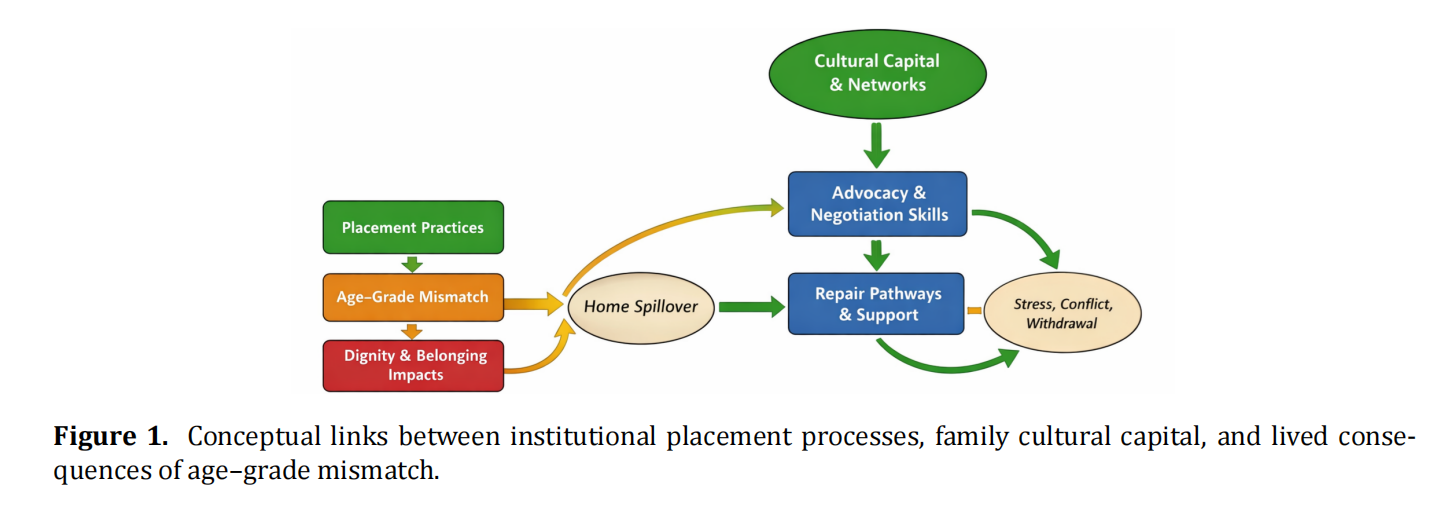
This qualitative study explores how immigrant families experience and negotiate age–grade mismatch during school enrolment and transition, and how family cultural capital shapes their ability to engage with school placement decisions. Age grade mismatch (i.e., being below age grade level) can be considered as either a technical or guardian move, but has significant social, emotional, and educational implications. The research is based on semi-structured interviews with 12 immigrant parents and young people regarding the announcement, justification, and reaction to the placement decision-making in the daily interactions of the family and school, the results of which indicate that age–grade incompatibility is widely perceived as an institutional evaluation instead of an objective adaptation, which shapes the sense of belonging, confidence, and peer relationships in children. The ability of families to challenge or make new deals on the placement decisions differed significantly and was largely connected to access to information, language assistance, social networking, and knowledge of school systems. Some families could mobilise these resources to bring about change, but in other cases, the process appeared to be fixed and intimidating. The research points to the ability of language-based tests to blur the previous education and the support systems to propagate inequalities in situations where there are no established ways of review.
Keywords:
Age–Grade Mismatch Immigrant Families School Placement Cultural Capital Educational Inequality School BelongingReferences
- Lemmermann, D.; Riphahn, R.T. The causal effect of age at migration on youth educational attainment. Econ. Educ. Rev. 2018, 63, 78–99. DOI: https://doi.org/10.1016/j.econedurev.2017.11.001
- King, K.A.; Bigelow, M. The language policy of placement tests for newcomer English learners. Educ. Policy 2018, 32, 936–963. DOI: https://doi.org/10.1177/0895904816681527
- Chatzina, K.; Mouti, A. Second Language Assessment Issues in Refugee and Migrant Children’s Integration and Education: Assessment Tools and Practices for Young Students with Refugee and Migrant Background in Greece. Languages 2022, 7, 82. DOI: https://doi.org/10.3390/languages7020082
- Benediktsson, A.I. Reception of newly arrived immigrant schoolchildren in Iceland: Exploring challenges and dilemmas concerning teaching and assessment practices. Educ. Inq. 2023, 16, 508–526. DOI: https://doi.org/10.1080/20004508.2023.2262204
- Barglowski, K. Migrants’ class and parenting: The role of cultural capital in migrants’ inequalities in education. J. Ethn. Migr. Stud. 2019, 45, 1970–1987. DOI: https://doi.org/10.1080/1369183X.2018.1476130
- Antony-Newman, M. Parental involvement of immigrant parents: A meta-synthesis. Educ. Rev. 2019, 71, 362–381. DOI: https://doi.org/10.1080/00131911.2017.1423278
- Liu, A.; Heath, M.; Grzywacz, J.G. Cultural meaning of education and parents' involvement in education: Perspectives of immigrant Latinos. Family Relations 2024, 73, 262–281. DOI: https://doi.org/10.1111/fare.12940
- Berggren, J.; Torpsten, A.-C.; Järkestig Berggren, U. Education is my passport: Experiences of institutional obstacles among immigrant youth in the Swedish upper secondary educational system. J. Youth Stud. 2021, 24, 943–959. DOI: https://doi.org/10.1080/13676261.2020.1728239
- Hassani, S.; Schwab, S. Language support and institutional discrimination: Insights into school leaders’ experiences. J. Lang. Ident. Educ. 2025, in press. DOI: https://doi.org/10.1080/15348458.2025.2563603
- DeJonckheere, M.; Vaughn, L.M. Semistructured interviewing in primary care research: A balance of relationship and rigour. Fam. Med. Community Health 2019, 7, e000057. DOI: https://doi.org/10.1136/fmch-2018-000057
- Levitt, H.M.; Bamberg, M.; Creswell, J.W.; et al. Journal Article Reporting Standards for Qualitative Primary, Qualitative Meta-Analytic, and Mixed Methods Research in Psychology: The APA Publications and Communications Board Task Force Report. Am. Psychol. 2018, 73, 26–46. DOI: https://doi.org/10.1037/amp0000151
- Malterud, K.; Siersma, V.D.; Guassora, A.D. Sample size in qualitative interview studies: Guided by information power. Qual. Health Res. 2016, 26, 1753–1760. DOI: https://doi.org/10.1177/1049732315617444
- Saunders, B.; Sim, J.; Kingstone, T.; et al. Saturation in qualitative research: Exploring its conceptualization and operationalization. Qual. Quant. 2018, 52, 1893–1907. DOI: https://doi.org/10.1007/s11135-017-0574-8
- Hennink, M.; Kaiser, B.N. Sample sizes for saturation in qualitative research: A systematic review of empirical tests. Soc. Sci. Med. 2022, 292, 114523. DOI: https://doi.org/10.1016/j.socscimed.2021.114523
- Braun, V.; Clarke, V. Reflecting on reflexive thematic analysis. Qual. Res. Sport Exerc. Health 2019, 11, 589–597. DOI: https://doi.org/10.1080/2159676X.2019.1628806
- Braun, V.; Clarke, V. One size fits all? What counts as quality practice in (reflexive) thematic analysis? Qual. Res. Psychol. 2021, 18, 328–352. DOI: https://doi.org/10.1080/14780887.2020.1769238
- Kiger, M.E.; Varpio, L. Thematic analysis of qualitative data: AMEE Guide No. 131. Med. Teach. 2020, 42, 846–854. DOI: https://doi.org/10.1080/0142159X.2020.1755030
- Nowell, L.S.; Norris, J.M.; White, D.E.; et al. Thematic analysis: Striving to meet the trustworthiness criteria. Int. J. Qual. Methods 2017, 16, 1–13. DOI: https://doi.org/10.1177/1609406917733847
- Melnikova, J. Migrant parents at high school: Exploring new opportunities for involvement. Front. Educ. 2022, 7, 979399. DOI: https://doi.org/10.3389/feduc.2022.979399
- Çelik, Ç. Rethinking institutional habitus in education: A relational approach for studying its sources and impacts. Sociology 2021, 55, 522–538. DOI: https://doi.org/10.1177/0038038520966565
- Forster, A.G.; van de Werfhorst, H.G. Navigating institutions: Parents’ knowledge of the educational system and students’ success in education. Eur. Sociol. Rev. 2020, 36, 48–64. DOI: https://doi.org/10.1093/esr/jcz049
- Zimmermann, T. Unequal access to decision-relevant educational information and its implications for educational inequality. Res. Soc. Strat. Mobil. 2024, 90, 100894. DOI: https://doi.org/10.1016/j.rssm.2024.100894
- Norozi, S.A.; Vik, N.E. Navigating collaboration: Newcomer parents’ perceptions and experiences with Norwegian schools. Soc. Sci. 2024, 13, 698. DOI: https://doi.org/10.3390/socsci13120698
- Schneider, C.; Arnot, M. Transactional school–home–school communication: Addressing the mismatches between migrant parents’ and teachers’ views of parental knowledge, engagement and the barriers to engagement. Teach. Teach. Educ. 2018, 75, 10–20. DOI: https://doi.org/10.1016/j.tate.2018.05.005
- Morales, C.; Mogollon, M. The effects of a newcomer program on the academic achievement of English learners. J. Policy Anal. Manag. 2024, 43, 735–760. DOI: https://doi.org/10.1002/pam.22601
- Kyereko, D.O.; Smith, W.C.; Hlovor, I.; et al. Understanding grade repetition from the perspectives of teachers and principals in basic schools in Ghana. Int. J. Educ. Dev. 2022, 93, 102633. DOI: https://doi.org/10.1016/j.ijedudev.2022.102633
- Brinkmann, M.; Huth-Stöckle, N.; Schunck, R.; et al. Tracking and social inequalities in school belonging. Soc. Sci. Res. 2024, 124, 103075. DOI: https://doi.org/10.1016/j.ssresearch.2024.103075
- De Hoop, J.; Morey, M.; Seidenfeld, D. No lost generation: Supporting the school participation of displaced Syrian children in Lebanon. J. Dev. Stud. 2019, 55, 107–127. DOI: https://doi.org/10.1080/00220388.2019.1687875
- Rosvall, P.-Å.; Öhrn, E.; Beach, D.; et al. Sense of place in providers’ perspectives of school placement policies in relation to refugee settlement in rural Sweden. J. Rural Stud. 2025, 113, 103509. DOI: https://doi.org/10.1016/j.jrurstud.2024.103509