
Article
Navigating Task-Based Language Teaching: A Qualitative Study of Chinese University EFL Students’ Classroom Experiences and Perceptions
 Download

This work is licensed under a Creative Commons Attribution 4.0 International License.
Copyright
The authors shall retain the copyright of their work but allow the Publisher to publish, copy, distribute, and convey the work.
License
Journal of Qualitative Research in Education (ENAD) publishes accepted manuscripts under Creative Commons Attribution 4.0 International (CC BY 4.0). Authors who submit their papers for publication by ENAD agree to have the CC BY 4.0 license applied to their work, and that anyone is allowed to reuse the article or part of it free of charge for any purpose, including commercial use. As long as the author and original source are properly cited, anyone may copy, redistribute, reuse, and transform the content.
Authors

Received: 6 January 2026; Revised: 25 January 2026; Accepted: 10 February 2026; Published: 2 March 2026
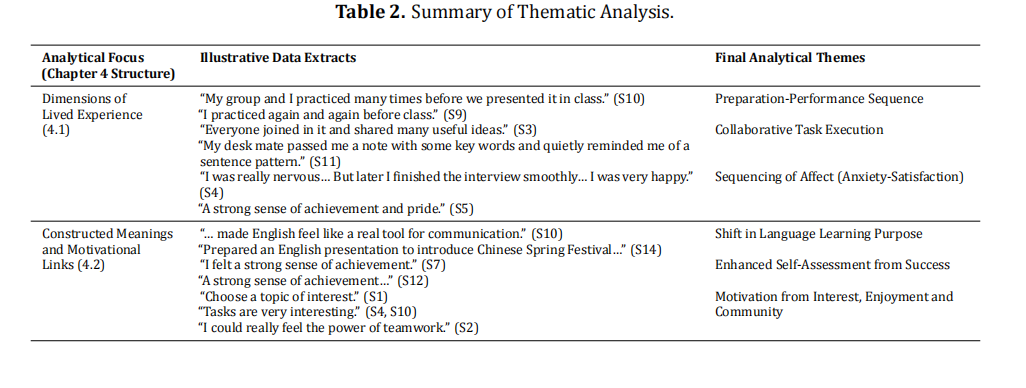
This qualitative study examines Chinese university EFL students’ classroom experiences and perceptions of Task-Based Language Teaching (TBLT). Data were collected through in-depth interviews with 15 purposefully selected students at a public university in China and analyzed using thematic analysis. The findings show three key features of the learner experience. First, students often followed a preparation-performance sequence. Second, tasks were commonly done through peer collaboration. Third, students’ emotions often shifted from anxiety to satisfaction during tasks. Students also constructed clear meanings from these experiences, which shaped their motivation and engagement. Many came to see English as a practical tool for communication. They reported a stronger sense of achievement when tasks included step-by-step support from teachers and peers. Interest, enjoyment, and a sense of classroom community also helped maintain engagement. The main contribution is an integrated framework that explains successful TBLT implementation from the student perspective. It brings together contextual and personal factors that students identified as enabling (e.g., supportive task design and interest-driven engagement) or constraining (e.g., time pressure and low self-confidence). The framework suggests that TBLT success depends on alignment between classroom conditions and learners’ internal dispositions. Practical teaching suggestions are offered based on students’ perspectives to support TBLT adaptation in similar contexts.
Keywords:
Task-Based Language Teaching Chinese EFL Students Student Perceptions Classroom Experience Qualitative StudyReferences
- Xu, H.; Wang, Y.; Ma, J. A comprehensive review of intercultural communicative competence in EFL education and global business. Cogent Educ. 2025, 12, 1–36. DOI: https://doi.org/10.1080/2331186X.2025.2557608
- Lai, Y.; Zhang, L.; Gai, X. A study on the application of input hypothesis and output hypothesis in task-based language teaching in mixed-level classes. Reg. Educ. Res. Rev. 2025, 7, 59–62. DOI: https://doi.org/10.32629/rerr.v7i1.3618
- Jannah, K.I.B.; Razaq, S.U.S.; Hafizudin. Revitalizing Speaking Fluency through Task-Based Language Teaching: Addressing Post-Pandemic Communicative Gaps in EFL Classrooms. Bull. Sci. Res. Engl. Educ. 2025, 2, 13–23. DOI: https://doi.org/10.59261/bsree.v2i1.8
- Nguyen, T.A.; Jaspaert, K. Implementing Task-based language teaching in an Asian context: Is it a real possibility or a nightmare? A case study in Vietnam. ITL Int. J. Appl. Linguist. 2021, 172, 121–151. DOI: https://doi.org/10.1075/itl.16022.ngu
- Liu, K.; Deris, F.D. Teachers’ Perceptions of Communicative Language Teaching Approach in English Grammar Teaching. Arab World Engl. J. 2023, 14, 124–136. DOI: https://doi.org/10.24093/awej/vol14no3.8
- Wang, P.; Puteri, Z.M.K. A Reconceptualisation of English Language Teaching and Second Language Teaching—Reflections on Task-Based English Language Teaching. Lect. Notes Lang. Lit. 2023, 6, 128–133. DOI: https://doi.org/10.23977/langl.2023.061420
- Lin, S.E.; Liu, J. Challenges and Strategies for English Language Learning in a Higher Education Institution in China. J. Serv. Manag. 2022, 17, 21–41.
- Liu, Y.; Hu, J. Perception and Practice of Formative Assessment among English Teachers: Dilemmas and Breakthroughs in the Context of Exam-Oriented Teaching. In Proceedings of the 2025 4th International Conference on Social Sciences and Humanities and Arts, Yantai, China, 28–30 March 2025; pp. 386–393. DOI: https://doi.org/10.2991/978-2-38476-432-7_45
- Wu, Y. From “Teacher-Centered” to “Student-Centered” from the Perspective of Ecology of Education—College ELT under Chinese Context. In Proceedings of the 2021 2nd International Conference on Computers, Information Processing and Advanced Education, Ottawa, ON, Canada, 25–27 May 2021; pp. 892–894. DOI: https://doi.org/10.1145/3456887.3457097
- Guan, L. Teachers’ Beliefs and Practices Relating to the Use of Tasks in Tertiary English as a Foreign Language Classrooms in China. J. Lang. Teach. Res. 2023, 14, 1354–1362. DOI: https://doi.org/10.17507/jltr.1405.24
- Li, H.; Thomas, N. Chinese EFL teachers’ understandings and implementation of task-based language teaching: A multiple case study. Tourism Anal. 2023, 3, 305–335. DOI: https://doi.org/10.1075/task.22015.li
- Jing, Y. TBLT in Curriculum Innovation and TPD Programs in Chinese Context. In School-Based EFL Teacher Professional Development for Task-Based Language Teaching; Palgrave Macmillan: Cham, Switzerland, 2024; pp. 47–64. DOI: https://doi.org/10.1007/978-3-031-64002-5_5
- Gou, Y. Analysis of the Advantages and Challenges Concerning the Implementation of TBLT into EFL Context of China. Int. J. Educ. Humanit. 2024, 13, 84–86. DOI: https://doi.org/10.54097/vv3z3x68
- Siregar, R.; Nuraida; Kalsum, E.U. Incorporating Environment Sustainability Content in Translation Teaching through a Task-Based Approach. Lang. Lit. J. Linguist. Lit. Lang. Teach. 2022, 6, 251–261. DOI: https://doi.org/10.30743/ll.v6i2.5669
- Huang, X. Research on the Effectiveness of Task-based Language Teaching in Higher Education. Adult High. Educ. 2024, 6, 74–79. DOI: https://doi.org/10.23977/aduhe.2024.060111
- Harun, Y.; Biduri, F.N. The effectiveness of task-based learning in historical and cultural research method classes. Qalamuna 2022, 14, 589–602. DOI: https://doi.org/10.37680/qalamuna.v14i2.3418
- Zhang, H. A Reaction Paper: Task-based Language Teaching in a Local EFL Context. New Explor. Educ. Teach. 2024, 2, 32–35. DOI: https://doi.org/10.18686/neet.v2i4.4371
- Romdoni, M.; Arzaqi, D.A.; Nugroho, T.B.; et al. A Comparative Analysis of Communicative Language Teaching (CLT) and Task-Based Language Teaching (TBLT) in Enhancing EFL Learners Outcomes. Peshum 2024, 4, 1291–1298.
- Kurniati, T.S.; Margana; Nurhayati, E.; et al. Exploring Challenges and Motivational Factors in Task-Based Language Teaching for Speaking Proficiency: Learning-Oriented Assessment. J. Cult. Anal. Soc. Change 2025, 10, 364–374. DOI: https://doi.org/10.64753/jcasc.v10i3.2420
- Liu, Y.; Ren, W. Task-based language teaching in a local EFL context: Chinese university teachers’ beliefs and practices. Lang. Teach. Res. 2024, 28, 2234–2250. DOI: https://doi.org/10.1177/13621688211044247
- Zhang, S.; Goh, Y. Student number size as moderator in affecting the four factors of students’ perceived engagement in task-based learning under blended English learning environment. Int. J. Educ. Technol. 2023, 1, 29–40. DOI: https://doi.org/10.59021/ijetech.v1i1.15
- Hanif, S.; Ullah, W. Curriculum Models for Teaching English and Chinese: A Pedagogical and Comparative Perspective. J. Glob. Res. Educ. Soc. Sci. 2025, 19, 45–61. DOI: https://doi.org/10.56557/jogress/2025/v19i19118
- Shang, Y. Research on Challenges of Task-based Language Teaching Implementation in Chinese Senior High School EFL Writing Course. Reg. Educ. Res. Rev. 2023, 7, 156–161.
- Zhang, X.; Huang, Y.; Liu, Y. Enhancing language task engagement in the instructed language classroom: Voices from Chinese English as a foreign language students and teachers. Int. J. Chin. Educ. 2022, 11, 1–18. DOI: https://doi.org/10.1177/2212585X221097718
- He, J. TBLT in Virtual L2 Classroom: Challenges, Actions and Insights. Master’s Thesis, University of Massachusetts Amherst, Amherst, MA, USA, September 2021. DOI: https://doi.org/10.7275/24254256.0
- Pervin, N.; Mokhtar, M. The interpretivist research paradigm: A subjective notion of a social context. Int. J. Acad. Res. Prog. Educ. Dev. 2022, 11, 419–428. DOI: https://doi.org/10.6007/IJARPED/v11-i2/12938
- Leese, J.; Li, L.C.; Nimmon, L.; et al. Moving beyond “Until Saturation Was Reached”: Critically Examining How Saturation Is Used and Reported in Qualitative Research. Arthritis Care Res. 2021, 73, 1225–1227. DOI: https://doi.org/10.1002/acr.24600
- Braun, V.; Clarke, V. Thematic analysis. In APA Handbook of Research Methods in Psychology; Cooper, H., Camic, P.M., Long, D.L., et al., Eds.; American Psychological Association: Washington, DC, USA, 2012; 2, pp. 57–71. DOI: https://doi.org/10.1037/13620-004