
Article
Genre-Oriented Philippine Literary Pieces That Appeal to the Learners' Motivation to Read
 Download

This work is licensed under a Creative Commons Attribution 4.0 International License.
Copyright
The authors shall retain the copyright of their work but allow the Publisher to publish, copy, distribute, and convey the work.
License
Journal of Qualitative Research in Education (ENAD) publishes accepted manuscripts under Creative Commons Attribution 4.0 International (CC BY 4.0). Authors who submit their papers for publication by ENAD agree to have the CC BY 4.0 license applied to their work, and that anyone is allowed to reuse the article or part of it free of charge for any purpose, including commercial use. As long as the author and original source are properly cited, anyone may copy, redistribute, reuse, and transform the content.
Authors
-
Jason V. Chavez
 School of Business Administration, Zamboanga Peninsula Polytechnic State University, Zamboanga City 7000, Philippines
-
Erwyn O. Valencia
College of Education, Iloilo State University of Fisheries Science and Technology-Dumangas Campus, Iloilo City 5006, Philippines
-
Etchel B. Palma
College of Education, Iloilo State University of Fisheries Science and Technology-Dumangas Campus, Iloilo City 5006, Philippines
-
Pearly Jade E. Samilo
Filipino Language Teaching Division, College of Education, West Visayas State University, Iloilo City 5000, Philippines
-
Neña Vanessa A. Cabiles
Filipino Language Teaching Division, College of Education, West Visayas State University, Iloilo City 5000, Philippines
-
Joseph B. Quinto
Department of English, College of Arts and Humanities, Benguet State University, Municipality of La Trinidad 2601, Philippines
-
Angeline L. Ramos
College of Humanities, Social Sciences, and Communication, Basilan State College, Isabela City 7300, Philippines
-
Haydee G. Adalia
College of Liberal Arts, Western Mindanao State University, Zamboanga City 7000, Philippines
-
Ivy M. Nazareth
College of Teacher Education, Zamboanga Peninsula Polytechnic State University, Zamboanga City 7000, Philippines
-
Collin C. Ceneciro
College of Teacher Education, Zamboanga Peninsula Polytechnic State University, Zamboanga City 7000, Philippines
Received: 6 January 2026; Revised: 9 February 2026; Accepted: 16 March 2026; Published: 30 March 2026
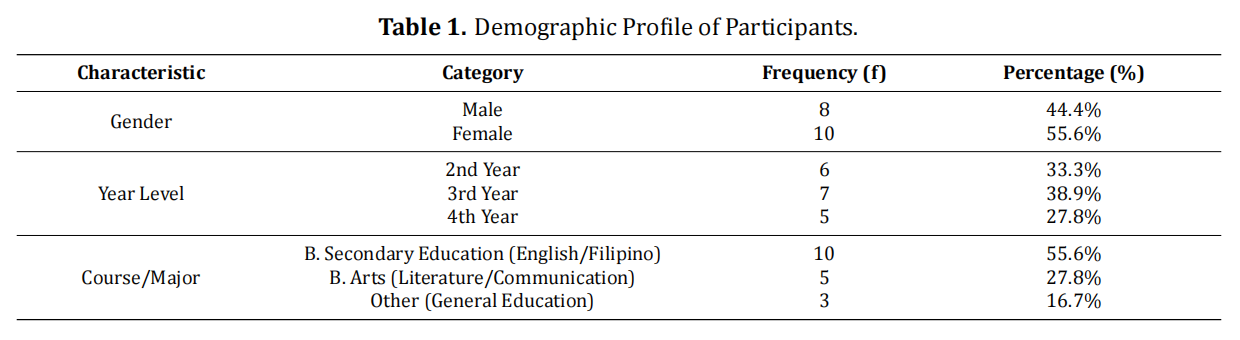
Despite the rich landscape of Philippine literature, there remains a limited understanding of how specific literary forms and their linguistic delivery influence students' motivation to read across the archipelago. Grounded in Guthrie and Wigfield's Engagement Model, this study addresses this gap by exploring the intrinsic and extrinsic factors that shape learners' engagement with local texts. Utilizing an exploratory qualitative design, the study involved 18 language students purposefully selected from the Philippines' three major island groups, Luzon, Visayas, and Mindanao, who participated in semi-structured one-on-one interviews. Reflexive thematic analysis revealed a duality in reading motivation: while learners are primarily driven to read contemporary genres due to their social realism and linguistic accessibility via "Taglish", they simultaneously exhibit deep engagement with complex historical narratives like Noli Me Tangere. This finding suggests that historical consciousness, the desire for identity reclamation, can override linguistic barriers regardless of regional background. The study concludes that effective literature instruction must navigate both the psychological need for mirroring lived experiences and the sociological need for anchoring a unified national identity. These insights support a pedagogical strategy of thematic pairing, where educators integrate high-interest contemporary texts with canonical works to optimize student engagement on a national scale.
Keywords:
L2 Reading Motivation Literary Pedagogy Philippine Literature Genre AnalysisReferences
- Guthrie, J.T.; Wigfield, A. Engagement and Motivation in Reading. In Handbook of Reading Research; Kamil, M.L., Mosenthal, P.B., Pearson, P.D., et al., Eds.; Lawrence Erlbaum Associates: Mahwah, NJ, USA, 2000; 3, pp. 403–422.
- Kamil, M.L.; Mosenthal, P.B.; Pearson, P.D.; et al. Handbook of Reading Research; Lawrence Erlbaum Associates: Mahwah, NJ, USA, 2000; 3.
- Schiefele, U.; Schaffner, E.; Möller, J.; et al. Dimensions of Reading Motivation and Their Relation to Reading Behavior and Competence. Read. Res. Q. 2012, 47, 427–463.
- Garil, B.A. Socio-Cultural Factors Affecting Reading Comprehension Levels and Demographic-based Grammatical Competence of Higher Education Students. Forum Linguist. Stud. 2024, 6, 184–197.
- Nolasco, R.M. The Prospects of Multilingual Education and Literacy in the Philippines. Curr. Issues Lang. Plann. 2008, 9, 95–100.
- Lumbera, B. Revaluation: Essays on Philippine Literature, Cinema, and Popular Culture; University of the Philippines Press: Quezon City, Philippines, 1997.
- Ceneciro, C.C. Characterizing Workshops Promoting Motivated Engagement and Retention beyond the Sessions: Experiential Narratives from Education, Language and Social Science Instructors. Forum Linguist. Stud. 2025, 7, 51–65.
- Godinez-Ortega, C.F. The Literary Forms in Philippine Literature; National Commission for Culture and the Arts (NCCA): Manila, Philippines, 2020.
- Francia, L. Brown River, White Ocean: An Anthology of Twentieth-Century Philippine Literature in English; Rutgers University Press: New Brunswick, NJ, USA, 1993.
- Estoque, M.R. Analysis of Library Resources and Services in Developing Confidence for Language Use. Forum Linguist. Stud. 2023, 5, 1709.
- Idulog, M.V.; Gadiano, R.; Toledo, E.; et al. Filipino students' reading abilities: A note on the challenges and potential areas for improvement. Int. J. Educ. Teach. Zone 2023, 2, 233–242.
- Nabong, L.O.; Ferenal, E.S. Reading Habit Practices on Reading Comprehension among Learners in Selected Districts of Misamis Oriental. Int. J. Sci. Technol. 2025, 16, 1–32.
- Widyaningsih, Y.; Nugroho, I.A. Exploring the Impact of Reading Motivation on Academic Achievement among 3rd Grade Students Using Univariate and Bivariate Analysis. Mimbar Sekol. Dasar 2025, 12, 193–204.
- Garil, B.A.; Abbas, T.S.C.; Limen, M.V. Analyzing the Demographic-Based Grammatical Competence and Its Relationship to Academic Performance in Higher Education Setting. Forum Linguist. Stud. 2024, 6, 343–356.
- Guia, J.V.; Juliane, S.M.C.; Canoy, F.T. Reading motivation and reading comprehension of senior high school learners: A descriptive-correlational approach. Asian J. Educ. Soc. Stud. 2024, 50, 505–517.
- Espartero, M.M.; Caldaza, K.P.D.; Prado, R.T.D. Analyzing the Level of Interest of High School Students in Solving Mathematical Problems in Modular and Face-to-Face Learning. Environ. Soc. Psychol. 2024, 9, 2167.
- Basanal, C.M.A.; Bauyot, M.M. Fading Voices: A Study on the Decline of Local English Literature Appreciation among Senior High School Students across the Philippines. Int. J. Multidiscip. Educ. Res. Innov. 2024, 4, 33.
- Murro, R.A. Modular Distance Learning: Exploring the Study Habits and Academic Achievements of State-Funded Elementary School Learners. Environ. Soc. Psychol. 2024, 9, 2462.
- Muegna, J.C.; Generalao, R.L.; Cerna, C.B. Cooperative Storytelling through Role-Playing: Enhancing Filipino Oral Fluency for Grade 5 Students in Marcos P. Estoque Elementary School. Int. J. Res. Publ. 2025, 175, 852–865.
- De-la-Peña, C.; Luque-Rojas, M.J. Levels of reading comprehension in higher education: Systematic review and meta-analysis. Front. Psychol. 2021, 12, 712901.
- Entong, M.B.M.; Garil, B.A.; Muarip, V.C.; et al. Language Delivery Styles in Academic Trainings: Analysis of Speaker's Emotional Connection to Audience for Lasting Learning. Forum Linguist. Stud. 2024, 6, 326–342.
- Braun, V.; Clarke, V. Using Thematic Analysis in Psychology. Qual. Res. Psychol. 2006, 3, 77–101.
- Li, H.; Wang, C.; Yang, Y.; et al. Teacher Support, Reading Enjoyment, and Self-Efficacy: Predictors of Student Reading Engagement and Volume. Read. Writ. Q. 2025, 41, 597–611.
- Bautista, A.; Biares, S.; Florague, J.D.; et al. Tales Passed Down: Investigating the Integration of Philippine Folklore in Kindergarten Classrooms. Int. J. Res. Innov. Soc. Sci. 2026, 10, 3225–3231.
- Paguio, D.P.; Gadia, E.D.; Sardina, D.P.; et al. Empowering communities through reading literacy: A community-based action research on Gordon College's reading program initiative in Olongapo City. Asian J. Community Serv. 2025, 4, 35–46.
- Shebani, Z.; Aldhafri, S.; Alsaidi, F. The effect of parental involvement on academic passion: The mediating role of student motivation in learning English online. Int. J. Adolesc. Youth 2025, 30, 2467109.
- Rafferty, P. Fiction Genre: From the Academy to the Library. Libr. Trends 2025, 74, 107–122.
- Mushtaq, S.; Soroya, S.H.; Mahmood, K. Reading habits of generation Z students in Pakistan: Is it time to re-examine school library services? Inf. Dev. 2021, 37, 389–401.
- Michalko, K. The Effect of Spoken Word Poetry on the Development of Voice in Writing. Master's Thesis, St. John Fisher College, Rochester, NY, USA, 2012.
- Adarna, N.I. Ang MGA Pinagdaanang Buhay. Refereed Electron. J. Lit. Cult. Lang. Stud. 2008, 1, 10.
- Butac, S.; Manera, A.; Gonzales, E.; et al. Forging global citizens: A comparative study of intercultural pedagogical practices of higher educational institutions in the Philippines. Int. J. Cult. Hist. Relig. 2025, 7, 62–79.
- Lesada, J.D. Taglish in Metro Manila: An Analysis of Tagalog-English Code-Switching. PhD Thesis, University of Michigan, Ann Arbor, MI, USA, 2017.
- Bahingawan, L.K.M.; Bulatao, M.G. Taglish as a Medium of Instruction in Teaching MAPEH 7: A Basis for Improving Instruction. J. Interdiscip. Perspect. 2025, 3, 276–284.
- Caliboso, J.; Bagalay, B.; Santiago, M.G.; et al. Literary texts as cultural tools: A study on contextualized learning strategies in Philippine higher education. Int. J. Cult. Hist. Relig. 2025, 7, 340–355.
- Luyt, B. A Golden Age of Library Development: The Social and Political Context of the Philippine Library in Manila in the Early Years of the Twentieth Century. Libr. Inf. Hist. 2022, 38, 112–131.
- Makgabo, C.; Quintero, G.J. Philippine and South African experiences on folk literature research: Relevance, gains, and challenges. J. Lang. Lang. Teach. 2024, 12, 985–995.
- Chavez, J.V.; Garil, B.A.; Padirque, C.B.; et al. Assessing Innovative and Responsive Young Leaders in Public Service: Lens from Community Clientele. Environ. Soc. Psychol. 2024, 9, 2876.
- Lamorinas, D.D.; Luna, L.A.; Lai, M.N.D.; et al. A General Perspective on the Factors Influencing the Low Preferences of Gen Z College Students towards the Filipino Language. Forum Linguist. Stud. 2025, 7, 451–466.