
Article
Scaffolding the Story: A Mixed-Methods Investigation of AI-Generated Pre-Writing Support for EFL Continuation Writing
 Download

This work is licensed under a Creative Commons Attribution 4.0 International License.
Copyright
The authors shall retain the copyright of their work but allow the Publisher to publish, copy, distribute, and convey the work.
License
Journal of Qualitative Research in Education (ENAD) publishes accepted manuscripts under Creative Commons Attribution 4.0 International (CC BY 4.0). Authors who submit their papers for publication by ENAD agree to have the CC BY 4.0 license applied to their work, and that anyone is allowed to reuse the article or part of it free of charge for any purpose, including commercial use. As long as the author and original source are properly cited, anyone may copy, redistribute, reuse, and transform the content.
Authors
-
Zhengxian Li
 School of Foreign Studies, South China Normal University, Guangzhou 510631, China
-
Bao Chen
School of Foreign Studies, South China Normal University, Guangzhou 510631, China
-
Ziying Ling
School of Foreign Studies, South China Normal University, Guangzhou 510631, China
-
Rixi Wu
School of Arts and Social Science, Monash University Malaysia Campus, Bandar Sunway 47500, Malaysia
-
Da Ling
School of Foreign Studies, South China Normal University, Guangzhou 510631, China
Received: 8 December 2025; Revised: 27 December 2025; Accepted: 19 January 2025; Published: 28 February 2026
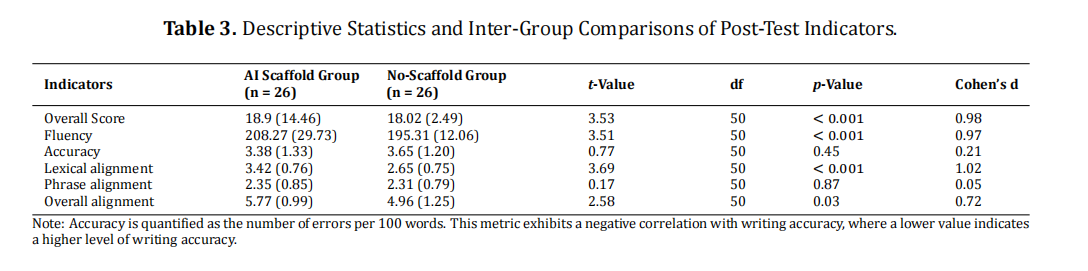
This mixed-methods study investigates the efficacy and learner experience of using an AI-generated, multi-dimensional scaffold during the pre-writing stage of continuation writing tasks for Chinese English as a Foreign Language (EFL) learners. The quantitative phase employed a between-subjects design (N = 52 undergraduates), comparing an AI Scaffold Group with a No-Scaffold Control Group. Results indicated the scaffold group produced texts with significantly higher holistic quality, fluency, and lexical alignment, though no significant differences were found in grammatical accuracy. The qualitative phase, which is central to this study's purpose of achieving an in-depth understanding, involved stimulated recall interviews and scaffold use logs with a focal sub-sample. A reflexive thematic analysis of this rich qualitative data revealed that learners experienced the scaffold as a tool that: (1) reduced cognitive load by structuring the complex planning process, (2) deepened their comprehension and connection to the source narrative by activating a detailed situation model, and (3) increased confidence and self-efficacy by providing actionable linguistic and structural guidance. The integrated findings substantiate the role of AI-generated scaffolding as a potential instructional tool, demonstrating that its primary benefits are mediated through cognitive and affective pathways that facilitate a more engaged and meaningful interaction with the writing task. This study contributes to the fields of AI in education and L2 writing by delineating not only the outcomes but, more importantly, the lived experience and underlying learner-cognitive processes of AI-assisted planning, thereby highlighting the essential role of interpretive qualitative inquiry in evaluating educational technology.
Keywords:
Continuation Writing Pre-Writing Scaffolding Artificial Intelligence EFL Writing Mixed-Methods ResearchReferences
- Ellis, R.; Yuan, F. The effects of planning on fluency, complexity, and accuracy in second language narrative writing. Stud. Second Lang. Acquis. 2004, 26, 59–84. DOI: https://doi.org/10.1017/S0272263104026130
- Hyland, K. Second Language Writing; Cambridge University Press: Cambridge, UK, 2010. DOI: https://doi.org/10.1017/CBO9780511667251
- Ong, J.; Zhang, L.J. Effects of task complexity on the fluency and lexical complexity in EFL students' argumentative writing. J. Second Lang. Writ. 2010, 19, 218–233. DOI: https://doi.org/10.1016/j.jslw.2010.10.003
- Lee, J.; Burch, A.R. Collaborative planning in process: An ethnomethodological perspective. TESOL Q. 2017, 51, 536–575. DOI: https://doi.org/10.1002/tesq.386
- Wang, C. The continuation task: An efficient way to facilitate L2 learning. Foreign Lang. World 2012, 152, 2–7. (in Chinese)
- Long, M.H. The role of the linguistic environment in second language acquisition. In Handbook of Second Language Acquisition; Ritchie, W.C., Bhatia, T.K., Eds.; Academic Press: San Diego, CA, USA, 1996; pp. 426–468.
- Pickering, M.J.; Garrod, S. Toward a mechanistic psychology of dialogue. Behav. Brain Sci. 2004, 27, 169–226. DOI: https://doi.org/10.1017/S0140525X04000056
- Wang, C.; Wang, M. Effect of alignment on L2 written production. Appl. Linguist. 2014, 36, 503–526.
- Wang, C. The logic of promoting foreign language learning through continuation tasks. Foreign Lang. World 2021, 207, 2–7. (in Chinese)
- Wood, D.; Bruner, J.S.; Ross, G. The role of tutoring in problem solving. J. Child Psychol. Psychiatry 1976, 17, 89–100. DOI: https://doi.org/10.1111/j.1469-7610.1976.tb00381.x
- Jiang, Y.; Chen, J. The role of pre-writing scaffolding in L2 continuation writing: A mixed-methods study. Lang. Teach. Res. 2022, 26, 389–408.
- Tai, H.-C.; Chen, C.-M.; Tsai, Y.-H.; et al. Is instructional scaffolding a better strategy for teaching writing to EFL learners? A functional MRI study in healthy young adults. Brain Sci. 2021, 11, 1378. DOI: https://doi.org/10.3390/brainsci11111378
- Barrot, J.S. Using ChatGPT for second language writing: Pitfalls and potentials. Assess. Writ. 2023, 57, 100745. DOI: https://doi.org/10.1016/j.asw.2023.100745
- Lin, C.J.; Hwang, G.-J. Artificial intelligence-supported procedural scaffolding for promoting EFL learners' writing performance in flipped peer assessment activities. Interact. Learn. Environ. 2025, 33, 1–15. DOI: https://doi.org/10.1080/10494820.2025.2532629
- Xie, Y.; Zhu, D. Effects of participatory structure of pre-task planning on EFL learners' linguistic performance and alignment in the continuation writing task. System 2023, 114, 103008. DOI: https://doi.org/10.1016/j.system.2023.103008
- Ellis, R. Understanding Second Language Acquisition, 4th ed.; Oxford University Press: Oxford, UK, 2019.
- Ren, W.; Lyu, X. A meta-analysis of the alignment effect in the continuation writing task. Foreign Lang. World 2021, 205, 44–52. (in Chinese)
- Zhang, X.; Zhang, L.J. Comparison of alignment effect in the continuation tasks of narration and argumentation. Foreign Lang. World 2017, 177, 90–96. (in Chinese)
- Xin, S. Effects of continuation task condition on L2 grammatical structuring. Mod. Foreign Lang. 2017, 40, 507–517. (in Chinese)
- Williams, J. Teaching Writing in Second and Foreign Language Classrooms; McGraw-Hill: New York, NY, USA, 2005.
- Ellis, R. The effects of pre-task planning on second language writing: A systematic review of experimental studies. Chin. J. Appl. Linguist. 2021, 44, 131–165. DOI: https://doi.org/10.1515/CJAL-2021-0009
- Peng, J.; Wang, C.; Lu, X.F. Effect of the linguistic complexity of the input text on alignment, writing fluency, and writing accuracy in the continuation task. Lang. Teach. Res. 2020, 24, 364–381.
- Kormos, J. The role of individual differences in L2 writing. J. Second Lang. Writ. 2012, 21, 390–403. DOI: https://doi.org/10.1016/j.jslw.2012.09.003
- Wang, C. From ‘write-to-learn’ to ‘learn-by-continuation’. Foreign Lang. Teach. Res. 2017, 49, 547–556.
- Nation, P.; Webb, S. Researching and Teaching Vocabulary; Pearson: New York, NY, USA, 2011.
- Abrams, Z.I.; Byrd, D.R. The effects of pre-task planning on L2 writing: Mind-mapping and chronological sequencing in a 1st-year German class. System 2016, 63, 1–12. DOI: https://doi.org/10.1016/j.system.2016.08.011
- Kuiken, F.; Vedder, I. Task complexity and measures of linguistic performance in L2 writing. Int. Rev. Appl. Linguist. Lang. Teach. 2007, 45, 261–284.
- Li, H.; Zhang, L.J.; Parr, J.M. Small-group student talk before individual writing in tertiary English writing classrooms in China: Nature and insights. Front. Psychol. 2020, 11, 570565. DOI: https://doi.org/10.3389/fpsyg.2020.570565
- Kang, S.; Lee, J.-H. Are two heads always better than one? The effects of collaborative planning on L2 writing in relation to task complexity. J. Second Lang. Writ. 2019, 45, 67–72. DOI: https://doi.org/10.1016/j.jslw.2019.08.001
- Padmadewi, N.N.; Artini, L.P. Using scaffolding strategies in teaching writing for improving student literacy in primary school. In Proceedings of the 1st International Conference on Innovation in Education (ICoIE 2018), Padang, Indonesia, 28–29 September 2018; pp. 156–160. DOI: https://doi.org/10.2991/icoie-18.2019.36
- Wu, S.H.; Alrabah, S. Instructional scaffolding strategies to support the L2 writing of EFL college students in Kuwait. Engl. Lang. Teach. 2023, 16, 53. DOI: https://doi.org/10.5539/elt.v16n5p53
- Su, Y.; Lin, Y.; Lai, C. Collaborating with ChatGPT in argumentative writing classrooms. Assess. Writ. 2023, 57, 100752. DOI: https://doi.org/10.1016/j.asw.2023.100752
- Zhao, X. Leveraging Artificial Intelligence (AI) Technology for English Writing: Introducing Wordtune as a Digital Writing Assistant for EFL Writers. RELC J. 2022, 54, 890–894. DOI: https://doi.org/10.1177/00336882221094089
- Sysoyev, P.; Filatov, E. Method of teaching students' foreign language creative writing based on evaluative feedback from artificial intelligence. Perspect. Sci. Educ. 2024, 115–135. DOI: https://doi.org/10.32744/pse.2024.1.6 (in Russian)
- Qin, J. Relationship between learner creativity, task planning, and speaking performance in L2 narrative tasks. Int. Rev. Appl. Linguist. Lang. Teach. 2024, 63, 567–590. DOI: https://doi.org/doi:10.1515/iral-2023-0252
- Lakens, D. Sample size justification. PsyArXiv preprint 2021. DOI: https://doi.org/10.31234/osf.io/9d3yf
- Napoles, C.; Nădejde, M.; Tetreault, J. Enabling robust grammatical error correction in new domains: Data sets, metrics, and analyses. Trans. Assoc. Comput. Linguist. 2019, 7, 551–566. DOI: https://doi.org/10.1162/tacl_a_00282
- Anthony, L. AntConc (Version 4.3.1) [Computer Software]; Waseda University: Tokyo, Japan, 2024. Available online: https://www.laurenceanthony.net/software/AntConc
- Lu, X.; Wang, B.P.-Y. Towards a metaphor-annotated corpus of Mandarin Chinese. Lang. Resour. Eval. 2017, 51, 663–694. DOI: https://doi.org/10.1007/s10579-017-9392-9
- Lumivero. NVivo 15—The Most Trusted Qualitative Analysis Software (QDA) is Even Better. Available online: https://lumivero.com/products/nvivo/ (accessed on 10 October 2025).
- Braun, V.; Clarke, V. Using thematic analysis in psychology. Qual. Res. Psychol. 2006, 3, 77–101. DOI: https://doi.org/10.1191/1478088706qp063oa
- Braun, V.; Clarke, V. Reflecting on reflexive thematic analysis. Qual. Res. Sport Exerc. Health 2019, 11, 589–597. DOI: https://doi.org/10.1080/2159676X.2019.1628806
- Wang, C.M. Promoting learning through “continuation”: The continuation hypothesis of language acquisition. Mod. Foreign Lang. 2016, 39, 784–793, 873. (in Chinese)
- Sweller, J. Cognitive load theory. In Handbook of Writing Research; Graham, S., Bus, A., Sterneberg, L., Eds.; Guilford Press: New York, NY, USA, 2011; pp. 396–407.
- Foster, P.; Skehan, P. The Influence of Planning and Task Type on Second Language Performance. Stud. Second Lang. Acquis. 1996, 18, 299–323. DOI: http://doi.org/10.1017/S0272263100015047
- Copyright © 2026 by the author(s). Published by UK Scientific Publishing Limited. This is an open access article under the Creative Commons Attribution (CC BY) license (https://creativecommons.org/licenses/by/4.0/).
- Publisher’s Note: The views, opinions, and information presented in all publications are the sole responsibility of the respective authors and contributors, and do not necessarily reflect the views of UK Scientific Publishing Limited and/or its editors. UK Scientific Publishing Limited and/or its editors hereby disclaim any liability for any harm or damage to individuals or property arising from the implementation of ideas, methods, instructions, or products mentioned in the content.