
Article
Selective Color Image Encryption Based on MSB and Sensitive Bits
 Download

This work is licensed under a Creative Commons Attribution 4.0 International License.
Copyright
The authors shall retain the copyright of their work but allow the Publisher to publish, copy, distribute, and convey the work.
License
Journal of Intelligent Communication (JIC) publishes accepted manuscripts under Creative Commons Attribution 4.0 International (CC BY 4.0). Authors who submit their papers for publication by Journal of Intelligent Communication (JIC) agree to have the CC BY 4.0 license applied to their work, and that anyone is allowed to reuse the article or part of it free of charge for any purpose, including commercial use. As long as the author and original source is properly cited, anyone may copy, redistribute, reuse and transform the content.
Authors

Received: 6 July 2025; Revised: 17 August 2025; Accepted: 22 August 2025; Published: 8 September 2025
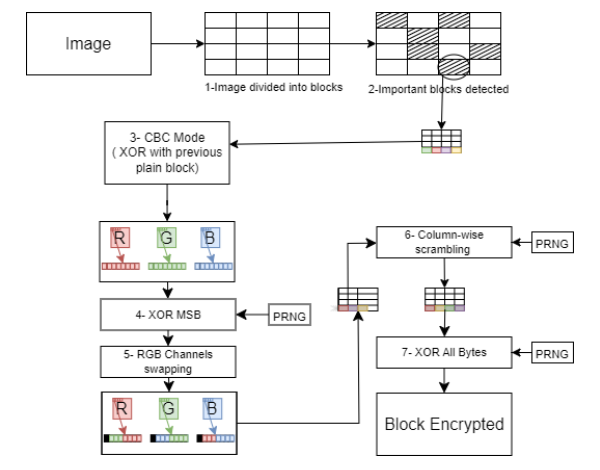
This paper introduces a selective image encryption framework for color imagery, emphasizing computational efficiency without compromising practical security. The core idea is to encrypt only the most informative and perceptually critical components of each pixel, while bypassing nonessential data to reduce processing cost; a full-encryption variant is implemented to enable apples-to-apples comparison. Evaluated on a representative set of natural color images, the selective scheme achieves encrypted outputs with an average Peak Signal-to-Noise Ratio (PSNR) of 8.7 dB, Mean Structural Similarity (MSSIM) of 0.07, and Information Entropy (IE) of 7.8 bits. These values are closely aligned with those obtained under full encryption, indicating low residual similarity to the plaintext and near-uniform randomness in cipher histograms. In qualitative terms, the visual content is thoroughly obfuscated, while the selective strategy decreases the amount of data entering the cryptographic core, yielding measurable speedups. The design integrates permutation and diffusion stages suitable for block-based processing and common cipher modes, and supports region-of-interest operation when desired. Together, the empirical evidence and design choices suggest a practical trade-off: comparable security indicators at a fraction of the computational effort. The approach is particularly attractive for resource-constrained settings, batch protection of large image corpora, and latency-sensitive pipelines. Future work will extend the methodology to grayscale imagery, broaden the testbed, and incorporate a dedicated pseudo-random number generator to decouple randomness from platform dependencies.
Keywords:
Selective Image Encryption Region of Interest (ROI) MSB Fisher–Yates Shuffling CBC Information EntropyReferences
- Ma, K.; Teng, L.; Wang, X.; et al. Color image encryption scheme based on the combination of the fisher-yates scrambling algorithm and chaos theory. Multimedia Tools Appl. 2021, 80, 24737–24757.
- Yavuz, E. A novel chaotic image encryption algorithm based on content-sensitive dynamic function switching scheme. Opt. Laser Technol. 2019, 114, 224–239.
- Jacaman, I.; Farajallah, M. A Lightweight Spatial Domain Image Encryption Algorithms: A Review Paper. J. Theor. Appl. Inf. Technol. 2023, 101, 1275–1290.
- Roy, S.; Shrivastava, M.; Pandey, C.V.; et al. IEVCA: An efficient image encryption technique for IoT applications using 2-D Von-Neumann cellular automata. Multimedia Tools Appl. 2021, 80, 31529–31567.
- Zhang, L.; Wang, X.; Zhao, Y. Research on color image encryption algorithm based on bit-plane and chaotic system. Entropy 2022, 24, 186.
- Al-Hazaimeh, A.S.; Al-Betar, M.A. Image encryption algorithms: A survey of design and evaluation metrics. Digital 2021, 4, 126–152.
- Kiran, P.; Parameshchari, B.D. Resource Optimized Selective Image Encryption of Medical Images Using Multiple Chaotic Systems. Microprocess. Microsyst. 2022, 91, 104546. DOI: https://doi.org/10.1016/j.micpro.2022.104546
- Wang, L.; Chen, Z.; Sun, X.; et al. Color image ROI encryption algorithm based on a novel 4D hyperchaotic system. Phys. Scr. 2023, 99, 015229. DOI: https://doi.org/10.1088/1402-4896/ad14d1
- Wang, X.; Guan, N.; Liu, P. A selective image encryption algorithm based on a chaotic model using modular sine arithmetic. Optik 2022, 258, 168955. DOI: https://doi.org/10.1016/j.ijleo.2022.168955
- Barker, E.; Kelsey, J. Recommendation for Random Number Generation Using Deterministic Random Bit Generators (Revised). NIST SP 800-90A Rev. 1; U.S. Department of Commerce: Gaithersburg, MD, USA, 2015. DOI: https://doi.org/10.6028/NIST.SP.800-90Ar1
- Nir, Y.; Langley, A. ChaCha20 and Poly1305 for IETF Protocols. RFC 8439; Internet Engineering Task Force (IETF): Fremont, CA, USA, 2018. Available online: https://datatracker.ietf.org/doc/rfc8439/
- Dworkin, M. Recommendation for Block Cipher Modes of Operation: Methods and Techniques. NIST SP 800-38A; U.S. Department of Commerce: Gaithersburg, MD, USA, 2001.
- Kuhn, M. Image Processing Standard Test Images. Available online: https://www.eecs.qmul.ac.uk/~phao/IP/Labs/cwk/images/ (accessed on 21 August 2023).
- Massoudi, A.; Lefebvre, F.; De Vleeschouwer, C.; et al. Overview on selective encryption of image and video: challenges and perspectives. Eur. J. Inf. Secur. 2008, 2008, 179290.
- Geetha, S.; Punithavathi, P.; Infanteena, A.M.; et al. A literature review on image encryption techniques. Int. J. Inf. Secur. Privacy 2014, 12, 42–83.
- Kelsey, J. Recommendation for the Entropy Sources Used for Random Bit Generation. NIST SP 800-90B; U.S. Department of Commerce: Gaithersburg, MD, USA, 2018. DOI: https://doi.org/10.6028/NIST.SP.800-90B
- Barker, E.; Kelsey, J. Recommendation for Random Bit Generator (RBG) Constructions. NIST SP 800-90C; U.S. Department of Commerce: Gaithersburg, MD, USA, 2016. DOI: https://doi.org/10.6028/NIST.SP.800-90C
- Krawczyk, H.; Eronen, P. HMAC-based Extract-and-Expand Key Derivation Function (HKDF). RFC 5869; Internet Engineering Task Force (IETF): Fremont, CA, USA, 2010. DOI: https://doi.org/10.17487/RFC5869
- Baker, E,; Chen, L.; Davis, R. Recommendation for Key-Derivation Methods in Key-Establishment Schemes. NIST SP 800-56C Rev. 2; U.S. Department of Commerce: Gaithersburg, MD, USA, 2020. DOI: https://doi.org/10.6028/NIST.SP.800-56Cr2
- Baker, E,; Chen, L.; Davis, R. Recommendation for Cryptographic Key Generation. NIST SP 800-133 Rev. 2; U.S. Department of Commerce: Gaithersburg, MD, USA, 2020. DOI: https://doi.org/10.6028/NIST.SP.800-133r2
- Wu, Y.; Noonan, J.P.; Agaian, S. NPCR and UACI randomness tests for image encryption. Cyber J. Multidiscip. J. Sci. Technol. 2011, 4, 31–38. Available online: https://www.cyberjournals.com/Papers/Apr2011/05.pdf
- Berman, H.G. Random Number Generator - Stat Trek. Available online: https://stattrek.com/statistics/random-number-generator#table/ (accessed on 16 September 2023).
- NIST. Security Requirements for Cryptographic Modules. FIPS PUB 140-3; U.S. Department of Commerce: Gaithersburg, MD, USA, 2019. DOI: https://doi.org/10.6028/NIST.FIPS.140-3
- TestImages.jl. Image database, testimage. Available online: https://testimages.juliaimages.org/stable/imagelist/ (accessed on 21 August 2023).
- ISO/IEC 10116:2017. Information technology — Security techniques — Modes of operation for an n-bit block cipher; ISO/IEC: Geneva, Switzerland, 2017. Available online: https://www.iso.org/standard/64575.html
- Jacaman, I. Selective Color Image Encryption Code (MATLAB) — GitHub repository. Available online: https://github.com/IJacaman/MatLab (accessed on 10 July 2025).
- Ko, K.; Kim, S.; Kwon, H. Selective Audio Perturbations for Targeting Specific Phrases in Speech Recognition Systems. Int. J. Comput. Intell. Syst. 2025, 18, 103.
- Lee, T.; Lee, S.; Kwon, H. Multi-Targeted Textual Backdoor Attack: Model-Specific Misrecognition via Trigger Position and Word Choice. IEEE Access 2025, 13, 57983–57993.
- Ko, K.; Kim, S.; Kwon, H. Multi-targeted Audio Adversarial Example for Use against Speech Recognition Systems. Comput. Secur. 2023, 128, 103168. DOI: https://doi.org/10.1016/j.cose.2023.103168
- Kwon, H.; Nam, S.-H. Audio Adversarial Detection through Classification Score on Speech Recognition Systems. Comput. Secur. 2023, 126, 103061. DOI: https://doi.org/10.1016/j.cose.2022.103061
- Kwon, H.; Baek, J.-W. Targeted Discrepancy Attacks: Crafting Selective Adversarial Examples in Graph Neural Networks. IEEE Access 2025, 13, 13700–13712.
- Kwon, H.; Lee, S. Detecting Textual Adversarial Examples through Text Modification on Text Classification Systems. Appl. Intell. 2023, 53, 19161–19185. DOI: https://doi.org/10.1007/s10489-022-03313-w
- Kwon, H.; Kim, D.-J. Dual-Targeted Adversarial Example in Evasion Attack on Graph Neural Networks. Sci. Rep. 2025, 15, 3912.
- Hraini, I. ; Farajallah, M. ; Arman, N. ; et al. Joint crypto-compression based on selective encryption for WMSNs. IEEE Access. 2021, 9, 161269–161282.