
Articles
Research on Collaborative Governance Strategies for Air Pollution Based on Differential Game Theory
 Download

This work is licensed under a Creative Commons Attribution-NonCommercial 4.0 International License.
Copyright
The authors shall retain the copyright of their work but allow the Publisher to publish, copy, distribute, and convey the work.
License
Climate Policy and Green Economy Journal (CPGEJ) publishes accepted manuscripts under Creative Commons Attribution 4.0 International (CC BY 4.0). Authors who submit their papers for publication by Climate Policy and Green Economy Journal (CPGEJ) agree to have the CC BY 4.0 license applied to their work, and that anyone is allowed to reuse the article or part of it free of charge for any purpose, including commercial use. As long as the author and original source is properly cited, anyone may copy, redistribute, reuse and transform the content.
Authors
-
Fulei Shi
 School of Management and Engineering, Capital University of Economics and Business, Beijing 100070, China
-
Zisha Zhou
School of Management and Engineering, Capital University of Economics and Business, Beijing 100070, China
-
Moyang Hu
School of Management and Engineering, Capital University of Economics and Business, Beijing 100070, China
-
Zhihan Huang
School of Management and Engineering, Capital University of Economics and Business, Beijing 100070, China
-
Zixuan Cheng
School of Statistics and Data Science, Capital University of Economics and Business, Beijing 100070, China
Received: 28 April 2025; Revised: 3 June 2025; Accepted: 8 July 2025; Published: 13 August 2025
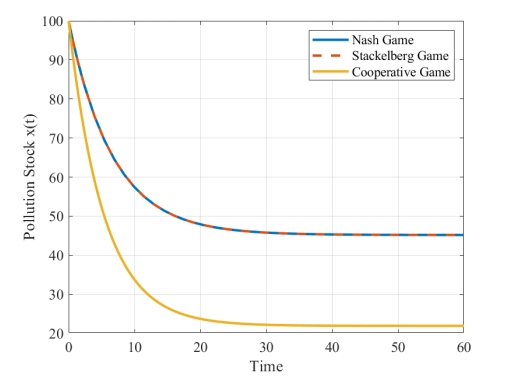
In recent years, air pollution has become an increasingly important issue along with economic and industrial development. To study the interaction between government and enterprises in pollution control, we have developed a differential game model and analyzed their dynamic decision-making process under different governance situations. Three scenarios are considered, including a Nash non-cooperative game, a Stackelberg game led by the government, and a cooperative game with subsidies. The results show that under both the Nash and Stackelberg games, the strategies of government regulation and enterprise emission reduction are completely identical, and the pollution stock remains at a relatively high level. In these two situations, enterprises tend to stay in a passive emission reduction state, so the improvement in pollution governance is limited. However, under the cooperative game, the government encourages enterprises by providing subsidies for emission reduction. As a result, enterprises are more willing to increase their abatement efforts, while the government can reduce part of its regulatory pressure at the same time. Compared with the other two scenarios, the pollution stock decreases more significantly in the cooperative case. These findings indicate that subsidy policies can improve cooperation between government and enterprises and help achieve better environmental governance. And this study may provide some references for the design of air pollution control policies.
Keywords:
Pollution Abatement Game Theory Differential Game Environmental RegulationReferences
- Yi, Y.; Wei, Z.; Fu, C. A Differential Game of Transboundary Pollution Control and Ecological Compensation in a River Basin. Complexity 2020, 2020, 6750805.
- Yu, C.; Tu, G.; Yu, F. Research on Transboundary Air Pollution Control and Cooperative Strategies Based on Differential Game. Atmosphere 2024, 15, 1528.
- Wang, C.; Shi, F.; Yao, C. A differential game of industrial pollution management considering public participation. J. Math. 2020, 2020, 6621331.
- Zhou, K.; Wang, Q.; Tang, J. Evolutionary game analysis of environmental pollution control under the government regulation. Sci. Rep. 2022, 12, 474.
- Wei, G.; Li, G.; Sun, X. Evolutionary Game Analysis of the Regulatory Strategy of Third-Party Environmental Pollution Management. Sustainability 2022, 14, 15449.
- Sun, M.; Gao, X.; Li, J.; et al. Research on Evolutionary Game of Water Environment Governance Behavior from the Perspective of Public Participation. Int. J. Environ. Res. Public Health 2022, 19, 14732.
- Zhao, H.; Liu, H.; Zhang, Y. Evolutionary game analysis of collaborative mechanism in the third-party environmental pollution governance. Glob. NEST J. 2025, 27, 07823.
- Song, Y.; Chang, D.; Cui, L. The evolutionary game of cooperative air pollution management under complex networks. Sustainability 2023, 15, 246.
- Wang, J.; Jia, L.; He, P.; et al. Engaging stakeholders in collaborative control of air pollution: A tripartite evolutionary game of enterprises, public and government. J. Clean. Prod. 2023, 418, 138074.
- Batabyal, A.A. Consistency and Optimality in a Dynamic Game of Pollution Control I: Competition; Utah State University: Logan, UT, USA, 1995.
- Cai, F.; Lu, Z.; Yang, J.; et al. Optimal control for transboundary pollution under inter-temporal transfer of emission permits: A differential game approach. Appl. Math. Model. 2023, 113, 376–397.
- Xu, H.; Luo, M. Optimal Environmental Policy in a Dynamic Transboundary Pollution Game: Emission Standards, Taxes, and Permit Trading. Sustainability 2022, 14, 9028.
- Caravaggio, A.; De Cesare, L.; Di Liddo, A. A differential game for optimal water price management. Games 2023, 14, 33.
- Zhu, X.; Wang, X.; Li, Y.; et al. Differential game-based cooperative interception guidance law with collision avoidance. Aerospace 2024, 11, 771.
- Fan, X.; Xiao, D.; Hui, P.; et al. Multi-entity collaboration mechanism of key core technology innovation based on differential game. Systems 2025, 13, 436.
- Kang, Y.; Dong, P.; Ju, Y.; et al. Differential game theoretic analysis of blockchain technology investment and carbon reduction strategy in digital supply chain with government intervention. Comput. Ind. Eng. 2024, 189, 109953.
- Zhang, H.; Mi, Y.; Liu, X.; et al. A differential game approach for real-time security defense decision in scale-free networks. Comput. Netw. 2023, 224, 109635.
- Mu, X.; Liu, J.; Pu, Y. Differential games in the supply chain of innovative products with consumer purchase regret induced returns. PLoS One 2024, 19, e0302154.
- Chen, Y.; Li, L. Differential game model of carbon emission reduction decisions with two types of government contracts: Green funding and green technology. J. Clean. Prod. 2023, 389, 135847.
- Li, H.; Tan, D. How to Control Waste Incineration Pollution? Cost-Sharing or Penalty Mechanism—Based on Two Differential Game Models. Decis. Anal. 2024, 21, 91.
- Luo, E.; Hu, Z.; Xiang, S.; et al. The Design of Ecological Compensation for Air Pollution Based on Differential Game. Sustainability 2024, 16, 944.
- Sun, H.; Liu, J.; Zhang, L. Differential Game Analysis of Carbon Emission Reduction Effect and Price Strategy Considering Government Intervention and Manufacturer Competition. Manag. Decis. Econ. 2025, 46, 1146–1166.
- Nash, J.F. Non-cooperative games. Ann. Math. 1951, 54, 286–295.
- Ding, J.; Chen, L.; Deng, M.; et al. A differential game for basin ecological compensation mechanism based on cross-regional government-enterprise cooperation. J. Clean. Prod. 2022, 362, 132335.
- Meng, L.; Wang, J.; Yan, W.; et al. A differential game model for emission reduction decisions between ports and shipping enterprises considering environmental regulations. Ocean Coast. Manag. 2022, 225, 106221.
- Liu, Y.; Zheng, R.; Yu, B.; et al. An improved chaotic game optimization algorithm and its application in air quality prediction. Axioms 2025, 14, 235.