
Articles
Trapped in Tradition or Trailblazing Change? Unveiling the Dual Nature of Path Dependence in Manufacturing Pollution Control
 Download

This work is licensed under a Creative Commons Attribution-NonCommercial 4.0 International License.
Copyright
The authors shall retain the copyright of their work but allow the Publisher to publish, copy, distribute, and convey the work.
License
Climate Policy and Green Economy Journal (CPGEJ) publishes accepted manuscripts under Creative Commons Attribution 4.0 International (CC BY 4.0). Authors who submit their papers for publication by Climate Policy and Green Economy Journal (CPGEJ) agree to have the CC BY 4.0 license applied to their work, and that anyone is allowed to reuse the article or part of it free of charge for any purpose, including commercial use. As long as the author and original source is properly cited, anyone may copy, redistribute, reuse and transform the content.
Authors

Received: 20 April 2025; Revised: 9 June 2025; Accepted: 13 June 2025; Published: 25 June 2025
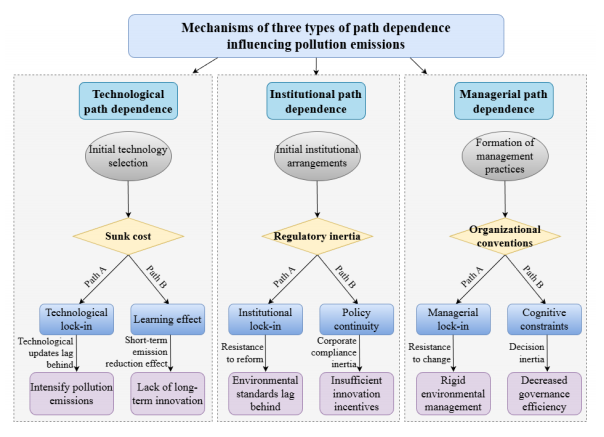
This study employs panel data from 1884 listed manufacturing companies in China (2009–2021) to investigate the environmental effects of path dependence on atmospheric pollution emissions. Using dictionary-based textual analysis of annual reports, we measure three dimensions of path dependence—technological, institutional, and managerial—and examine their non-linear relationships with sulfur dioxide emissions through fixed-effects models. Our findings reveal consistent U-shaped patterns across all dependence types: moderate levels initially reduce emissions (the “honey phase”) while excessive reliance leads to increased pollution (the “arsenic phase”). The analysis demonstrates that technological path dependence operates through sunk costs and learning effects, institutional dependence reflects regulatory inertia, and managerial dependence stems from organizational routines. Robustness tests using alternative pollution measures and instrumental variable approaches confirm these relationships. The study identifies significant heterogeneity in these effects. Non-state-owned enterprises exhibit stronger path dependence impacts due to greater flexibility, while high-maturity firms show amplified U-curves reflecting their accumulated experience. Conversely, capital-intensive enterprises display attenuated effects, suggesting diminishing returns to scale in pollution control. These findings highlight the dual nature of path dependence as both a stability mechanism and potential barrier to innovation. The policy implication is that manufacturing pollution control strategies should account for both dependence levels and firm-specific characteristics, maintaining path dependence within optimal ranges to harness stabilization benefits without impeding technological transitions. This research contributes to environmental governance literature by extending path dependence theory to pollution control and offering a multidimensional analytical framework for sustainable manufacturing transformation.
Keywords:
Technological Dependence Institutional Dependence Management Dependence Air Pollution Manufacturing IndustryReferences
- Xiao, W.L.; Qiu, T.Z.; Liu, Q.; et al. Manufacturing crisis and twin-oriented manufacturing. J. Manuf. Syst. 2024, 73, 205–22. DOI: https://doi.org/10.1016/j.jmsy.2024.02.002
- Zhou, D.; Zhong, Z.; Chen, L.; et al. Can the joint regional air pollution control policy achieve a win-win outcome for the environment and economy? Evidence from China. Econ. Anal. Policy 2022, 74, 13–33. DOI: https://doi.org/10.1016/j.eap.2022.01.011
- Chow, J.; Liu, T.; Du, C.D.; et al. From research to policy recommendations: A scientometric case study of air quality management in the Greater Bay Area, China. Environ. Sci. Policy 2025, 165, 104025. DOI: https://doi.org/10.1016/j.envsci.2025.104025
- Drechsler, M.; Wätzold, F. Biodiversity conservation in a dynamic world may lead to inefficiencies due to lock-in effects and path dependence. Ecol. Econ. 2020, 173, 106652. DOI: https://doi.org/10.1016/j.ecolecon.2020.106652
- Huang, J. Resources, innovation, globalization, and green growth: The BRICS financial development strategy. Geosci. Front. 2024, 15, 101741. DOI: https://doi.org/10.1016/j.gsf.2023.101741
- Kotlikoff, L.; Kubler, F.; Polbin, A.; et al. Can today’s and tomorrow’s world uniformly gain from carbon taxation? Eur. Econ. Rev. 2024, 168, 104819. DOI: https://doi.org/10.1016/j.euroecorev.2024.104819
- Jin, W. Path dependence, self-fulfilling expectations, and carbon lock-in. Resour. Energy Econ. 2021, 66, 101263. DOI: https://doi.org/10.1016/j.reseneeco.2021.101263
- Feng, W.; Wang, Z.; Xiao, T.; et al. Adaptive weighted dictionary representation using anchor graph for subspace clustering. Pattern Recogn. 2024, 151, 110350. DOI: https://doi.org/10.1016/j.patcog.2024.110350
- Zhao, C.; Zhong, C.; Liu, C.; et al. How the digital economy is empowering green strategies for breaking carbon lock-in. J. Environ. Manage. 2024, 365, 121670. DOI: https://doi.org/10.1016/j.jenvman.2024.121670
- Biddau, F.; Rizzoli, V.; Cottone, P.; et al. “These industries have polluted consciences; we are unable to envision change”: Sense of place and lock-in mechanisms in Sulcis coal and carbon-intensive region, Italy. Glob. Environ. Change 2024, 86, 102850. DOI: https://doi.org/10.1016/j.gloenvcha.2024.102850
- Trencher, G.; Okubo, Y.; Mori, A. Phasing out carbon not coal? Identifying coal lock-in sources in Japan’s power utilities. Clim. Policy 2024, 24, 766–784. DOI: https://doi.org/10.1080/14693062.2024.2302324
- Eitan, A.; Hekkert, M.P. Locked in transition? Towards a conceptualization of path-dependence lock-ins in the renewable energy landscape. Energy Res. Soc. Sci. 2023, 106, 103316. DOI: https://doi.org/10.1016/j.erss.2023.103316
- Klitkou, A.; Bolwig, S.; Hansen, T.; et al. The role of lock-in mechanisms in transition processes: The case of energy for road transport. Environ. Innov. Soc. Transit. 2015, 16, 22–37. DOI: https://doi.org/10.1016/j.eist.2015.07.005
- Hetemi, E.; Jerbrant, A.; Mere, J.O. Exploring the emergence of lock-in in large-scale projects: A process view. Int. J. Proj. Manag. 2020, 38, 47–63. DOI: https://doi.org/10.1016/j.ijproman.2019.10.001
- Gitelman, V.; Kaplan, S.; Hakkert, S. The causation–prevention chain in infrastructure safety measures: A consideration of four types of policy lock-ins. Accid. Anal. Prev. 2024, 195, 107399. DOI: https://doi.org/10.1016/j.aap.2023.107399
- Goldstein, J.E.; Neimark, B.; Garvey, B.; et al. Unlocking “lock-in” and path dependency: A review across disciplines and socio-environmental contexts. World Dev. 2023, 161, 106116. DOI: https://doi.org/10.1016/j.worlddev.2022.106116
- Wu, H.; Wang, L.; Peng, F. Does it pay to be green? The impact of emissions reduction on corporate tax burden. J. Asian Econ. 2024, 91, 101707. DOI: https://doi.org/10.1016/j.asieco.2024.101707
- Belaounia, S.; Tao, R.; Zhao, H. Director foreign experience: Geographic specificity and value implication. Int. Rev. Financ. Anal. 2024, 91, 102998. DOI: https://doi.org/10.1016/j.irfa.2023.102998
- Song, P.; Lu, H.; Zhang, Y. Unveiling tone manipulation in MD&A: Evidence from ChatGPT experiments. Financ. Res. Lett. 2024, 67, 105837. DOI: https://doi.org/10.1016/j.frl.2024.105837
- Wang, F.; Wang, X.; Li, B.; et al. Ownership structure and eco-innovation: Evidence from Chinese family firms. Pac.-Basin Financ. J. 2023, 82, 102158. DOI: https://doi.org/10.1016/j.pacfin.2023.102158
- Chen, F.; Zhang, T.; Chen, Z. Assessment of environmental concern for enterprise pollution reduction. Econ. Anal. Policy 2024, 81, 772–786. DOI: https://doi.org/10.1016/j.eap.2024.01.003
- Zhou, L.; Fan, J.; Hu, M.; et al. Clean air policy and green total factor productivity: Evidence from Chinese prefecture-level cities. Energy Econ. 2024, 133, 107512. DOI: https://doi.org/10.1016/j.eneco.2024.107512
- Talebzadehhosseini, S.; Garibay, I. The interaction effects of technological innovation and path-dependent economic growth on countries’ overall green growth performance. J. Clean Prod. 2022, 333, 130134. DOI: https://doi.org/10.1016/j.jclepro.2021.130134
- Ai, H.; Wang, M.; Zhang, Y.; et al. How does air pollution affect urban innovation capability? Evidence from 281 cities in China. Struct. Change Econ. Dyn. 2022, 61, 166–178. DOI: https://doi.org/10.1016/j.strueco.2022.02.012
- Jiang, Z.; Liu, Z. Policies and exploitative and exploratory innovations of the wind power industry in China: The role of technological path dependence. Technol. Forecast. Soc. Change 2022, 177, 121519. DOI: https://doi.org/10.1016/j.techfore.2022.121519