
Review
Biologics: Its Role in Treating Chronic Rhinosinusitis and Nasal Polyps
 Download

This work is licensed under a Creative Commons Attribution 4.0 International License.
Authors

Received: 7 April 2026; Revised: 27 April 2026; Accepted: 29 May 2026; Published: 5 June 2026
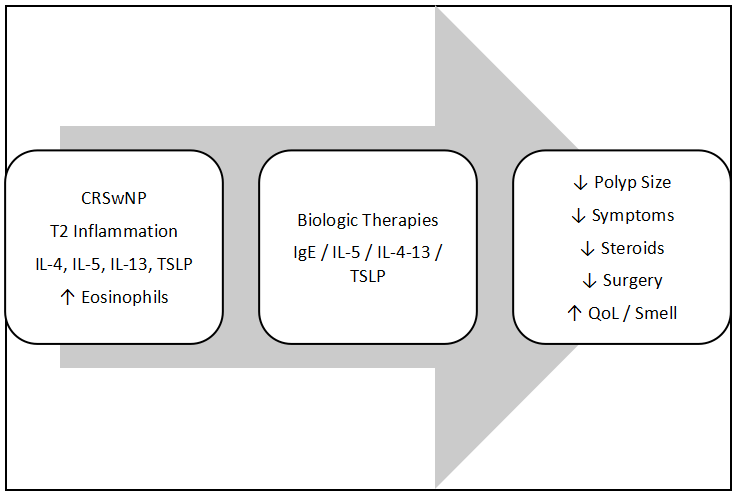
Chronic rhinosinusitis with nasal polyps (CRSwNP) is a clinically heterogeneous inflammatory disorder characterized by persistent sinonasal inflammation and a notable tendency for recurrence, even in patients receiving appropriate medical and surgical treatment. This heterogeneity largely reflects differences in underlying inflammatory endotypes, which in turn influence clinical presentation, risk of postoperative relapse, and response to therapy. In the majority of patients, type 2 (T2) inflammation represents the dominant immunologic profile, driven by cytokines such as interleukin (IL)-4, IL-5, IL-13, and thymic stromal lymphopoietin (TSLP). Targeting these pathways has become a central focus in recent therapeutic strategies. In this context, the introduction of biologic agents has substantially altered the management of patients with severe and difficult-to-control disease. Data from phase 3 randomized trials have consistently shown meaningful reductions in polyp burden and symptom severity, along with decreased reliance on systemic corticosteroids and a lower need for revision surgery. These findings are supported by real-world studies, which suggest that the benefits of biologic therapies extend to more heterogeneous patient populations, including those with comorbid asthma or aspirin-exacerbated respiratory disease. Despite these advances, several important questions remain unresolved. In particular, there is a need for more precise patient selection based on reliable biomarkers, as well as clearer guidance on long-term treatment strategies. Issues related to cost-effectiveness and the optimal timing of treatment discontinuation or switching also continue to represent areas of ongoing debate in clinical practice.
Keywords:
Biologics IL-5 IL-13/4 IgE Mepolizumab Omalizumab Dupilumab TezepelumabReferences
- Hirsch, A.G.; Stewart, W.F.; Sundaresan, A.S.; et al. Nasal and Sinus Symptoms and Chronic Rhinosinusitis in a Population-Based Sample. Allergy 2017, 72, 274–281. DOI: https://doi.org/10.1111/all.13042
- Chen, S.; Zhou, A.; Emmanuel, B.; et al. Systematic Literature Review of the Epidemiology and Clinical Burden of Chronic Rhinosinusitis with Nasal Polyposis. Curr. Med. Res. Opin. 2020, 36, 1897–1911. DOI: https://doi.org/10.1080/03007995.2020.1815682
- Khan, A.H.; Gouia, I.; Kamat, S.; et al. Prevalence and Severity Distribution of Type 2 Inflammation-Related Comorbidities Among Patients with Asthma, Chronic Rhinosinusitis with Nasal Polyps, and Atopic Dermatitis. Lung 2023, 201, 57–63. DOI: https://doi.org/10.1007/s00408-023-00603-z
- Wang, X.; Zhang, N.; Bo, M.; et al. Diversity of TH Cytokine Profiles in Patients with Chronic Rhinosinusitis: A Multicenter Study in Europe, Asia, and Oceania. J. Allergy Clin. Immunol. 2016, 138, 1344–1353. DOI: https://doi.org/10.1016/j.jaci.2016.05.041
- Peters, A.T.; Han, J.K.; Heffler, E.; et al. Thymic Stromal Lymphopoietin as a Therapeutic Target in Patients with Chronic Rhinosinusitis and Nasal Polyps. Clin. Exp. Immunol. 2025, 219, uxaf041. DOI: https://doi.org/10.1093/cei/uxaf041
- Bachert, C.; Hicks, A.; Gane, S.; et al. The Interleukin-4/Interleukin-13 Pathway in Type 2 Inflammation in Chronic Rhinosinusitis with Nasal Polyps. Front. Immunol. 2024, 15, 1356298. DOI: https://doi.org/10.3389/fimmu.2024.1356298
- Matsunaga, K.; Katoh, N.; Fujieda, S.; et al. Dupilumab: Basic Aspects and Applications to Allergic Diseases. Allergol. Int. 2020, 69, 187–196. DOI: https://doi.org/10.1016/j.alit.2020.01.002
- Luo, X.; Li, C.; Wang, Y.; et al. Interleukin-33 Promotes Th2/Th17 Response in Eosinophilic and Non-Eosinophilic Nasal Polyps. ORL J. Otorhinolaryngol. Relat. Spec. 2020, 82, 34–39. DOI: https://doi.org/10.1159/000503976
- Liu, J.; Li, Y.Y.; Andiappan, A.K.; et al. Role of IL-13Rα2 in Modulating IL-13-Induced MUC5AC and Ciliary Changes in Healthy and CRSwNP Mucosa. Allergy 2018, 73, 1673–1685. DOI: https://doi.org/10.1111/all.13424
- Berni Canani, R.; Caminati, M.; Carucci, L.; et al. Skin, Gut, and Lung Barrier: Physiological Interface and Target of Intervention for Preventing and Treating Allergic Diseases. Allergy 2024, 79, 1485–1500. DOI: https://doi.org/10.1111/all.16092
- Kyriakopoulos, C.; Ntritsos, G.; Gogali, A.; et al. Efficacy of Biologic Agents in Patients with Comorbid Asthma and Chronic Rhinosinusitis with Nasal Polyps: A Systematic Review and Meta-Analysis of Randomised Controlled Trials. Eur. Respir. Rev. 2026, 35. DOI: https://doi.org/10.1183/16000617.0186-2025
- Fokkens, W.J.; Viskens, A.S.; Backer, V.; et al. EPOS/EUFOREA Update on Indication and Evaluation of Biologics in Chronic Rhinosinusitis with Nasal Polyps 2023. Rhinology 2023, 61, 194–202. DOI: https://doi.org/10.4193/Rhin22.489
- Snidvongs, K.; Kalish, L.; Sacks, R.; et al. Sinus Surgery and Delivery Method Influence the Effectiveness of Topical Corticosteroids for Chronic Rhinosinusitis: Systematic Review and Meta-Analysis. Am. J. Rhinol. Allergy 2013, 27, 221–233. DOI: https://doi.org/10.2500/ajra.2013.27.3880
- Kariyawasam, H.H.; James, L.K. Chronic Rhinosinusitis with Nasal Polyps: Targeting IgE with Anti-IgE Omalizumab Therapy. Drug Des. Devel. Ther. 2020, 14, 5483–5494. DOI: https://doi.org/10.2147/DDDT.S226575
- Chhiba, K.D.; Patel, G.B.; Peters, A.T. Anti-IgE Therapy in Chronic Rhinosinusitis with Nasal Polyps. J. Allergy Clin. Immunol. 2025, 155, 24–30. DOI: https://doi.org/10.1016/j.jaci.2024.11.011
- Bai, J.; Tan, B.K. B Lineage Cells and IgE in Allergic Rhinitis and CRSwNP and the Role of Omalizumab Treatment. Am. J. Rhinol. Allergy 2023, 37, 182–192. DOI: https://doi.org/10.1177/19458924221147770
- Bachert, C.; Maurer, M.; Palomares, O.; et al. What Is the Contribution of IgE to Nasal Polyposis? J. Allergy Clin. Immunol. 2021, 147, 1997–2008. DOI: https://doi.org/10.1016/j.jaci.2021.03.016
- Gevaert, P.; Saenz, R.; Corren, J.; et al. Long-Term Efficacy and Safety of Omalizumab for Nasal Polyposis in an Open-Label Extension Study. J. Allergy Clin. Immunol. 2022, 149, 957–965. DOI: https://doi.org/10.1016/j.jaci.2021.07.045
- Gevaert, P.; Omachi, T.A.; Corren, J.; et al. Efficacy and Safety of Omalizumab in Nasal Polyposis: 2 Randomized Phase 3 Trials. J. Allergy Clin. Immunol. 2020, 146, 595–605. DOI: https://doi.org/10.1016/j.jaci.2020.05.032
- Geng, B.; Dilley, M.; Anterasian, C. Biologic Therapies for Allergic Rhinitis and Nasal Polyposis. Curr. Allergy Asthma Rep. 2021, 21, 36. DOI: https://doi.org/10.1007/s11882-021-01013-y
- Damask, C.; Chen, M.; Holweg, C.T.J.; et al. Defining the Efficacy of Omalizumab in Nasal Polyposis: A POLYP 1 and POLYP 2 Subgroup Analysis. Am. J. Rhinol. Allergy 2022, 36, 135–141. DOI: https://doi.org/10.1177/19458924211030486
- Gevaert, P. Omalizumab Improves Outcomes in Patients with Nasal Polyps Regardless of Their Asthma Status. J. Allergy Clin. Immunol. 2022, 149, AB64. DOI: https://doi.org/10.1016/j.jaci.2021.12.239
- Safia, A.; Khater, A.; Abd Elhadi, U.; et al. Optimizing Biologic Treatment Selection in Chronic Rhinosinusitis with Nasal Polyps: A Network Meta-Analysis of Efficacy and Safety Across 22 RCTs. Pharmaceuticals 2025, 18, 1455. DOI: https://doi.org/10.3390/ph18101455
- Fang, X.; Zhou, T.; Ye, F. Analysis of Adverse Reaction Characteristics of Four Biologics for the Treatment of Chronic Sinusitis with Nasal Polyps: A Descriptive Analysis from WHO-VigiAccess. Am. J. Otolaryngol. 2025, 46, 104705. DOI: https://doi.org/10.1016/j.amjoto.2025.104705
- Bachert, C.; Han, J.K.; Desrosiers, M.; et al. Efficacy and Safety of Dupilumab in Patients with Severe Chronic Rhinosinusitis with Nasal Polyps (LIBERTY NP SINUS-24 and LIBERTY NP SINUS-52): Results from Two Multicentre, Randomised, Double-Blind, Placebo-Controlled, Parallel-Group Phase 3 Trials. Lancet 2019, 394, 1638–1650. DOI: https://doi.org/10.1016/S0140-6736(19)31881-1
- Gandhi, N.A.; Pirozzi, G.; Graham, N.M.H. Commonality of the IL-4/IL-13 pathway in atopic diseases. Expert Rev. Clin. Immunol. 2017, 13, 425–437. DOI: https://doi.org/10.1080/1744666X.2017.1298443
- Bachert, C.; Bhattacharyya, N.; Desrosiers, M.; et al. Burden of Disease in Chronic Rhinosinusitis with Nasal Polyps. J. Asthma Allergy 2021, 14, 127–134. DOI: https://doi.org/10.2147/JAA.S290424
- Hara, Y.; Jha, M.K.; Mattoo, H.; et al. Interleukin 4 directly activates olfactory neurons and induces loss of smell in mice. J. Allergy Clin. Immunol. 2023, 151, AB128. DOI: https://doi.org/10.1016/j.jaci.2022.12.403
- Saraswathula, A.; Liu, M.M.; Kulaga, H.; et al. Chronic interleukin-13 expression in mouse olfactory mucosa results in regional aneuronal epithelium. Int. Forum Allergy Rhinol. 2023, 13, 230–241. DOI: https://doi.org/10.1002/alr.23073
- Le Floc'h, A.; Allinne, J.; Nagashima, K.; et al. Dual blockade of IL-4 and IL-13 with dupilumab, an IL-4Ralpha antibody, is required to broadly inhibit type 2 inflammation. Allergy 2020, 75, 1188–1204. DOI: https://doi.org/10.1111/all.14151
- Alobid, I.; Benitez, P.; Cardelus, S.; et al. Oral plus nasal corticosteroids improve smell, nasal congestion, and inflammation in sino-nasal polyposis. Laryngoscope 2014, 124, 50–56. DOI: https://doi.org/10.1002/lary.24330
- DeConde, A.S.; Mace, J.C.; Levy, J.M.; et al. Prevalence of polyp recurrence after endoscopic sinus surgery for chronic rhinosinusitis with nasal polyposis. Laryngoscope 2017, 127, 550–555. DOI: https://doi.org/10.1002/lary.26391
- Rabe, K.F.; Nair, P.; Brusselle, G.; et al. Efficacy and Safety of Dupilumab in Glucocorticoid-Dependent Severe Asthma. N. Engl. J. Med. 2018, 378, 2475–2485. DOI: https://doi.org/10.1056/NEJMoa1804093
- Blauvelt, A.; de Bruin-Weller, M.; Gooderham, M.; et al. Long-term management of moderate-to-severe atopic dermatitis with dupilumab and concomitant topical corticosteroids (LIBERTY AD CHRONOS): a 1-year, randomised, double-blinded, placebo-controlled, phase 3 trial. Lancet 2017, 389, 2287–2303. DOI: https://doi.org/10.1016/S0140-6736(17)31191-1
- Thaci, D.; Simpson, E.L.; Beck, L.A.; et al. Efficacy and safety of dupilumab in adults with moderate-to-severe atopic dermatitis inadequately controlled by topical treatments: a randomised, placebo-controlled, dose-ranging phase 2b trial. Lancet 2016, 387, 40–52. DOI: https://doi.org/10.1016/S0140-6736(15)00388-8
- Mieli, O.M.; Valera, F.C.P.; Dinarte, V.R.P.; et al. One-year efficacy of Dupilumab in sense of smell, nasal polyp score and quality of life in CRSwNP patients: A real-world multicenter study in Brazil. Braz. J. Otorhinolaryngol. 2025, 91, 101704. DOI: https://doi.org/10.1016/j.bjorl.2025.101704
- Seys, S.F.; Schneider, S.; de Kinderen, J.; et al. Real-world effectiveness of dupilumab in a European cohort of chronic rhinosinusitis with nasal polyps (CHRINOSOR). J. Allergy Clin. Immunol. 2025, 155, 451–460. DOI: https://doi.org/10.1016/j.jaci.2024.10.016
- Hirschberg, A.; Matuz, M.; Kiricsi, A. Long-term experience with dupilumab treatment of chronic rhinosinusitis with nasal polyps. Orv. Hetil. 2025, 166, 1123–1131. DOI: https://doi.org/10.1556/650.2025.33356 (in Hungarian)
- Kemp, P.; van der Lans, R.J.L.; Otten, J.J.; et al. Hypereosinophilia during dupilumab treatment in patients with chronic rhinosinusitis with nasal polyps. Rhinology 2024, 62, 202–207. DOI: https://doi.org/10.4193/Rhin23.357
- Wechsler, M.E.; Klion, A.D.; Paggiaro, P.; et al. Effect of Dupilumab on Blood Eosinophil Counts in Patients With Asthma, Chronic Rhinosinusitis With Nasal Polyps, Atopic Dermatitis, or Eosinophilic Esophagitis. J. Allergy Clin. Immunol. Pract. 2022, 10, 2695–2709. DOI: https://doi.org/10.1016/j.jaip.2022.05.019
- Di, Y.; Zeng, R.; Huang, L.; et al. Advance in biologics for chronic rhinosinusitis with nasal polyps. Front. Allergy 2026, 7, 1759649. DOI: https://doi.org/10.3389/falgy.2026.1759649
- Shen, S.; Yan, B.; Wang, M.; et al. Stapokibart for Severe Uncontrolled Chronic Rhinosinusitis With Nasal Polyps: The CROWNS-2 Randomized Clinical Trial. JAMA 2025, 334, 962–972. DOI: https://doi.org/10.1001/jama.2025.12515
- Liu, X.; Charn, T.C.; Wang, D.Y. Mepolizumab in chronic rhinosinusitis with nasal polyposis. Immunotherapy 2023, 15, 1105–1116. DOI: https://doi.org/10.2217/imt-2023-0026
- Brusselle, G.G.; Gevaert, P. Mepolizumab for chronic rhinosinusitis with nasal polyps. Lancet Respir. Med. 2021, 9, 1081–1082. DOI: https://doi.org/10.1016/S2213-2600(21)00133-8
- Klimek, L.; Förster-Ruhrmann, U.; Beule, A.G.; et al. Indicating biologics for chronic rhinosinusitis with nasal polyps (CRSwNP). Allergo J. Int. 2022, 31, 149–160. DOI: https://doi.org/10.1007/s40629-022-00220-x
- Bachert, C.; Sousa, A.R.; Han, J.K.; et al. Mepolizumab for chronic rhinosinusitis with nasal polyps: Treatment efficacy by comorbidity and blood eosinophil count. J. Allergy Clin. Immunol. 2022, 149, 1711–1721. DOI: https://doi.org/10.1016/j.jaci.2021.10.040
- Han, J.K.; Bachert, C.; Fokkens, W.; et al. Mepolizumab for chronic rhinosinusitis with nasal polyps (SYNAPSE): a randomised, double-blind, placebo-controlled, phase 3 trial. Lancet Respir. Med. 2021, 9, 1141–1153. DOI: https://doi.org/10.1016/S2213-2600(21)00097-7
- Fokkens, W.; Trigg, A.; Lee, S.E.; et al. Mepolizumab improvements in health-related quality of life and disease symptoms in a patient population with very severe chronic rhinosinusitis with nasal polyps: psychometric and efficacy analyses from the SYNAPSE study. J. Patient Rep. Outcomes 2023, 7, 4. DOI: https://doi.org/10.1186/s41687-023-00543-5
- Mullol, J.; Lund, V.J.; Wagenmann, M.; et al. Mepolizumab improves sense of smell in severe chronic rhinosinusitis with nasal polyps: SYNAPSE. Rhinology 2024, 62, 320–329. DOI: https://doi.org/10.4193/Rhin22.416
- Fujieda, S.; Wang, C.; Yoshikawa, M.; et al. Mepolizumab in CRSwNP/ECRS and NP: the phase III randomised MERIT trial in Japan, China, and Russia. Rhinology 2024, 62, 576–589. DOI: https://doi.org/10.4193/Rhin24.156
- Gallo, S.; Castelnuovo, P.; Spirito, L.; et al. Mepolizumab Improves Outcomes of Chronic Rhinosinusitis with Nasal Polyps in Severe Asthmatic Patients: A Multicentric Real-Life Study. J. Pers. Med. 2022, 12, 1304. DOI: https://doi.org/10.3390/jpm12081304
- Barroso, B.; Valverde-Monge, M.; Alobid, I.; et al. Improvement in Olfaction in Patients With CRSwNP and Severe Asthma Taking Anti-IgE and Anti-IL-5 Biologics: A Real-Life Study. J. Investig. Allergol. Clin. Immunol. 2023, 33, 37–44.
- Desrosiers, M.; Diamant, Z.; Castelnuovo, P.; et al. Sustained efficacy of mepolizumab in patients with severe chronic rhinosinusitis with nasal polyps: SYNAPSE 24-week treatment-free follow-up. Int. Forum Allergy Rhinol. 2024, 14, 18–31. DOI: https://doi.org/10.1002/alr.23219
- Chupp, G.; Alobid, I.; Lugogo, N.L.; et al. Mepolizumab Reduces Systemic Corticosteroid Use in Chronic Rhinosinusitis With Nasal Polyps. J. Allergy Clin. Immunol. Pract. 2023, 11, 3504–3512. DOI: https://doi.org/10.1016/j.jaip.2023.08.015
- Pelaia, C.; Calabrese, C.; Vatrella, A.; et al. Benralizumab: From the Basic Mechanism of Action to the Potential Use in the Biological Therapy of Severe Eosinophilic Asthma. Biomed Res. Int. 2018, 2018, 4839230. DOI: https://doi.org/10.1155/2018/4839230
- Dagher, R.; Kumar, V.; Copenhaver, A.M.; et al. Novel mechanisms of action contributing to benralizumab's potent anti-eosinophilic activity. Eur. Respir. J. 2022, 59, 2004306. DOI: https://doi.org/10.1183/13993003.04306-2020
- Emson, C.; Han, J.K.; Hopkins, C.; et al. Pharmacokinetics/pharmacodynamics of benralizumab in chronic rhinosinusitis with nasal polyps: Phase III, randomized, placebo-controlled OSTRO trial. Br. J. Clin. Pharmacol. 2024, 90, 1952–1963. DOI: https://doi.org/10.1111/bcp.16087
- Bachert, C.; Han, J.K.; Desrosiers, M.Y.; et al. Efficacy and safety of benralizumab in chronic rhinosinusitis with nasal polyps: A randomized, placebo-controlled trial. J. Allergy Clin. Immunol. 2022, 149, 1309–1317. DOI: https://doi.org/10.1016/j.jaci.2021.08.030
- Russo, D.; Di Filippo, P.; Di Pillo, S.; et al. New Indications of Biological Drugs in Allergic and Immunological Disorders: Beyond Asthma, Urticaria, and Atopic Dermatitis. Biomedicines 2023, 11, 236. DOI: https://doi.org/10.3390/biomedicines11020236
- Almulhim, R.N.; Alsabhawi, A.H.; Alkhawajah, A.A.; et al. Efficacy of Benralizumab in Paediatric and Adult Populations with Chronic Rhinosinusitis with Nasal Polyps: A Systematic Review and Meta-analysis. J. Adv. Trends Med. Res. 2024, 1, 409–415.
- Tversky, J.; Lane, A.P.; Azar, A. Benralizumab effect on severe chronic rhinosinusitis with nasal polyps (CRSwNP): A randomized double-blind placebo-controlled trial. Clin. Exp. Allergy 2021, 51, 836–844. DOI: https://doi.org/10.1111/cea.13852
- De Corso, E.; Mele, D.A.; Rizzi, A.; et al. Sinonasal Outcomes Obtained after 2 Years of Treatment with Benralizumab in Patients with Severe Eosinophilic Asthma and CRSwNP: A "Real-Life" Observational Study. J. Pers. Med. 2024, 14, 1014. DOI: https://doi.org/10.3390/jpm14091014
- De Corso, E.; Bellocchi, G.; De Benedetto, M.; et al. Biologics for severe uncontrolled chronic rhinosinusitis with nasal polyps: a change management approach. Consensus of the Joint Committee of Italian Society of Otorhinolaryngology on biologics in rhinology. Acta Otorhinolaryngol. Ital. 2022, 42, 1–16. DOI: https://doi.org/10.14639/0392-100X-N1614
- ClinicalTrials.gov. Efficacy and Safety Study of Benralizumab in Patient With Eosinophilic Chronic Rhinosinusitis With Nasal Polyps (ORCHID). Available online: https://clinicaltrials.gov/study/NCT04157335 (accessed on 19 February 2026).
- Maspero, J. Reslizumab in the treatment of inadequately controlled asthma in adults and adolescents with elevated blood eosinophils: clinical trial evidence and future prospects. Ther. Adv. Respir. Dis. 2017, 11, 311–325. DOI: https://doi.org/10.1177/1753465817717134
- Gevaert, P.; Lang-Loidolt, D.; Lackner, A.; et al. Nasal IL-5 levels determine the response to anti-IL-5 treatment in patients with nasal polyps. J. Allergy Clin. Immunol. 2006, 118, 1133–1141. DOI: https://doi.org/10.1016/j.jaci.2006.05.031
- Koski, R.R.; Hill, L.; Taavola, K. Efficacy and Safety of Biologics for Chronic Rhinosinusitis With Nasal Polyps. J. Pharm. Technol. 2022, 38, 289–296. DOI: https://doi.org/10.1177/87551225221105749
- Weinstein, S.F.; Katial, R.K.; Bardin, P.; et al. Effects of Reslizumab on Asthma Outcomes in a Subgroup of Eosinophilic Asthma Patients with Self-Reported Chronic Rhinosinusitis with Nasal Polyps. J. Allergy Clin. Immunol. Pract. 2019, 7, 589–596. DOI: https://doi.org/10.1016/j.jaip.2018.08.021
- Lombardi, C.; Comberiati, P.; Ridolo, E.; et al. Anti-IL-5 Pathway Agents in Eosinophilic-Associated Disorders Across the Lifespan. Drugs 2024, 84, 661–684. DOI: https://doi.org/10.1007/s40265-024-02037-0
- Tiotiu, A. The current evidence regarding the efficacy of tezepelumab administered for asthma on T2-related comorbidities. Expert Rev. Respir. Med. 2026, 20, 5–11. DOI: https://doi.org/10.1080/17476348.2025.2600110
- Pavord, I.D.; Hoyte, F.C.L.; Lindsley, A.W.; et al. Tezepelumab reduces exacerbations across all seasons in patients with severe, uncontrolled asthma (NAVIGATOR). Ann. Allergy Asthma Immunol. 2023, 131, 587–597. DOI: https://doi.org/10.1016/j.anai.2023.08.015
- Chen, L.; Fan, X.; Yang, L.; et al. Research progress of glucocorticoid resistance in chronic rhinosinusitis with nasal polyps: A review. Medicine (Baltimore) 2023, 102, e36024. DOI: https://doi.org/10.1097/MD.0000000000036024
- Lipworth, B.J.; Han, J.K.; Desrosiers, M.; et al. Tezepelumab in Adults with Severe Chronic Rhinosinusitis with Nasal Polyps. N. Engl. J. Med. 2025, 392, 1178–1188. DOI: https://doi.org/10.1056/NEJMoa2414482
- Jackson, D.J.; Wechsler, M.E.; Jackson, D.J.; et al. Twice-Yearly Depemokimab in Severe Asthma with an Eosinophilic Phenotype. N. Engl. J. Med. 2024, 391, 2337–2349. DOI: https://doi.org/10.1056/NEJMoa2406673
- Jackson, D.J.; Bourdin, A.; Blackorby, A.; et al. Safety and Tolerability of Twice-Yearly Depemokimab in Patients with Asthma and Chronic Rhinosinusitis with Nasal Polyps: Pooled Results from SWIFT-1/-2 and ANCHOR-1/-2. Adv. Ther. 2026, 43, 880–897. DOI: https://doi.org/10.1007/s12325-025-03457-4
- Gevaert, P.; Desrosiers, M.; Cornet, M.; et al. Efficacy and safety of twice per year depemokimab in chronic rhinosinusitis with nasal polyps (ANCHOR-1 and ANCHOR-2): phase 3, randomised, double-blind, parallel trials. Lancet 2025, 405, 911–926. DOI: https://doi.org/10.1016/S0140-6736(25)00197-7