
Article
How Storytelling Supports EFL Speaking Development among Chinese Primary Pupils: Evidence from Proficiency, Motivation, and Anxiety
 Download

This work is licensed under a Creative Commons Attribution 4.0 International License.
Copyright
The authors shall retain the copyright of their work but allow the Publisher to publish, copy, distribute, and convey the work.
License
Journal of Qualitative Research in Education (ENAD) publishes accepted manuscripts under Creative Commons Attribution 4.0 International (CC BY 4.0). Authors who submit their papers for publication by ENAD agree to have the CC BY 4.0 license applied to their work, and that anyone is allowed to reuse the article or part of it free of charge for any purpose, including commercial use. As long as the author and original source are properly cited, anyone may copy, redistribute, reuse, and transform the content.
Authors
-
Luying Zheng
 Faculty of Education, Universiti Kebangsaan Malaysia, Bangi 43600, Malaysia
-
Hanita Hanim Ismail
Faculty of Education, Universiti Kebangsaan Malaysia, Bangi 43600, Malaysia
-
Harwati Hashim
Faculty of Education, Universiti Kebangsaan Malaysia, Bangi 43600, Malaysia
-
Zuraina Binti Ali
Centre for Modern Languages, Universiti Malaysia Pahang, Pekan 26600, Malaysia
Received: 22 March 2026; Revised: 10 April 2026; Accepted: 28 April 2026; Published: 9 May 2026
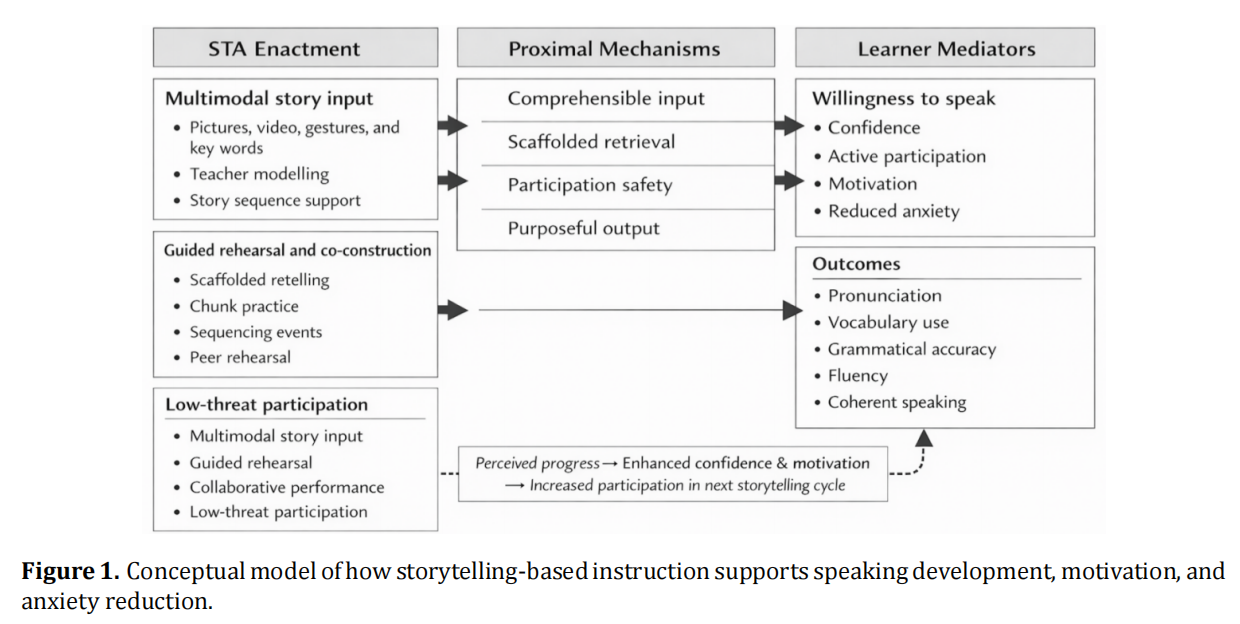
This study explored how storytelling-based instruction supported the speaking development of Chinese primary school pupils in an English as a Foreign Language (EFL) context. A qualitatively dominant mixed-methods design was used so that the study could move beyond outcome comparison and examine how pupils experienced storytelling lessons in classroom practice. The research was conducted in a public primary school in China and involved four intact Grade 5 classes (N = 160), including two experimental classes that received storytelling-based instruction and two control classes that followed regular textbook-based teaching. Qualitative data came from classroom observations and semi-structured interviews with nine purposively selected pupils, while quantitative data were drawn from pretest and posttest speaking assessments and questionnaires on motivation and anxiety. The qualitative analysis showed that storytelling-based instruction appeared to support speaking through several connected classroom processes. These included multimodal support that helped pupils understand and organise language, embodied and creative activities that encouraged expressive use, peer rehearsal that reduced the pressure of speaking, stronger engagement with lesson content, and a greater sense of ease during oral participation. Pupils also described noticeable changes in their own speaking, especially in fluency, vocabulary use, pronunciation, and confidence. The quantitative results were broadly in line with these patterns: compared with the control group, the experimental group performed better on the posttest speaking measures, reported stronger motivation, and showed lower anxiety. The findings suggest that storytelling can support young EFL learners’ speaking not simply by making lessons more enjoyable, but by changing how classroom participation is organised. In this study, storytelling created conditions in which speaking became easier to understand, more purposeful, and less intimidating for primary school pupils.
Keywords:
Storytelling Pedagogy Young EFL Learners Speaking Development Qualitative-Dominant Mixed Methods Primary English Education ChinaReferences
- Ministry of Education of the People’s Republic of China. English Curriculum Standards for Compulsory Education (2022 Edition); Beijing Normal University Press: Beijing, China, 2022.
- Jiang, Z. The policy and development characteristics of English education in primary and secondary schools in China in the new era. Adv. Educ. 2023, 13, 3614–3621.
- Ellis, G.; Brewster, J. Tell It Again! The Storytelling Handbook for Primary English Language Teachers; British Council: London, UK, 2014.
- Wright, A. Storytelling with Children; Oxford University Press: Oxford, UK, 1995.
- Bruner, J. The narrative construction of reality. Crit. Inq. 1991, 18, 1–21.
- Férez-Mora, P.A.; Coyle, Y. Storytelling in EFL primary education: Defining a sociocritical and participatory model with pre-service teachers. Think. Ski. Creat. 2023, 49, 101360. DOI: https://doi.org/10.1016/j.tsc.2023.101360
- Yao, T.; Xi, X.; Prieto, P. The effects of oral narrative interventions on second language learning: A systematic review and meta-analysis. System 2025, 134, 103835. DOI: https://doi.org/10.1016/j.system.2025.103835
- Zheng, L.; Ismail, H.H.; Hashim, H.; et al. Storytelling in English language education in China: A systematic review of empirical research from the past decade (2014–2024). Forum Linguist. Stud. 2025, 7, 280–295. DOI: https://doi.org/10.30564/fls.v7i2.8314
- Dewaele, J.M.; MacIntyre, P.D. Foreign language enjoyment and foreign language classroom anxiety: The right and left feet of the language learner. In Positive Psychology in SLA; MacIntyre, P., Gregersen, T., Mercer, S., Eds.; Multilingual Matters: Bristol, UK, 2016; pp. 215–236.
- Horwitz, E.K.; Horwitz, M.B.; Cope, J.A. Foreign language classroom anxiety. Mod. Lang. J. 1986, 70, 125–132. DOI: https://doi.org/10.2307/327317
- Bai, Y.; Xian, H. Exploring the interplay of digital storytelling, L2 speaking skills, self-regulation, and anxiety in an IELTS preparation course. Humanit. Soc. Sci. Commun. 2024, 11, 1584. DOI: https://doi.org/10.1057/s41599-024-04109-8
- Egan, K. Teaching as Storytelling: An Alternative Approach to Teaching and Curriculum in the Elementary School; University of Chicago Press: Chicago, IL, USA, 1989.
- Lichtman, K. Teaching Proficiency through Reading and Storytelling (TPRS): An Input-Based Approach to Second Language Instruction; Routledge: New York, NY, USA, 2018. DOI: https://doi.org/10.4324/9781315208022
- Ismail, H.H.; Azizan, M.; Rashid, R.A.; et al. Appropriating Shakespearean graphic novels for Malaysian classrooms to create correct gender representations. Front. Psychol. 2022, 13, 874960. DOI: https://doi.org/10.3389/fpsyg.2022.874960
- Ghafar, Z.N. Storytelling as an educational tool to improve language acquisition: A review of the literature. J. Digit. Learn. Distance Educ. 2024, 2, 781–790. DOI: https://doi.org/10.56778/jdlde.v2i9.227
- Huang, X. Teaching English through stories to Chinese primary students. J. Contemp. Educ. Res. 2021, 5, 106–110. DOI: https://doi.org/10.26689/jcer.v5i4.2093
- Cao, Y.; Philp, J. Interactional context and willingness to communicate: A comparison of behavior in whole class, group and dyadic interaction. System 2006, 34, 480–493. DOI: https://doi.org/10.1016/j.system.2006.05.002
- Qiu, X. Picture or non-picture? The influence of narrative task types on lower- and higher-proficiency EFL learners’ oral production. Int. Rev. Appl. Linguist. Lang. Teach. 2022, 60, 383–409. DOI: https://doi.org/10.1515/iral-2017-0094
- Yang, P.; Tong, F.; Irby, B.J.; et al. The effect of storytelling and retelling and higher order thinking on oral performance of elementary students in English as a foreign language (EFL) program: A pilot study in mainland China and Taiwan. Asian J. Educ. Train. 2016, 2, 23–33. DOI: https://doi.org/10.20448/journal.522/2016.2.1/522.1.23.33
- DRYM, J.; Romero, I.R.C. The use of storytelling for the development of oral production in English for sixth grade A2 level. South Fla. J. Dev. 2023, 4, 2114–2126. DOI: https://doi.org/10.46932/sfjdv4n5-022
- Ramadhani, S.P.; Atmowardoyo, H.; Baa, S. English teachers’ storytelling strategy in teaching speaking class at junior high school 17 Barru. Performa 2023, 20, 74–83.
- Liu, Y.; Cheung, A.W. The effects of learning with digital storytelling on classroom engagement in a Grade 6 English class. In Proceedings of the 30th International Conference on Computers in Education, Kuala Lumpur, Malaysia, 28 November–2 December 2022; pp. 571–580.
- Shen, X.; Hao, C.; Peng, J.E. Promoting EFL learners’ willingness to communicate through transmediation in a digital storytelling workshop. J. Multiling. Multicult. Dev. 2024, 45, 3109–3126.
- Sheng, W. Discussion on primary school English based on the story teaching under the core literacy. Innov. Pract. Teach. Method 2020, 3, 239–241. (in Chinese)
- Yan, H. A study on the application of picture book teaching in elementary school English teaching. Lect. Notes Educ. Psychol. Public Media 2023, 22, 151–156.
- Yang, K.; Yang, X. Problems and countermeasures in primary school English picture books teaching: Based on the study of P primary school in northwestern China. J. Lang. Linguist. 2020, 7, 80–87.
- Xie, B.; Dong, Y.; Yang, J. Investigation on picture books reading education in primary school: Taking H Province for example. Creat. Educ. 2023, 14, 3597–3606.
- Gardner, R.C. Social Psychology and Second Language Learning: The Role of Attitudes and Motivation; Edward Arnold: London, UK, 1985.
- Duan, J.; Sun, Y. English stories teaching and learners’ attitude towards English. Stud. Lit. Lang. 2017, 15, 49–55. DOI: https://doi.org/10.3968/10111
- Jeyasakthi, V.; Mishra, S. A review of storytelling’s role and effect on language acquisition in English language classrooms. Impact Int. J. Res. Humanit. Arts Lit. 2022, 10, 13–22.
- Hu, H.; Zhou, Q. The subterranean English training market: Examining grassroots resistance amidst China’s double-reduction policies. In Shadow Education in Asia: Policies and Practices; Alam, M., Ed.; IGI Global Scientific Publishing: Hershey, PA, USA, 2024; pp. 160–180. DOI: https://doi.org/10.4018/979-8-3693-2952-8.ch010
- Krashen, S.D. Principles and Practice in Second Language Acquisition; Pergamon Press: Oxford, UK, 1982.
- Vygotsky, L.S. Mind in Society: The Development of Higher Psychological Processes; Harvard University Press: Cambridge, MA, USA, 1978.
- Lantolf, J.P.; Thorne, S.L. Sociocultural Theory and the Genesis of Second Language Development; Oxford University Press: Oxford, UK, 2006.
- Ellis, R. Task-Based Language Learning and Teaching; Cambridge University Press: Cambridge, UK, 2003.
- Swain, M. The output hypothesis: Theory and research. In Handbook of Research in Second Language Teaching and Learning; Hinkel, E., Ed.; Routledge: New York, NY, USA, 2005; pp. 471–483.
- Creswell, J.W.; Poth, C.N. Qualitative Inquiry and Research Design: Choosing among Five Approaches, 4th ed.; SAGE: Thousand Oaks, CA, USA, 2018.
- Bryman, A. Social Research Methods, 5th ed.; Oxford University Press: Oxford, UK, 2016.