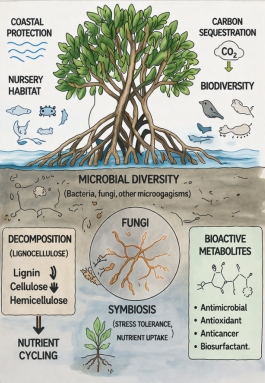
Mangrove ecosystems are known for carbon sequestration, nutrient cycling, and coastal protection, and they host diverse fungal communities shaped by salinity, tides, hypoxia, and physicochemical gradients. Mangrove-associated fungi are often cited as sources of enzymes, biopolymers, biosurfactants, and bioactive metabolites, yet proposed applications frequently overlook ecological, physiological, and molecular constraints outside native habitats. This review critically examines when mangrove fungal adaptations translate into industrially relevant traits. We synthesize evidence on taxonomic diversity, lignocellulose degradation, symbioses, and stress responses, while noting methodological biases, limited omics characterization, and overgeneralization of fungal “uniqueness.” We evaluate their potential as biofactories for green materials in bioremediation, waste valorization, mycelium biocomposites, and circular bioeconomy models, emphasizing the gap between proof of concept and scalable bioprocesses. We also assess how climate change stressors warming, sea level rise, and salinity shifts may restructure communities, influencing ecosystem functions and trait reliability. Integrating microbial ecology, systems biology, materials science, and environmental governance, we identify gaps in functional validation, strain domestication, reproducibility, scalability, and regulation. The promise of mangrove fungi depends on advancing from description to mechanistic understanding and responsible innovation aligned with conservation in a changing climate.


 117 (Views)
  112 (Downloads)