
Review
Ecological Adaptations, Functional Traits, and Biotechnological Potential of Mangrove-Associated Fungi for Sustainable Materials under Climate Change
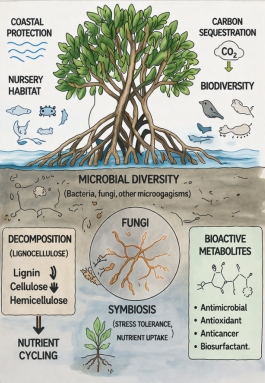
 Download
Authors

Received: 9 August 2025; Revised: 23 October 2025; Accepted: 24 November 2025; Published: 17 December 2025
Mangrove ecosystems are known for carbon sequestration, nutrient cycling, and coastal protection, and they host diverse fungal communities shaped by salinity, tides, hypoxia, and physicochemical gradients. Mangrove-associated fungi are often cited as sources of enzymes, biopolymers, biosurfactants, and bioactive metabolites, yet proposed applications frequently overlook ecological, physiological, and molecular constraints outside native habitats. This review critically examines when mangrove fungal adaptations translate into industrially relevant traits. We synthesize evidence on taxonomic diversity, lignocellulose degradation, symbioses, and stress responses, while noting methodological biases, limited omics characterization, and overgeneralization of fungal “uniqueness.” We evaluate their potential as biofactories for green materials in bioremediation, waste valorization, mycelium biocomposites, and circular bioeconomy models, emphasizing the gap between proof of concept and scalable bioprocesses. We also assess how climate change stressors warming, sea level rise, and salinity shifts may restructure communities, influencing ecosystem functions and trait reliability. Integrating microbial ecology, systems biology, materials science, and environmental governance, we identify gaps in functional validation, strain domestication, reproducibility, scalability, and regulation. The promise of mangrove fungi depends on advancing from description to mechanistic understanding and responsible innovation aligned with conservation in a changing climate.
Keywords:
Mangrove-Associated Fungi Sustainable Biomaterials Fungal Biofactories Biopolymers Circular Bioeconomy Climate Change ImpactsReferences
- Alongi, D.M. Carbon sequestration in mangrove forests. Carbon Manag. 2012, 3, 313–322. DOI: https://doi.org/10.4155/cmt.12.20
- Donato, D.C.; Kauffman, J.; Murdiyarso, D.; et al. Mangroves among the most carbon-rich forests in the tropics. Nat. Geosci. 2011, 4, 293–297. DOI: https://doi.org/10.1038/ngeo1123
- Britto Martins de Oliveira, J.; Corrêa Júnior, D.; Parente, C.E.T.; et al. Fungi in mangrove: Ecological importance, climate change impacts, and the role in environmental remediation. Microorganisms 2025, 13, 878. DOI: https://doi.org/10.3390/microorganisms13040878
- Wang, S.; Zhao, Z.; Cheng, R.; et al. Phylogenetically and metabolically diverse active carbon-fixing microbes reside in mangrove sediments. Microbiome 2025, 13, 194. DOI: https://doi.org/10.1186/s40168-025-02177-9
- Zhou, S.; Deng, X.; Nethmini, R.T.; et al. Fungal Community Complexity and Stability in Clay Loam and Sandy Soils in Mangrove Ecosystems. J. Fungi 2025, 11, 262. DOI: https://doi.org/10.3390/jof11040262
- Huang, K.; Liu, W.; Zhao, F.-J. Methylarsenite is a broad-spectrum antibiotic disrupting cell wall biosynthesis and cell membrane potential. Environ. Microbiol. 2023, 25, 562–574. DOI: https://doi.org/10.1111/1462-2920.16309
- Liu, Y.; Tang, H.; Lin, Z.; et al. Cross protection of lactic acid bacteria during environmental stresses: Stress responses and underlying mechanisms. LWT 2021, 144, 111203. DOI: https://doi.org/10.1016/j.lwt.2021.111203
- Ellena, V.E.; Steiger, M.G. The importance of complete and high-quality genome sequences in Aspergillus niger research. Front. Fungal Biol. 2022, 3, 935993. DOI: https://doi.org/10.3389/ffunb.2022.935993
- Baldrian, P. Forest microbiome: Diversity, complexity and dynamics. FEMS Microbiol. Rev. 2017, 41, 109–130. DOI: https://doi.org/10.1093/femsre/fuw040
- Fang, M.; Sun, X.; Yao, F.; et al. A combination of transcriptome and enzyme activity analysis unveils key genes and patterns of corncob lignocellulose degradation by Auricularia heimuer under cultivation conditions. J. Fungi 2024, 10, 545. DOI: https://doi.org/10.3390/jof10080545
- Banerjee, S.; van der Heijden, M.G.A. Soil microbiomes and one health. Nat. Rev. Microbiol. 2023, 21, 6–20. DOI: https://doi.org/10.1038/s41579-022-00779-w
- Wainwright, B.J.; Millar, T.; Bowen, L.; et al. The core mangrove microbiome reveals shared taxa potentially involved in nutrient cycling and promoting host survival. Environ. Microbiome 2023, 18, 47. DOI: https://doi.org/10.1186/s40793-023-00499-5
- Song, J.; Zhang, S.; Lu, L. Fungal cytochrome P450 protein Cyp51: What we can learn from its evolution, regulons and Cyp51-based azole resistance. Fungal Biol. Rev. 2018, 32, 131–142. DOI: https://doi.org/10.1016/j.fbr.2018.05.001
- Raghukumar, C. Fungi in Coastal and Oceanic Marine Ecosystems; Springer: Cham, Switzerland, 2017. DOI: https://doi.org/10.1007/978-3-319-54304-8
- Rodríguez Ramírez, I.; Solano-González, S.; Cortés, J.; et al. Deepsea fungi of the eastern tropical Pacific of Costa Rica: Morphological, genetic, and enzymatic characterization. Front. Mar. Sci. 2025, 12, 1514874. DOI: https://doi.org/10.3389/fmars.2025.1514874
- Singhania, R.R.; Patel, A.K.; Kumar, P.; et al. Bioprospecting of cellulases from marine fungi for macro-algal biomass degradation for biofuel application. Int. J. Biol. Macromol. 2025, 307, 141935. DOI: https://doi.org/10.1016/j.ijbiomac.2025.141935
- Yunasfi; Lubis, S.R.; Utomo, B.; et al. Diversity of fungal species and decomposition of Rhizophora mucronata leaf litter in the Deli Belawan River Estuary, North Sumatra, Indonesia. Biodivers. J. 2025, 26, 1631–1640. DOI: https://doi.org/10.13057/biodiv/d260414
- Panico, S.C.; Alberti, G.; Foscari, A.; et al. Bacterial and fungal communities respond differently to changing soil properties along afforestation dynamic. Microb. Ecol. 2025, 88, 2. DOI: https://doi.org/10.1007/s00248-025-02500-9
- Zheng, Y.Y.; Zhang, H.; Yin, H.; et al. Antioxidant Secondary Metabolites from Marine-Derived Fungi: Chemical Diversity and Bioactivity Profiling. Chem. Biodivers. 2025, 22, e00901. DOI: https://doi.org/10.1002/cbdv.202500901
- Xu, J. Bioactive secondary metabolites from mangrove-associated fungi. Mar. Drugs 2015, 13, 711–736. DOI: https://doi.org/10.1039/C4RA11756E
- Nielsen, J.; Keasling, J.D. Engineering cellular metabolism. Cell 2016, 164, 1185–1197. DOI: https://doi.org/10.1016/j.cell.2016.02.004
- Meyer, V.; Basenko, E.Y.; Benz, J.P.; et al. Growing a circular economy with fungal biotechnology: A white paper. Fungal Biol. Biotechnol. 2020, 7, 5. DOI: https://doi.org/10.1186/s40694-020-00095-z
- Appels, F.V.W.; Camere, S.; Montalti, M.; et al. Fabrication factors influencing mechanical, moisture- and water-related properties of mycelium-based composites. Mater. Des. 2019, 161, 64–71. DOI: https://doi.org/10.1016/j.matdes.2018.11.027
- Attias, N.; Danai, O.; Abitbol, T.; et al. Mycelium bio-composites in industrial design and architecture: Comparative review and life cycle assessment. J. Cleaner Prod. 2020, 246, 119037. DOI: https://doi.org/10.1016/j.jclepro.2019.119037
- Volk, R.; Schröter, M.; Saeidi, N.; et al. Life cycle assessment of mycelium-based composite materials. Resour. Conserv. Recycl. 2024, 205, 107579. DOI: https://doi.org/10.1016/j.resconrec.2024.107579
- Gilman, E.L.; Ellison, J.; Duke, N.C.; et al. Threats to mangroves from climate change and adaptation options: A review. Aquat. Bot. 2008, 89, 237–250. DOI: https://doi.org/10.1016/j.aquabot.2007.12.009
- Alongi, D.M. The impact of climate change on mangrove forests. Curr. Clim. Change Rep. 2015, 1, 30–39. DOI: https://doi.org/10.1007/s40641-015-0002-x
- Vanderklift, M.A.; Marcos-Martinez, R.; Butler, J.R.; et al. Constraints and opportunities for market-based finance for the restoration and protection of blue carbon ecosystems. Mar. Policy 2019, 107, 103429. DOI: https://doi.org/10.1016/j.marpol.2019.02.001
- Kristensen, E.; Bouillon, S.; Dittmar, T.; et al. Organic carbon dynamics in mangrove ecosystems. Aquat. Bot. 2008, 89, 201–219. DOI: https://doi.org/10.1016/j.aquabot.2007.12.005
- Porras-Alfaro, A.; Bayman, P. Hidden fungi, emergent properties: Endophytes and microbiomes. Annu. Rev. Phytopathol. 2011, 49, 291–315. DOI: https://doi.org/10.1146/annurev-phyto-080508-081831
- Thatoi, H.; Behera, B.B.; Mishra, R.R. Ecological role and biotechnological potential of mangrove fungi: A review. Mycology 2013, 4, 54–71. DOI: https://doi.org/10.1080/21501203.2013.785448
- Alberto, R.P.; Teano, J.A.; Paz-Alberto, A.M.; et al. Impacts of climate change on mangrove subsistence fisheries: A global review. Mar. Life Sci. Technol. 2024, 6, 610–630. DOI: https://doi.org/10.1007/s42995-024-00231-3
- Amend, A.S.; Burgaud, G.; Cunliffe, M.; et al. Fungi in the marine environment: Open questions and unsolved problems. mBio 2019, 10, e01189-18. DOI: https://doi.org/10.1128/mbio.01189-18
- Hyde, K.D.; Dong, Y.; Phookamsak, R.; et al. Fungal diversity notes 1151–1276: Taxonomic and phylogenetic contributions on genera and species of fungal taxa. Fungal Divers. 2020, 100, 5–277. DOI: https://doi.org/10.1007/s13225-020-00439-5
- Gostinčar, C.; Grube, M.; De Hoog, S.; et al. Extremotolerance in fungi: Evolution on the edge. FEMS Microbiol. Ecol. 2011, 71, 2–11. DOI: https://doi.org/10.1111/j.1574-6941.2009.00794.x
- Su, T.; Han, M.; Cao, D.; et al. Molecular and biological properties of snakins: The foremost cysteine-rich plant host defense peptides. J. Fungi 2020, 6, 220. DOI: https://doi.org/10.3390/jof6040220
- Imhoff, J.F. Natural products from marine fungi—Still an underrepresented resource. Mar. Drugs 2016, 14, 19. DOI: https://doi.org/10.3390/md14010019
- Monciardini, P.; Iorio, M.; Maffioli, S.; et al. Discovering new bioactive molecules from microbial sources. Microb. Biotechnol. 2014, 7, 209–220. DOI: https://doi.org/10.1111/1751-7915.12123
- Yu, M.; Zheng, C.; Zheng, G.; et al. Structural diversity and bioactivities of mangrove-derived fungal polyketids (2020–2025). Mar. Drugs 2025, 23, 474. DOI: https://doi.org/10.3390/md23120474
- Pointing, S.B.; Hyde, K.D. Lignocellulose-degrading marine fungi. Biofouling 2000, 15, 221–229. DOI: https://doi.org/10.1080/08927010009386312
- Nilsson, R.H.; Larsson, K.H.; Taylor, A.F.; et al. The UNITE database for molecular identification of fungi: Handling dark taxa and parallel taxonomic classifications. Nucleic Acids Res. 2019, 47, D259–D264. DOI: https://doi.org/10.1093/nar/gky1022
- Tedersoo, L.; Bahram, M.; Põlme, S.; et al. Global diversity and geography of soil fungi. Science 2014, 346, 1256688. DOI: https://doi.org/10.1126/science.1256688
- Hawksworth, D.L.; Lücking, R. Fungal diversity revisited: 2.2 to 3.8 million species. Microbiol. Spectr. 2017, 5, 4. DOI: https://doi.org/10.1128/microbiolspec.FUNK-0052-2016
- Raja, H.A.; Miller, A.N.; Pearce, C.J.; et al. Fungal identification using molecular tools: A primer for the natural products research community. J. Nat. Prod. 2017, 80, 756–770. DOI: https://doi.org/10.1021/acs.jnatprod.6b01085
- Peay, K.G.; Kennedy, P.G.; Talbot, J.M. Dimensions of biodiversity in the Earth mycobiome. Nat. Rev. Microbiol. 2016, 14, 434–447. DOI: https://doi.org/10.1038/nrmicro.2016.59
- Tzelepis, G.; Karlsson, M. Killer toxin-like chitinases in filamentous fungi: Structure, regulation and potential roles in fungal biology. Fungal Biol. Rev. 2019, 33, 123–132. DOI: https://doi.org/10.1016/j.fbr.2018.11.001
- Grossart, H.-P.; Van den Wyngaert, S.; Kagami, M.; et al. Fungi in aquatic ecosystems. Nat. Rev. Microbiol. 2019, 17, 339–354. DOI: https://doi.org/10.1038/s41579-019-0175-8
- Rodriguez, R.J.; White Jr, J.F.; Arnold, A.E.; et al. Fungal endophytes: Diversity and functional roles. New Phytol. 2009, 182, 314–330. DOI: https://doi.org/10.1111/j.1469-8137.2009.02773.x
- Hardoim, P.R.; van Overbeek, L.S.; Berg, G.; et al. The Hidden World within Plants: Ecological and Evolutionary Considerations for Defining Functioning of Microbial Endophytes. Microbiol. Mol. Biol. Rev. 2015, 79, 293–320. DOI: https://doi.org/10.1128/MMBR.00050-14
- Blunt, J.W.; Carroll, A.R.; Copp, B.R.; et al. Marine natural products. Nat. Prod. Rep. 2018, 35, 8–53. DOI: https://doi.org/10.1039/C7NP00052A
- Barbitoff, Y.A.; Matveenko, A.G.; Zhouravleva, G.A. Differential interactions of molecular chaperones and yeast prions. J. Fungi 2022, 8, 122. DOI: https://doi.org/10.3390/jof8020122
- Singh, P.; Raghukumar, C. Mangrove fungi: Ecological role and biotechnological applications in biomass conversion. Indian J. Mar. Sci. 2012, 41, 340–350.
- Rinaudo, M. Chitin and chitosan: Properties and applications. Prog. Polym. Sci. 2006, 31, 603–632. DOI: https://doi.org/10.1016/j.progpolymsci.2006.06.001
- Dash, M.; Chiellini, F.; Ottenbrite, R.M.; et al. Chitosan—A versatile semi-synthetic polymer in biomedical applications. Prog. Polym. Sci. 2011, 36, 981–1014. DOI: https://doi.org/10.1016/j.progpolymsci.2011.02.001
- Flores, G.A.; Cusumano, G.; Venanzoni, R.; et al. The glucans mushrooms: Molecules of significant biological and medicinal value. Polysaccharides 2024, 5, 212–224. DOI: https://doi.org/10.3390/polysaccharides5030016
- Qiu, J.; Wilkens, C.; Barrett, K.; et al. Microbial enzymes catalyzing keratin degradation: Classification, structure, function. Biotechnol. Adv. 2020, 44, 107607. DOI: https://doi.org/10.1016/j.biotechadv.2020.107607
- Madusanka, C.; Udayanga, D.; Nilmini, R.; et al. A review of recent advances in fungal mycelium based composites. Discov. Mater. 2024, 4, 13. DOI: https://doi.org/10.1007/s43939-024-00084-8
- Virués-Segovia, J.R.; Muñoz-Mira, S.; Durán-Patrón, R.; et al. Marine-derived fungi as biocatalysts. Front. Microbiol. 2023, 14, 1125639. DOI: https://doi.org/10.3389/fmicb.2023.1125639
- Otero, I.V.R.; Haslbeck, M.; Santello, L.C.; et al. Heterologous laccase from the marine environment: Purification, characterization, and degradation of synthetic dyes. Biocatal. Agric. Biotechnol. 2025, 63, 103485. DOI: https://doi.org/10.1016/j.bcab.2024.103485
- Banat, I.M.; Franzetti, A.; Gandolfi, I.; et al. Microbial biosurfactants production, applications and future potential. Appl. Microbiol. Biotechnol. 2010, 87, 427–444. DOI: https://doi.org/10.1007/s00253-010-2589-0
- Harms, H.; Schlosser, D.; Wick, L.Y. Untapped potential: Exploiting fungi in bioremediation of hazardous chemicals. Nat. Rev. Microbiol. 2011, 9, 177–192. DOI: https://doi.org/10.1038/nrmicro2519
- Gadd, G.M. Metals, minerals and microbes: Geomicrobiology and bioremediation. Microbiology 2010, 156, 609–643. DOI: https://doi.org/10.1099/mic.0.037143-0
- Jones, M.P.; Huynh, T.; Dekiwadia, C.; et al. Mycelium composites: A review of engineering characteristics and growth kinetics. J. Bionanosci. 2017, 11, 241–257. DOI: https://doi.org/10.1166/jbns.2017.1442
- Sharma, D.; Le Ferrand, H. 3D printed gyroid scaffolds enabling strong and thermally insulating mycelium-bound composites for greener infrastructures. Nat. Commun. 2025, 16, 5775. DOI: https://doi.org/10.1038/s41467-025-61369-x
- Urrea Vivas, M.A.; Seguí Amórtegui, L.; Guerrero-García-Rojas, H. Understanding the characteristics of the green, circular and bioeconomy models within the context of sustainable development. Energy Sustain. Soc. 2025, 15, 27. DOI: https://doi.org/10.1186/s13705-025-00528-w
- Convention on Biological Diversity (CBD). Nagoya Protocol on Access to Genetic Resources and the Fair and Equitable Sharing of Benefits Arising from Their Utilization; Secretariat of the Convention on Biological Diversity: Montreal, QC, Canada, 2011.
- Xu, Q.; Jin, Y. Benefit sharing of marine genetic resources and intellectual property protection under the BBNJ agreement. Front. Mar. Sci. 2025, 12, 1631043. DOI: https://doi.org/10.3389/fmars.2025.1631043
- Intergovernmental Panel on Climate Change (IPCC). AR6 Synthesis Report: Climate Change 2023; IPCC: Geneva, Switzerland, 2023.
- Hyde, K.D.; Xu, J.; Rapior, S.; et al. The amazing potential of fungi: 50 ways we can exploit fungi industrially. Fungal Divers. 2019, 97, 1–136. DOI: https://doi.org/10.1007/s13225-019-00430-9
- Tedersoo, L.; Bahram, M.; Toots, M.; et al. Towards global patterns in the diversity and community structure of ectomycorrhizal fungi. Mol. Ecol. 2012, 21, 4160–4170. DOI: https://doi.org/10.1111/j.1365-294X.2012.05602.x
- Hsin, K.-T.; Lee, H.; Huang, Y.-C.; et al. Lignocellulose degradation in bacteria and fungi: Cellulosomes and industrial relevance. Front. Microbiol. 2025, 16, 1583746. DOI: https://doi.org/10.3389/fmicb.2025.1583746
- Marzban, G.; Tesei, D. The extremophiles: Adaptation mechanisms and biotechnological applications. Biology 2025, 14, 412. DOI: https://doi.org/10.3390/biology14040412
- Ding, Z.Y.; Tao, M.F.; Ji, X.Y.; et al. Unveiling species diversity within early-diverging fungi from China VII: Seven new species of Cunninghamella (Mucoromycota). J. Fungi 2025, 11, 417. DOI: https://doi.org/10.3390/jof11060417
- Rometius, S.; Wang, W. Unlocking the global commons: Legal analysis of benefit-sharing for marine genetic resources in the BBNJ agreement. Front. Mar. Sci. 2025, 12, 1541331. DOI: https://doi.org/10.3389/fmars.2025.1541331