
Article
Enhancing Digital Governance through AI‑Driven Public Opinion Monitoring in Live Streaming Environments
 Download

This work is licensed under a Creative Commons Attribution 4.0 International License.
Copyright
The authors shall retain the copyright of their work but allow the Publisher to publish, copy, distribute, and convey the work.
License
Journal of Intelligent Communication (JIC) publishes accepted manuscripts under Creative Commons Attribution 4.0 International (CC BY 4.0). Authors who submit their papers for publication by Journal of Intelligent Communication (JIC) agree to have the CC BY 4.0 license applied to their work, and that anyone is allowed to reuse the article or part of it free of charge for any purpose, including commercial use. As long as the author and original source is properly cited, anyone may copy, redistribute, reuse and transform the content.
Authors

Received: 2 December 2025; Revised: 29 December 2025; Accepted: 31 December 2025; Published: 14 January 2026
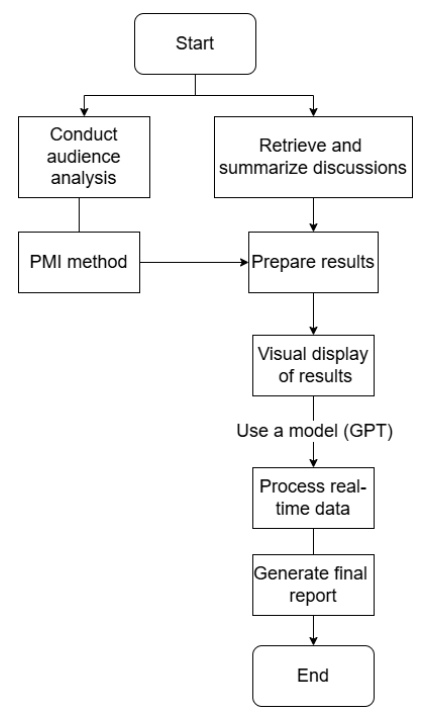
The rise of short videos and live streaming has transformed digital governance, enabling governments to engage with citizens in real time. This paper explores the integration of artificial intelligence (AI) in government live streaming, focusing on its role in enhancing public opinion monitoring and sentiment analysis. We analyze current practices and introduce innovative solutions that leverage AI for improved content dissemination and audience engagement. Using the SO-PMI (Semantic Orientation Pointwise Mutual Information) algorithm, we conduct sentiment analysis on audience comments to capture emotional nuances. Additionally, large language models are employed for efficient live data processing, enabling real-time comment handling and generating responsive communication tailored to audience sentiment. The methodology includes robust data collection from social media platforms, employing API connections to retrieve comments during broadcasts. Extensive preprocessing involves filtering irrelevant content, normalization, tokenization, and lemmatization. Sentiment analysis categorizes comments as positive, negative, or neutral, while real-time monitoring allows presenters to adapt their messaging based on audience sentiment. Our experimental results demonstrate the effectiveness of AI-driven methods in managing real-time comments, providing accurate emotional analyses, and facilitating prompt responses. This study illustrates AI’s potential to engage citizens more effectively and enhance governmental communication strategies, ultimately fostering transparency and responsiveness in the digital age.
Keywords:
Digital Governance Public Opinion Monitoring Sentiment Analysis Artificial Intelligence Live StreamingReferences
- Smith, C.E.; Alam, I.; Tan, C.; et al. The impact of governance bots on sense of virtual community: Development and validation of the gov-bots scale. Proc. ACM Hum.-Comput. Interact. 2022, 6, 1–30.
- Hartmann, S.; Mainka, A.; Stock, W.G. Opportunities and challenges for civic engagement: A global investigation of innovation competitions. Int. J. Knowl. Soc. Res. 2016, 7, 1–15.
- Liu, J. A public opinion monitoring system based on big data technology. In Proceedings of the 2022 International Conference on Artificial Intelligence in Everything, Lefkosa, Cyprus, 2–4 August 2022; pp. 368–372.
- Zavattaro, S.M.; French, P.E.; Mohanty, S.D. A sentiment analysis of US local government tweets: The connection between tone and citizen involvement. Gov. Inf. Q. 2015, 32, 333–341.
- Martin, K. Ethical implications and accountability of algorithms. J. Bus. Ethics 2019, 156, 835–850.
- Burnett, J.R.; Lisk, T.C. The future of employee engagement: Real-time monitoring and digital tools for engaging a workforce. In International Perspective on Employee Engagement; Routledge: London, UK, 2021; pp. 117–128.
- Geiselhart, K. Digital government and citizen participation in international context. In Digital Government: Principles and Best Practices; IGI Global Scientific Publishing: Hershey, PA, USA, 2004; pp. 320–343.
- Sambrook, R. Delivering trust: Impartiality and objectivity in the digital age. J. Media Ethics 2012, 27, 183–194.
- Vanisree, M.; Veerraghava, P. AI-powered English communication tools for strengthening citizen–local government engagement through social media. Lex Localis 2025, 23, 1–20.
- Ahn, M.J.; Chen, Y.C. Artificial intelligence in government: Potentials, challenges, and the future. In Proceedings of the 21st Annual International Conference on Digital Government Research, Seoul, Korea, 15–19 June 2020; pp. 243–252.
- Suryana, C.; Budiandru, B.; Naibaho, K.E.T.; et al. The impact of fake news on public opinion during crisis situations. J. Acad. Sci. 2024, 1, 395–407.
- Charles, V.; Rana, N.P.; Carter, L. Artificial intelligence for data-driven decision-making and governance in public affairs. Gov. Inf. Q. 2022, 39, 101742.
- Datta, K. AI-driven public administration: Opportunities, challenges, and ethical considerations. Soc. Sci. Rev. 2024, 2, 134–139.
- Tasriqul, I.; Sadia, A.; Neda, Z. AI in public governance: Ensuring rights and innovation in non-high-risk AI systems in the United States. Eur. J. Technol. 2024, 8, 17–27.
- Zhang, B.; Dafoe, A. US public opinion on the governance of artificial intelligence. In Proceedings of the AAAI/ACM Conference on AI, Ethics, and Society, New York, NY, USA, 7–8 February 2020; pp. 187–193.
- Batty, M.; Axhausen, K.W.; Giannotti, F.; et al. Smart cities of the future. Eur. Phys. J. Spec. Top. 2012, 214, 481–518.
- Floridi, L.; Cowls, J. A unified framework of five principles for AI in society. In Machine Learning and the City: Applications in Architecture and Urban Design; John Wiley & Sons Ltd.: Hoboken, NJ, USA, 2022; pp. 535–545.
- Zhao, P.; Hu, H. Geographical patterns of traffic congestion in growing megacities: Big data analytics from Beijing. Cities 2019, 92, 164–174.
- Espinosa, V.I.; Pino, A. E-government as a development strategy: The case of Estonia. Int. J. Public Adm. 2025, 48, 86–99.
- Diberardino, N.; Baleshta, C.; Stark, L. Algorithmic harms and algorithmic wrongs. In Proceedings of the 2024 ACM Conference on Fairness, Accountability, and Transparency, Rio de Janeiro, Brazil, 3–6 June 2024; pp. 1725–1732.
- Zhang, B.; Anderljung, M.; Kahn, L.; et al. Ethics and governance of artificial intelligence: Evidence from a survey of machine learning researchers. J. Artif. Intell. Res. 2021, 71, 591–666.
- Brayne, S. Big data surveillance: The case of policing. Am. Sociol. Rev. 2017, 82, 977–1008.
- Verma, S. Weapons of math destruction: How big data increases inequality and threatens democracy. Vikalpa 2019, 44, 97–98.
- Zuboff, S. The Age of Surveillance Capitalism: The Fight for a Human Future at the New Frontier of Power; PublicAffairs: New York, NY, USA, 2019.
- Heath, D.R. Prediction machines: The simple economics of artificial intelligence. J. Inf. Technol. Case Appl. Res. 2019, 21, 163–166. DOI: https://doi.org/10.1080/15228053.2019.1673511