
Article
Expression Capacity‑Based Negative Sentiment (ECNS) Detection and Mitigation in Online Social Networks
 Download

This work is licensed under a Creative Commons Attribution 4.0 International License.
Copyright
The authors shall retain the copyright of their work but allow the Publisher to publish, copy, distribute, and convey the work.
License
Journal of Intelligent Communication (JIC) publishes accepted manuscripts under Creative Commons Attribution 4.0 International (CC BY 4.0). Authors who submit their papers for publication by Journal of Intelligent Communication (JIC) agree to have the CC BY 4.0 license applied to their work, and that anyone is allowed to reuse the article or part of it free of charge for any purpose, including commercial use. As long as the author and original source is properly cited, anyone may copy, redistribute, reuse and transform the content.
Authors

Received: 28 October 2025; Revised: 4 January 2026; Accepted: 8 January 2026; Published: 23 January 2026
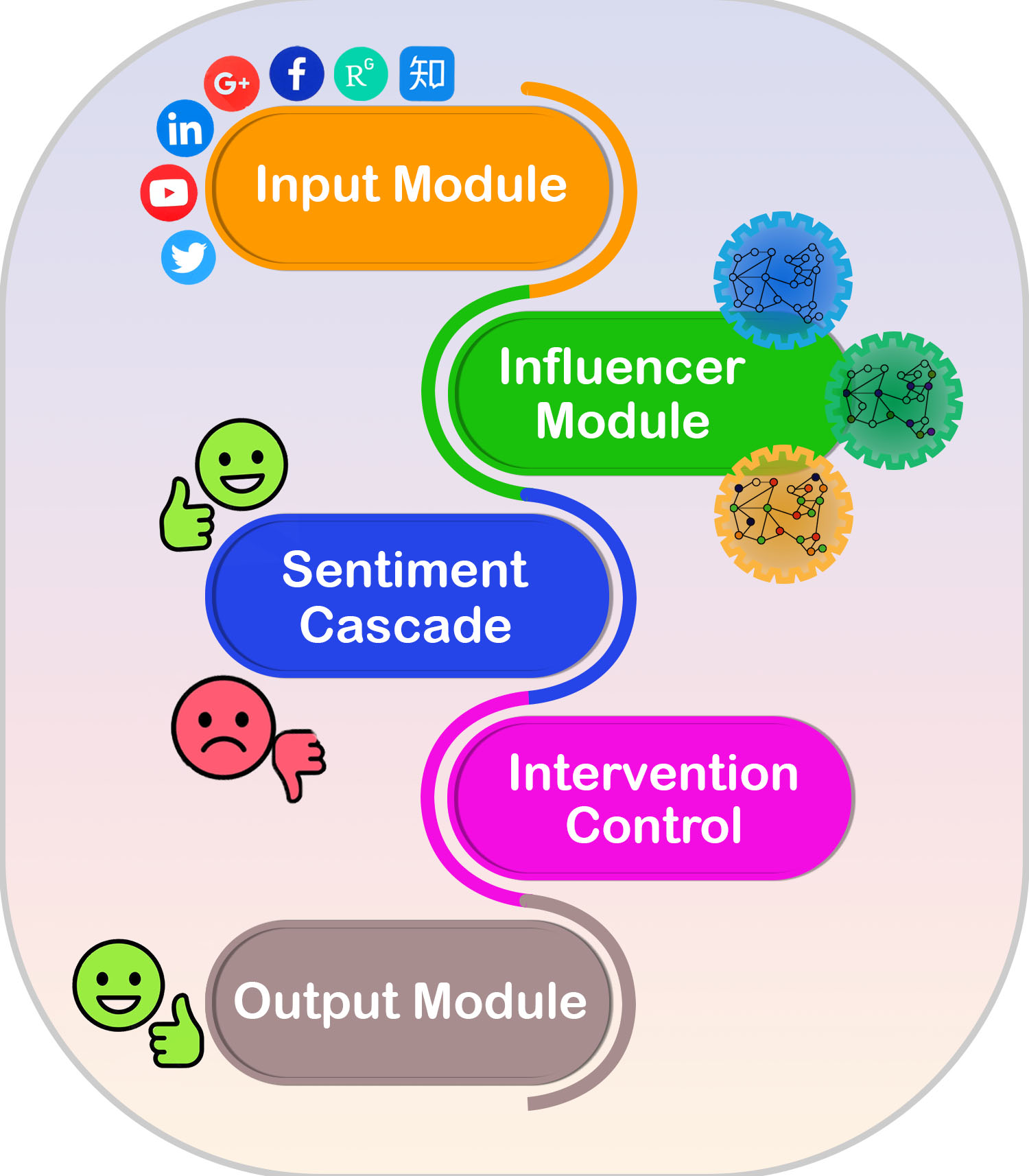
The rapid expansion of social media platforms has intensified the spread of negative sentiments, misinformation, and hostile digital interactions, producing measurable consequences for public discourse, institutional trust, and societal stability. Existing models often overlook the cognitive and network-structural mechanisms that drive negative sentiment cascades, limiting capacity for early detection and effective intervention. The proposed study introduces the Expression Capacity-based Negative Sentiment (ECNS) Mitigation framework that integrates graph-theoretic analysis with psychological modeling to better understand and mitigate sentiment propagation. The ECNS architecture consists of five interconnected models dedicated to data ingestion, influencer identification, cascade monitoring, intervention control, and final sentiment-state generation. The operational core relies on two algorithms: the first identifies high-impact influencer nodes using community-level analysis and expression-capacity thresholds, while the second monitors negativity diffusion, evaluates sequential comment behavior, and applies targeted mitigation based on capacity depletion and sentiment intensity. This design enables proactive control of sentiment cascades rather than reactive moderation. The framework was evaluated across three heterogeneous datasets ResearchGate, Zhihu, and Sentiment140 to reflect diverse interaction patterns and topical domains. Comparative performance against three leading models such as EANN, HMCan, and AOAN demonstrates that ECNS provides more accurate influencer detection, stronger cascade containment, and more effective sentiment reduction. Overall, ECNS achieved improvements ranging from 5.8% to 11.4% points across key evaluation metrics, confirming its capacity to suppress negative sentiment propagation with significantly higher reliability.
Keywords:
Negative Sentiment Propagation Expression Capacity Modeling Computational Social Networks Influencer Node Analysis Sentiment Mitigation Algorithms Graph Based Behavioral ModelingReferences
- Saif, N.; Khan, S.U.; Shaheen, I.; et al. Chat-GPT; Validating Technology Acceptance Model (TAM) in Education Sector via Ubiquitous Learning Mechanism. Comput. Hum. Behav. 2024, 154, 108097. DOI: https://doi.org/10.1016/j.chb.2023.108097
- Ullah, I.; Chen, J.; Su, X.; et al. Localization and Detection of Targets in Underwater Wireless Sensor Using Distance and Angle Based Algorithms. IEEE Access 2019, 7, 45693–45704. DOI: https://doi.org/10.1109/ACCESS.2019.2909133
- Paschalides, D.; Pallis, G.; Dikaiakos, M.D. A Framework for the Unsupervised Modeling and Extraction of Polarization Knowledge from News Media. ACM Trans. Soc. Comput. 2025, 8, 1–38. DOI: https://doi.org/10.1145/3703594
- Saleem, S.; Ashraf, S.; Basit, M.K. CMBA—A Candid Multi-Purpose Biometric Approach. ICTACT J. Image Video Process. 2020, 11, 2211–2216. DOI: https://doi.org/10.21917/ijivp.2020.0317
- Ashraf, S.; Gao, Z.; Chen, Z.; et al. CED-OR Based Opportunistic Routing Mechanism for Underwater Wireless Sensor Networks. Wirel. Pers. Commun. 2022, 125, 487–511. DOI: https://doi.org/10.1007/s11277-022-09561-w
- Khan, M.A.; Dharejo, F.A.; Deeba, F.; et al. Toward Developing Tangling Noise Removal and Blind Inpainting Mechanism Based on Total Variation in Image Processing. Electron. Lett. 2021, 57, 436–438. DOI: https://doi.org/10.1049/ell2.12148
- Ashraf, S.; Saleem, S.; Ahmed, T.; et al. Succulent Link Selection Strategy for Underwater Sensor Network. Int. J. Comput. Sci. Math. 2022, 15, 224–242.
- Ashraf, S. Towards Shrewd Object Visualization Mechanism. Trends Comput. Sci. Inf. Technol. 2020, 97–102. DOI: https://doi.org/10.17352/tcsit.000030
- Rasheed, Z.; Ashraf, S.; Ibupoto, N.A.; et al. SDS: Scrumptious Dataflow Strategy for IoT Devices in Heterogeneous Network Environment. Smart Cities 2022, 5, 1115–1128. DOI: https://doi.org/10.3390/smartcities5030056
- Ashraf, S. Avoiding Vulnerabilities and Attacks with a Proactive Strategy for Web Applications. Adv. Robot. Mech. Eng. 2021, 3, 9. DOI: https://doi.org/10.32474/ARME.2021.03.000157
- Asif, R.M.; Ur Rehman, A.; Ur Rehman, S.; et al. Design and analysis of robust fuzzy logic maximum power point tracking based isolated photovoltaic energy system. Eng. Rep. 2020, 2, e12234. DOI: https://doi.org/10.1002/eng2.12234
- Hill, C.; Irshaidat, F.; Johnson, M.; et al. An analytical assessment of sentiment analysis trends and methods through systematic review and topic modeling. Decis. Anal. J. 2025, 17, 100644. DOI: https://doi.org/10.1016/j.dajour.2025.100644
- Mehak, S.K.; Rasheed, Z.; Ibupoto, N.A.; et al. Machine Learning Algorithms for Prediction of Thyroid Syndrome at Initial Stages in Females. Khyber Sci. 2024, 12, 466–470. DOI: https://doi.org/10.53555/ks.v12i5.3247
- Masood, B.; Khan, M.A.; Baig, S.; et al. Investigation of Deterministic, Statistical and Parametric NB-PLC Channel Modeling Techniques for Advanced Metering Infrastructure. Energies 2020, 13, 3098. DOI: https://doi.org/10.3390/en13123098
- Naqvi, R.A.; Rehman, A.U.; Saleem, M.A.; et al. Effect of Blurring on Real Time Quality Inspection of Knives in a Wood Chipper. World Appl. Sci. J. 2014, 32, 2106–2113.
- Wang, Y.; Ma, F.; Jin, Z.; et al. EANN: Event Adversarial Neural Networks for Multi-Modal Fake News Detection. In Proceedings of the 24th ACM SIGKDD International Conference on Knowledge Discovery & Data Mining, New York, NY, USA, 19–23 July 2018; pp. 849–857. DOI: https://doi.org/10.1145/3219819.3219903
- Brauner, P.; Glawe, F.; Vervier, L.; et al. Public Perception of Technologies in Society: Mapping Laypeople’s Mental Models in Terms of Risk and Valence. Digit. Soc. 2024, 3, 62. DOI: https://doi.org/10.1007/s44206-024-00148-5
- AONE-NLP/ABSA-AOAN. Available online: https://github.com/AONE-NLP/ABSA-AOAN (accessed on 26 October 2025).
- ResearchGate. Available online: https://www.researchgate.net/ (accessed on 6 October 2025).
- Zhihu. Available online: https://ir.zhihu.com/ (accessed on 6 October 2025).
- Sentiment140 Dataset with 1.6 Million Tweets. Available online: https://www.kaggle.com/datasets/kazanova/sentiment140 (accessed on 6 October 2025).
- Neubaum, G.; Krämer, N.C. Monitoring the Opinion of the Crowd: Psychological Mechanisms Underlying Public Opinion Perceptions on Social Media. Media Psychol. 2017, 20, 502–531. DOI: https://doi.org/10.1080/15213269.2016.1211539
- Gorodnichenko, Y.; Pham, T.; Talavera, O. Social Media, Sentiment and Public Opinions: Evidence from #Brexit and #USElection. Eur. Econ. Rev. 2021, 136, 103772. DOI: https://doi.org/10.1016/j.euroecorev.2021.103772
- Xie, X.-Z.; Tsai, N.-C. The Effects of Negative Information-Related Incidents on Social Media Discontinuance Intention: Evidence from SEM and fsQCA. Telemat. Inform. 2021, 56, 101503. DOI: https://doi.org/10.1016/j.tele.2020.101503
- Piko, B.F.; Krajczár, S.K.; Kiss, H. Social Media Addiction, Personality Factors and Fear of Negative Evaluation. Youth 2024, 4, 357–368. DOI: https://doi.org/10.3390/youth4010025
- Chen, M.; Xie, G.; Yu, Y.; et al.; 2024, Detection of False Data Injection Attacks on Distributed Energy Resources Integration into Distribution Networks. Recent Adv. Electr. Electron. Eng. 2024, 18, 490–500. DOI: https://doi.org/10.2174/0123520965284240240118074556
- Manurung, J.; Sihombing, P.; Budiman, M.A.; et al. Deep Learning Approaches for Analyzing and Controlling Rumor Spread in Social Networks Using Graph Neural Networks. Bull. Electr. Eng. Inform. 2025, 14, 581–586. DOI: https://doi.org/10.11591/eei.v14i1.8143
- Kwao, L.; Yang, Y.; Zou, J.; et al. A Survey of Approaches to Early Rumor Detection on Microblogging Platforms. WIREs Data Min. Knowl. Discov. 2025, 15, e70001. DOI: https://doi.org/10.1002/widm.70001
- Venkatachalam, M.; Prasad, R. AI-Powered Mathematical Sentiment Model and Graph Theory for Social Media Trends. BenchCounc. Trans. Benchm. Stand. Eval. 2024, 4, 100202. DOI: https://doi.org/10.1016/j.tbench.2025.100202
- Ashraf, S. F-LTDM: Federated Lightweight Threat Detection Model for Smart City IoT Devices. Int. J. Mobile Comput. Softw. Eng. 2025, 1, 36–45. DOI: https://doi.org/10.46610/IJMCSE.2025.v01i02.005
- Blondel, V.D.; Guillaume, J.-L.; Lambiotte, R.; et al. Fast Unfolding of Communities in Large Networks. J. Stat. Mech. 2008, 10, P10008. DOI: https://doi.org/10.1088/1742-5468/2008/10/P10008
- Sun, B.; Yang, S.; Wang, Y.; et al. A fusion safety and security analysis framework for intelligent and connected vehicles. PLOS One 2025, 20, e0332050. DOI: https://doi.org/10.1371/journal.pone.0332050
- Meng, L.; Yang, X.; Guo, W.; et al. A Two-Layer Voltage Coordination Control Strategy for Active Distribution Network Considering Photovoltaic Uncertainty and Network Partitioning. IEEJ Trans. Electr. Electron. Eng. 2025. DOI: https://doi.org/10.1002/tee.70226
- Sun, Y.; Parameshachari, B.D.; Wang, H.; et al. Trustworthy AI-Driven 6G-IoT Architecture for Remote Healthcare: Reliable Resource Orchestration and Adaptive Network Intelligence. IEEE Internet Things J. 2025. DOI: https://doi.org/10.1109/JIOT.2025.3583340
- Arfeen, Z.A.; Sheikh, U.U.; Azam, M.K.; et al. A Comprehensive Review of Modern Trends in Optimization Techniques Applied to Hybrid Microgrid Systems. Concurrency Comput. Pract. Exp. 2021, 33, e6165. DOI: https://doi.org/10.1002/cpe.6165