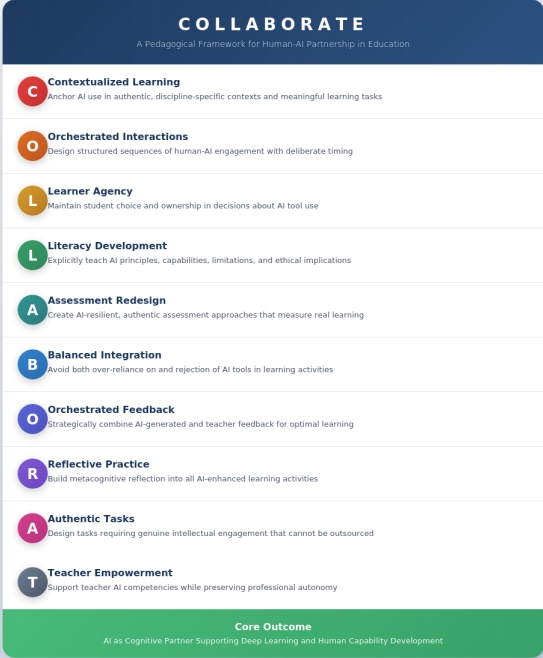
This article examines how generative artificial intelligence can be integrated into teaching without reducing learning to automated answer production. Rather than treating AI adoption as a purely technical question, the paper argues that the central pedagogical challenge is how to preserve human judgment, metacognitive effort, and disciplinary understanding when students can now generate plausible outputs in seconds. Building on the original manuscript's distinction between automation and augmentation, the revised version strengthens the argument by anchoring the problem in concrete classroom pain points, especially writing-intensive and feedback-heavy courses where students' use of AI often outpaces institutional policy. It synthesizes recent scholarship on hybrid intelligence, self-regulated learning, teacher-AI collaboration, assessment redesign, and academic integrity, while also identifying limitations in current frameworks, including weak subject-specific guidance, limited long-term evidence, and insufficient attention to equity and cultural context. In response, the paper clarifies the rationale for the COLLABORATE framework and explains how its ten principles work together to make AI use visible, bounded, and pedagogically productive. The framework is presented as a conceptual, evidence-informed design model rather than as an empirically validated intervention. The paper concludes by outlining practical implementation pathways, ethical safeguards, and a concrete research agenda for testing which forms of human-AI collaboration best support student learning, process transparency, and foundational skill retention.

 148 (Views)
  384 (Downloads)