
Review
Beyond Automation: Pedagogical Strategies for Meaningful Human-AI Collaboration in the Classroom
 Download

This work is licensed under a Creative Commons Attribution 4.0 International License.
Copyright
The authors shall retain the copyright of their work but allow the Publisher to publish, copy, distribute, and convey the work.
License
Journal of Artificial Intelligence and Science Communication (JAISC) publishes accepted manuscripts under Creative Commons Attribution 4.0 International (CC BY 4.0). Authors who submit their papers for publication by Journal of Artificial Intelligence and Science Communication (JAISC) agree to have the CC BY 4.0 license applied to their work, and that anyone is allowed to reuse the article or part of it free of charge for any purpose, including commercial use. As long as the author and original source is properly cited, anyone may copy, redistribute, reuse and transform the content.
Authors

Received: 30 August 2025; Revised: 16 November 2025; Accepted: 2 December 2025; Published: 4 January 2026
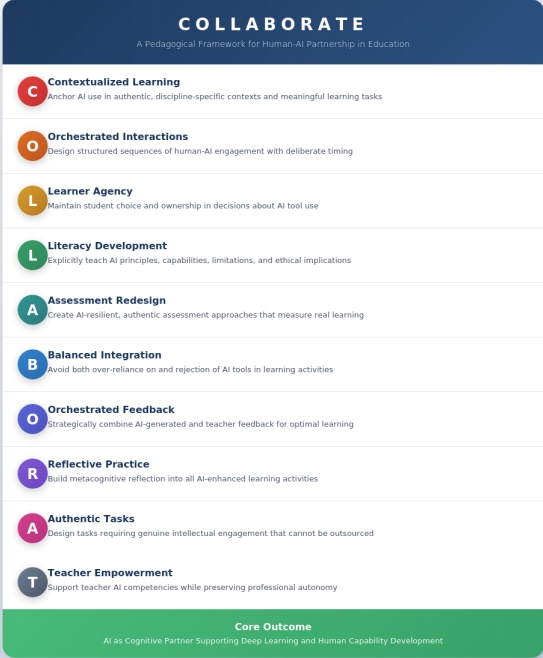
This article examines how generative artificial intelligence can be integrated into teaching without reducing learning to automated answer production. Rather than treating AI adoption as a purely technical question, the paper argues that the central pedagogical challenge is how to preserve human judgment, metacognitive effort, and disciplinary understanding when students can now generate plausible outputs in seconds. Building on the original manuscript's distinction between automation and augmentation, the revised version strengthens the argument by anchoring the problem in concrete classroom pain points, especially writing-intensive and feedback-heavy courses where students' use of AI often outpaces institutional policy. It synthesizes recent scholarship on hybrid intelligence, self-regulated learning, teacher-AI collaboration, assessment redesign, and academic integrity, while also identifying limitations in current frameworks, including weak subject-specific guidance, limited long-term evidence, and insufficient attention to equity and cultural context. In response, the paper clarifies the rationale for the COLLABORATE framework and explains how its ten principles work together to make AI use visible, bounded, and pedagogically productive. The framework is presented as a conceptual, evidence-informed design model rather than as an empirically validated intervention. The paper concludes by outlining practical implementation pathways, ethical safeguards, and a concrete research agenda for testing which forms of human-AI collaboration best support student learning, process transparency, and foundational skill retention.
Keywords:
Human-AI Collaboration Generative AI Pedagogical Strategies AI Literacy Metacognition Teacher-AI Partnership Educational TechnologyReferences
- Dwivedi, Y.K.; Kshetri, N.; Hughes, L.; et al. So what if ChatGPT wrote it? Multidisciplinary perspectives on opportunities, challenges and implications of generative conversational AI for research, practice and policy. Int. J. Inf. Manag. 2023, 71, 102642.
- Kasneci, E.; Sessler, K.; Küchemann, S.; et al. ChatGPT for good? On opportunities and challenges of large language models for education. Learn. Individ. Differ. 2023, 103, 102274.
- UNESCO. UNESCO Survey: Less than 10% of Schools and Universities Have Formal Guidance on AI; UNESCO: Paris, France, 2023.
- Freeman, J. Student Generative AI Survey 2025; Higher Education Policy Institute: Oxford, UK, 2025.
- Trust, T.; Whalen, J.; Mouza, C. Editorial: ChatGPT: Challenges, Opportunities, and Implications for Teacher Education. Contemp. Issues Technol. Teach. Educ. 2023, 23, 1–23.
- Lodge, J.M.; Howard, S.K.; Bearman, M.; et al. Assessment reform for the age of artificial intelligence. Tert. Educ. Manag. 2023, 1–12. Available online: https://www.teqsa.gov.au/sites/default/files/2023-09/assessment-reform-age-artificial-intelligence-discussion-paper.pdf
- Scarfe, P.; Watcham, K.; Clarke, A.; et al. A real-world test of artificial intelligence infiltration of a university examinations system: A 'Turing Test' case study. PLoS ONE 2024, 19, e0305354. DOI: https://doi.org/10.1371/journal.pone.0305354
- Wilson, H.J.; Daugherty, P.R. Collaborative intelligence: Humans and AI are joining forces. Harv. Bus. Rev. 2018, 96, 114–123.
- Mollick, E.; Mollick, L. Assigning AI: Seven Approaches for Students, with Prompts. SSRN Electron. J. 2023, 1–48. Available online: https://papers.ssrn.com/sol3/papers.cfm?abstract_id=4475995
- Dellermann, D.; Ebel, P.; Söllner, M.; et al. Hybrid Intelligence. Bus. Inf. Syst. Eng. 2019, 61, 637–643.
- Holstein, K.; McLaren, B.M.; Aleven, V. Co-Designing a Real-Time Classroom Orchestration Tool to Support Teacher–AI Complementarity. J. Learn. Anal. 2019, 6, 27–52.
- Sharples, M.; Pérez y Pérez, R. Story Machines: How Computers Have Become Creative Writers; Routledge: London, UK, 2022.
- Prather, J.; Reeves, B.N.; Denny, P.; et al. "It's Weird That It Knows What I Want": Usability and Interactions with Copilot for Novice Programmers. ACM Trans. Comput.-Hum. Interact. 2023, 31, 4.
- Gero, K.I.; Ashktorab, Z.; Dugan, C.; et al. Mental Models of AI Agents in a Cooperative Word Guessing Game. In Proceedings of the 2020 CHI Conference on Human Factors in Computing Systems, Honolulu, HI, USA, 25–30 April 2020.
- Attewell, S. Student Perceptions of AI 2025; Jisc: Bristol, UK, 2025.
- McDonald, N.; Johri, A.; Ali, A.; et al. Generative artificial intelligence in higher education: Evidence from an analysis of institutional policies and guidelines. Comput. Hum. Behav. Artif. Hum. 2025, 3, 100121. DOI: https://doi.org/10.1016/j.chbah.2025.100121
- Bond, M.; Khosravi, H.; De Laat, M.; et al. A meta-systematic review of artificial intelligence in higher education: A call for increased ethics, collaboration, and rigour. Int. J. Educ. Technol. High. Educ. 2024, 21, 4. DOI: https://doi.org/10.1186/s41239-023-00436-z
- Banihashem, S.K.; Noroozi, O.; Khosravi, H.; et al. Pedagogical framework for hybrid intelligent feedback. Innov. Educ. Teach. Int. 2025, 63, 554–570. DOI: https://doi.org/10.1080/14703297.2025.2499174
- Banihashem, S.K.; Bond, M.; Khosravi, H.; et al. A systematic mapping review at the intersection of artificial intelligence and self-regulated learning. Int. J. Educ. Technol. High. Educ. 2025, 22, 50. DOI: https://doi.org/10.1186/s41239-025-00548-8
- Chan, C.K.Y. A comprehensive AI policy education framework for university teaching and learning. Int. J. Educ. Technol. High. Educ. 2023, 20, 38. DOI: https://doi.org/10.1186/s41239-023-00408-3
- Topping, K.J.; Gehringer, E.; Khosravi, H.; et al. Enhancing peer assessment with artificial intelligence. Int. J. Educ. Technol. High. Educ. 2025, 22, 3. DOI: https://doi.org/10.1186/s41239-024-00501-1
- Lo, L.S. The CLEAR path: A framework for enhancing information literacy through prompt engineering. J. Acad. Librariansh. 2023, 49, 102720.
- Perkins, M. Academic Integrity in the Age of AI. Nat. Mach. Intell. 2023, 5, 2–4.
- Bender, E.M.; Gebru, T.; McMillan-Major, A.; et al. On the Dangers of Stochastic Parrots: Can Language Models Be Too Big? In Proceedings of the 2021 ACM Conference on Fairness, Accountability, and Transparency, Online, 3–10 March 2021; pp. 610–623.
- Mah, D.-K.; Groß, N. Artificial intelligence in higher education: Exploring faculty use, self-efficacy, distinct profiles, and professional development needs. Int. J. Educ. Technol. High. Educ. 2024, 21, 58. DOI: https://doi.org/10.1186/s41239-024-00490-1
- Ifenthaler, D.; Majumdar, R.; Gorissen, P.; et al. Artificial Intelligence in Education: Implications for Policymakers, Researchers, and Practitioners. Technol. Knowl. Learn. 2024, 29, 1693–1710. DOI: https://doi.org/10.1007/s10758-024-09747-0
- Tlili, A.; Shehata, B.; Adarkwah, M.A.; et al. What if the devil is my guardian angel: ChatGPT as a case study of using chatbots in education. Smart Learn. Environ. 2023, 10, 15. DOI: https://doi.org/10.1186/s40561-023-00237-x
- Yim, I.H.Y.; Su, J. Artificial intelligence (AI) learning tools in K-12 education: A scoping review. J. Comput. Educ. 2025, 12, 93–131. DOI: https://doi.org/10.1007/s40692-023-00304-9
- Biagini, G. Towards an AI-Literate Future: A Systematic Literature Review Exploring Education, Ethics, and Applications. Int. J. Artif. Intell. Educ. 2025, 35, 2616–2666. DOI: https://doi.org/10.1007/s40593-025-00466-w
- Memarian, B.; Doleck, T. Teaching and learning artificial intelligence: Insights from the literature. Educ. Inf. Technol. 2024, 29, 21523–21546. DOI: https://doi.org/10.1007/s10639-024-12679-y
- Xia, Q.; Weng, X.; Ouyang, F.; et al. A scoping review on how generative artificial intelligence transforms assessment in higher education. Int. J. Educ. Technol. High. Educ. 2024, 21, 40. DOI: https://doi.org/10.1186/s41239-024-00468-z
- Qian, Y. Pedagogical Applications of Generative AI in Higher Education: A Systematic Review of the Field. TechTrends 2025, 69, 1105–1120. DOI: https://doi.org/10.1007/s11528-025-01100-1
- Fu, Y.; Weng, Z.; Wang, J. Examining AI Use in Educational Contexts: A Scoping Meta-Review and Bibliometric Analysis. Int. J. Artif. Intell. Educ. 2025, 35, 1388–1444. DOI: https://doi.org/10.1007/s40593-024-00442-w
- Jensen, L.X.; Buhl, A.; Sharma, A.; et al. Generative AI and higher education: A review of claims from the first months of ChatGPT. High. Educ. 2025, 89, 1145–1161. DOI: https://doi.org/10.1007/s10734-024-01265-3
- McGrath, C.; Farazouli, A.; Cerratto-Pargman, T. Generative AI chatbots in higher education: A review of an emerging research area. High. Educ. 2025, 89, 1533–1549. DOI: https://doi.org/10.1007/s10734-024-01288-w