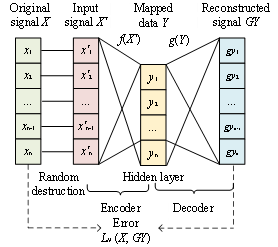
During long-term operation in high-temperature and high-pressure environments, the pressure pipelines of boiler heating systems are prone to damage, which directly affects the safe and stable operation of pressure pipelines and boiler heating systems. Generally, the acoustic sensor is employed to detect the abnormal sound of pressure pipelines for condition monitoring. However, the signals obtained from the acoustic sensor are easily drowned out in background noise generated by fans and exhaust equipment, resulting in unsatisfactory performance for condition monitoring. Therefore, the intelligent acoustic sensor framework is proposed to establish a physics-informed digital twin for pressure pipelines, integrating condition monitoring as a core function. By implementing the digital twin, real-time synchronization between physical and virtual systems enables predictive maintenance, early fault diagnosis, and optimized operational strategies, thereby reducing unplanned downtime and enhancing industrial safety. Specifically, the traditional acoustic sensor system is improved based on the noise reduction model, which can obtain the de-noised acoustic signals for all conditions. Furthermore, the real-time decision-making model for abnormal sound detection is embedded in the proposed intelligent acoustic sensor framework based on the long short-term memory network, and the result is employed as the digital twin for pressures pipeline by monitoring their condition. In addition, the experimental platform is built to test the effectiveness and reliability of the proposed intelligent acoustic sensor framework. The results indicate that the quality of acoustic signals is improved by over 3 dB, and the accuracy of condition monitoring can reach 91.67% for different conditions. By comparing and analyzing with other methods, the superiority and effectiveness of the proposed intelligent acoustic sensor framework are further verified. This approach not only improves monitoring precision but also offers broader social benefits, including reduced energy waste in heating systems and minimized risks of industrial accidents.

 882 (Views)
  677 (Downloads)