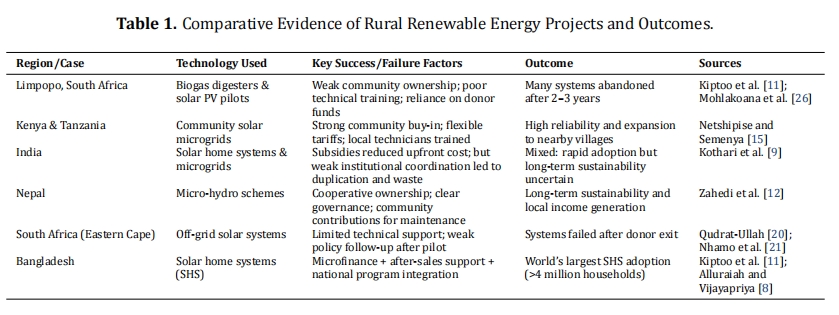
Despite ongoing efforts to expand rural electrification in developing countries, many communities still lack reliable and affordable electricity. Low population densities, limited economic activity, and modest energy demand make grid extension costly and impractical in remote areas. As a result, renewable energy microgrids are increasingly viewed as viable alternatives for supporting local development. While prior research highlights their technical feasibility, limited attention has been given to how these systems operate as integrated socio-technical interventions that connect energy access with agricultural productivity and broader community outcomes. In South Africa, persistent challenges such as load shedding, unstable grid supply, and limited access to modern energy services continue to disrupt farming activities and constrain education and healthcare delivery. Although renewable energy initiatives have been introduced, evidence of their long-term performance, institutional sustainability, and contribution to livelihoods remains fragmented. In particular, there is limited empirical understanding of how financial, technical, and institutional factors interact to influence microgrid success. This paper addresses this gap by examining the design and implementation of a renewable energy microgrid at the Masia Development Centre in Limpopo Province using a systems thinking approach. It analyses the interactions between technical performance, community participation, agricultural needs, and environmental conditions. By moving beyond purely technical assessments, the study provides context-specific insights into how microgrids can be designed and governed to enhance sustainability, resilience, and rural development outcomes.

 198 (Views)
  190 (Downloads)