
Research Article
A Methodology for Firm Capacity Planning, Including the Economic Feasibility Assessment of a Hydrogen Storage–Based Generation Project
 Download

This work is licensed under a Creative Commons Attribution-NonCommercial 4.0 International License.
Copyright
The authors shall retain the copyright of their work but allow the Publisher to publish, copy, distribute, and convey the work.
License
Clean Energy Technologies (CET) publishes accepted manuscripts under Creative Commons Attribution 4.0 International (CC BY 4.0). Authors who submit their papers for publication by Clean Energy Technologies (CET) agree to have the CC BY 4.0 license applied to their work, and that anyone is allowed to reuse the article or part of it free of charge for any purpose, including commercial use. As long as the author and original source is properly cited, anyone may copy, redistribute, reuse and transform the content.
Authors

Received: 26 July 2025; Revised: 7 September 2025; Accepted: 17 October 2025; Published: 6 November 2025
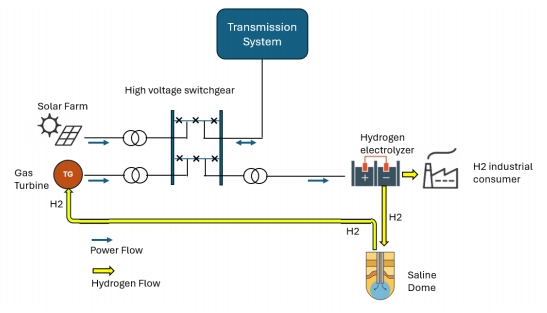
A high penetration of wind and solar generation within the generation mix will result in an increased supply risk due to the random variations inherent in renewable generation. This document proposes a new methodology for calculating system marginal costs as part of generation fleet expansion planning that accounts for the impact of these random variations. This new methodology incorporates an additional cost into the marginal cost calculation, reflecting the risk of supply deficits during periods of scarcity. This allows for the inclusion in the planning process of generation units that contribute to the electricity system firm capacity, thereby enhancing the security of supply to meet demand. As an example, this document analyzes the economic feasibility of a generation project that utilizes hydrogen (H2) as fuel. The project combines H2 production for industrial use, powered by renewable generation (the GH2 project), with the provision of firm capacity supplied by a gas turbine (TG) generator fueled by H2 (the hybrid project). The economic feasibility of this hybrid project stems from two key factors: i) intra-annual energy arbitrage—purchasing energy from the electricity market during periods of the year characterized by low marginal costs, and selling energy during periods of scarcity with high marginal costs; and ii) maximizing the electrolyzer's capacity factor by purchasing energy in the market during hours when the electrolyzer possesses residual capacity (i.e., capacity not currently utilized by the GH2 project). The project incorporates H2 storage within salt domes.
Keywords:
Electricity Markets Market Prices Optimal Planning Reliability Analysis Green Hydrogen Renewable Energy Energy Transition GH2 to Power ProjectsReferences
- Kabeyi, M.J.B.; Olanrewaju, O.A. Sustainable Energy Transition for Renewable and Low-Carbon Grid Electricity Generation and Supply. Front. Energy Res. 2022, 9, 743114. DOI: https://doi.org/10.3389/fenrg.2021.743114
- Alhuyi Nazari, M.; Fahim Alavi, M.; Salem, M.; et al. Utilization of Hydrogen in Gas Turbines: A Comprehensive Review. Int. J. Low-Carbon Technol. 2022, 17, 513–519. DOI: https://doi.org/10.1093/ijlct/ctac025
- Fernandes, L.; Machado, F.; Marcon, L.; et al. Unified Case Study Analysis of Techno-Economic Tools to Study the Viability of Off-Grid Hydrogen Production Plants. Hydrogen 2025, 6, 72. DOI: https://doi.org/10.3390/hydrogen6030072
- Data Product Details: Hourly Aggregated Wind and Solar Output. Available online: https://www.ercot.com/mp/data-products/data-product-details?id=PG7-126-M (accessed on 20 July 2025).
- Zheng, C.; Nan, S. Reliability-Constrained Capacity Market Design with High Proportions of Renewable Energies. Front. Energy Res. 2023, 11, 1335363. DOI: https://doi.org/10.3389/fenrg.2023.1335363
- Si, Y.; Ma, L.; Chen, L.; et al. Equivalent Firm Capacity Assessment of HDR–PV Hybrid Power System: A Distributionally Robust Approach. Front. Energy Res. 2021, 9, 791818. DOI: https://doi.org/10.3389/fenrg.2021.791818
- Llarens, D.; Souilla, L.; Masiriz, S.A.; et al. Renewable Energy: How the Energy Markets Rules Could Improve Electrical System Reliability. In Advances in Green Electronics Technologies in 2023; Sabban, A., Ed.; IntechOpen: London, UK, 2023. DOI: https://doi.org/10.5772/intechopen.107062
- Oren, S.S. Capacity Payments and Supply Adequacy in Competitive Electricity Markets. In Proceedings of the VII Symposium of Specialists in Electric Operational and Expansion Planning, Curitiba, Brazil, 21–26 May 2000. Available online: https://oren.ieor.berkeley.edu/workingp/sepope.pdf
- Byles, D.; Kuretich, P.; Mohagheghi, S.; et al. Generation and Transmission Expansion Planning: Nexus of Resilience, Sustainability, and Equity. Processes 2024, 12, 590. DOI: https://doi.org/10.3390/pr12030590
- da Luz, T.J.; Unsihuay-Vila, C. Generation and Transmission Expansion Planning with Full-Year Hourly Power Balance. Braz. Arch. Biol. Technol. 2024, 67, e24231004. DOI: https://doi.org/10.1590/1678-4324-2024231004
- Tabora, J.M.; Velasquez, Y.G.; Rivera, D.A.; et al. A Multiobjective Strategy for Generation Expansion Planning to Enable Increased Penetration of Variable Renewable Energy Sources. IEEE Access 2024, 12, 187665–187675. DOI: https://doi.org/10.1109/ACCESS.2024.3514373
- Hole, J.; Philpott, A.; Dowson, O.; et al. Capacity Planning of Renewable Energy Systems Using Stochastic Dual Dynamic Programming. arXiv preprint 2023, arXiv:2312.08556. DOI: https://doi.org/10.48550/arXiv.2312.08556
- Roald, L.A.; Pozo, D.; Papavasiliou, A.; et al. Power Systems Optimization under Uncertainty: A Review of Methods and Applications. Electr. Power Syst. Res. 2023, 214, 108725. DOI: https://doi.org/10.1016/j.epsr.2022.108725
- Allan, R.N.; da Silva, A.M.L.; Abu-Nasser, A.A.; et al. Discrete Convolution in Power System Reliability. IEEE Trans. Reliab. 1981, 30, 452–456. DOI: https://doi.org/10.1109/TR.1981.5221166
- Llarens, D. Electricity Markets Price Projection: An Innovative Approach for Risk Assessment Based on a Convolution Algorithm. Front. Environ. Econ. 2025, 4, 1434796. DOI: https://doi.org/10.3389/frevc.2025.1434796
- Ruiz Maraggi, L.M.; Moscardelli, L.G. Hydrogen Storage Potential of Salt Domes in the Gulf Coast of the United States. J. Energy Storage 2024, 82, 110585. DOI: https://doi.org/10.1016/j.est.2024.110585
- Tarel, G.; Korpås, M.; Botterud, A. Long-Term Equilibrium in Electricity Markets with Renewables and Energy Storage Only. Energy Syst. 2024. DOI: https://doi.org/10.1007/s12667-024-00654-y
- Pham, A.; Cole, W.; Gagnon, P. Average and Marginal Capacity Credit Values of Renewable Energy and Battery Storage in the United States Power System; National Renewable Energy Laboratory: Golden, CO, USA, 2024. Available online: https://www.nrel.gov/docs/fy25osti/89587.pdf
- Hogan, W.W. Electricity Scarcity Pricing through Operating Reserves: An ERCOT Window of Opportunity. Available online: https://whogan.scholars.harvard.edu/sites/g/files/omnuum4216/files/whogan/files/hogan_ordc_110112r.pdf (accessed on 20 July 2025).
- Electric Reliability Council of Texas (ERCOT). 2024 Biennial ERCOT Report on the Operating Reserve Demand Curve. ERCOT: Austin, TX, USA, 2024. Available online: https://www.ercot.com/files/docs/2024/10/31/2024-biennial-ercot-report-on-the-ordc-20241031.pdf
- Short-Term Energy Outlook Supplement: Sources of Price Volatility in the ERCOT Market. Available online: https://www.eia.gov/outlooks/steo/special/supplements/2022/2022_sp_03.pdf (accessed on 20 July 2025).
- Levelized Cost of Energy. Available online: https://www.lazard.com/media/uounhon4/lazards-lcoeplus-june-2025.pdf (accessed on 20 July 2025).
- U.S. Energy Information Administration. Levelized Costs of New Generation Resources in the Annual Energy Outlook 2025; U.S. Energy Information Administration: Washington, DC, USA, 2025. Available online: https://www.eia.gov/outlooks/aeo/electricity_generation/pdf/AEO2025_LCOE_report.pdf
- Papadias, D.D.; Ahluwalia, R.K. Bulk Storage of Hydrogen. Int. J. Hydrogen Energy 2021, 46, 34527–34541. DOI: https://doi.org/10.1016/j.ijhydene.2021.08.028
- Talukdar, M.; Blum, P.; Heinemann, N.; et al. Techno-Economic Analysis of Underground Hydrogen Storage in Europe. iScience 2024, 27, 108771. DOI: https://doi.org/10.1016/j.isci.2023.108771