
Articles
Effects of Agroecological-Based Techniques on Pest, Weed, and Disease Management in Orange-Fleshed Sweet Potato (OFSP)
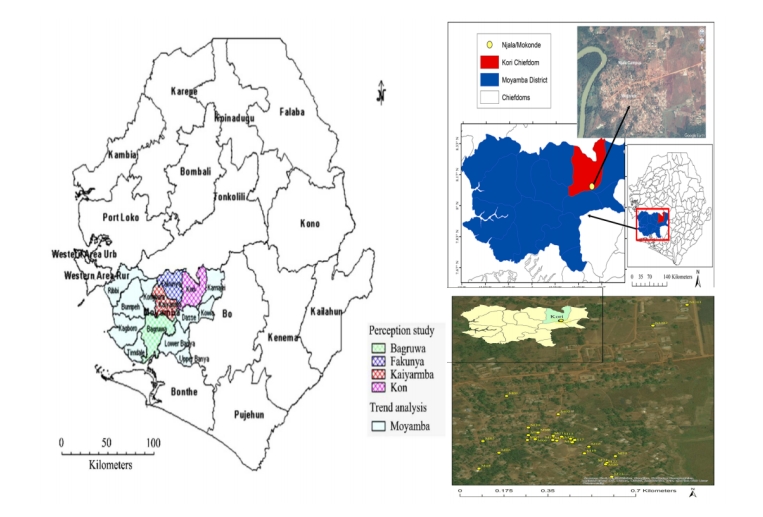
 Download

This work is licensed under a Creative Commons Attribution-NonCommercial 4.0 International License.
Copyright
The authors shall retain the copyright of their work but allow the Publisher to publish, copy, distribute, and convey the work.
License
Urban Agriculture and Circular Food Systems (UACFS) publishes accepted manuscripts under Creative Commons Attribution 4.0 International (CC BY 4.0). Authors who submit their papers for publication by Urban Agriculture and Circular Food Systems (UACFS) agree to have the CC BY 4.0 license applied to their work, and that anyone is allowed to reuse the article or part of it free of charge for any purpose, including commercial use. As long as the author and original source is properly cited, anyone may copy, redistribute, reuse and transform the content.
Authors
-
Alusaine Edward Samura
 Department of Crop Protection, Njala University, Moyamba, Sierra Leone
- Charles Buster Johnson Department of Agronomy, University of Liberia, Monrovia, Liberia
-
Vandi Amara
Department of Crop Protection, Njala University, Moyamba, Sierra Leone
-
David Dan Quee
Department of Crop Protection, Njala University, Moyamba, Sierra Leone
-
Joseph Musa
Department of Crop Protection, Njala University, Moyamba, Sierra Leone
Received: 15 April 2025; Revised: 4 June 2025; Accepted: 13 June 2025; Published: 1 July 2025
Orange-fleshed sweet potato (OFSP) is a key biofortified crop for improving food and nutritional security in Sub-Saharan Africa, including Sierra Leone, however, its production is hindered by insect pests, diseases, and weeds. A field experiment was conducted in 2024 at Njala University, Sierra Leone, using a 3 × 4 factorial arrangement in a randomized complete block design (RCBD) with three replications to evaluate agroecological management techniques. Data were collected on vegetative growth, pest population and damage, diseases incidence and severity, weed density and yield, and analyzed using RStudio software. The results showed significant (p < 0.05) varietal and treatment effects on all measured parameters. Organic 1 significantly reduced aphid, tortoise beetle, and whitefly population (3.33–6.0 insect plant−1 at 12 weeks after planting) compared to control (13.67–13.78 insects’ plant−1), and a lowered disease severity score was observed which ranged from 1.0–1.2 at 12 weeks after planting compared to control (4.6–4.8). Organic 1 also produces the highest tuber yield (6.2 t ha−1), outperforming the inorganic treatment (3.1 t ha−1) and control (1.5 t ha−1). In contrast, the inorganic treatment achieved the greatest weed suppression (4.5–4.9 plants m−2) compared with the control (28.6–30.1 plants m−2). Among varieties, Kaphulira recorded superior vegetative growth and yield, while Chipika exhibited relatively lower pest infestation. Integrating organic-based agroecological pest management, especially the combination of poultry manure and neem extract, provides an ecologically sustainable, productive alternative to sole reliance on synthetic inputs and enhanced OFSP productivity.
Keywords:
Orange-Fleshed Sweet Potato Agroecological Techniques Pests Diseases Weeds ManagementReferences
- Lividini, K.; Campos, H.; Heck, S.; et al. Biofortified orange-fleshed sweetpotato can meaningfully reduce the burden of vitamin A deficiency. Curr. Dev. Nutr. 2024, 8, 102300. DOI: https://doi.org/10.1016/j.cdnut.2024.102300
- Ahoudou, I.; Sogbohossou, D.E.O.; Fassinou Hotegni, V.N.; et al. A systematic review on the factors influencing adoption and consumption of orange-fleshed sweetpotato in sub-Saharan Africa. Front. Sustain. Food Syst. 2025, 9, 1545827. DOI: https://doi.org/10.3389/fsufs.2025.1545827
- Low, J.W.; Ortiz, R.; Vandamme, E.; et al. Nutrient-dense orange-fleshed sweetpotato: Advances in drought tolerance breeding and understanding of management practices for sustainable next-generation cropping systems in sub-Saharan Africa. Front. Sustain. Food Syst. 2020, 4, 50. DOI: https://doi.org/10.3389/fsufs.2020.00050
- Tenaye, A.; Gizachew, A.; Asa, A. Effect of integrated organic and inorganic fertilizer management on sweetpotato yield and soil fertility in West Africa. Sci. Hortic. 2025, 330, 112345.
- Echodu, R.; Edema, H.; Wokorach, G.; et al. Farmers’ practices and their knowledge of biotic constraints to sweetpotato production in East Africa. Physiol. Mol. Plant Pathol. 2019, 105, 3–16. DOI: https://doi.org/10.1016/j.pmpp.2018.07.004
- Chabi, N.K.A.; Name, P.E.; Tibiri, E.B.; et al. Identification of viruses infecting sweetpotato (Ipomoea batatas Lam.) in Benin. Open Agric. 2024, 9, e0208214. DOI: https://doi.org/10.1515/opag-2022-0403
- Xu, K.; Hou, Y.; Sun, W.; et al. A detection method for sweet potato leaf spot disease and leaf-eating pests. Agriculture 2025, 15, 503. DOI: https://doi.org/10.3390/agriculture15050503
- Isman, M.B. Botanical insecticides, deterrents, and repellents in modern agriculture and an increasingly regulated world. Annu. Rev. Entomol. 2006, 51, 45–66. DOI: https://doi.org/10.1146/annurev.ento.51.110104.151146
- Campos, E.V.R.; Oliveira, J.L.; Fraceto, L.F.; et al. Applications of neem-based pesticides in agriculture: A review. Front. Plant Sci. 2016, 7, 1494. DOI: https://doi.org/10.3389/fpls.2016.01494
- Pavela, R.; Benelli, G. Essential oils as ecofriendly biopesticides? Challenges and constraints. Trends Plant Sci. 2016, 21, 1000–1007. DOI: https://doi.org/10.1016/j.tplants.2016.10.005
- Diacono, M.; Montemurro, F. Long-term effects of organic amendments on soil fertility. Agron. Sustain. Dev. 2010, 30, 401–422. DOI: https://doi.org/10.1051/agro/2009040
- Gattinger, A.; Muller, A.; Haeni, M.; et al. Enhanced topsoil carbon stocks under organic farming. Proc. Natl. Acad. Sci. U. S. A. 2012, 109, 18226–18231. DOI: https://doi.org/10.1073/pnas.1209429109
- Zheng, H.; Ying, H.; Yin, Y.; et al. Irrigation leads to greater maize yield at higher water productivity and lower environmental costs: A global meta-analysis. Agric. Ecosyst. Environ. 2019, 273, 62–69. DOI: https://doi.org/10.1016/j.agee.2018.12.009
- War, A.R.; Paulraj, M.G.; War, M.Y.; et al. Mechanisms of plant defense against insect herbivores. Plant Signal. Behav. 2012, 7, 1306–1320. DOI: https://doi.org/10.4161/psb.21663
- Lori, M.; Symnaczik, S.; Mäder, P.; et al. Organic farming enhances soil microbial abundance and activity—A meta-analysis and meta-regression. PLoS ONE 2017, 12, e0180442. DOI: https://doi.org/10.1371/journal.pone.0180442
- Hartmann, M.; Frey, B.; Mayer, J.; et al. Cropping practices manipulate soil microbial communities. ISME J. 2015, 9, 1177–1194. DOI: https://doi.org/10.1038/ismej.2014.210
- Raaijmakers, J.M.; Mazzola, M. Soil immune responses. Science 2016, 352, 1392–1393. DOI: https://doi.org/10.1126/science.aaf3252
- Pieterse, C.M.J.; Zamioudis, C.; Berendsen, R.L.; et al. Induced systemic resistance by beneficial microbes. Annu. Rev. Phytopathol. 2014, 52, 347–375. DOI: https://doi.org/10.1146/annurev-phyto-082712-102340
- Trivedi, P.; Leach, J.E.; Tringe, S.G.; et al. Plant–microbiome interactions: From community assembly to plant health. Nat. Rev. Microbiol. 2020, 18, 607–621. DOI: https://doi.org/10.1038/s41579-020-0412-1
- Morella, N.M.; Weng, F.C.-H.; Joubert, P.M.; et al. Successive passaging of a plant-associated microbiome reveals robust habitat and host genotype-dependent selection. Proc. Natl. Acad. Sci. U.S.A. 2020, 117, 1148–1159. DOI: https://doi.org/10.1073/pnas.1908600116
- Duke, S.O. The history and current status of glyphosate. Pest Manag. Sci. 2018, 74, 1027–1034. DOI: https://doi.org/10.1002/ps.4652
- Oerke, E.C. Crop losses to pests. J. Agric. Sci. 2006, 144, 31–43. DOI: https://doi.org/10.1017/S0021859605005708
- Zhang, S.; Li, H.; Chen, X.; et al. Long-term fertilization altered microbial community structure in an aeolian sandy soil in northeast China. Front. Microbiol. 2022, 13, 979759. DOI: https://doi.org/10.3389/fmicb.2022.979759
- Seufert, V.; Ramankutty, N.; Foley, J.A. Comparing yields of organic and conventional agriculture. Nature 2012, 485, 229–232. DOI: https://doi.org/10.1038/nature11069
- Ponisio, L.C.; M’Gonigle, L.K.; Mace, K.C.; et al. Diversification practices reduce organic yield gap. Proc. R. Soc. B 2015, 282, 20141396. DOI: https://doi.org/10.1098/rspb.2014.1396
- Pretty, J.; Benton, T.G.; Bharucha, Z.P.; et al. Global assessment of sustainable intensification. Nat. Sustain. 2018, 1, 441–446. DOI: https://doi.org/10.1038/s41893-018-0114-0
- Dass, A.; San, A.A.; Jinger, D.; et al. Sustainable intensification strategies: Balancing productivity, quality, and profitability in agri-food systems with resource optimization. Front. Agron. 2025, 7, 1611739. DOI: https://doi.org/10.3389/fagro.2025.1611739