
Articles
Hybrid-Coupled Solution Model for the Internal Energy Equation: Hydrogeomechanics HGM
 Download
Authors

Received: 26 June 2025; Revised: 9 August 2025; Accepted: 12 September 2025; Published: 9 October 2025
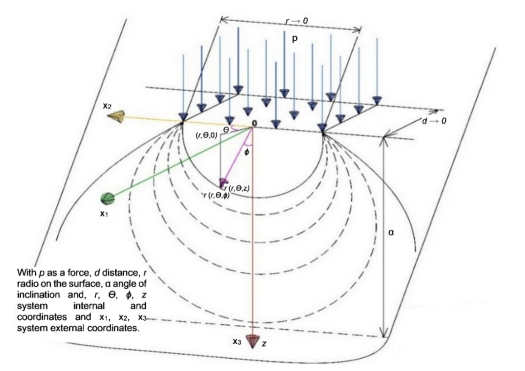
Water infiltration and recharge cause stresses, deformations, and displacements in the soil, which can lead to landslides, subsidence, erosion, etc. The objective was to propose a solution for the internal energy equation, (water flow in the soil mass) based on modern mechanics and underground hydraulics. From continuum mechanics, the internal energy equation was analyzed: i) the distribution of water flow at the surface as a source; ii) the expansion of water flow within the soil mass in cylindrical coordinates; iii) the distribution at the upper boundary, and the transient conduction of internal radial flow. Analogous near-surface and internal conduction were proposed as a load source. Stresses, deformations, displacements, and potentials were reviewed using modern mechanics, and the superposition principle was applied. The formulation was applied to a case study. It was found that Cartesian equations best represent the external surface flow of water (runoff), while cylindrical and radial equations best fit the internal flow in the soil (conduction-distribution). The proposed solution is in terms of the supplied load (precipitation). At different soil moisture contents—dry, saturated, and supersaturated—dynamic processes generate different energy rates. Externally, in supersaturated soils, the energy is purely hydraulic and is a parallel mobilization force on the surface (runoff or flooding). This solution could be applied to other multidisciplinary problems in mechanics, geomechanics, and hydrogeology, given the rigor of mathematical formulations that have described problems independently.
Keywords:
Hydrogeomechanical Coupling Thermal Analogy-Hydraulics Hybrid/Coupled Flow SolutionReferences
- Heemels, W.P.M.H.; Lehmann, D.; Lunze, J.; et al. Introduction to hybrid systems. In Handbook of Hybrid Systems Control: Theory, Tools, Applications; Jan, L., Francoise, L.-L., Eds.; Cambridge University Press: Cambridge, UK, 2009; pp. 3–30. DOI: https://doi.org/10.1017/CBO9780511807930.002
- Mittal, H.; Al, A.A.; Alhassan, S.M. Hybrid super-porous hydrogel composites with high water vapor adsorption capacity—Adsorption isotherm and kinetics studies. J. Environ. Chem. Eng. 2021, 9, 106611. DOI: https://doi.org/10.1016/j.jece.2021.106611
- Tran, K.M.; Bui, H.H.; Nguyen, G.D. Hybrid discrete-continuum approach to model hydromechanical behavior of soil during desiccation. J. Geotech. Geoenviron. Eng. 2021, 147. DOI: https://doi.org/10.1061/(ASCE)GT.1943-5606.0002633
- Pan, S.; Yamaguchi, Y.; Suppasri, A.; et al. MPM-FEM hybrid method for granular mass-water interaction problems. Comput. Mech. 2021, 68, 155–173. DOI: https://doi.org/10.1007/s00466-021-02024-2
- El-Zorkany, H.L.; Balasubramanian, R. Hybrid computer solution of PDE’S using Laplace modified Galerkin approximation. Math. Comput. Simul. 1981, 23, 304–311. DOI: https://doi.org/10.1016/0378-4754(81)90089-6
- Asaoka, A.; Nakano, M.; Noda, T. Soil-water coupled behaviour of saturated clay near/at critical state. Soil Found. 1994, 34, 91–105. DOI: https://doi.org/10.3208/sandf1972.34.91
- Lima, J.A.; Perez-Guerrero, J.S.; Cotta, R.M. Hybrid solution of the averaged Navier–Stokes equations for turbulent flow. Comput. Mech. 1997, 19, 297–307. DOI: https://doi.org/10.1007/s004660050178
- Erduran, K.S. Further application of hybrid solution to another form of Boussinesq equations and comparisons. Int. J. Numer. Methods Fluids 2006, 53, 827–849. DOI: https://doi.org/10.1002/fld.1307
- Huang, X.; Rudolph, D.L. A hybrid analytical-numerical technique for solving soil temperature during the freezing process. Adv. Water Resour. 2022, 162, 104163. DOI: https://doi.org/10.1016/j.advwatres.2022.104163
- Nastase, A. Hybrid numerical solutions for three-dimensional compressible Navier–Stokes layer. Proc. Appl. Math. Mech. 2010, 9, 493–494. DOI: https://doi.org/10.1002/pamm.200910219
- Xie, M.; Navas, P.; López-Querol, S. A stabilized semi-implicit double-point material point method for soil-water coupled problems. Comput. Part. Mech. 2025, 12, 3389–3419. DOI: https://doi.org/10.1007/s40571-025-01027-7
- Chen, T.-M. Numerical solution of hyperbolic heat conduction problems in the cylindrical coordinate system by the hybrid Green’s function method. Int. J. Heat Mass Transf. 2010, 53, 1319–1325. DOI: https://doi.org/10.1016/j.ijheatmasstransfer.2009.12.029
- Luo, C.-l.; Yu, Y.-y.; Zhang, J.; et al. Thermal-water-salt coupling process of unsaturated saline soil under unidirectional freezing. J. Mt. Sci. 2023, 20, 557–569. DOI: https://doi.org/10.1007/s11629-022-7652-7
- Madureira, L.R.; Melo, F.Q. Hybrid formulation solutions for stress analysis of curved pipes with welded bending joints. Eng. Fract. Mech. 2010, 77, 2992–2999. DOI: https://doi.org/10.1016/j.engfracmech.2010.04.009
- Nick, H.M.; Matthäi, S.K. A hybrid finite-element finite-volume method with embedded discontinuities for solute transport in heterogeneous media. Vadose Zone J. 2011, 10, 299–312. DOI: https://doi.org/10.2136/vzj2010.0015
- Zhang, M.; Wen, Z.; Xue, K.; et al. A coupled model for liquid water, water vapor and heat transport of saturated-unsaturated soil in cold regions: Model formulation and verification. Environ. Earth Sci. 2016, 75, 701. DOI: https://doi.org/10.1007/s12665-016-5499-3
- Sun, J.; Sun, H.; Lu, M.; et al. Finite-difference solution for dissipation of excess pore water pressure within liquefied soil stabilized by stone columns with consideration of coupled radial-vertical seepage. Soil Dyn. Earthq. Eng. 2024, 176, 108328. DOI: https://doi.org/10.1016/j.soildyn.2023.108328
- Tu, S.; Li, W.; Zhang, C.; et al. Seepage effect on progressive failure of shield tunnel face in granular soils by coupled continuum-discrete method. Comput. Geotech. 2024, 166, 106009. DOI: https://doi.org/10.1016/j.compgeo.2023.106009
- Hai, M.; Wang, M.; Meng, S.; et al. Research on hydro-thermal coupling model of canal foundation soil based on particle grading curve predicting soil-water characteristic curve. Case Stud. Therm. Eng. 2024, 56, 104270. DOI: https://doi.org/10.1016/j.csite.2024.104270
- Deng, C.; Zhang, Y.; Bailey, R.T. Evaluating crop-soil-water dynamics in waterlogged areas using a coupled groundwater-agronomic model. Environ. Model. Softw. 2021, 143, 105130. DOI: https://doi.org/10.1016/j.envsoft.2021.105130
- Nguyen, T.T.; Indraratna, B. Fluidization of soil under increasing seepage flow: An energy perspective through CFD-DEM coupling. Granular Matter 2022, 24, 80. DOI: https://doi.org/10.1007/s10035-022-01242-6
- Sun, R.; Ma, J.; Sun, X.; et al. Responses of soil water-root coupling and coupling effects on grapevines to irrigation methods in extremely arid region. Agric. Water Manag. 2024, 302, 108984. DOI: https://doi.org/10.1016/j.agwat.2024.108984
- Wang, B.; Wang, P.; Zhao, M.; et al. Three-dimensional fully coupled analytical solution for a water-pile-saturated soil system under vertical P-wave incident. Appl. Math. Model. 2025, 138, 115825. DOI: https://doi.org/10.1016/j.apm.2024.115825
- Shao, J.; Liu, L.; Cui, J.; et al. Enhancing the coupling coordination of soil-crop systems by optimizing soil properties and crop production via subsoiling. Soil Tillage Res. 2025, 248, 106438. DOI: https://doi.org/10.1016/j.still.2024.106438
- Han, G.; Huo, J.; Hu, R.; et al. Coupling relationships between vegetation and soil in different vegetation types in the Ulan Buh Desert and the Kubuqi Desert. Front. Plant Sci. 2025, 16, 1505526. DOI: https://doi.org/10.3389/fpls.2025.1505526
- Ambati, V.R.; Bokhove, O. Space-time discontinuous Galerkin finite element method for shallow water flows. J. Comput. Appl. Math. 2007, 204, 452–462. DOI: https://doi.org/10.1016/j.cam.2006.01.047
- Atangana, A.; Botha, J.F. Analytical solution of the groundwater flow equation obtained via homotopy decomposition method. J. Earth Sci. Clim. Change 2012, 3, 115. DOI: https://doi.org/10.4172/2157-7617.1000115
- Raats, P.A.C.; Gardner, W.R. Comparison of empirical relationships between pressure head and hydraulic conductivity and some observations on radially symmetric flow. Water Resour. Res. 1971, 7, 921–928. DOI: https://doi.org/10.1029/WR007i004p00921
- López-Acosta, N.P. Numerical modeling of water flow problems. Available online: https://www.smig.org.mx/archivos/comite/6.pdf (accessed on 14 June 2025). (in Spanish)
- Nowinski, J.L. On the three-dimensional Cerruti problem for an elastic nonlocal half-space. Z. Angew. Math. Mech. 1992, 72, 243–249. DOI: https://doi.org/10.1002/zamm.19920720702
- Marmo, F.; Sessa, S.; Rosati, L. Analytical solution of the Cerruti problem under linearly distributed horizontal loads over polygonal domains. J. Elast. 2016, 124, 27–56. DOI: https://doi.org/10.1007/s10659-015-9560-3
- Li, C.; Zou, J-f. Anisotropic elasto-plastic solutions for cavity expansion problem in saturated soil mass. Soil Found. 2019, 59, 1313–1323. DOI: https://doi.org/10.1016/j.sandf.2019.05.012
- Ye, H.; Michel, A.N.; Hou, L. Stability theory for hybrid dynamical system. IEEE Trans. Autom. Control 1998, 43, 461–474. DOI: https://doi.org/10.1109/9.664149
- Teófilo-Salvador, E.; Morales-Reyes, G.P.; Muciño-Castañeda, R.; et al. Hydrogeomechanical model: Soil mass + water flow. Concienc. Tecnol. 2019, 57, 1–13. Available online: http://www.redalyc.org/articulo.oa?id=94459796007 (in Spanish)
- Courant, R.; John, F. Introduction to Calculus and Analysis; John Wiley and Sons, Inc: New York, NY, USA, 1965. Available online: https://www.astrosen.unam.mx/~aceves/Metodos/ebooks/courant_john1.pdf
- Sanfelice, R.G.; Goebel, R.; Teel, A.R. Generalized solutions to hybrid dynamical systems. ESAIM: COCV 2008, 14, 699–724. DOI: https://doi.org/10.1051/cocv:2008008
- Rakoto-Ravalontsalama, N. Control of hybrid systems and discrete-event systems. Available online: https://theses.hal.science/tel-01761771 (accessed on 14 June 2025).
- Michel, A.N.; Hou, L.; Liu, D. Stability of Dynamical Systems; Springer Science+Business Media LLC: Boston, MA, USA, 2009. DOI: https://doi.org/10.1007/978-0-8176-4649-3
- Teófilo-Salvador, E.; Morales Reyes, G.P.; Esteller Alberich, M.V.; et al. Parameters controlling deep percolation in a wheat crop. Terra Latinoamericana 2019, 37, 57–68.
- Richards, L.A. Capillary conduction of liquids through porous mediums. Physics 1931, 1, 318–333. DOI: http://dx.doi.org/10.1063/1.1745010
- Richardson, L.F. Weather Prediction by Numerical Process; Cambridge University Press: Cambridge, UK, 1922. Available online: https://dn721509.ca.archive.org/0/items/weatherpredictio00richrich/weatherpredictio00richrich.pdf
- Xiong, Y. Flow of water in porous media with saturation overshoot: A review. J. Hydrol. 2014, 510, 353–362. DOI: http://dx.doi.org/10.1016/j.jhydrol.2013.12.043
- Philip, J.R. Steady infiltration from buried point sources and spherical cavities. Water Resour. Res. 1968, 4, 1039–1047. DOI: https://doi.org/10.1029/WR004i005p01039
- Carslaw, H.S.; Jaeger, J.C. Conduction of Heat in Solids; Oxford University Press: Oxford, UK, 1959. Available online: https://archive.org/details/conductionheatin0000hsca/page/n9/mode/2up
- Unsworth, J.; Duarte, F.J. Heat diffusion in a solid sphere and Fourier theory: An elementary practical example. Am. J. Phys. 1979, 47, 981–983. DOI: https://doi.org/10.1119/1.11601
- Slaughter, W.S. The Linearized Theory of Elasticity; Springer Science+Business Media LLC: New York, NY, USA, 2002. DOI: https://doi.org/10.1007/978-1-4612-0093-2
- Sadd, M.H. Elasticity: Theory, Applications, and Numerics; Elsevier: Burlington, MA, USA, 2014.
- Teófilo-Salvador, E. Hydrogeomechanical Model to Evaluate Soil Slippage Due to Subsurface Water Flow. PhD Thesis, Universidad Autónoma del Estado de México, Toluca, México, 2019. (in Spanish)
- van Genuchten, M.T. A closed-form equation for predicting the hydraulic conductivity of unsaturated soils. Soil Sci. Soc. Am. J. 1980, 44, 892–898. Available online: https://www.ars.usda.gov/arsuserfiles/20360500/pdf_pubs/p0682.pdf
- Menini, L.; Tornambé, A. Nonlinear superposition formulas: Some physically motivated examples. In Proceedings of the 2011 50th IEEE Conference on Decision and Control and European Control Conference, Orlando, FL, USA, 12–15 December 2011; pp. 1092–1097. DOI: https://doi.org/10.1109/CDC.2011.6160344
- Nikas, G.K. Boussinesq-Cerruti functions and a simple technique for substantial acceleration of subsurface stress computations in elastic half-spaces. J. Eng. Tribol. 2006, 220, 19–28. DOI: https://doi.org/10.1243/13506501JET125
- Thompson, J.A.; Brodzik, M.J.; Silverstein, K.A.T.; et al. EASE-DGGS: A hybrid discrete global grid system for earth sciences. Big Earth Data 2022, 6, 340–357. DOI: https://doi.org/10.1080/20964471.2021.2017539
- Kantarji, I.G. Hybrid modeling of wave processes in the scientific justification of hydraulic solutions. IOP Conf. Ser.: Mater. Sci. Eng. 2020, 905, 012035. DOI: https://doi.org/10.1088/1757-899X/905/1/012035
- Platzer, A. Logical Analysis of Hybrid Systems; Springer-Verlag: Berlin, Germany, 2010. DOI: https://doi.org/10.1007/978-3-642-14509-4
- Platzer, A. The complete proof theory of hybrid systems. In Proceedings of the 2012 27th Annual ACM/IEEE Symposium on Logic in Computer Science, New Orleans, LA, USA, 25–28 June 2012. DOI: https://doi.org/10.1109/LICS.2012.64
- Andrade, P.F.; Negrão, M.E.; da Silva, B.C.; et al. Hybrid solutions obtained via integral transforms for magnetohydrodynamic flow with heat transfer in parallel-plate channels. Int. J. Numer. Methods Heat Fluid Flow 2018, 28, 1474–1505. DOI: https://doi.org/10.1108/HFF-02-2017-0076
- Wesseling, J.G.; Ritsema, C.J.; Stolte, J.; et al. Describing the soil physical characteristics of soil samples with cubical splines. Transp. Porous Media 2008, 71, 289–309. DOI: https://doi.org/10.1007/s11242-007-9126-3
- Timoshenko, S.; Goodier, J.N. Theory of Elasticity; McGraw-Hill Book Company, Inc.: New York, NY, USA, 1951.
- Anagnostou, D.S.; Gourgiotis, P.A.; Georgiadis, H.G. The Cerruti problem in dipolar gradient elasticity. Math. Mech. Solids 2015, 20, 1088–1106. DOI: https://doi.org/10.1177/1081286513514882
- Lisboa, K.M.; Zanon, Z.J.L.; Machado, C.R. Hybrid solutions for thermally developing flows in channels partially filled with porous media. Numer. Heat Transf. B Fundam. 2021, 79, 189–215. DOI: https://doi.org/10.1080/10407790.2020.1819700
- Moukalled, F.; Mangali, L.; Darwish, M. The Finite Volume Method in Computational Fluid Dynamics: An Advanced Introduction with OpenFOAM and Matlab; Springer: Cham, Switzerland, 2016. DOI: https://doi.org/10.1007/978-3-319-16874-6
- Teófilo-Salvador, E. Model of water flow infiltration force in a soil mass. Terra Latinoamericana 2025, 42, 1–13.
- Shang, X.; Zhang, Z.; Yang, W.; et al. A thermal-hydraulic-gas-mechanical coupling model on permeability enhancement in heterogeneous shale volume fracturing. Mathematics 2022, 10, 3473. DOI: https://doi.org/10.3390/math10193473
- Yan, X.; Xue, K.; Liu, X.; et al. A novel numerical method for geothermal reservoirs embedded with fracture networks and parameter optimization for power generation. Sustainability 2023, 15, 9744. DOI: https://doi.org/10.3390/su15129744
- Teófilo-Salvador, E. Computational review for fluid flow—Heat transfer in stress deformation in porous/fractured media, THGMC. Earth Planet. Sci. 2025, 4, 89–108. DOI: https://doi.org/10.36956/eps.v4i1.2089
- McDermott, C.; Bond, A.; Fraser, H.A.; et al. Application of hybrid numerical and analytical solutions for the simulation of coupled thermal, hydraulic, mechanical and chemical processes during fluid flow through a fractured rock. Environ. Earth Sci. 2015, 74, 7837–7854. DOI: https://doi.org/10.1007/s12665-015-4769-9