
Articles
Network Signatures of Verbal Ability in Autism: A Multisite fMRI Study Using Graph Theory and Machine Learning
 Download

This work is licensed under a Creative Commons Attribution 4.0 International License.
Authors
-
Huibin Ma
 School of Information and Electronics Technology, Jiamusi University, Jiamusi 154007, China
-
Jinying Wu
School of Information and Electronics Technology, Jiamusi University, Jiamusi 154007, China
-
Lanfen Chen
School of Medical Imaging, Shandong Second Medical University, Weifang 261053, China
-
Jiaying Song
School of Information and Electronics Technology, Jiamusi University, Jiamusi 154007, China
-
Hang Zhang
School of Medical Imaging, Shandong Second Medical University, Weifang 261053, China
-
Zeqi Hao
School of Psychology, Zhejiang Normal University, Jinhua 321004, China
-
Linlin Zhan
Faculty of Western Languages, Heilongjiang University, Harbin 150080, China
-
Lulu Cheng
School of Foreign Studies, China University of Petroleum (East China), Qingdao 266580, China
-
Xize Jia
School of Psychology, Zhejiang Normal University, Jinhua 321004, China
Intelligent Laboratory of Zhejiang Province in Mental Health and Crisis Intervention for Children and Adolescents, Zhejiang Normal University, Jinhua 321004, China
Received: 3 August 2025; Revised: 15 October 2025; Accepted: 17 December 2025; Published: 2 January 2026
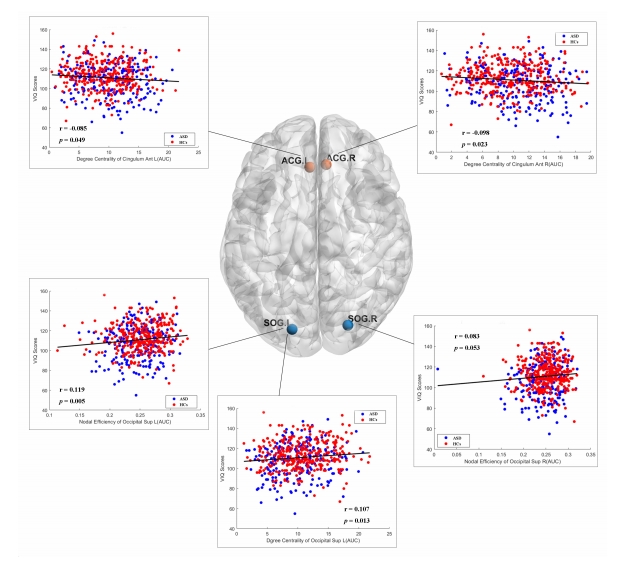
Autism spectrum disorder (ASD) is associated with atypical functional connectivity (FC), but its relationship with verbal ability remains unclear. In this study, resting-state functional magnetic resonance imaging (rs-fMRI) data from 219 individuals with ASD and 322 healthy controls (HCs) with valid verbal intelligence quotient (VIQ) scores were obtained from 12 sites in the Autism Brain Imaging Data Exchange (ABIDE) database. Region of interest (ROI)-based FC and whole-brain network metrics were computed and correlated with VIQ. Three feature sets—raw connectivity and topology, group-difference metrics, and group-difference metrics combined with VIQ—were evaluated using support vector machine (SVM) and manifold learning. ASD showed widespread FC alterations with overall increases and localized decreases in specific networks. At the global level, ASD patients exhibited a significantly lower area under the receiver operating characteristic curve (AUC) specifically for the normalized clustering coefficient γ compared with HCs. Nodal analyses revealed increased degree centrality and efficiency in subcortical and frontal regions, but decreased values in limbic and temporal regions in ASD. Centrality of the anterior cingulate cortex showed a negative correlation with VIQ, while nodal efficiency and degree centrality in occipital regions showed positive correlations. Classification using the raw feature set achieved the best overall performance under the Principal Component Analysis-Uniform Manifold Approximation and Projection-Support Vector Machine (PCA-UMAP-SVM) pipeline, whereas group-difference features augmented with VIQ yielded the highest AUC among the standard SVM models. These results suggest that VIQ-anchored network features may help explain variability in verbal ability and brain organization in ASD.
Keywords:
Autism Spectrum Disorder Functional Connectivity Manifold Learning Machine Learning Graph Theoretical Analysis Verbal AbilityReferences
- American Psychiatric Association. Diagnostic and Statistical Manual of Mental Disorders: DSM-5; American Psychiatric Association: Washington, DC, USA, 2013.
- Vulchanova, M.; Saldaña, D.; et al. Figurative language processing in atypical populations: The ASD perspective. Front. Hum. Neurosci. 2015, 9, 24. DOI: https://doi.org/10.3389/fnhum.2015.00024
- Dichter, G.S. Functional magnetic resonance imaging of autism spectrum disorders. Dialogues Clin. Neurosci. 2012, 14, 319–351. DOI: https://doi.org/10.31887/DCNS.2012.14.3/gdichter
- Biswal, B.B.; Uddin, L.Q. The history and future of resting-state functional magnetic resonance imaging. Nature 2025, 641, 1121–1131. DOI: https://doi.org/10.1038/s41586-025-08953-9
- Lin, Q.; Shi, Y.; Huang, H.; et al. Functional brain network alterations in the co-occurrence of autism spectrum disorder and attention deficit hyperactivity disorder. Eur. Child Adolesc. Psychiatry 2024, 33, 369–380. DOI: https://doi.org/10.1007/s00787-023-02165-0
- Lee, Y.; Park, B.Y.; James, O.; et al. Autism spectrum disorder related functional connectivity changes in the language network in children, adolescents and adults. Front. Hum. Neurosci. 2017, 11, 418. DOI: https://doi.org/10.3389/fnhum.2017.00418
- Márquez-García, A.V.; Vakorin, V.A.; Kozhemiako, N.; et al. Atypical Brain Connectivity During Pragmatic and Semantic Language Processing in Children with Autism. Brain Sci. 2024, 14, 1066. DOI: https://doi.org/10.3390/brainsci14111066
- Schaeffer, J.; Abd El-Raziq, M.; Castroviejo, E.; et al. Language in autism: Domains, profiles and co-occurring conditions. J. Neural Transm. 2023, 130, 433–457. DOI: https://doi.org/10.1007/s00702-023-02592-y
- Alamdari, S.B.; Sadeghi Damavandi, M.; Zarei, M.; et al. Cognitive theories of autism based on the interactions between brain functional networks. Front. Hum. Neurosci. 2022, 16, 828985. DOI: https://doi.org/10.3389/fnhum.2022.828985
- Horien, C.; Floris, D.L.; Greene, A.S.; et al. Functional connectome-based predictive modeling in autism. Biol. Psychiatry 2022, 92, 626–642. DOI: https://doi.org/10.1016/j.biopsych.2022.04.008
- Rudie, J.D.; Brown, J.A.; Beck-Pancer, D.; et al. Altered functional and structural brain network organization in autism. Neuroimage-Clin. 2012, 2, 79–94. DOI: https://doi.org/10.1016/j.nicl.2012.11.006
- Keown, C.L.; Datko, M.C.; Chen, C.P.; et al. Network organization is globally atypical in autism: A graph theory study of intrinsic functional connectivity. Biol. Psychiatry-Cogn. Neurosci. Neuroimaging 2017, 2, 66–75. DOI: https://doi.org/10.1016/j.bpsc.2016.07.008
- Chen, L.; Chen, Y.; Zheng, H.; et al. Changes in the topological organization of the default mode network in autism spectrum disorder. Brain Imaging Behav. 2021, 15, 1058–1067. DOI: https://doi.org/10.1007/s11682-020-00312-8
- Moraglia, L.E.; Weigman, B.; Abdi, H.; et al. Brain morphometry in infants later diagnosed with autism is related to later language skills. Hum. Brain Mapp. 2025, 46, e70221. DOI: https://doi.org/10.1002/hbm.70221
- Johnson, C.N.; Ramphal, B.; Koe, E.; et al. Cognitive correlates of autism spectrum disorder symptoms. Autism Res. 2021, 14, 2405–2411. DOI: https://doi.org/10.1002/aur.2577
- Klöppel, S.; Abdulkadir, A.; Jack, C.R.; et al. Diagnostic neuroimaging across diseases. Neuroimage 2012, 61, 457–463. DOI: https://doi.org/10.1016/j.neuroimage.2011.11.002
- Orrù, G.; Pettersson-Yeo, W.; Marquand, A.F.; et al. Using support vector machine to identify imaging biomarkers of neurological and psychiatric disease: A critical review. Neurosci. Biobehav. Rev. 2012, 36, 1140–1152. DOI: https://doi.org/10.1016/j.neubiorev.2012.01.004
- Ahsan, M.M.; Luna, S.A.; Siddique, Z. Machine-learning-based disease diagnosis: A comprehensive review. Healthcare 2022, 10, 541. DOI: https://doi.org/10.3390/healthcare10030541
- Pereira, F.; Mitchell, T.; Botvinick, M. Machine learning classifiers and fMRI: A tutorial overview. Neuroimage 2009, 45, S199–S209. DOI: https://doi.org/10.1016/j.neuroimage.2008.11.007
- Bi, X.; Wang, Y.; Shu, Q.; et al. Classification of autism spectrum disorder using random support vector machine cluster. Front. Genet. 2018, 9, 18. DOI: https://doi.org/10.3389/fgene.2018.00018
- Ibrahim, B.; Suppiah, S.; Ibrahim, N.; et al. Diagnostic power of resting-state fMRI for detection of network connectivity in Alzheimer's disease and mild cognitive impairment: A systematic review. Hum. Brain Mapp. 2021, 42, 2941–2968. DOI: https://doi.org/10.1002/hbm.25369
- Lin, L.; Zhang, J.; Liu, Y.; et al. Aberrant brain functional networks in type 2 diabetes mellitus: A graph theoretical and support-vector machine approach. Front. Hum. Neurosci. 2022, 16, 974094. DOI: https://doi.org/10.3389/fnhum.2022.974094
- Li, W.; Wang, Z.; Zhang, L.; et al. Remodeling Pearson's correlation for functional brain network estimation and autism spectrum disorder identification. Front. Neuroinform. 2017, 11, 55. DOI: https://doi.org/10.3389/fninf.2017.00055
- Thomas, C.G.; Harshman, R.A.; Menon, R.S. Noise reduction in BOLD-based fMRI using component analysis. Neuroimage 2002, 17, 1521–1537. DOI: https://doi.org/10.1006/nimg.2002.1200
- Casanova, R.; Lyday, R.G.; Bahrami, M.; et al. Embedding functional brain networks in low dimensional spaces using manifold learning techniques. Front. Neuroinform. 2021, 15, 740143. DOI: https://doi.org/10.3389/fninf.2021.740143
- Healy, J.; McInnes, L. Uniform manifold approximation and projection. Nat. Rev. Methods Prim. 2024, 4, 82. DOI: https://doi.org/10.1038/s43586-024-00363-x
- Bradley, A.P. The use of the area under the ROC curve in the evaluation of machine learning algorithms. Pattern Recogn. 1997, 30, 1145–1159. DOI: https://doi.org/10.1016/S0031-3203(96)00142-2
- Ling, C.X.; Huang, J.; Zhang, H. AUC: A better measure than accuracy in comparing learning algorithms. In Advances in Artificial Intelligence; Xiang, Y., Chaib-draa, B., Eds.; Springer: Berlin, Germany, 2003; pp. 329–341.
- Fawcett, T. An introduction to ROC analysis. Pattern Recogn. Lett. 2006, 27, 861–874. DOI: https://doi.org/10.1016/j.patrec.2005.10.010
- Sun, L.; Wang, J.; Wei, J. AVC: Selecting discriminative features on basis of AUC by maximizing variable complementarity. BMC Bioinform. 2017, 18, 50. DOI: https://doi.org/10.1186/s12859-017-1468-4
- Saponaro, S.; Lizzi, F.; Serra, G.; et al. Deep learning based joint fusion approach to exploit anatomical and functional brain information in autism spectrum disorders. Brain Inform. 2024, 11, 2. DOI: https://doi.org/10.1186/s40708-023-00217-4
- Marek, S.; Tervo-Clemmens, B.; Calabro, F.J.; et al. Reproducible brain-wide association studies require thousands of individuals. Nature 2022, 603, 654–660. DOI: https://doi.org/10.1038/s41586-022-04492-9
- Larson, C.; Rivera-Figueroa, K.; Thomas, H.R.; et al. Structural language impairment in autism spectrum disorder versus loss of autism diagnosis: Behavioral and neural characteristics. Neuroimage-Clin. 2022, 34, 103043. DOI: https://doi.org/10.1016/j.nicl.2022.103043
- Wu, Y.; Lu, C.; Li, M.; et al. Atypical developmental patterns of sensorimotor-related networks in autism spectrum disorder: A BrainAGE study based on resting-state fMRI. Autism Res. 2025, 18, 765–773. DOI: https://doi.org/10.1002/aur.70008
- Di Martino, A.; Yan, C.G.; Li, Q.; et al. The autism brain imaging data exchange: Towards a large-scale evaluation of the intrinsic brain architecture in autism. Mol. Psychiatry 2014, 19, 659–667. DOI: https://doi.org/10.1038/mp.2013.78
- Di Martino, A.; O'Connor, D.; Chen, B.; et al. Enhancing studies of the connectome in autism using the autism brain imaging data exchange II. Sci. Data 2017, 4, 170010. DOI: https://doi.org/10.1038/sdata.2017.10
- Wechsler, D. Wechsler Abbreviated Scale of Intelligence; Psychological Corporation: San Antonio, TX, USA, 1999.
- Jia, X.-Z.; Wang, J.; Sun, H.-Y.; et al. RESTplus: An improved toolkit for resting-state functional magnetic resonance imaging data processing. Sci. Bull. 2019, 64, 953–954. DOI: https://doi.org/10.1016/j.scib.2019.05.008
- Friston, K.J.; Williams, S.; Howard, R.; et al. Movement-related effects in fMRI time-series. Magn. Reson. Med. 1996, 35, 346–355. DOI: https://doi.org/10.1002/mrm.1910350312
- Tzourio-Mazoyer, N.; Landeau, B.; Papathanassiou, D.; et al. Automated anatomical labeling of activations in SPM using a macroscopic anatomical parcellation of the MNI MRI single-subject brain. Neuroimage 2002, 15, 273–289. DOI: https://doi.org/10.1006/nimg.2001.0978
- Dai, Z.; Yan, C.; Wang, Z.; et al. Discriminative analysis of early Alzheimer's disease using multi-modal imaging and multi-level characterization with multi-classifier (M3). Neuroimage 2012, 59, 2187–2195. DOI: https://doi.org/10.1016/j.neuroimage.2011.10.003
- Wee, C.-Y.; Yap, P.-T.; Zhang, D.; et al. Identification of MCI individuals using structural and functional connectivity networks. Neuroimage 2012, 59, 2045–2056. DOI: https://doi.org/10.1016/j.neuroimage.2011.10.015
- Zeng, L.-L.; Shen, H.; Liu, L.; et al. Identifying major depression using whole-brain functional connectivity: A multivariate pattern analysis. Brain 2012, 135, 1498–1507. DOI: https://doi.org/10.1093/brain/aws059
- Yeo, B.T.; Krienen, F.M.; Sepulcre, J.; et al. The organization of the human cerebral cortex estimated by intrinsic functional connectivity. J. Neurophysiol. 2011, 106, 1125–1165. DOI: https://doi.org/10.1152/jn.00338.2011
- Schaefer, A.; Kong, R.; Gordon, E.M.; et al. Local-global parcellation of the human cerebral cortex from intrinsic functional connectivity MRI. Cereb. Cortex 2018, 28, 3095–3114. DOI: https://doi.org/10.1093/cercor/bhx179
- Rubinov, M.; Sporns, O. Complex network measures of brain connectivity: Uses and interpretations. Neuroimage 2010, 52, 1059–1069. DOI: https://doi.org/10.1016/j.neuroimage.2009.10.003
- Wang, J.; Wang, X.; Xia, M.; et al. GRETNA: A graph theoretical network analysis toolbox for imaging connectomics. Front. Hum. Neurosci. 2015, 9, 386. DOI: https://doi.org/10.3389/fnhum.2015.00386
- Watts, D.J.; Strogatz, S.H. Collective dynamics of ‘small-world’ networks. Nature 1998, 393, 440–442. DOI: https://doi.org/10.1038/30918
- Freeman, L.C. Centrality in social networks conceptual clarification. Soc. Netw. 1978, 1, 215–239. DOI: https://doi.org/10.1016/0378-8733(78)90021-7
- Achard, S.; Bullmore, E. Efficiency and cost of economical brain functional networks. PLOS Comput. Biol. 2007, 3, e17. DOI: https://doi.org/10.1371/journal.pcbi.0030017
- Zhang, J.; Wang, J.; Wu, Q.; et al. Disrupted brain connectivity networks in drug-naive, first-episode major depressive disorder. Biol. Psychiatry 2011, 70, 334–342. DOI: https://doi.org/10.1016/j.biopsych.2011.05.018
- van Rooij, D.; Anagnostou, E.; Arango, C.; et al. Cortical and subcortical brain morphometry differences between patients with autism spectrum disorder and healthy individuals across the lifespan: results from the ENIGMA ASD working group. Am. J. Psychiatry 2018, 175, 359–369. DOI: https://doi.org/10.1176/appi.ajp.2017.17010100
- Cheng, L.; Zhan, L.; Huang, L.; et al. The atypical functional connectivity of Broca's area at multiple frequency bands in autism spectrum disorder. Brain Imaging Behav. 2022, 16, 2627–2636. DOI: https://doi.org/10.1007/s11682-022-00718-6
- Onitsuka, T.; Hirano, Y.; Nemoto, K.; et al. Trends in big data analyses by multicenter collaborative translational research in psychiatry. Psychiatry Clin. Neurosci. 2022, 76, 1–14. DOI: https://doi.org/10.1111/pcn.13311
- Steele, N.; Huggins, A.A.; Morey, R.A.; et al. Image-based meta- and mega-analysis (IBMMA): A unified framework for large-scale, multi-site, neuroimaging data analysis. Neuroimage 2025, 322, 121554. DOI: https://doi.org/10.1016/j.neuroimage.2025.121554
- Vieira, S.; Gong, Q.; Scarpazza, C.; et al. Neuroanatomical abnormalities in first-episode psychosis across independent samples: A multi-centre mega-analysis. Psychol. Med. 2021, 51, 340–350. DOI: https://doi.org/10.1017/s0033291719003568
- Benjamini, Y.; Hochberg, Y. Controlling the false discovery rate: A practical and powerful approach to multiple testing. J. R. Stat. Soc. Ser. B Methodol. 1995, 57, 289–300. DOI: https://doi.org/10.1111/j.2517-6161.1995.tb02031.x
- Guyon, I.; Elisseeff, A. An introduction to variable and feature selection. J. Mach. Learn. Res. 2003, 3, 1157–1182.
- Arbabshirani, M.R.; Kiehl, K.A.; Pearlson, G.D.; et al. Classification of schizophrenia patients based on resting-state functional network connectivity. Front. Neurosci. 2013, 7, 133. DOI: https://doi.org/10.3389/fnins.2013.00133
- Dyrba, M.; Grothe, M.; Kirste, T.; et al. Multimodal analysis of functional and structural disconnection in Alzheimer's disease using multiple kernel SVM. Hum. Brain Mapp. 2015, 36, 2118–2131. DOI: https://doi.org/10.1002/hbm.22759
- Arbabshirani, M.R.; Plis, S.; Sui, J.; et al. Single subject prediction of brain disorders in neuroimaging: Promises and pitfalls. Neuroimage 2017, 145, 137–165. DOI: https://doi.org/10.1016/j.neuroimage.2016.02.079
- Just, M.A.; Cherkassky, V.L.; Keller, T.A.; et al. Cortical activation and synchronization during sentence comprehension in high-functioning autism: Evidence of underconnectivity. Brain 2004, 127, 1811–1821. DOI: https://doi.org/10.1093/brain/awh199
- Uddin, L.Q. Salience processing and insular cortical function and dysfunction. Nat. Rev. Neurosci. 2015, 16, 55–61. DOI: https://doi.org/10.1038/nrn3857
- Rubenstein, J.L.; Merzenich, M.M. Model of autism: Increased ratio of excitation/inhibition in key neural systems. Genes Brain Behav. 2003, 2, 255–267. DOI: https://doi.org/10.1034/j.1601-183x.2003.00037.x
- Sohal, V.S.; Rubenstein, J.L.R. Excitation-inhibition balance as a framework for investigating mechanisms in neuropsychiatric disorders. Mol. Psychiatry 2019, 24, 1248–1257. DOI: https://doi.org/10.1038/s41380-019-0426-0
- Washington, S.D.; Gordon, E.M.; Brar, J.; et al. Dysmaturation of the default mode network in autism. Hum. Brain Mapp. 2014, 35, 1284–1296. DOI: https://doi.org/10.1002/hbm.22252
- Yerys, B.E.; Gordon, E.M.; Abrams, D.N.; et al. Default mode network segregation and social deficits in autism spectrum disorder: Evidence from non-medicated children. Neuroimage-Clin. 2015, 9, 223–232. DOI: https://doi.org/10.1016/j.nicl.2015.07.018
- Bullmore, E.; Sporns, O. Complex brain networks: Graph theoretical analysis of structural and functional systems. Nat. Rev. Neurosci. 2009, 10, 186–198. DOI: https://doi.org/10.1038/nrn2575
- Peng, L.; Liu, X.; Ma, D.; et al. The altered pattern of the functional connectome related to pathological biomarkers in individuals for autism spectrum disorder identification. Front. Neurosci. 2022, 16, 913377. DOI: https://doi.org/10.3389/fnins.2022.913377
- Friederici, A.D. The brain basis of language processing: from structure to function. Physiol. Rev. 2011, 91, 1357–1392. DOI: https://doi.org/10.1152/physrev.00006.2011
- Cristia, A.; Seidl, A.; Junge, C.; et al. Predicting individual variation in language from infant speech perception measures. Child Dev. 2014, 85, 1330–1345. DOI: https://doi.org/10.1111/cdev.12193
- Kleinhans, N.M.; Richards, T.; Sterling, L.; et al. Abnormal functional connectivity in autism spectrum disorders during face processing. Brain 2008, 131, 1000–1012. DOI: https://doi.org/10.1093/brain/awm334
- Márquez-García, A.V.; Ng, B.K.; Iarocci, G.; et al. Atypical associations between functional connectivity during pragmatic and semantic language processing and cognitive abilities in children with autism. Brain Sci. 2023, 13, 1448. DOI: https://doi.org/10.3390/brainsci13101448
- Redcay, E.; Moran, J.M.; Mavros, P.L.; et al. Intrinsic functional network organization in high-functioning adolescents with autism spectrum disorder. Front. Hum. Neurosci. 2013, 7, 573. DOI: https://doi.org/10.3389/fnhum.2013.00573
- Minshew, N.J.; Williams, D.L. The new neurobiology of autism: Cortex, connectivity, and neuronal organization. Arch. Neurol. 2007, 64, 945–950. DOI: https://doi.org/10.1001/archneur.64.7.945
- Davis, G.; Plaisted-Grant, K. Low endogenous neural noise in autism. Autism 2015, 19, 351–362. DOI: https://doi.org/10.1177/1362361314552198
- Bush, G.; Luu, P.; Posner, M.I.; et al. Cognitive and emotional influences in anterior cingulate cortex. Trends Cogn. Sci. 2000, 4, 215–222. DOI: https://doi.org/10.1016/s1364-6613(00)01483-2
- Kennedy, D.P.; Redcay, E.; Courchesne, E. Failing to deactivate: Resting functional abnormalities in autism. Proc. Natl. Acad. Sci. USA 2006, 103, 8275–8280. DOI: https://doi.org/10.1073/pnas.0600674103