
Research Article
Anthropogenic Drivers of Land Take—A Panel Spatial Durban Error Model Analysis for Bavarian Municipalities
 Download

This work is licensed under a Creative Commons Attribution-NonCommercial 4.0 International License.
Copyright
The authors shall retain the copyright of their work but allow the Publisher to publish, copy, distribute, and convey the work.
License
Land Management and Utilization (LMU) publishes accepted manuscripts under Creative Commons Attribution 4.0 International (CC BY 4.0). Authors who submit their papers for publication by Land Management and Utilization (LMU) agree to have the CC BY 4.0 license applied to their work, and that anyone is allowed to reuse the article or part of it free of charge for any purpose, including commercial use. As long as the author and original source is properly cited, anyone may copy, redistribute, reuse and transform the content.
Authors

Received: 21 December 2025; Revised: 18 February 2026; Accepted: 29 February 2026; Published: 27 March 2026
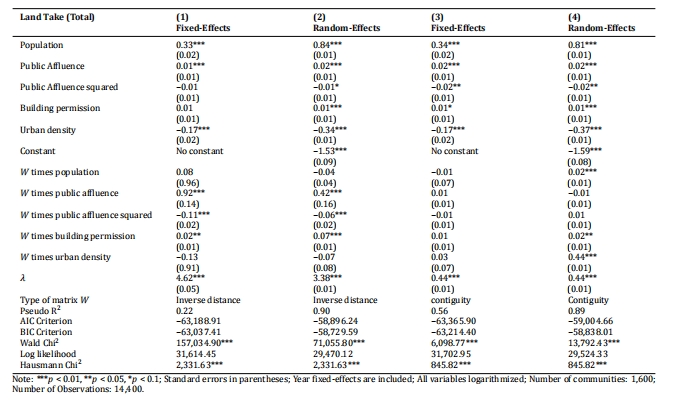
This study examines the anthropogenic determinants of land take using a spatially extended STIRPAT (Stochastic Impacts by Regression on Population, Affluence, and Technology) framework applied to panel data from 1,600 municipalities in Bavaria, Germany, covering the period from 2014–2022. A Spatial Durbin Error Model is employed to account for spatial dependence and spillover effects across neighboring municipalities. Moreover, literature defines affluence typically as income or GDP per capita indicating the level of affluence of private households or regions. In contrast, the results of this paper demonstrate that (also) public affluence is a suitable indicator for explaining land take. The results show that population and public affluence exert positive local effects on land take, while urban density significantly restrains land take. Moreover, a non-linear Environmental Kuznets Curve relationship for public affluence is observed, which materializes also through spatial spillover effects. Building permissions emerge as a key policy-related driver, generating positive indirect effects that propagate land consumption across adjacent municipalities. These findings highlight that land take is not only shaped by local conditions but evolves as a spatially interconnected process driven by fiscal capacity and planning decisions. The study underscores the need for coordinated, multi-regional land-use policies and highlights the analytical value of small-scale spatial STIRPAT applications in capturing environmentally relevant development dynamics.
Keywords:
Land Take Regional STIRPAT SpatialReferences
- European Environment Agency. Net land take in cities and commuting zones in Europe. Available online: https://www.eea.europa.eu/en/analysis/indicators/net-land-take-in-cities?activeAccordion=ecdb3bcf-bbe9-4978-b5cf-0b136399d9f8 (accessed on 15 December 2025).
- European Commission. Communication from the Commission to the European Parliament, the Council, the European Economic and Social Committee and the Committee of the Regions: EU Soil Strategy for 2030. Available online: https://eur-lex.europa.eu/legal-content/EN/TXT/?uri=CELEX%3A52021DC0699 (accessed on 15 December 2025).
- Umweltbundesamt. Built-up areas and soil sealing. Available online: https://www.umweltbundesamt.de/themen/boden-flaeche/bodenbelastungen/bebauung-versiegelung (accessed on 15 September 2025). (in German)
- Colsaet, A.; Laurans, Y.; Levrel, H. What drives land take and urban land expansion? A systematic review. Land Use Policy 2018, 79, 339–349. DOI: https://doi.org/10.1016/j.landusepol.2018.08.017
- Behnisch, M.; Poglitsch, H.; Krüger, T. Soil sealing and the complex bundle of influential factors: Germany as a case study. ISPRS Int. J. Geo-Inf. 2016, 5, 132. DOI: https://doi.org/10.3390/ijgi5080132
- Naumann, S.; Frelih-Larsen, A.; Prokop, G.; et al. Land Take and Soil Sealing—Drivers, Trends and Policy (Legal) Instruments: Insights from European Cities. In International Yearbook of Soil Law and Policy 2018; Ginzky, H., Dooley, E., Heuser, I., et al., Eds.; Springer: Cham, Switzerland, 2019; Vol. 2018, pp. 83–112. DOI: https://doi.org/10.1007/978-3-030-00758-4_4
- Getzner, M.; Bröthaler, J.; Neuhuber, T.; et al. Socio-economic, political and fiscal drivers of unsustainable local land use decisions. Land Use Policy 2025, 153, 107537. DOI: https://doi.org/10.1016/j.landusepol.2025.107537
- Ge, K.; Wang, Y.; Liu, X.; et al. Spatial effects and influence mechanisms of urban land use green transition on urban carbon emissions. Ecol. Indic. 2025, 172, 113261. DOI: https://doi.org/10.1016/j.ecolind.2025.113261
- Luge, W.; Tianjiao, Z.; Tiyan, S. Spatial-temporal evolution and influencing factors of urban land use structure efficiency: Evidence from 282 cities in China. J. Cleaner Prod. 2025, 500, 145275. DOI: https://doi.org/10.1016/j.jclepro.2025.145275
- Bimonte, S.; Stabile, A. The effect of growth and corruption on soil sealing in Italy: A regional environmental Kuznets curve analysis. Environ. Resource Econ. 2019, 74, 1497–1518. DOI: https://doi.org/10.1007/s10640-019-00376-1
- Borruso, G.; Gallo, A.; Magris, F.; et al. Land take, land use and environmental issues. Is the Kuznets curve valid? The case of Italy. Spatial Econ. Anal. 2025, 1–16. DOI: https://doi.org/10.1080/17421772.2025.2547059
- Lohwasser, J.; Bolognesi, T.; Schaffer, A. Impacts of population, affluence and urbanization on local air pollution and land transformation—A regional STIRPAT analysis for German districts. Ecol. Econ. 2025, 227, 108416. DOI: https://doi.org/10.1016/j.ecolecon.2024.108416
- Larsen, H.N.; Hertwich, E.G. Identifying important characteristics of municipal carbon footprints. Ecol. Econ. 2010, 70, 60–66. DOI: https://doi.org/10.1016/j.ecolecon.2010.05.001
- Huang, W.; Wang, H.; Zhao, H.; et al. Temporal-spatial characteristics and key influencing factors of PM2.5 concentrations in China based on STIRPAT model and Kuznets curve. Environ. Eng. Management J. 2019, 18. DOI: https://doi.org/10.30638/eemj.2019.244
- Liu, C.; Nie, G.H. Identifying the driving factors of food nitrogen footprint in China, 2000–2018: Econometric analysis of provincial spatial panel data by the STIRPAT model. Sustainability 2021, 13, 6147. DOI: https://doi.org/10.3390/su13116147
- Li, L.; Li, Y. The spatial relationship between CO2 emissions and economic growth in the construction industry: Based on the Tapio decoupling model and STIRPAT model. Sustainability 2022, 15, 528. DOI: https://doi.org/10.3390/su15010528
- You, W.; Lv, Z. Spillover effects of economic globalization on CO2 emissions: A spatial panel approach. Energy Econ. 2018, 73, 248–257. DOI: https://doi.org/10.1016/j.eneco.2018.05.016
- McGee, J.A.; Clement, M.T.; Besek, J.F. The impacts of technology: A re-evaluation of the STIRPAT model. Environ. Sociol. 2015, 1, 81–91. DOI: https://doi.org/10.1080/23251042.2014.1002193
- Montero, J.M.; Fernández-Avilés, G.; Laureti, T. A local spatial STIRPAT model for outdoor NOx concentrations in the community of Madrid, Spain. Mathematics 2021, 9, 677. DOI: https://doi.org/10.3390/math9060677
- Vélez-Henao, J.A.; Vivanco, D.F.; Hernández-Riveros, J.A. Technological change and the rebound effect in the STIRPAT model: A critical view. Energy Policy 2019, 129, 1372–1381. DOI: https://doi.org/10.1016/j.enpol.2019.03.044
- Ehrlich, P.R.; Holdren, J.P. Impact of population growth: Complacency concerning this component of man's predicament is unjustified and counterproductive. Science 1971, 171, 1212–1217. DOI: https://doi.org/10.1126/science.171.3977.1212
- Commoner, B.; Corr, M.; Stamler, P.J. The causes of pollution. Environment 1971, 13, 2–19. DOI: https://doi.org/10.1080/00139157.1971.9930577
- Dietz, T.; Rosa, E.A. Rethinking the environmental impacts of population, affluence and technology. Hum. Ecol. Rev. 1994, 1, 277–300.
- Umweltbundesamt. Soil Sealing. Available online: https://www.umweltbundesamt.de/daten/flaeche-boden-land-oekosysteme/boden/bodenversiegelung#was-ist-bodenversiegelung (accessed on 12 November 2025). (in German)
- Diezmartínez, C.V.; Short Gianotti, A.G. Municipal finance shapes urban climate action and justice. Nat. Clim. Change 2024, 14, 247–252. DOI: https://doi.org/10.1038/s41558-024-01924-4
- Bayerisches Landesamt für Statistik. The Database of the Bavarian State Office for Statistics. Available online: https://www.statistikdaten.bayern.de/genesis/online (accessed on 18 May 2025). (in German)
- LeSage, J.; Pace, R.K. Introduction to Spatial Econometrics; Chapman and Hall/CRC: New York, NY, USA, 2009. DOI: https://doi.org/10.1201/9781420064254
- Naveed, A.; Ahmad, N.; Aghdam, R.F.; et al. What have we learned from Environmental Kuznets Curve hypothesis? A citation-based systematic literature review and content analysis. Energy Strategy Rev. 2022, 44, 100946. DOI: https://doi.org/10.1016/j.esr.2022.100946
- Bibi, F.; Jamil, M. Testing environment Kuznets curve (EKC) hypothesis in different regions. Environ. Sci. Pollut. Res. 2021, 28, 13581–13594. DOI: https://doi.org/10.1007/s11356-020-11516-2
- Zhou, B.; Kockelman, K.M. Neighborhood impacts on land use change: A multinomial logit model of spatial relationships. Ann. Reg. Sci. 2008, 42, 321–340. DOI: https://doi.org/10.1007/s00168-007-0149-z